
Archives

How to celebrate Yom Haatzmaut (Israel’s Independence Day)

How to celebrate Yom Haatzmaut (Israel’s Independence Day)

Sara Himeles


“The State of Israel wouldn’t be able to celebrate its existence if it weren’t for those who gave their lives for it.”
.

Fireworks are seen above Tel Aviv’s City Hall, lit up for Yom Ha’atzmaut on April 14, 2021, in honor of Israel’s 73rd year of independence. (Photo: Matt Keston via StandWithUs on Twitter)

Immediately after Yom Hazikaron ends, Yom Haatzmaut (Israel’s Independence Day) begins. It takes place on the date in the Hebrew calendar that Israel declared independence, the 5th of Iyar.

When is Yom Haatzmaut 2023?

In 2023, Yom Haatzmaut will mark Israel’s 75th birthday. It will take place from the evening of Tuesday, April 25 through the evening of Wednesday, April 26. Israel will celebrate its 75th birthday in 2023.

How Yom Haatzmaut and Yom Hazikaron are connected

Typically, in other countries, Memorial Day for fallen soldiers and Independence Day occur on two separate days of the year. So why is it that, in Israel, Independence Day begins the moment that Memorial Day ends?

“The State of Israel wouldn’t be able to celebrate its existence if it weren’t for those who gave their lives for it,” the IDF explains. “We wouldn’t be able to have one of those days without the other one. We honor their memory and everything they fought for, so that today, we can celebrate our independence.”

How is Yom Haatzmaut celebrated in Israel?

The official “switch” from Yom Hazikaron to Yom Haatzmaut takes place a few minutes after sundown at the military ceremony on Mount Herzl. The Israeli flag is raised from half staff to the top of the pole, and soldiers representing the Army, Navy and Air Force parade with their flags.

This is followed by a torch lighting (hadlakat masuot) ceremony, in which 12 torches are lit symbolizing the 12 Tribes of Israel by people who have made outstanding contributions to society. The ceremony also includes music, dances, parades and fireworks.
.

.

In addition to the official ceremonies, Israelis celebrate Yom Haatzmaut by attending public shows across the country with leading Israeli singers and fireworks. The streets in the area are closed and Israelis sing and dance in the streets.

During the day, workplaces are closed, and many go on hikes or have a picnic or barbecue. The day concludes with a ceremony of granting the Israel Prize, recognizing those who display excellence in their field or contribute strongly to Israeli culture. Past recipients of the prestigious award include Martin BuberGolda MeirA.B. Yehoshua and Amos Oz.

Yom Haatzmaut outside of Israel

Outside of Israel, Jewish communities around the world mark the day by expressing solidarity with the state of Israel and participating in Israel-related programs and events. Many congregations hold a special religious service or add special readings to the Shabbat service that is closest to Yom Haatzmaut.

Jews in the Diaspora join with Israelis in celebrating Israel’s independence, which future Prime Minister David Ben-Gurion declared on May 14, 1948, in the old Tel Aviv Museum with the words: “We hereby declare the establishment of a Jewish state in Eretz Yisrael, to be known as the State of Israel.”

The historian and former Israeli Ambassador to the U.S. Michael Oren describes the mood outside of Ben-Gurion’s home just prior to the declaration, capturing the spirit of the day:

“The Jews of Palestine…were dancing because they were about to realize what was one of the most remarkable and inspiring achievements in human history: A people which had been exiled from its homeland two thousand years before, which had endured countless pogroms, expulsions, and persecutions, but which had refused to relinquish its identity—which had, on the contrary, substantially strengthened that identity; a people which only a few years before had been the victim of mankind’s largest single act of mass murder, killing a third of the world’s Jews, that people was returning home as sovereign citizens in their own independent state.”


Zawartość publikowanych artykułów i materiałów nie reprezentuje poglądów ani opinii Reunion’68,
ani też webmastera Blogu Reunion’68, chyba ze jest to wyraźnie zaznaczone.
Twoje uwagi, linki, własne artykuły lub wiadomości prześlij na adres:
webmaster@reunion68.com

Mystery as old as Israel: Who is the little girl buried with Hahagana fighter?

Mystery as old as Israel: Who is the little girl buried with Hahagana fighter?

ZIV REINSTEIN/WALLA!


An eight-year-old girl was buried with a fallen Hahagan fighter in 1948, but nothing is known about her.
.

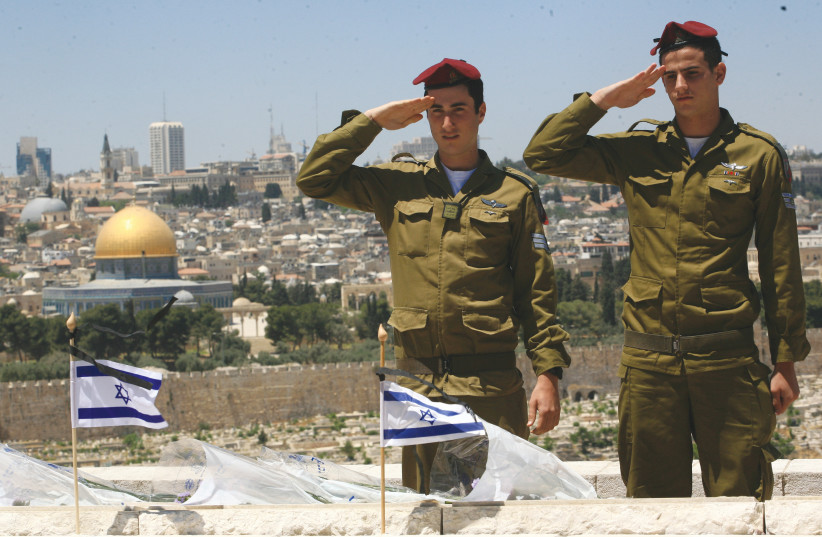
PARATROOPERS SALUTE after placing flags on the graves of fallen soldiers, during preparations for Remembrance Day ceremonies on the Mount of Olives. / (photo credit: NATI SHOHAT/FLASH90)

A mystery from the days of the establishment of Israel is still waiting to be solved, but no one has a lead, even 75 years later.

The story starts in Jerusalem in 1948, months before the state was established when the War of Independence had already begun, and the British Mandate was coming to an end.

On the night of February 12, the British arrested four Hagana fighters who were guarding a lookout near the Mandelbaum Gate in Jerusalem and put them in a car. At the end of a short drive, the fighters were thrown from the vehicle at Damascus Gate, and the next day, their bodies were found next to the Lions Gate after they were murdered by a Palestinian mob.

One of the fighters was Shimon Nissani, the owner of a carpentry shop in the Bet Israel neighborhood who wasn’t even supposed to be at the guard post but was present because he had swapped shifts with fellow Hagana member Pinhas Spiegelman months before the shift was meant to start. Thanks to the swap, Spiegelman was saved.

Girl gets buried with Nissani

The story of Nissani’s burial is like it was taken from a movie. Because of the delicate security situation in those days, burials on the Mount of Olives only took place at certain times, and Nissani was taken to be buried together with other bodies of people who had died in the last few days.

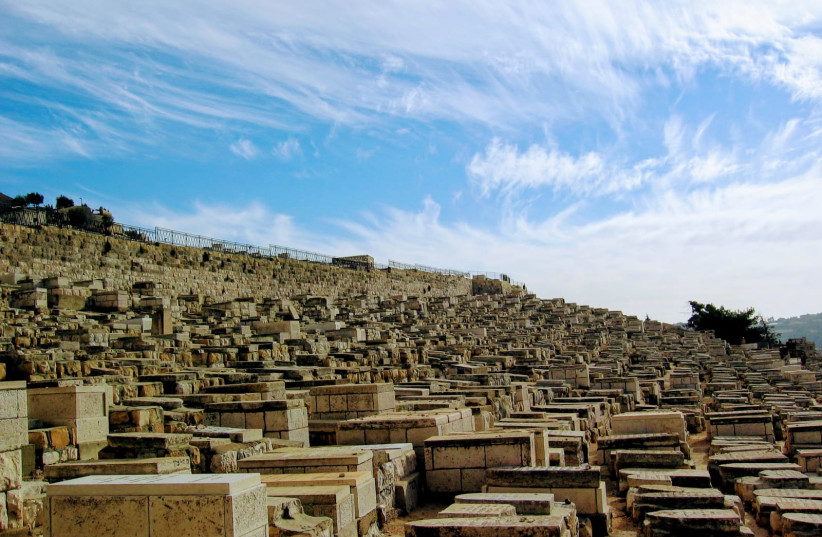
The Mount of Olives is home to the largest Jewish cemetery in Israel (credit: Kobi Cooper)

Nissani, who was born in Persia, was supposed to be buried in the Sephardi plot, but while the stretcher carriers were busy with a different grave, they started to be shot at and were forced to escape the area. Because of the circumstances, Nissani was quickly buried in a nearby grave, not in the plot he was meant to be buried in, and the people burying him turned to escape.

A moment before they left the place, Isaac, Nissani’s brother-in-law, stopped. He had spotted the body of an eight-year-old girl who was left on the ground without being buried. According to the death records of the Sephardi Committee, her name was Rachel, daughter of Victoria Haim.

Making a quick decision, Isaac dug up Nissani’s fresh grave, buried the girl with him, and covered them up together without any gravestone or sign. Even though he was buried in a different plot, to this day, the Chevra Kadisha’s records show that Nissani is buried in the Sephardi plot.

Nissani’s family finds girl in his grave

In the 19 years after that, while the Jordanians controlled the Mount of Olives, Nissani’s family couldn’t visit his grave. At the end of the Six Day War, his family tried to find his resting place. Because his actual grave’s location wasn’t written down anywhere and because the cemetery was heavily damaged during the Jordanian control, they couldn’t find identifying markers, and they didn’t find the grave.

Only in 1990 was Nissani’s grave recognized. It happened after Spiegelman conducted research to find the grave of his fallen friend after many years that he carried feelings of guilt. An old picture with identifying markers that Nissani’s brother-in-law remembered, together with a man who helped with his burial, helped the family find the estimated burial location.

When they opened the grave 42 years later, the family found Nissani’s bones and the girl’s bones, and that’s how after decades, they were able to definitively say that this was Nissani’s grave.

The two were covered up again, their bones remained in place and they continue to share the grave. Later, a military gravestone was placed on the grave with Nissani’s name, but the girl’s identity has remained a mystery to this day. Aside from her name and the name of her parents, nothing is known about her.

Ir David Foundation tried to find out more

Since 2006, the Ir David Foundation has been managing an information center that, among other things, helps find information about graves and their occupants in the cemetery and make it accessible. Thus far, the project has led to great success, and thousands of graves, many of which were anonymous, have already been identified and mapped.

Out of a wish to honor the girl, the Ir David Foundation entered the scene in this case too. Last week, a memorial sign was made for her which will be placed on the grave during the memorial ceremony on Tuesday. In order to get more details on her life and character, the foundation is trying to find relatives or friends who know her story and can shine a light on the details of the incident or even take part in the ceremony.

“In the last few months, we have been doing a lot to try to locate information about the unknown girl, but in the meantime, we haven’t even found a lead.”

Yonatan Manovich

“In the last few months, we have been doing a lot to try to locate information about the unknown girl, but in the meantime, we haven’t even found a lead,” said Yonatan Manovich who manages the information center. “The search efforts involved volunteers from the ‘Latet Panim Lanoflim’ (give a face to the fallen) organization and employees of the Jerusalem Municipality Archives, but since the search efforts failed to lead to a breakthrough, we decided to turn to the general public for help.”

“People don’t know the story,” said Mount of Olives researcher Sarah Barnea. “There were so many events in the time between the November 29 vote in the UN and the establishment of the State of Israel in May. These are people who have been forgotten. We don’t know who she is, we don’t know anything about her family. We need to do something in her honor.”

Barnea heard about the girl’s story while visiting Nissani’s sister Leah.

“It’s really heart-rending that there isn’t anyone to go to the grave and honor her memory,” she said. “I thought the time has come to do something for her.”


Zawartość publikowanych artykułów i materiałów nie reprezentuje poglądów ani opinii Reunion’68,
ani też webmastera Blogu Reunion’68, chyba ze jest to wyraźnie zaznaczone.
Twoje uwagi, linki, własne artykuły lub wiadomości prześlij na adres:
webmaster@reunion68.com

IDF chief joins Netanyahu, Lapid call to keep protest outside cemeteries

IDF chief joins Netanyahu, Lapid call to keep protest outside cemeteries

MICHAEL STARR, GADI ZAIG, JERUSALEM POST STAFF


“It’s on us to respect the cemeteries and not to turn them into arenas of debate,” said IDF Chief of Staff Herzi Halevi.
.

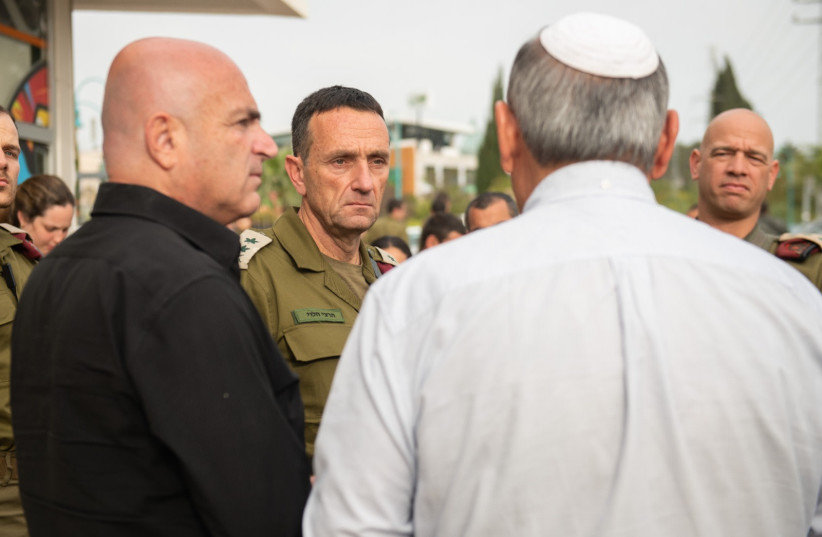
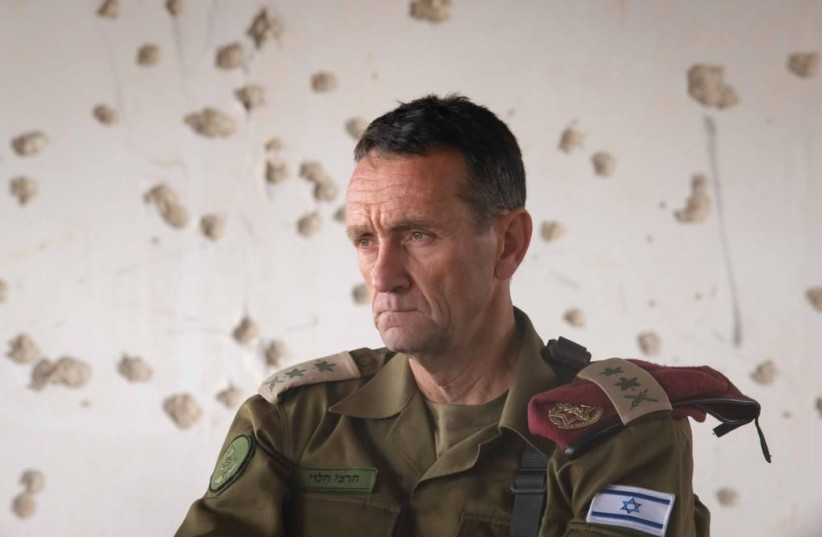
IDF Chief of Staff Lt.-Gen Herzi Halevi seen in northern Israel on April 7, 2023 / (photo credit: IDF SPOKESPERSON’S UNIT)

IDF chief of Staff Herzi Halevi called for judicial reform protests to remain outside military ceremonies on Remembrance Day in a letter published on Sunday morning, joining a similar call made by Prime Minister Benjamin Netanyahu, Defense Minister Yoav Gallant, Opposition leader Yair Lapid, and National Unity leader Benny Gantz in a Friday joint statement.

“It’s on us to respect the cemeteries and not to turn them into arenas of debate,” said Lieutenant-General Halevi. “Restraint and silence have a deafening power, and paying respects for our fallen loved ones isn’t possible with the noise of argument.”

Halevi said that Remembrance Day requires Israeli citizens to unite around it and recognize the connection between them all. The memorial day for Israel’s fallen soldiers, security personnel and victims of terrorism establishes a connection between the personal and national.

“Many families in Israel are hurting because the bereavement has no address; It can knock on the door of any family whose sons and daughters serve in the military,” Halevi continued.

“Restraint and silence have a deafening power, and paying respects for our fallen loved ones isn’t possible with the noise of argument.”

Herzi Halevi

Halevi called for focus on the memories of the fallen, recalling in his open letter the memory of fallen IDF soldier Jonathan Boyden, who was mortally wounded in Lebanon in 1993 while serving with the anti-tank Paratrooper company. The Chief of Staff said that he had met with Boyden when he interviewed for a position with the “Orev” unit, and that the oleh from Britain had spoken about his desire to be a warrior and protect Israel.

IDF Chief of Staff Herzi Halevi. (credit: IDF SPOKESPERSON’S OFFICE)

“[Boyden] loved life, and was right to risk it for the sake of the country,” said Halevi. “Our independence is shaped in this place, where the choice of life meets the willingness to die for the defense of the country.”

Halevi said that he is conscious of how Boyden and other families continue to hurt over the loss of their loved ones.

Netanyahu, Lapid, Gallant and Gantz issued their own statement on Friday through the efforts of Eli Ben-Shem, a bereaved father and chairman of Yad Lebanim, which works to support mourning families and help commemorate Israel’s fallen soldiers.

Respect for Remembrance Day

The politicians said that their statement came out of respect for Remembrance Day and the memory of the fallen, and requested all Israeli citizens, “from the depth of our hearts, leave the controversy this Remembrance Day outside the military cemeteries.”

“This is a day for silencing out controversy, all of us, and making room for pain and memory,” said the Israeli leaders. “The holiness of the fallen and the respect that we feel for the bereaved families connects us together — over the graves of our loved ones, we’re all brothers. We’re all one nation.”

Remembrance Day has been a symbol of unity for the last 75 years of the State of Israel’s existence, the coalition and opposition leaders said, a status which is need in 2023 as well. Those in the cemeteries gave the nation its state, and Israel’s citizens have a moral and national duty to respect them and not make the day any more difficult for those mourning their family and friends.

Over 115 heads of local councils and cities also issued a joint statement on Friday calling for respect for Remembrance Day.

“On Remembrance Day, in the cemeteries and ceremonies throughout the country, we will sanctify the fallen whose deaths granted us our lives in the land of Israel,” said Center for Local Government head Haim Bivas. “We will rally around the bereaved families and give them all the respect they deserve.”

Jerusalem Mayor Moshe Lion said that together with the heads of local government, he called on Israeli citizens “to stop the divisive discourse and unite for everyone to unite behind the bereaved families who lost their dearest ones for the sake of all of our lives.”

Tel Aviv Mayor Ron Huldai called Remembrance Day a holy day and said that they would stand united with the bereaved families.

As the calls for keeping Remembrance Day apolitical continued, there were also indications that strife between members of the coalition and opposition over the judicial reform would continue.

While the judicial reform first proposed in January had been paused, protests continued for the 16th week throughout Israel on Saturday night, with protest organizers claiming that around 380,000 demonstrators had taken to the streets.

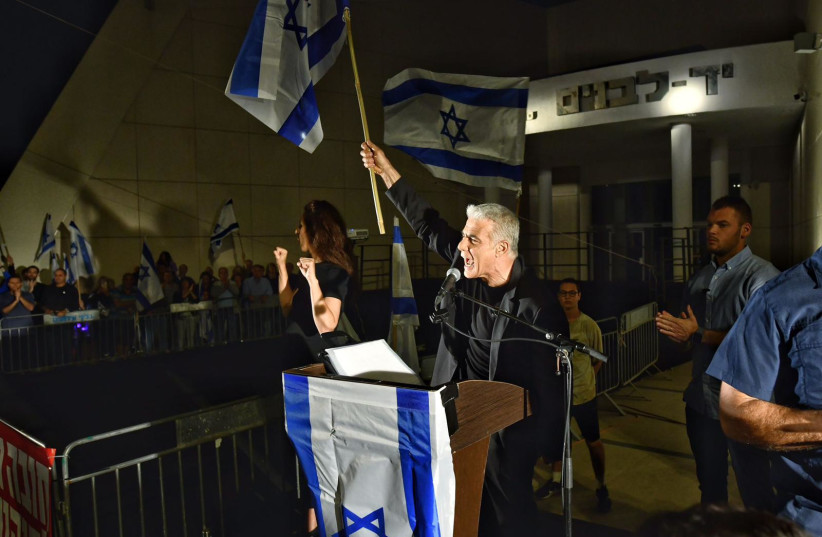
Lapid spoke at a demonstration in Hod Hasharon, saying that protesters were fighting for the same democracy and Zionism espoused in the weeks of Holocaust Day, Remembrance Day and Independence Day.

“If you hadn’t taken to the streets, the disaster would have already happened. Israel would have been no longer democratic,” said Lapid. “One day you will tell this to your grandchildren and your great-grandchildren about how in 2023, you marched through the streets wrapped in a flag and saved the State of Israel. How before Independence Day, you fought for your country, you fought and won.”

Opposition Leader Yair Lapid holds an Israeli flag up high at a judicial reform protest in Hod HaSharon on April 22, 2023. (credit: ELAD GUTMAN)

Lapid had previously said that he would not participate in the traditional torch lighting ceremony on Independence Day, as a form of protest against the judicial reform and the government.

“I signed the call not to be involved in Holocaust Remembrance Day and Memorial Day in protest,” said Lapid. “I will be, as always, in the military cemetery. Bereavement is where the internal debate must not be allowed to enter. In the 75th year of the state, we will be sad together, we will only be happy separately.”

Channel 12 reported on Friday that Transportation Minister Miri Regev would attempt to convince Lapid to attend the ceremony to create a message of unity. Lapid had noted that Netanyahu didn’t participate in the ceremony when Yesh Atid’s coalition was in power.

While Regev sought Lapid’s participation, several bereaved families expressed anger on Thursday night at the news that National Security Minister Itamar Ben-Gvir would attend Remembrance Day memorial services at a cemetery in Beersheba.

Some of the families, according to Maariv, had requested that the Knesset Member not attend. Some asserted that while the day was a day for remembering the victims of terrorism, they alleged that Ben-Gvir was involved with terrorists, was investigated by the Shin Bet, and had not served in the military. Some announced that they would sing during Ben-Gvir’s speech.


Zawartość publikowanych artykułów i materiałów nie reprezentuje poglądów ani opinii Reunion’68,
ani też webmastera Blogu Reunion’68, chyba ze jest to wyraźnie zaznaczone.
Twoje uwagi, linki, własne artykuły lub wiadomości prześlij na adres:
webmaster@reunion68.com

Hamas Is Planning the Next War; Is Israel’s Current Government Ready?

Hamas Is Planning the Next War; Is Israel’s Current Government Ready?

Grisha Yakubovich


People hold Hamas flags as Palestinians gather after performing the last Friday of Ramadan to protest over the possible eviction of several Palestinian families from homes on land claimed by Jewish settlers in the Sheikh Jarrah neighbourhood, in Jerusalem’s Old City, May 7, 2021. REUTERS/Ammar Awad

For the past year, Israel and the Palestinians have been in escalation mode, a phase that began under the previous Israeli government.

The sparks that lit the current escalation are unrelated to whether a right-wing or center-left government is in power, but Hamas is prepared to use the new right-wing Israeli government as justification for further conflict and violence if it finds it necessary to do so.

The escalation originates in a calculated strategy by Hamas, which envisioned, with considerable foresight, a Palestinian civil war — a scenario that appears to be around the corner — and a new opportunity to both weaken its rival, Fatah, in the West Bank, and ignite a regional explosion against Israel.

While some observers have attributed the deterioration in the security situation to the power vacuum in the northern West Bank, where the Fatah-run Palestinian Authority (PA) is indeed losing control, the more significant catalyst driving it is the clash between the narratives promoted by Hamas and the PA, led by Mahmoud Abbas.

Both Hamas and Fatah ultimately seek to rule the land between the Mediterranean Sea and the Jordan River, yet both are realistic in understanding that Israel will not vanish any time soon — and neither for that matter will the Palestinians. While Hamas believes that in the long run, it will succeed in destroying Israel, it still needs to answer the question of how it envisions the Palestinians living alongside Israel in the same land in this current phase of history.

Hamas’ answer to this question is, first, to reject any possibility of a peace treaty. Due to this position, Abbas’ PA has felt unable to enter into any real substantial diplomatic process with Israel over the years, and Abbas has rejected Israeli two-state offers made in the past, such as the one put forward by former Prime Minister Ehud Olmert in 2008.

Abbas realizes that he will never be able to defeat Hamas. While Israel is powerful enough to deal with any threat posed by Hamas, Fatah’s existence as a ruling party is under direct threat from it, as the Hamas coup against Fatah in Gaza 2007 so clearly demonstrated.

As a result, Abbas has settled for the vision of seeking a more comfortable existence for Palestinians in the West Bank. At the same time, he is resigned to the division of Palestinians between Gaza and the West Bank, and to the idea that he is not strong enough to reach an agreement with Israel.

Hamas, for its part, promotes the Mukawama, the Arabic word for resistance, a word often misunderstood in the international community to mean resistance against occupation, when in fact it is resistance to acceptance of Israel — and the promotion of terrorism.

Since Ismail Haniyeh left Gaza to become the head of Hamas’s political bureau (he is now based in Qatar), the organization has decided that it wishes to be the legitimate representative of all Palestinians at the global level.

As Hamas navigates the region, reaching tense understandings with Egypt, while also moving closer once again to Syria’s Bashar Assad — after years in which it backed the anti-Assad rebels in Syria — it continually maintains its resistance narrative, claiming that it is leading Palestinians on the path to the destruction of Israel.

To market this narrative further, Hamas sparked an intense conflict in May 2021 in order to present itself as the defender of Jerusalem and the Al-Aqsa Mosque. Yet a little over a year later, in July 2022, it cleverly sat out a clash between Israel and Palestinian Islamic Jihad (PIJ), as the IDF pulverized PIJ operatives and positions. Hamas was able to get the message across to Palestinians: Only Hamas can challenge Israel, fire rockets at Jerusalem, incite riots among Israeli Arabs, and create Palestinian unity. Only it can lead the fight against “the Zionist enemy.”

Abbas sees the ground underneath his feet shaking, and he is gradually enabling the PA to join the fight against the Israeli Defense Forces (IDF). These days, it’s not just Hamas — but also Fatah and the PA — that post “martyr” posters glorifying terrorists. The dead terrorists receive PA state burials, and this is accompanied by declarations by the PA of ending security coordination with Israel.

Ironically, this dynamic has created an opportunity for Hamas to present itself as the new “responsible adult,” and thereby gain regional and international credit. Despite the escalation in Jerusalem and the West Bank, Hamas has not directly joined in hostilities, and it is only the PIJ that has fired rockets, before being “stopped” by Hamas in a manner that is convenient to its current positioning.

After building itself up as the ruler of Gaza and protector of Jerusalem, Hamas is, in a highly calculated manner, proceeding towards its next goal — taking over the West Bank, and consolidating itself as the legitimate Palestinian representative.

Hamas will also seek to find ways to escape the terrorism designation that the Western world has correctly placed it under, without compromising on its “resistance” credentials.

Ultimately, as Hamas moves towards its next objectives, it is walking a tightrope. While it wishes to take over the West Bank without exposing its Gazan base to a new round of fighting with Israel, a high casualty dynamic or major incident could compel Hamas to act and lead it into a new round of fighting with Israel.

Hamas has made it clear that if this scenario comes to pass, it will use Israel’s new right-wing government to justify such actions, and for leveraging future achievements.

As a result, any action taken by Israel, perceived by Palestinians to be radical, will serve as justification by Hamas for opening fire.

The more that Israel’s government markets its steps vis-à-vis the Palestinians as vengeful, or stemming from a far-right ideology, the more that could potentially serve Hamas as legitimization for it to use violence against Israel.


Col. Grisha Yakubovich (IDF, Ret.) is a publishing Expert at The MirYam Institute. He concluded his military service in 2016 as the head of the civil department for the Coordination of Government Activities in the Territories (C.O.G.A.T.)

The MirYam Institute is the leading international forum for Israel focused discussion, dialogue, and debate, focused on campus presentations, engagement with international legislators, and gold-standard trips to the State of Israel. Follow their work at www.MirYamInstitute.org.


Zawartość publikowanych artykułów i materiałów nie reprezentuje poglądów ani opinii Reunion’68,
ani też webmastera Blogu Reunion’68, chyba ze jest to wyraźnie zaznaczone.
Twoje uwagi, linki, własne artykuły lub wiadomości prześlij na adres:
webmaster@reunion68.com

Live Broadcast of Holocaust Remembrance Day 2023 Opening Ceremony at Yad Vashem

“>


Live Broadcast of Holocaust Remembrance Day 2023 Opening Ceremony at Yad Vashem

Yad Vashem


The central state ceremony, marking the start of Holocaust Martyrs’ and Heroes’ Remembrance Day in Israel, will be held at Yad Vashem on Wednesday night, April 17th at 20:00 (UTC +3). The ceremony will be held in the presence of the President of the State of Israel and the Prime Minister, dignitaries and Holocaust survivors.
.


Zawartość publikowanych artykułów i materiałów nie reprezentuje poglądów ani opinii Reunion’68,
ani też webmastera Blogu Reunion’68, chyba ze jest to wyraźnie zaznaczone.
Twoje uwagi, linki, własne artykuły lub wiadomości prześlij na adres:
webmaster@reunion68.com