Archives

Israel Daily News – March 19, 2023

Israel Daily News – March 19, 2023

ILTV Israel News


Tensions in Israel rise ahead of upcoming Ramadan, on the eve of a regional security conference meaning to restore security cooperation

Meantime; new poll indicating Democrats’ sympathies lie more with the Palestinians than Israelis.

and 30,000 runners participating in the annual Jerusalem marathon.


Zawartość publikowanych artykułów i materiałów nie reprezentuje poglądów ani opinii Reunion’68,
ani też webmastera Blogu Reunion’68, chyba ze jest to wyraźnie zaznaczone.
Twoje uwagi, linki, własne artykuły lub wiadomości prześlij na adres:
webmaster@reunion68.com


How Israel can benefit from Iran and Saudi Arabia’s deal

How Israel can benefit from Iran and Saudi Arabia’s deal

SETH J. FRANTZMAN


REGIONAL AFFAIRS: Saudi Arabia could bring a calm to the region and slow threats to Israel’s national security
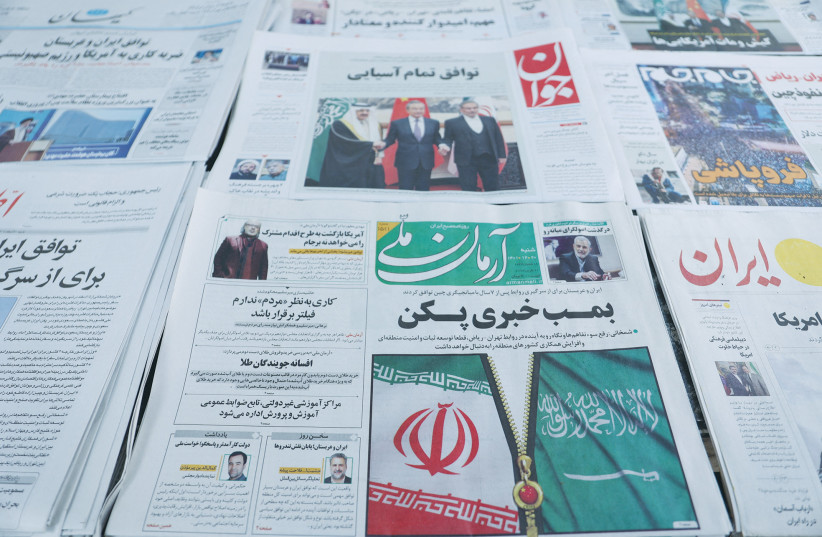
A NEWSPAPER with a cover picture of the flag of Iran and Saudi Arabia, is seen in Tehran last weekend. /  (photo credit: MAJID ASGARIPOUR/REUTERS)

In the wake of the deal between Saudi Arabia and Iran to reestablish relations and potentially reconcile some of their differences, there have been concerns that this is a setback for Israel.

The reason it is portrayed as a setback is that just days before the Saudi-Iran deal was announced, there were reports in The Wall Street Journal and The New York Times that Saudi Arabia had presented conditions for it to possibly normalize ties with Israel. The reports were interesting because it seemed Riyadh was asking for security guarantees from the US in exchange for increasing ties with Israel. Then suddenly Saudi Arabia and Iran were signing a deal in Beijing.

This is not necessarily a setback for Israel. Saudi Arabia has important interests in Iraq, Yemen, Syria and Iraq. Riyadh also is likely against Iran having a nuclear weapon. The new ties might mean Tehran listens more to Saudi concerns, or at least gives them credence because of China’s involvement.

The perception in some circles is that US influence in the Middle East is declining, and that Riyadh’s decision-making is guided by this lack of US influence. An article at CNN claimed China had “shattered” the assumption of US dominance in the Middle East.

The reality is more complex. For the last decade and a half, the US has been signaling to the Middle East that it is drawing down its interest in the region. For instance, the Obama administration sought to leave Iraq. The Trump administration sought to leave Afghanistan and Syria. The Biden administration did leave Afghanistan. The US is shifting from its global war on terror to confront near-peer rivals such as China and Russia. This is obvious and is the stated US policy.
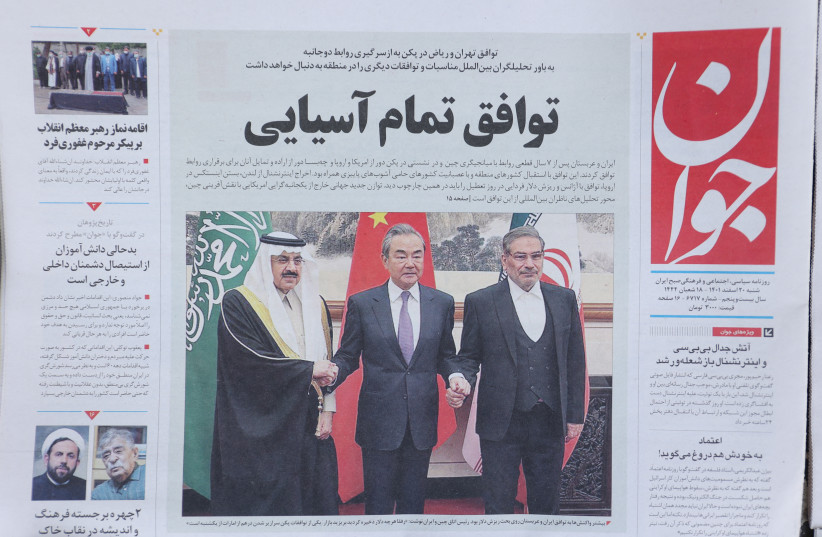
A newspaper with a cover picture of the Iranian Rear Admiral Ali Shamkhani, the secretary of the Supreme National Security Council and Saudi Minister of State and National Security Adviser Musaed bin Mohammed Al-Aiban, is seen in Tehran, Iran March 11, 2023. (credit: MAJID ASGARIPOUR/WANA (WEST ASIA NEWS AGENCY) VIA REUTERS)

The question is what this means for Israel. While some see a setback for Israel-Gulf ties, there is no evidence that the Saudi deal will result in an erosion of Israel’s success in the Gulf. The Abraham Accords appear to be thriving in terms of trade and people-to-people connections on some levels. The Saudi deal may not be linked to Israel; it may be due to Riyadh’s own calculations. Saudi Arabia has seen how Qatar and Turkey are able to have their own independent policies and still get concessions from the West. Qatar has been upgraded to a major non-NATO ally of the US. This is despite the fact that Doha has hosted Hamas and the Taliban. Saudi Arabia, meanwhile, faces increased criticism in the US, especially in Congress. Therefore, Riyadh’s decision may not be about Israel, but about its own pragmatic interest.

It’s important to remember how Saudi Arabia got here. Back during the Obama administration, Washington made important decisions in Iraq and Lebanon that would affect Saudi Arabia. Riyadh had played a key role in Lebanon since 1989. However, the US appeared to excuse Hezbollah’s increasing growth in power in 2008 and its threats to Beirut. At the same time the US had helped bring Nouri al-Maliki, a pro-Iranian strongman, to power in Iraq. This meant that key states in the region were being handed to Iran. The US policy in this regard was complex, but it was part of a broader shift by the Obama administration to seek ties with Iran. While the US did a “reset” with Russia, working with Putin’s regime, it also ignored Moscow’s aggression against Georgia and would eventually choose not to confront the Assad regime, enabling Russia’s intervention in Syria. As part of this, the goal was the Iran deal, signed in 2015. All of this led to Riyadh feeling Iran was rising too fast in the region.

Saudi Arabia intervened in Yemen in 2015 to stop the Iranian-backed Houthis from taking over the country. However, Saudi Arabia’s decision to stand up to the Houthis and also to oppose the Iran deal led to it being sidelined in Washington’s foreign policy on Iran issues. This led to a very cold relationship with the Obama administration.

It’s not surprising that given these circumstances Saudi Arabia and some other Gulf states began to see China as a welcome player in the region. But Riyadh also felt that the Trump administration and now the Biden administration have not returned to close ties with Saudi Arabia, and it has come to see an “independent” foreign policy as more in its interest. As such, it has sought to return to ties with Iran.

This kind of policy shift seems ironic, since Riyadh was against Iran when the US was working on the Iran deal, and now is closer to Iran when the US is tougher on Tehran. But that irony is coming about because of other shifts in the region. The era of conflict and countries severing ties has now passed, as many countries are seeking diplomatic ties.

SO HOW does Israel play into all this?
Israel has achieved new diplomatic ties in the region. The Abraham Accords began in 2020, and since then Israel has also been part of the Negev Forum and has had increasingly warm ties with Morocco, Egypt and Jordan, as well as Bahrain and the UAE. Rumors of ties with Saudi Arabia have also increased, but it is understood that those ties would only come after some shift on Israel’s part. The current government is dealing with domestic issues, such as judicial reform. Riyadh has not been a major priority.

How can Israel benefit from Saudi-Iran ties?

First of all, it’s plausible Saudi Arabia may end up investing in Iran, but that would likely only happen if Iran stops backing the Houthis to target Saudi Arabia. It would also come with a toning down of criticism of Riyadh in Iranian state and pro-regime media. This means there may be a toning down of rhetoric in general. Saudi Arabia has an interest in stability, both in Yemen, Iraq and Lebanon. These are all key issues that affect Israel. Iran has sought to hijack Iraq over the years and empower militias there. Those militias can threaten Israel with drones and missiles exported by Iran. The militias also help Iran move weapons to Syria and Lebanon.

At the same time, political chaos in Lebanon can lead to threats to Israel. It’s plausible that the Saudi deal could enable compromise on Lebanon’s presidency and fill the vacuum of power in Lebanon. While the recent terrorist incident in Megiddo and the North show that Hezbollah may still be enabling threats, there are key questions that could be resolved if the Saudi-Iran deal impacts Lebanon.

Yemen is another area where Iran exploited chaos to get a foot in the door. Iran has moved drones and missile technology to Yemen. The Houthis have increased their threats to Israel over the years. Iran also threatens commercial ships in the Gulf of Oman. The Saudi deal could lead to a ceasefire in Yemen or some kind of deal. This could mean a reduction in the Iranian arms flow.

The deal with Saudi Arabia may also come with new ties between Riyadh and Damascus. It’s not known what this would mean for the Syrian regime, but it could mean a return to the Arab League. Would this reduce Iranian influence in Damascus? Probably not, but it could mean that Iran might get the message that moving missiles to Syria destabilizes the regime. It’s not clear what impact this would have on Israel’s “war between the wars” campaign, but it could lead to ramifications for Israel’s attempts to stop Iranian entrenchment in Syria.

Most important, the Iran-Saudi deal may lead to Iran reducing its enrichment and attempted weaponization of a nuclear weapon. Saudi Arabia will not want to sign a deal and then suddenly have Iran develop a bomb that threatens the region. Clearly regional stability means not having a nuclear-armed Iran or a nuclear arms race. China, which will listen to Saudi concerns, may raise this issue with Iran. China and Iran have a new 25-year deal. China also has deals with the Gulf states.

There are a lot of possibilities being opened up now. Turkey could also reconcile with Syria. The Iran-Saudi deal may affect a number of countries. Some of these are key areas of concern for Israel.

It’s likely that Saudi Arabia will pursue these tracks independently, meeting with Iranian officials in Baghdad, while also hinting to Washington that it could increase ties with Israel. Saudi Arabia likely does not see these as mutually exclusive.

Iran, however, does want to believe its new deal with Riyadh will be a setback for Israel and the US. That is Iran’s interest, but it is not necessarily Saudi Arabia’s interest. Riyadh could become a conduit for concerns about Iran and its proxies’ threats to the region, now that the countries have ties.


Zawartość publikowanych artykułów i materiałów nie reprezentuje poglądów ani opinii Reunion’68,
ani też webmastera Blogu Reunion’68, chyba ze jest to wyraźnie zaznaczone.
Twoje uwagi, linki, własne artykuły lub wiadomości prześlij na adres:
webmaster@reunion68.com


Davidson Center in Jerusalem Archaeological Park reopens with brand-new modernized experience

Davidson Center in Jerusalem Archaeological Park reopens with brand-new modernized experience

ZVIKA KLEIN


The Davidson Center will feature several ancient artifacts, dating back to the First Temple Period 2,700 years ago
.

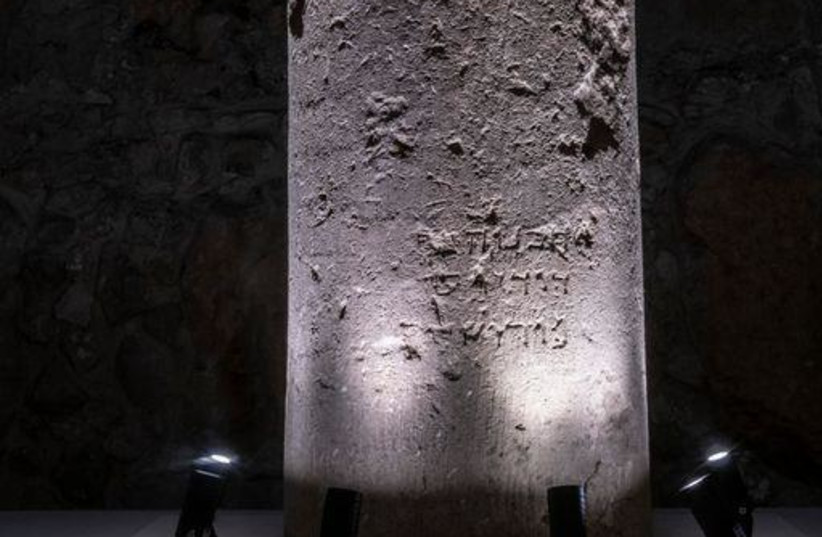
Davidson Center renovation
(photo credit: ANTIQUITIES AUTHORITY)

The newly renovated Davidson Center re-opens with updated exhibits featuring first ever publicly displayed archaeological finds, innovative technology, and interactive galleries.

The Davidson Center in Jerusalem Archaeological Park will reopen to the public on Sunday (March 13th) after being closed for three years for renovations. Located in the Old City of Jerusalem at the foot of the Temple Mount, visitors to the newly renovated Davidson Center will explore the theme of the Temple City of Jerusalem through a unique combination of ancient archaeological finds, innovative technology, artistic depictions, and interactive galleries. The Davidson Center renovation project, which included a building expansion and full content refresh, was led by the Israel Antiquities Authority with funding provided by the William Davidson Foundation.

The Davidson Center will feature several ancient artifacts, dating back to the First Temple Period 2,700 years ago, with some of the oldest known inscriptions bearing Jerusalem’s ancient Hebrew name, “yršlm”. Visitors will experience an entire gallery dedicated to the story of the origin of the Temple Menorah. Among the artifacts on display is an extremely rare coin minted by the last Hasmonean king, Antigonus II Mattathias, depicts the Temple Menorah and is the oldest known artistic representation created 107 years before the Second Temple’s destruction.

Significance of the center

“This is the oldest known artistic depiction of the menorah, created 107 years before the destruction of the Second Temple,” said Dr. Yuval Baruch, head of archaeology and administration at the Israel Antiquities Authority, who was one of the excavators of the site and led the archaeological curation of the Davidson Center. The other archaeological find on public display for the first time since it was excavated in the 1950s is a fragment of plasterwork from a Second Temple-era burial cave, known as Jason’s Tomb, bearing five carvings of menorahs.

The Southern Wall, adjacent to the Jerusalem Archaeological Park and the Davidson Center, is also strongly featured. In Temple times, this wall contained the main entry point for pilgrims ascending the Temple courtyards (via the Hulda Gates) to fulfill the commandment of bringing offerings on festivals and other occasions.

Davidson Center artifact (credit: Emil Elgem, Antiquities Authority)

Darin McKeever, president and CEO of the William Davidson Foundation said this week that the foundation is “excited to announce the reopening of the Davidson Center, which will offer visitors a unique experience exploring Jerusalem’s rich and varied history through its archaeological treasures.” McKeever added that he believes the museum will “be an important cultural destination for both foreign and Israeli visitors,” and looks forward to “sharing the stories and discoveries from Jerusalem’s past with this large and diverse audience. The William Davidson Foundation is proud to continue building on its late founder’s transformational investments in Jerusalem Archaeological Park.”

The Jerusalem Archaeological Park is one of the most important archaeological sites in Israel. Due to its archaeological, historical, and cultural importance, hundreds of thousands of people visit the park each year. The Society for the Development of the Jewish Quarter leads the visitor experiences in the Old City, including the area of the Southern Wall, Davidson Center, and Jerusalem Archaeological Park. 

Herzl Ben Ari, CEO of the Company for the Reconstruction and Development of the Jewish Quarter added that “after years of work, we are proud to reopen the Davidson Center in the Jerusalem Archaeological Park. Thanks to all the partners in this endeavor, the Center tells the moving story of Jerusalem, the Temple Mount, and the remembrance of the Temple, using first-rate and innovative techniques and technologies. It is a testament to the vision of Mr. Davidson, and an exciting new chapter for a site where Jews have come to and longed for, for generations.” 

Jerusalem Archaeological Park was established in 1995 through the support of Detroit businessman and philanthropist, William “Bill” Davidson (1922-2009), who had an appreciation for archaeology and believed deeply in preserving the history of the Jewish people. Building on his transformational contribution to the park, Davidson established the Davidson Center, which first opened in 2001, and quickly became one of Jerusalem’s most innovative and technologically advanced tourist attractions.


Zawartość publikowanych artykułów i materiałów nie reprezentuje poglądów ani opinii Reunion’68,
ani też webmastera Blogu Reunion’68, chyba ze jest to wyraźnie zaznaczone.
Twoje uwagi, linki, własne artykuły lub wiadomości prześlij na adres:
webmaster@reunion68.com


Israeli Video Streaming Service Launches Prime Ministers of Israel Film Series

Israeli Video Streaming Service Launches Prime Ministers of Israel Film Series

Shiryn Ghermezian


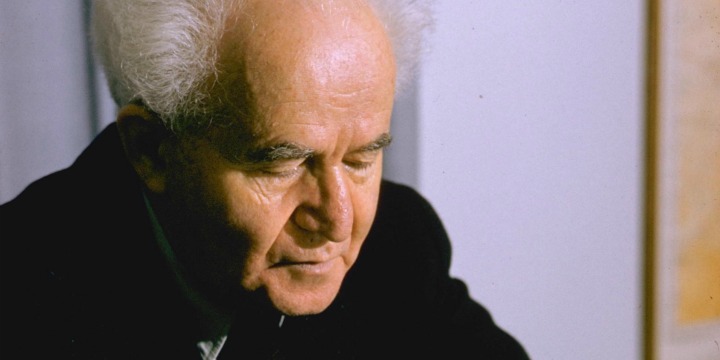
Israel’s first prime minister David Ben-Gurion. Photo: Wikimedia Commons

The Israeli video on-demand streaming service IZZY debuted on Wednesday the first movie in its Prime Ministers of Israel Film Series, which features documentaries and biographies about Israel’s past leaders.

The series starts with the documentary Ben Gurion, Epilogue from director Yariv Mozer. David Ben-Gurion was Israel’s first prime minister from 1955-1963 and is considered to be the founder of the Jewish state. The film spotlights a lost interview with the former Israeli world leader from 1968, when Ben-Gurion is 82 and living in the desert. In its description of the film, IZZY said Ben-Gurion’s “introspective soul-searching provides a surprising vision for crucial decisions Israel needs to make today. At the time of the global leadership crisis, the film also brings thought-provoking insights about the role of leaders in today’s complex world.”

Launched in 2020, IZZY is a subscription-based streaming service available worldwide that highlights Israeli films, television shows and documentaries.

“We want to be the platform for Israeli content and to provide the opportunity for people around the world to see content from Israel that we believe enhances the world’s relationship with Israel because you see a more diverse story that just what comes out in the news outlets,” IZZY Co-Founder and CEO Nati Dinnar told The Algemeiner on Thursday. “We try to bring all sorts of content that could interest our subscribers. Films and biographies about influential Israelis are always something that we search out for [and] I think it’s interesting to learn about the prime ministers and the differences between them.”

The next film in the series, 2019’s Golda, is about Golda Meir’s term as prime minister of Israel, from her rise to power and status as “queen of the Jewish people” to her downfall. The documentary will be released on IZZY next week followed later by the 2020 film Menachem Begin – Peace & War, which includes rare archival footage about Israel’s sixth prime minister as well as interviews with key figures during Begin’s term.


Zawartość publikowanych artykułów i materiałów nie reprezentuje poglądów ani opinii Reunion’68,
ani też webmastera Blogu Reunion’68, chyba ze jest to wyraźnie zaznaczone.
Twoje uwagi, linki, własne artykuły lub wiadomości prześlij na adres:
webmaster@reunion68.com


Israeli-Palestinian relations are deeply affected – opinion

Israeli-Palestinian relations are deeply affected – opinion

JAMAL AMIAR


The status of Israeli Arabs has been improving amid firm and continuous efforts after decades of stagnation.
.

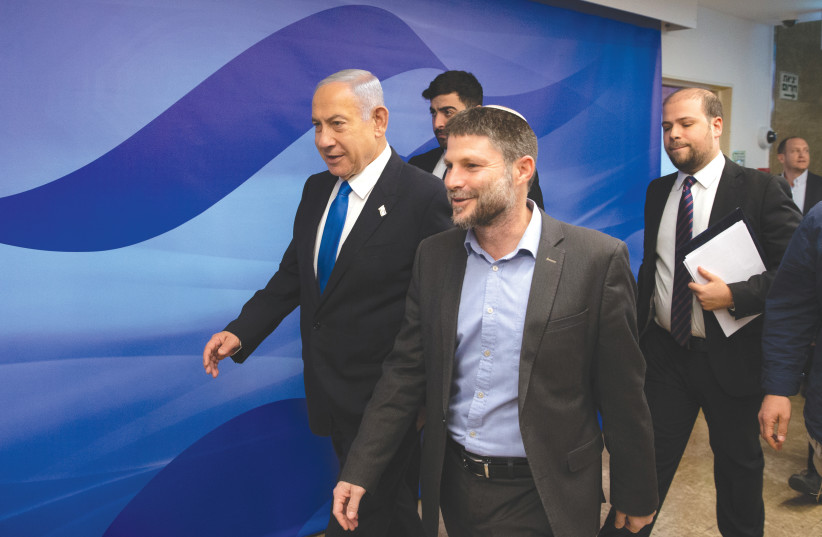
FINANCE MINISTER and Minister in the Defense Ministry Bezalel Smotrich arrives for a cabinet meeting, as Prime Minister Benjamin Netanyahu follows him, at the Prime Minister’s Office in Jerusalem, last month. / (photo credit: ALEX KOLOMOISKY/FLASH90)

The project of the present Israeli governing coalition to overhaul the organization and powers of the High Court will have deep implications on Israeli-Arab relations if it succeeds.

Given the coalition members’ plans to harden legal sanctions on Arab Israelis to the point of stripping them of their citizenship and expel them from Israel, and given the projects to extend the settlers’ presence in the occupied territories, the proposed plans are bound to raise tensions between Jews and Arabs in Israel. This could set off actions of solidarity among Palestinians in the occupied territories and in Arab countries.

Meanwhile, the new coalition’s plans to expand the settlements and give them a better legal cover by exerting control over the High Court – through legislative override or change in the judges nomination process – is also bound to raise Israeli-Palestinian tensions in the West Bank.

One could rightly argue that the establishment of settlements in the West Bank and the harsh treatment of its population has gotten for a half-century did not wait for new rules to be enacted by a rightist government.

Tensions are bound to rise

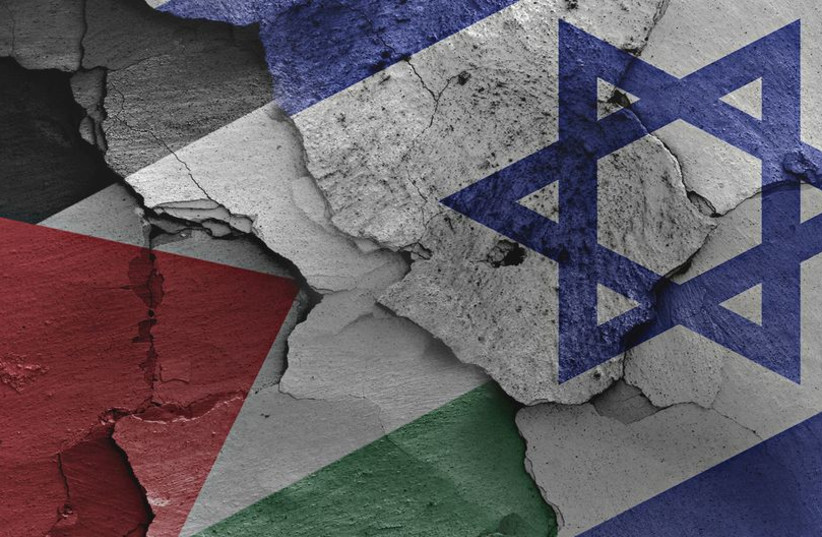
Palestinian Authority and Israeli flags (illustrative) (credit: Provided by the Lausanne Movement)

But if the proposed legislation succeeds, particularly the override rule and the change in the judicial nomination process, any move would become possible as Prime Minister Netanyahu and his allies crave for total control of the West Bank. With Finance Minister and Minister in the Defense Ministry Bezalel Smotrich in charge of civil affairs in the West Bank and with part of the powers of the Coordinator of Government Activities in the Territories, tensions are bound to raise.

These tensions may be contained for a while but for how long given Smotrich’s political aims in the West Bank, his political alliance with National Security Minister Itamar Ben-Gvir, and the fact that these two men and their allies in the Knesset exert true control on the fate of Netanyahu’s government?

Then, yes, the message from the Israeli government would become clear: there is no Palestinian Authority and there will be no Palestinian state, even a demilitarized state as Palestinian leaders have agreed to as a condition for Israeli-Palestinian and Israeli-Arab peace since the 1990s.

Given their possible consequences on the ground, on Jewish-Arab relations in Israel and in the West Bank, the proposed rules are bound to provoke a deterioration of the relations between Israel and the Arab countries with which it maintains diplomatic relations – no fewer than six.

STOPPING THE projects of the annexation of the West Bank by the previous Netanyahu government was already a condition that made the Abraham Accords possible. The plans of the present Israeli coalition to expand settlements won’t benefit Israeli-Arab relations when progress is expected in Israeli-Palestinian relations.

This point is not only a diplomatic issue, it touches the very fabric of Arab public opinion. Normalization won’t be fully accepted if there is no progress and there is indeed a deterioration in Israeli-Palestinian relations.

The moment is for building on the assets that the Abraham Accords represent for regional cooperation and peace. The present Israeli government needs to show political and diplomatic maturity. The Middle East has changed positively since the Camp David, Oslo and Abraham Accords, except for a majority of the Palestinian people.

It is time an Israeli and Arab leadership emerges that understands these issues and breaks with the politics of conflict and arrogance. The business communities are here and the civil societies, too, and the potential for shared initiatives and prosperity is real.

It may be that today the unlocking of this situation sits on the shoulders of one man: Netanyahu. The possibility that he does not go to court and avoids prison is completely linked to the fate that his governing coalition is preparing for the Israeli High Court. But by changing the legal rules and particularly by putting the override rule into law, Netanyahu might sacrifice the stability of this country and its relations with its neighbors for his singular benefit.

No one knows better than Netanyahu and the members of Knesset what is better for peace and their country, and their regional and international standing. If the United States and the United Kingdom have already expressed strong reservations about dealing with the present Israeli government and certainly with some of its members, what could be the position of Cairo, Amman, Abu Dhabi, Manama or Rabat?

The present legal issues before the Knesset and Israeli public opinion may be a matter of domestic politics but the way they are handled through votes in the Knesset, civil disobedience, the resignation of opposition MKs or an amnesty law will deeply affect the fate of Israeli-Palestinian relations, which are already at a very low point, and the status of Israeli Arabs, which, in fact, has been improving amid firm and continuous efforts after decades of stagnation.

The writer is a Moroccan journalist and writer. He is a guest contributor to  Mitvim Institute for Regional Policies and recently published (in French) Le Maroc, Israël et les Juifs Marocains (Morocco, Israel and Moroccan Jews), Bibliomonde, Paris.


Zawartość publikowanych artykułów i materiałów nie reprezentuje poglądów ani opinii Reunion’68,
ani też webmastera Blogu Reunion’68, chyba ze jest to wyraźnie zaznaczone.
Twoje uwagi, linki, własne artykuły lub wiadomości prześlij na adres:
webmaster@reunion68.com