Richard Hurowitz
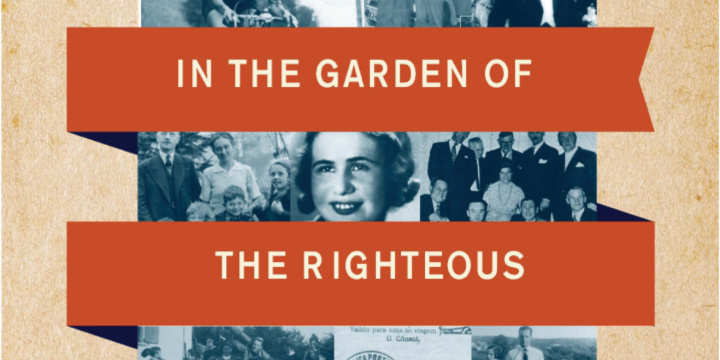 “In the Garden of the Righteous” by Richard Hurowitz (Harper, 2023)
“In the Garden of the Righteous” chronicles extraordinary acts at a time when the moral choices were stark, the threat immense, and the passive apathy of millions predominated. Deeply researched and astonishingly moving, it focuses on ten remarkable stories of rescuers during the Holocaust who provided hiding places, participated in underground networks, refused to betray their neighbors, and secured safe passage for Jewish victims. They repeatedly defied authorities and risked their lives, their livelihoods, and their families to save the helpless and the persecuted. “In the Garden of the Righteous” is a testament to their kindness and courage. Below is an excerpt from the book:
When France capitulated to the Nazis in June 1940, the Germans occupied the north, including Paris, while a collaborationist regime headquartered in the resort town of Vichy remained in place in the rest of the country. Under the armistice signed by Marshall Phillipe Pétain, the head of the new government, the French agreed to “surrender on demand” anyone the Nazis demanded. In particular peril were the many prominent artists, writers, political opponents and intellectuals who had spoken out against fascism, many of whom had taken refuge in France. Within days, a group formed in New York called the Emergency Rescue Committee which sent the thirty-three-year-old Harvard-educated journalist and book editor, Varian Fry, on a mission to help get them to safety.
Armed with a list of artists compiled by Alfred Barr, the director of the Museum of Modern Art, a roster of writers assembled by Thomas Mann, scores of other names, and several thousand dollars, Fry left for what he assumed would be several weeks in the south of France handing out special visas for safety in the United States.
He would stay for over a year. Fry quickly found that getting out even prominent refugees was a difficult task and often involved false papers, hiding places, and smuggling people across the border to Spain. He quickly attracted a circle of helpers, some American idealists, some foreigners who were refugees themselves. Of critical importance was his relationship with Hiram Bingham IV, known as Harry, the son of the famous discoverer of Maccu Pichu. The Yale graduate, then in his early forties, was posted as vice consul in Marseilles when Fry arrived there to set up his operation. Bingham, almost uniquely among American diplomats, was sympathetic to refugees and would issue visas to people fleeing for their lives, pulling them out of internment camps, and even hid the famous writer Lion Feutchwanger and his wife in his villa until they could escape.
Almost everyone else at the State Department was opposed to allowing refugees to come to the United States, many of whom they viewed as socially undesirable, following the lead of the Assistant Secretary of State Breckinridge Long, a notorious anti-Semite who issued directives to keep Jews out. Bingham and Fry were forced to use every trick they could to help those fleeing for lives. The two men quickly became, as Fry later put it, partners “in the crime of saving human lives.” A highly cultured man and a humanist, Bingham, like Fry, was determined to help both ordinary people but also the geniuses on the ERC’s list.
At the beginning of October 1940, things became more dangerous for all Jews in Vichy France, no matter how prominent, when Pétain issued a series of anti-Jewish laws, and at the end of the month, shook hands with Hitler at Montoire. One of the most famous Jewish artists in the world was the painter Marc Chagall, who was obviously on the ERC’s list. Fry wrote to him and to the sculptor Jacques Lipchitz, also Jewish, and to André Masson, whose was married to a Jew. None was prepared to leave France, although Masson did throw up when he read the racial laws.
The Russian Chagall was a naturalized French citizen, and had lived in France on and off since 1922. He had moved south with his wife and muse Bella and fallen in love with the Riviera, and he did not see why he should leave his adopted homeland. “He was just comfortable where he was,” Bingham recalled. “It was hard in the peaceful French countryside to imagine that there would be all this trouble.” His work was both highly modern and infused with religious and traditional Jewish imagery. As a “degenerate artist” with Jewish subject matter, he was a prime target of the Nazis, who mocked his work, as one scholar has explained, as “green, purple and red Jews shooting out of the earth, fiddling on violins, flying through the air … representing an assault on Western civilization.”
As things deteriorated, Fry kept pestering Chagall. As reality sunk in, the artist finally changed his mind. He and Bella came down to Marseille on December 29 and met with Fry and Bingham to plan their emigration. Over dinner at a restaurant, Chagall had nervously asked, “Are there cows in America?” No sooner had Fry assured him that there were than the lights went out, the blackout shades were drawn, and a candle was lit. The air raid that followed removed any lingering doubts the Chagalls might have had. The Museum of Modern Art had requested an emergency visa for Chagall in November, but it had still not been issued. So at the consulate Bingham gave the Chagalls visas, even though they did not have the required affidavits other than one from Fry attesting to Chagall’s moral character and financial independence. Fry also bought the Chagalls two tickets to New York.
On March 8, Bingham drove Fry to Gordes, the charming and difficult-to-access village northwest of Marseille where the Chagalls lived in a stone cottage, to spend the weekend and make further preparations. They were struck by the magnificence of the landscape — “beautiful beyond belief.” “The almond trees are in bloom, a delicate pink against the soft gray-green and sage-green and dark cypress-green of the Provençal landscape,” Fry wrote in his journal. “In this, of all places, it is hard to believe that men, given the beautiful world to live in, can sully and destroy it by war. I can see why they didn’t want to leave; it is an enchanted place.” Chagall had already begun to pack, and he told them they could have the house after he left to hide people in.
Chagall was a voluble and gracious host, childlike, talking about his paintings and about the world. Dressed informally, with creased old pants and a dark blue shirt, he showed off his studio. Bingham brought along his movie camera and filmed the visit. The Chagalls posed for a photograph with Bingham beaming behind them as Fry intensely studied an easel. Bingham talked with Chagall about his great-uncle, the great window maker Louis Comfort Tiffany, a conversation he believed influenced the artist in his later work in stained glass.
Despite having to return to Marseille in a hailstorm, Fry and Bingham adored the visit. Chagall sent a note to Bingham shortly after: “Thank you with all our hearts. We had a great deal of pleasure in spending these last two days with you.”
In April, the Chagalls came to Marseille to prepare to leave and checked in to the Hotel Moderne. By then Vichy had its own commissioner-general of Jewish affairs. A few days later there was a massive roundup of Jews early in the morning. Bella immediately called Fry and Bingham in a panic. Fry telephoned the police station and told them they had just arrested M. Marc Chagall.
“If, by any chance, the news of his arrest should leak out,” Fry told the man answering the phone, “the whole world would be shocked, Vichy would be gravely embarrassed, and you would probably be severely reprimanded.”
“Thank you very much for calling me,” the man said quickly. “I shall look into the case at once.”
Bingham too called, using the full weight of his authority and the prestige of the US government to press for Chagall’s immediate release. As the painter’s granddaughter later said, “Through sheer audacity, Fry and Bingham cajoled and threatened police officials to release him.” Thirty minutes later Chagall had returned to the hotel. He came around to thank them in the afternoon. “All the reluctance he used to feel to leave France has disappeared,” Fry wrote in his journal. “Now he is rarin’ to go.”
On May 7, the Chagalls went by train through Spain. They arrived in Lisbon four days later and continued on to America. Many of the paintings in Chagall’s studio followed after them, carefully identified in small sketches by the artist on the back of a copy of Le matin, rolled up by a Resistance fighter, and shipped in a diplomatic pouch arranged by Bingham. When they left, Chagall gave Fry a drawing of a goat holding a violin. The Chagalls settled in Connecticut, with some of the artist’s greatest work, particularly his monumental stained-glass windows and his commissions for the Paris Opéra and Metropolitan Opera House, ahead of him.
Things did not end as well for his saviors. Bingham was soon transferred to Lisbon and then posted far away in Buenos Aires, where his reports later in the war of Nazis arriving in Argentina were not appreciated by his superiors. He was repeatedly passed over for promotion and within a few years was pushed out of the foreign service, retreating to his family home in Connecticut where he struggled to support his eleven children.
For his own efforts, Fry was expelled by Vichy at the behest of the State Department, who viewed him as an embarrassment undermining American neutrality. Back in the United States, he wrote his memoirs and also became an outspoken advocate against the Holocaust during the war. He, too, struggled professionally, was twice divorced, and eventually died of a heart attack before his sixtieth birthday.
Neither man was recognized in his lifetime, although Fry was eventually made a Righteous Among the Nations by Yad Vashem. Among those rescued by the Emergency Rescue Committee were Marcel Duchamp, Max Ernst, Andre Breton and most of the Surrealists, Heinrich Mann, Hannah Arendt, Franz Werfel, and countless others. Fry, Bingham, and their comrades saved thousands of lives and were in large part responsible for the movement of the center of gravity of art, literature, science, and thought to the United States from Europe. Like so many other rescuers, they suffered for their heroism.
There is a wonderful production on this season at the New York City Ballet (founded by Fry’s friend Lincoln Kirstein) of “The Firebird” by Igor Stravinsky, choreographed by George Balanchine and with sets and costumes by Marc Chagall, which for years has delighted audiences. As you enter the theater to see it in Lincoln Center, Chagall’s great paintings in the Metropolitan Opera overlook the plaza. Without Fry and Bingham, neither would likely exist.
Richard Hurowitz is an investor and the publisher of The Octavian Report, an newsletter covering finance, foreign policy, politics and culture, and the author of “In the Garden of the Righteous.”
 Israel Daily News – February 26, 2023


