Archives

Israel Daily News – December 25, 2022

Israel Daily News – December 25, 2022


ILTV Israel News


Prime Minister Designate Benjamin Netanyahu putting the coalition puzzle together, handing out the remaining government positions. Will all Likud members be satisfied?

Meantime, Israel is breaking a record of 23 years in Aliyah numbers, with most newcomers coming from a surprising country.

And … Is it a bird? Is it an Aeroplane? Israeli startup working hard to make breakthrough in flying vehicles.


Zawartość publikowanych artykułów i materiałów nie reprezentuje poglądów ani opinii Reunion’68,
ani też webmastera Blogu Reunion’68, chyba ze jest to wyraźnie zaznaczone.
Twoje uwagi, linki, własne artykuły lub wiadomości prześlij na adres:
webmaster@reunion68.com


Silver coins found near Temple Mount prove Jewish history of Israel

Silver coins found near Temple Mount prove Jewish history of Israel

JUDY SIEGEL-ITZKOVICH


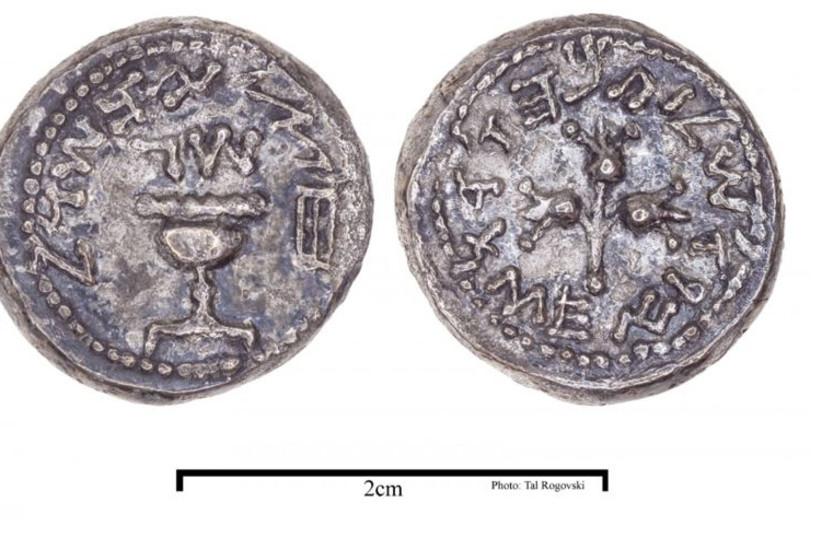
“This is the third coin of this type found in excavations in Jerusalem, and one of the few ever found in archeological excavations,” said the researchers.
.

Half-shekel coin from the third year of the Great Revolt.
(photo credit: Tal Rogovski)

A rare, half-shekel coin from the Great Revolt from 66 CE to 70 CE during the Second Temple period has been discovered in Jerusalem’s Ophel excavations south of the Temple Mount.

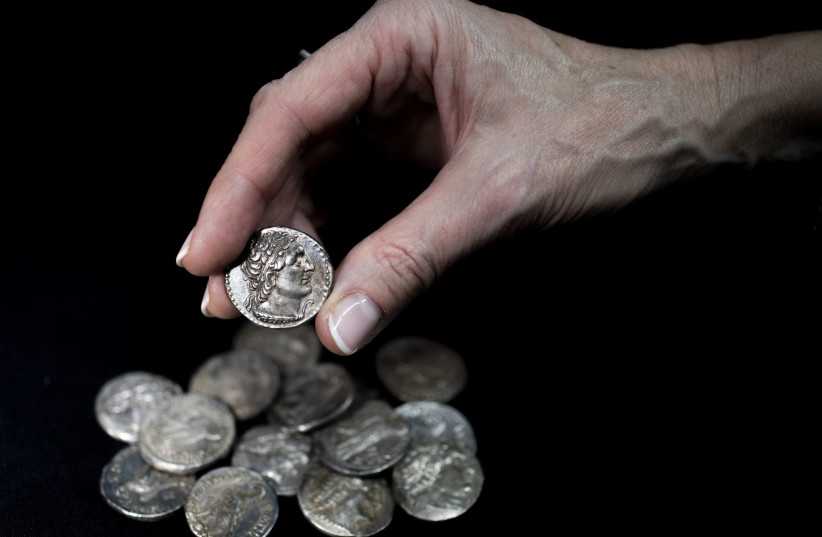
Only a few days ago, a wooden box containing 15 silver coins that serve as proof of the Hanukkah story of the Maccabees – which was found recently during an excavation in the Negev Desert – was announced.

The Ophel – or citadel – is the still-extant Herodian, cased-in Temple Mount bordered to the south by a saddle, followed by the ridge known as the southeastern hill that stretches down to the King’s Garden and the lower Siloam Pool. Two kings of Judah, Yotam and Manasseh, are described in the Book of 2 Chronicles to have massively strengthened the Ophel fortifications and was either very close to or identical with the “stronghold of Zion” conquered and reused by King David.

In the destruction layer, dozens of Jewish coins were found from the period of the Great Revolt, most of them made of bronze. They also included a particularly rare and unusual find – a silver coin in a half-shekel denomination originating from 69/70 CE.

A wooden box containing 15 silver coins from the Maccabean period was discovered in the Judean Desert earlier this year, and will be put on display in the Hasmonean Museum in Modi’in, December 13, 2022. (credit: SHAI HALEVI / ISRAEL ANTIQUITIES AUTHORITY)

The dig was carried out by a team from the Hebrew University (HU), led by Prof. Uzi Leibner of the Institute of Archaeology, in partnership with Armstrong College in Edmond, Oklahoma, and with the support of the East Jerusalem Development Company, the Israel Antiquities Authority and the Israel Nature and Parks Authority. 

The rare silver coin was cleaned at the conservation lab of the Institute of Archaeology and identified by Dr. Yoav Farhi, the team’s numismatic expert and curator of the Kadman Numismatic Pavilion at the Eretz Israel Museum in Tel Aviv. Silver coins from the Great Revolt were the first and the last in ancient times to bear the title “shekel,” the archaeologist said. “The next time this name was used was in 1980, on Israeli shekel coins produced by the Bank of Israel.”

“This is the third coin of this type found in excavations in Jerusalem, and one of the few ever found in archeological excavations,” said the researchers.

During the Great Revolt against Rome, the Jews in Jerusalem minted bronze and silver coins. Most of the silver coins featured a goblet on one side, with ancient Hebrew script above it noting the year of the Revolt. Depending on its denomination, the coins also included an inscription around the border noting either, “Israel Shekel,” “Half-Shekel” or “Quarter-Shekel.” The other side of these coins showcased a branch with three pomegranates, surrounded by an inscription in ancient Hebrew script, “Holy Jerusalem.”

The production of silver coins

Throughout the Roman era, the authority to produce silver coins was reserved solely for the emperor. During the Revolt, the minting of coins, especially those made of silver, was a political statement and an expression of national liberation from Roman rule by the Jewish rebels. In fact, throughout the Roman period leading up to the Revolt, no silver coins were minted by Jews, not even during the rule of King Herod the Great.

According to the researchers, half-shekel coins with an average weight of seven grams were also used to pay the “half-shekel” tax to the Temple, contributed annually by every Jewish adult male to help cover the costs of worship.

“Until the revolt, it was customary to pay the half-shekel tax using good-quality silver coins minted in Tyre in Lebanon, known as Tyrean shekels or Tyrean half-shekels,” said Farhi. These coins held the image of Herakles-Melqart, the principal deity of Tyre, and on the reverse, they featured an eagle surrounded by a Greek inscription, “Tyre the holy and City of refuge.” The silver coins produced by the rebels were intended to also serve as a replacement for the Tyrean coins, by using more appropriate inscriptions and replacing images forbidden by the Second Commandment with symbols. 


Zawartość publikowanych artykułów i materiałów nie reprezentuje poglądów ani opinii Reunion’68,
ani też webmastera Blogu Reunion’68, chyba ze jest to wyraźnie zaznaczone.
Twoje uwagi, linki, własne artykuły lub wiadomości prześlij na adres:
webmaster@reunion68.com


Muslim Brotherhood Succession Crisis Deepens

Muslim Brotherhood Succession Crisis Deepens

Hany Ghoraba


Egyptian protesters and Muslim Brotherhood members shout slogans against President Abdel Fattah al-Sisi and the government during a demonstration protesting the government’s decision to transfer two Red Sea islands to Saudi Arabia, in front of the Press Syndicate in Cairo, Egypt, April 15, 2016. Photos: REUTERS/Amr Abdallah Dalsh

The Nov. 4 death of the Muslim Brotherhood’s acting general guide, Ibrahim Munir, triggered a new internal power struggle.

At the moment, there are three factions struggling to control the Muslim Brotherhood, and they all operate outside of Egypt: one residing in Britain, and two others operating from Istanbul. The London faction, once led by Munir, is now led by Mohei El-din El Zayet. One Istanbul faction is led by Mahmoud Hussein, and the other operating from Istanbul is the “Current of Change” faction. Each claims to be the legitimate representative of the Muslim Brotherhood group and its goals.

Before his death, Munir declared that the Muslim Brotherhood no longer would seek political power in Egypt. In contrast, the Istanbul factions reject that stance. After Munir’s death, the group’s London faction immediately declared its leader, El Zayet, as acting guide. In response, the Istanbul-based faction announced Mahmoud Hussein is the new acting guide.

“The Muslim Brotherhood group realizes that the youth boys and girls are its present tools, the power of the group, the hope, its glory makers, the safety valve for its continuity and the name of its future,” Hussein said in a Nov. 20 speech to members. “That’s why the group is working on preparing and qualifying a generation of youth leaders who [are] completely qualified in all professions and able to lead the group toward a safe transition into the second centennial for the group, God willing.”

The feud cannot be settled anytime soon. It requires a general assembly vote, something difficult to arrange with members behind bars or in exile.

Egypt considers El Zayet a terrorist; he was sentenced to six years in prison by a military court in absentia for a number of terrorism related cases involving a terrorist cell known as the “Helwan Brigades.” Helwan Brigades attacks in 2014-15 killed five police officers and destroyed a number of electrical towers. El-Zayet was charged with coordinating various brigade groups.

Similar power struggles within the Brotherhood ignited earlier in 2013, following the arrest of General Guide Mohamed Badie. He later was sentenced to life in prison after being convicted of multiple charges relating to a mass prison breakout and killing of police officers.

Brotherhood bylaws say a vacancy should be filled by the oldest known free member of the group. Many are claiming that it is Ibrahim Munir.

Munir was credited with keeping the global Muslim Brotherhood group intact after it was banned in EgyptSaudi ArabiaUnited Arab Emirates, Bahrain, and Jordan.

Munir persuaded the British Parliament in 2016 not to ban the Muslim Brotherhood or label it as a terrorist entity. He told a British Parliament committee that Sharia laws tolerate apostates and homosexuals, which contradict the teachings of Brotherhood founder Hassan al-Banna.

But both Munir and Hussein opposed as potential leaders the Current of Change faction, which is comprised mostly of the group’s youth, who see the old guard as too old and entrenched. This faction is also known as “The Third Wave” and “The New Kamalists,” referring to Mohamed Kamal, a deceased founder of the group. The Current of Change organized a convention in Istanbul last October coinciding with the anniversary of Kamal’s death.

Kamal masterminded a number of terrorist activities in Egypt before being killed by Egyptian security in 2016 after a short battle at his hideout in Cairo. The Change movement believes in restoring the tenets set by the group founder Hassan al-Banna and its ideologue and terrorism mastermind, Sayyid Qutb. These tenets include fighting apostate governments and ousting rulers by force as a form of jihad. Qutb believed in forcing sharia laws into societies and replacing civic laws.

The Current of Change faction issued a charter during its first official meeting in Istanbul. It indicates that the group is willing to resume terrorist activities in Egypt, according to Sky News Arabia. It shuns any reconciliation or rapprochement efforts with the Egyptian government.

“All options are open to the use of force and violence, and the need to release prisoners,” the charter said.

It also called for “the end of the era of centralization within the [Brotherhood] and the reliance on decentralization,” seen as a statement that it would not follow the London or Istanbul factions.

These positions contradict Munir’s statement that the Muslim Brotherhood no longer seeks power in Egypt.

Another possible candidate is 80-year-old Mohamed El-Beheiry, who lives in Turkey. His supporters claim that he is the oldest member of the Muslim Brotherhood. He was part of the notorious cell known as the “Organization 65,” which was headed by Sayyid Qutb and also included Badie.

Organization 65 carried out a number of assassination attempts targeting then-President Gamal Abdel Nasser, and launched other coordinated attacks in an effort to topple the Egyptian government. Egyptian authorities dismantled the group in 1965, sentencing a number of its members — including Qutb — to death.

El-Beheiry was one Munir’s many enemies and participated in an attempted coup against him in October 2021. In response, Munir suspended El-Beheiry and a number of his accomplices.

El-Beheiry’s potential rise as the next acting general guide would deepen the rift between the Muslim Brotherhood factions. Younger members feel that they are being ignored and treated as cannon fodder in their leaders’ battle with the Egyptian state.


Investigative Project on Terrorism (IPT) Senior Fellow Hany Ghoraba is an Egyptian writer, political and counter-terrorism analyst at Al Ahram Weekly, author of Egypt’s Arab Spring: The Long and Winding Road to Democracy and a regular contributor to the BBC. A version of this article was originally published by IPT.


Zawartość publikowanych artykułów i materiałów nie reprezentuje poglądów ani opinii Reunion’68,
ani też webmastera Blogu Reunion’68, chyba ze jest to wyraźnie zaznaczone.
Twoje uwagi, linki, własne artykuły lub wiadomości prześlij na adres:
webmaster@reunion68.com


A Tale of Two Narratives

A Tale of Two Narratives

Martin Sherman / JNS.org


A menorah. Photo: Wikimedia Commons.

At the heart of the Israeli-Palestinian conflict lies a clash of two narratives.

On the one hand, there is the stirring, fact-based Zionist narrative. On the other, there is the fabricated “Palestinian” narrative—which, as one senior PLO official openly admitted, “serves only tactical purposes,” one of which is to be “a new tool in the continuing battle against Israel.”

Although enormous international efforts have been invested in futile endeavors to portray these two narratives as reconcilable, the truth is that they are inherently and incontrovertibly mutually exclusive. Either one of them will prevail, absolutely and exclusively, or the other will.

It is becoming ever clearer with the passage of time that the reason for this unfortunate impasse is that Palestinian Arab enmity towards a Jewish state does not arise from anything the Jews do, but from what the Jews are.

This enmity, therefore, can only be dissipated if the Jews cease to be.

Successive Israeli governments, cowed by left-leaning civil society elites, have refused to articulate this “inconvenient truth” and refrained from formulating policy that takes it adequately into account.

Accordingly, they have perpetuated the myth that there is some fictional “middle ground” that, if found, would leave both sides not totally unaggrieved, but still satisfied enough to eschew violence.

The clash of two narratives

If the key issue is irreconcilable claims of sovereignty over a given geographical area, driven by mutually exclusive national narratives, which claim and which narrative should prevail?

Although there is seldom agreement among political scientists on issues relating to nations and nationalism, there is a consensus that a discernibly unique identity is a crucial precondition for validating claims to national sovereignty and nationhood.

It is beyond dispute that Jews have a far stronger claim to a distinct national identity, and hence the right to sovereign nationhood, than most nations—particularly the Palestinian Arabs.

The Jews have a unique language, unique script, unique religion, unique history and heritage, unique calendar, unique customs, unique everything.

By contrast, Palestinian Arabs can point to nothing unique in any of these areas—not in language, not in religion, not in script, not in customs, not in anything.

Moreover, the Palestinian Arabs admit that they are part of a wider national grouping. Thus, Article 1 of the Palestinian National Covenant proclaims: “The Palestinian Arab people are… part of the Arab nation.” Article 12 baldly admits that a separate Palestinian identity is merely a temporary ruse to further wider Arab interests.

Thus, at an Arab League summit in 1987, convened in Amman, the late King Hussein of Jordan conceded that Palestinian identity was merely a response to Jewish national claims and was not driven by any authentic endogenic sentiment of uniqueness. He declared, “The appearance of the Palestinian national personality comes as an answer to Israel’s claim that Palestine is Jewish.”

From this, we are compelled to conclude that, if there were no Jewish claims to “Palestine,” there would be no Palestinian Arab claims. Therefore, these claims are merely a derivative of Jewish claims, without which they would not exist.

Clearly, if the Zionist claim has demonstrable validity over the irreconcilable, mutually exclusive counter-claim by the Palestinian Arabs, then the Zionist claim must prevail—exclusively and absolutely.

Expression of Jewish sovereignty

In a Jewish nation-state, Jewish people ought to comprise the sole and exclusive source of political sovereignty.

Non-Jewish residents should—as explicitly stated in Israel’s Declaration of Independence—enjoy full equality regarding individual civil rights, including the right to vote, but no collective national rights.

In a Jewish state, the national flag should bear the Star of David, not a crescent moon or cross; the state symbol should be the menorah, not an Arabian scimitar or a Crusader sword; the official day of rest—the Sabbath—should fall on Saturday, not Friday or Sunday; the national anthem should refer to the yearning of a Jewish soul, not a multicultural one of “all its citizens.”

In a Jewish state, there should be Judeo-centric legislation, enshrining the Law of Return for Jews in the Diaspora, but not the “right of return” for diasporic Palestinian Arabs.

Public life should be conducted, and the yearly calendar constructed, according to Jewish tradition and Zionist heritage. Hebrew, not Arabic or English, should be the hegemonic means of communication in commerce, academia and legal proceedings.

Any individual who actively rejects this should not continue to live within the frontiers of the country. There is absolutely nothing undemocratic about this. Indeed, it is a necessary precondition for sustainable democratic rule.

As John Stuart Mill reminded us: “Free institutions are next to impossible in a country… without fellow-feeling… [generated by] identity of political antecedents; the possession of a national history, and consequent community of recollections; collective pride and humiliation, pleasure and regret, connected with the same incidents in the past.”

Without this, he warns, “The united public opinion, necessary to the working of representative government, cannot exist.”

More than a random amalgam

For those who might throw up their hands in a show of politically-correct horror, current events in the region ought to serve as a sobering reminder that a cohesive nation—and hence a stable nation-state—is more than a random amalgam of the inhabitants of a given territory, bound by nothing more than the accident of their geographic location.

Any doubts as to the continuing validity of this historic insight should swiftly be dispelled by the spectacle of gore and guts across the splintering Arab world in places such as Syria, Iraq, Libya and Yemen. In these places, it is clear that “the united public opinion, necessary to the working of representative government” does not exist.

Of course, much has yet to be laid out regarding the “intellectual arsenal” that needs to be marshaled to preserve Israel as the nation-state of the Jews. But a clear idea of the superior Jewish claims to sovereignty, the expression of that sovereignty in the Jewish nation-state and the need for a muscular and adequately-funded public diplomacy offensive to promote and protect it, is an indispensable initial building block required to commence the assembly of such an “arsenal.”


Dr. Martin Sherman spent seven years in operational capacities in the Israeli defense establishment. He is the founder of the Israel Institute for Strategic Studies (IISS), a member of the Habithonistim-Israel Defense & Security Forum (IDSF) research team and a participant in the Israel Victory Initiative.


Zawartość publikowanych artykułów i materiałów nie reprezentuje poglądów ani opinii Reunion’68,
ani też webmastera Blogu Reunion’68, chyba ze jest to wyraźnie zaznaczone.
Twoje uwagi, linki, własne artykuły lub wiadomości prześlij na adres:
webmaster@reunion68.com


Palestinians Fire on Israeli Forces Securing Entry of Jewish Worshippers to Joseph’s Tomb

Palestinians Fire on Israeli Forces Securing Entry of Jewish Worshippers to Joseph’s Tomb

Algemeiner Staff


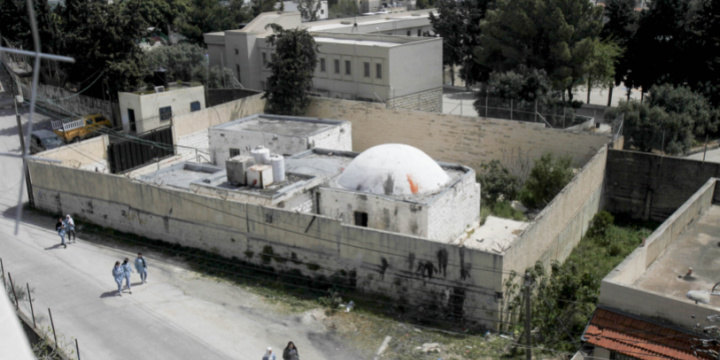
A general view of Joseph’s Tomb in the West Bank city of Nablus. Photo: Nasser Ishtayeh / SOPA Images/Sipa USA via Reuters

Israeli forces exchanged fire on Wednesday night with armed Palestinians in the West Bank city of Nablus, the military said, while securing the entrance of Jewish worshippers into Joseph’s Tomb.

Some 1,000 worshippers visited the religious site, according to local media, a longtime flashpoint that has seen multiple clashes between Israeli forces and Palestinian militants, and was vandalized by Palestinian rioters earlier this year.

In response, “armed Palestinians hurled explosive devices and fired toward the soldiers, endangering their lives,” the military said. Troops responded with live fire and identified hits, though the military did not specify how many.

While no Israeli injuries were reported, Palestinian sources said Ahmed Daraghmeh, 23, was killed in the overnight exchange, and five other Palestinians wounded.

Lt. Col. Richard Hecht, the IDF’s international spokesperson, noted on Thursday that Hamas, the Islamist group that controls the Gaza Strip and has been blacklisted as a terrorist organization by Israel, the US, and the European Union, posthumously celebrated Daraghmeh “as a holy martyr.”

Israeli forces earlier faced gunfire during three attacks in the Nablus area on Tuesday, which were claimed by a newer Palestinian armed faction, Lion’s Den, but resulted in no injuries, local media reported.

Israeli military activity continued in the West Bank on Thursday, with Israeli forces apprehending a suspect with five handguns in his possession in the Jordan Valley area, near the town of al-Auja, around four miles from the Jordanian border.


Zawartość publikowanych artykułów i materiałów nie reprezentuje poglądów ani opinii Reunion’68,
ani też webmastera Blogu Reunion’68, chyba ze jest to wyraźnie zaznaczone.
Twoje uwagi, linki, własne artykuły lub wiadomości prześlij na adres:
webmaster@reunion68.com