Archives

News From Israel- October 20, 2022

News From Israel- October 20, 2022


ILTV Israel News


The gunman responsible for the death of IDF soldier Noa Lazar last week was killed after attempting a second terror attack

Israel announces a new humanitarian aid package to Ukraine…But rejects Kyiv’s request to provide military arms to the war torn country

And ILTV heads to the Arava desert to see how young Israelis are connecting to the land and fulfilling the Zionist dream


Zawartość publikowanych artykułów i materiałów nie reprezentuje poglądów ani opinii Reunion’68,
ani też webmastera Blogu Reunion’68, chyba ze jest to wyraźnie zaznaczone.
Twoje uwagi, linki, własne artykuły lub wiadomości prześlij na adres:
webmaster@reunion68.com


Hundreds of ancient artifacts seized from home in northern Israel

Hundreds of ancient artifacts seized from home in northern Israel

JERUSALEM POST STAFF


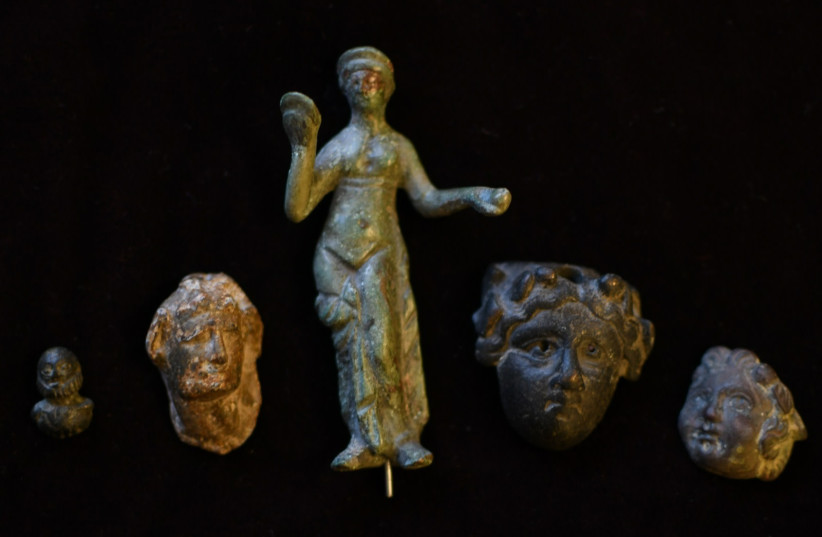
About 270 ancient artifacts were found in the search, including coins from different periods and figurines of Medusa.

.

Ancient artifacts seized from an antiquities dealer in northern Israel, September 2022 / (photo credit: YULI SCHWARTZ/IAA)

Hundreds of ancient decorated toga pins, earrings, rings and figurines of animals and idols were found in the home of a man who used to be an antiquities dealer in northern Israel, the Antiquities Authority announced on Thursday.

The Robbery Prevention Unit of the Antiquities Authority had entered the home with a search warrant. The suspect, a 70-year-old man, used to be an antiquities dealer and is suspected of trading in antiquities without a license and smuggling antiquities abroad.

“The suspect knew the provisions of the law but chose to ignore them and act against the law in order to make money,” said Amir Ganor, director of the Robbery Prevention Unit. “Hundreds of ancient finds reach the antiquities trade market as a result of illegal excavations at antiquities sites throughout the State of Israel. The time has come to act to ban the trade in antiquities in Israel, similar to all the countries of the Mediterranean Sea.”


Zawartość publikowanych artykułów i materiałów nie reprezentuje poglądów ani opinii Reunion’68,
ani też webmastera Blogu Reunion’68, chyba ze jest to wyraźnie zaznaczone.
Twoje uwagi, linki, własne artykuły lub wiadomości prześlij na adres:
webmaster@reunion68.com


Should Israel Lead the Fight Against Antisemitism?

Should Israel Lead the Fight Against Antisemitism?

Ben Cohen / JNS.org


Supporters of the Boycott, Divestment, and Sanctions campaign. Photo: Alex Chis.

The just-published Annual Assessment of the Jerusalem-based Jewish People Policy Institute (JPPI) makes for sobering reading when it comes to the section on antisemitism.

It’s not that the report contains any new information or fresh insights. Largely culled from the reporting of other institutions, the analysis in the JPPI publication notes that during the last two years, two events—the war in Gaza between Israel and Hamas in May 2021 as well as the persistence of the COVID-19 pandemic—have profoundly shaped antisemitic discourse and our perception of it. Further, it observes that the “fight against anti-Semitism has attained increasing awareness and support. It is the focus of more conferences and seminars than ever before, and legislative initiatives against anti-Semitism have multiplied.” Yet despite “the proliferation of initiatives, some reports have declared the effort to eradicate anti-Semitism a ‘failure,’” it adds.

Given that there is a question mark over whether antisemitism can ever be entirely eradicated, as opposed to controlled and marginalized, such judgements on existing efforts are perhaps unfair. Nevertheless, it is certainly true that in recent years, an unprecedented infrastructure for countering antisemitism has crystallized in place at just the same time that the problem has worsened on a scale not witnessed since World War II.

Many democratic countries have appointed government officials to deal with fight against antisemitism and the preservation of Jewish life more broadly. This global infrastructure is almost 20 years old, with the first steps towards its creation emerging in 2003 in the wake of a major inter-governmental conference on antisemitism hosted by the Organization for Security and Cooperation in Europe (OSCE). During that time, these officials have stressed similar themes to counter antisemitism on both sides of the Atlantic Ocean: more Holocaust education in schools, more training for police officers, emergency responders and other frontline personnel in recognizing and responding to antisemitism, and the active promotion of the International Holocaust Remembrance Alliance (IHRA) working definition of anti-Semitism, which includes instances of anti-Zionism among its examples.

A particularly grim account of what the resurgence of antisemitism has meant for Jewish communities was provided last week by Eddo Verdoner, the government-appointed national coordinator to counter antisemitism in the Netherlands. In an extensive interview with the Dutch newspaper Trouw, Verdoner revealed that his office is inundated with reports from Jewish students and Jewish employees that complain of antisemitic harassment—for example, Jews being told they have to first criticize Israel’s policies towards the Palestinians before they are permitted to participate in a campus debate.

“The result is that Jews hide their identity or apologize for it,” Verdoner remarked. “Children say: ‘Why am I even here?’ Or they don’t even want to be a Jew at all… A child should be able to express his identity at school, a student should feel safe at university, and in the workplace people should be able to say that they are Jewish to colleagues without any worries.”

This disarmingly simple statement is more revealing than the dry statistics that document the rise of antisemitic agitation in both Europe and North America. Essentially, Verdoner is saying that the climate of fear among Jews in the Netherlands—where the size of the community is estimated between 30,000 and 50,000—has become so great that it is a factor in their day-to-day routines. Will my Jewish identity, many Dutch Jews are evidently asking themselves, create a fresh problem for me today?

As the JPPI report makes clear, these issues are not confined to the Netherlands. In France too, it notes, Jewish students are equally prone to hiding their identities in the face of hostility, while the discernible movement of Jews from neighborhoods that are less Jewish into those that are more so—dubbed by some an “internal Aliyah”—continues apace. And hiding Jewish identity is even a factor in the U.S. The JPPI report cited an American Jewish Committee study which discovered that “four out of ten American Jews say they have avoided posting content online that would reveal their Jewishness or their views on Jewish issues, and 22 percent refrained from publicly displaying Jewish items.”

While the JPPI report doesn’t really tell us anything about antisemitism that we didn’t already know, it is nevertheless a useful overview of its global dimensions. Striking, too, is its conclusion.

“The return of anti-Semitism could become a long-term fixture of global discourse, while the ability of Jewish communities and Israel to influence it is limited,” it states. “Under these circumstances, Israel, as the world’s strongest Jewish organizing force, cannot confine itself to attempts to ‘fight anti-Semitism.’ Israelis must understand what it will mean to live in an era when anti-Semitism is a persistent factor in Jewish life, and prepare for that era accordingly, while formulating plans for appropriate explanatory, diplomatic, and security activity.”

Hence, the report went on to say, the response to antisemitism should be entrusted to “a single integrative body with powers and implementation capabilities” created by the Israeli government. For anyone familiar with the troughs and peaks of antisemitism over the last 20 years, such a proposal should give pause.

The Israeli government has been an important partner in the fight against antisemitism, for example running a vocal social media campaign to counter the anti-Zionist Boycott, Divestment and Sanctions (BDS) movement through its Ministry of Strategic Affairs. But it doesn’t follow logically that the Israeli government should be the main address for those who want to step up the fight against antisemitism.

There are several reasons for this. To begin with, antisemitism impacts Jews who are citizens of other countries, not Israel; it is their governments that need to be mobilized and it is local Jewish organizations, not Israeli diplomats, that are best placed to secure that response. Additionally, Israel is not just a Jewish state but an active member of the international community; in recent years and months, Israel has encountered diplomatic tensions with Poland, France and Russia among other countries over domestic antisemitism. Will making antisemitism a confirmed priority lead to more or less clear thinking when it comes to formulating Israeli foreign policy? The jury is out on that question.

Finally, and depressingly, Israel taking the reins in this particular fight will simply reinforce the antisemitic meme that all Jews are closet Israelis who are more loyal to Israel than their countries of citizenship. Better, then, for Israel to remain what it has always been—a beacon of hope and a refuge for those who need one, but absolutely not a substitute government for Jews in the Diaspora.


Ben Cohen is a New York City-based journalist and author who writes a weekly column on Jewish and international affairs for JNS.


Zawartość publikowanych artykułów i materiałów nie reprezentuje poglądów ani opinii Reunion’68,
ani też webmastera Blogu Reunion’68, chyba ze jest to wyraźnie zaznaczone.
Twoje uwagi, linki, własne artykuły lub wiadomości prześlij na adres:
webmaster@reunion68.com


Cache of 44 Byzantine-era solid gold coins uncovered in Israeli nature reserve

Cache of 44 Byzantine-era solid gold coins uncovered in Israeli nature reserve

JERUSALEM POST STAFF


The coins are thought to have been buried around the time of the Muslim Conquest of the Levantine Byzantine Empire in 635 AD.

.
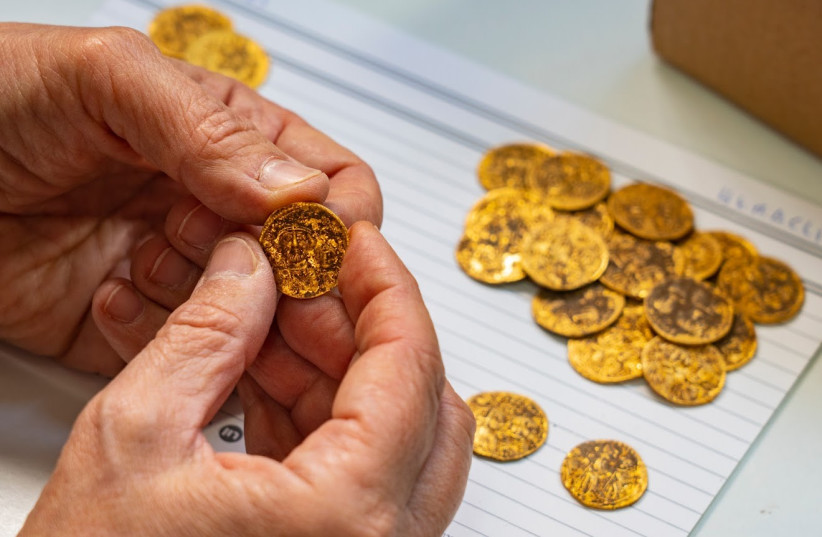
A cache of 44 solid gold coins from the Byzantine-era was discovered in Banias Nature Reserve, October 3, 2022 / (photo credit: DAFNA GAZIT/ISRAEL ANTIQUITIES AUTHORITY)

A cache of 44 pure gold coins from the Byzantine era was recently discovered during an archeological excavation at the Banius site within the Hermon River Nature Reserve, the Israel Antiquities Authority (IAA) announced on Monday morning.

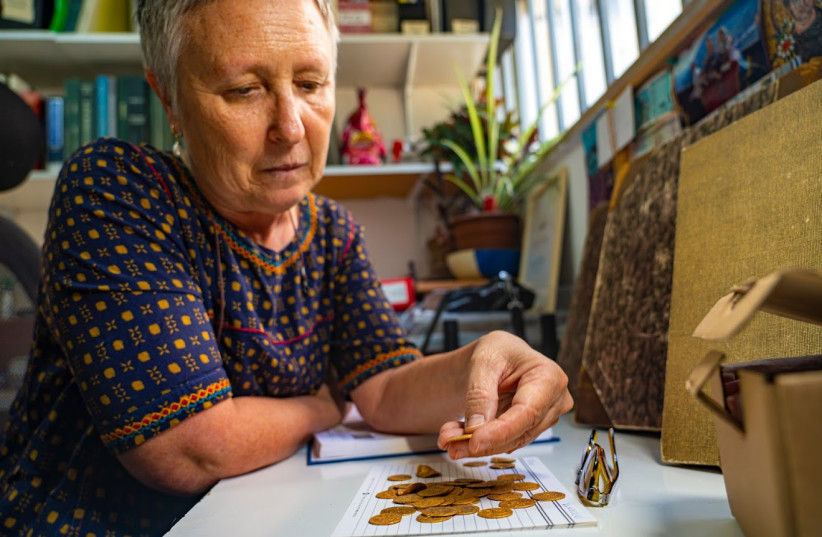
Upon the discovery of the coins, they were passed on to IAA numismatic expert Dr. Gabriela Bijovsky for examination. Bijovsky was able to identify several coins minted during the reign of Emperor Phocas (602–610 AD), as well as others minted during the reign of Emperor Heraclius between 610-641 AD.

The presence of coins minted by Heraclius towards the end of his reign help to place the cache of coins as being from around the time of the Muslim Conquest of the Levantine Byzantine Empire in 635 AD.

“What is particularly interesting is that in [Heraclius’] early years as emperor, only his portrait was depicted on the coin, whereas after a short time, the images of his sons also appear,” explained Bijovsky. “One can actually follow his sons growing up – from childhood until their image appears the same size as their father, who is depicted with a long beard.”

Gabriela Bijovsky examines the coins from Banias. (credit: YANIV BERMAN/ISRAELI ANTIQUITIES AUTHORITY)

A glimpse into days gone by

The collection of coins, weighing around 170g total, was concealed within the base of an ashlar stone wall during the time of the Muslim conquest, according to IAA excavation director Dr. Yoav Lerer. 

The discovery reflects a specific moment in time, when we can imagine the owner concealing his fortune in the threat of war, hoping to return one day to retrieve his property. In retrospect, we know that he was less fortunate,” he continued, painting a picture of the long-gone Byzantine Empire. “The discovery of the coin hoard may also shed light on the economy of the city of Banias during the last 40 years of Byzantine rule.”

Finding the coins in the Banias National Park

The excavations, funded by the Israel Electric Corporation, were carried out prior to connecting the adjacent Druze holy site Maqam Nabi Khadr to the national electricity grid. They took place in the northwestern residential quarter of the ancient city of Banias, and uncovered the remains of buildings, water channels and pipes, a pottery kiln, bronze coins, and fragments of many pottery, glass, and metal artifacts, as well as the solid gold coins.

The artifacts uncovered date back to the end of the Byzantine period in the early seventh century and all the way to the early Middle Ages (11th-13th century).

Gold coin depicting Emperor Heraclius (credit: DAFNA GAZIT/ISRAEL ANTIQUITIES AUTHORITY)

“The coin hoard is an extremely significant archaeological find as it dates to an important transitional period in the history of the city of Banias and the entire region of the Levant,” said IAA Director Eli Escusido. “The Israel Antiquities Authority, together with the National Parks Authority, will work together to exhibit the treasure to the public.”

The history of Banias

Banias was first settled during the Hellenistic period as a worship site for the god Pan in the third century BCE. The Greek name for the site, Paneas, was taken from the name of the god worshipped there.  The settlement reached its peak in the Early Roman period, when Herod the Great, and his son Philip II, entirely rebuilt the city and named it Caesarea Philippi, in honor of the Roman emperor Augustus.

According to Christian lore, Banias is the place where Peter the Apostle proclaimed Jesus to be the Christ, and where Jesus gave Peter the keys to the kingdom of heaven, and during the Byzantine era, a church was built next to the spring.

During the time of the Crusaders, they undertook the fortification of the city, turning it into a military base from which to attack and conquer Damascus. However, this was a short lived fortification, as the city was conquered by Muslim forces in 1132 AD.

“The Banias Nature Reserve, endowed with its unique nature and landscape, does not cease to surprise us from a historical-cultural point of view,” said Nature and Parks Authority Director Raya Shurky of the discovery. “The gold coin hoard is on a par with the Byzantine Church, possibly the Church of St. Peter, that was recently discovered. 

“The finds include the remains of a mosaic floor and a stone engraved with many crosses, indicating that Banias became a Christian pilgrim site. The church, that was damaged in an earthquake that struck the north of the country, will soon be exhibited to the public visiting the nature reserve.”


Zawartość publikowanych artykułów i materiałów nie reprezentuje poglądów ani opinii Reunion’68,
ani też webmastera Blogu Reunion’68, chyba ze jest to wyraźnie zaznaczone.
Twoje uwagi, linki, własne artykuły lub wiadomości prześlij na adres:
webmaster@reunion68.com


A New Year’s Resolution for Stopping Anti-Israel News

A New Year’s Resolution for Stopping Anti-Israel News

Benjamin Amram


A general view shows the plaza of the Western Wall in Jerusalem, amid the coronavirus pandemic, May 6, 2020. Photo: Reuters / Ronen Zvulun.

The Ten Days of Repentance — which culminate in Yom Kippur — is a time for reflection and introspection. How we can improve as individuals and as a community?

It seems like the media have their work cut out for them.

According to the 2022 Reuters Institute Digital News report, trust in news agencies has reached a seven-year low among Americans, steadily declining since 2017. Currently, it stands at only 26%. Another study published by The Washington Post found that, among US adults surveyed, only 16 and 11 percent have “a great deal” or “quite a lot” of confidence in newspapers and TV news, respectively.

The then-UN High Commissioner for Human Rights, Michelle Bachelet, illuminated the challenges facing the media in a speech at the Human Rights Council some three months ago:

We need to look at how best to contain the harms caused by disinformation, while addressing the underlying causes that give disinformation life and allow it to gain traction.

For its part, the prestigious Pew Research Center recently stated that the major causes of declining trust in the media are the shift to digital ad revenue, polarized news sources among Democrats and Republicans, and misinformation.

Interestingly, while readers distrust news sources, they do trust organizations that align with their own opinions. As Olivier Knox from The Washington Post claimed: “It seems people loathe Congress but are fine with their own representative. It seems plausible that people trust where they get their news, but not where people they disagree with get theirs.”

These biases, which affect journalists as well as their audiences, can possibly be attributed to certain psychological shortcuts. Readers are more likely to read and remember information congruent with previously held beliefs, the National Institutes of Health (NIH) argues.

The NIH highlighted two biases that seemingly contribute to the deteriorating trust: confirmation bias and selective exposure bias:

Confirmation bias: “Individuals may… actively seek out and assign more weight or validity to information that supports their current attitude.”

Selective exposure bias: “Phenomenon whereby people choose to focus on information in their environment that is congruent with and confirms their current attitudes in order to avoid or reduce cognitive dissonance.”

For readers, this translates to reading and remembering information they knew before — while disbelieving people who hold counter information from opposing viewpoints.

The selective exposure bias furthermore affects the ability of journalists to report impartially. Subconsciously, the brain compares previous memories and knowledge with incoming information. This would mean that — either deliberately or mistakenly — reporters struggle to be perfectly impartial. HonestReporting has this year highlighted many journalists who have purposely skewed facts and neglected crucial context, including at the BBC, The New York TimesAl Jazeera, and others.

The major challenge is the speed at which misinformation can spread. An MIT study of Twitter data found that fake news spreads six times quicker than factual news. A possible explanation is that false news is “novel” and shocking, causing stronger emotional reactions.

Soroush Vosoughi, a postdoc student and member of the research team at MIT, suggested that the “misinformation challenge” has two angles: people who deliberately spread fake news and people who unknowingly spread it. Political information was the largest cluster of misinformation among the 126,000 samples of false news published on Twitter.

All in all, this can contribute to polarization and a lack of trust in the media.

Steven Pinker, a Harvard psychology professor, mentions that misinformation is also caused by “human negative biases.” This refers to the brain’s tendency to perceive threats over positive information, which causes journalists to over-report shocking and tragic events while under-reporting positive events.

As the professor explains:

Bad things are sudden and newsworthy (a shooting rampage, a war, an epidemic), while good things are gradual and boring (a crime decline, a spreading peace, a longevity rise). The culture of journalists amplifies the negativity by dismissing positive developments as human-interest fluff, corporate PR or government propaganda.

To prevent the spread of fake news and counter negative biases, he suggests journalists should give context to negative information by providing the long-term trends related to current incidents, as these trends tend to show improvement rather than things getting worse.

By not posting fake news on social media, readers can contribute to the improvement of ethical journalism, which should uphold values of impartiality, truth, and transparency.

Yet attempting to regain the public’s trust in the media requires that journalists make a serious effort to put an end to misinformation and biased reporting.

First of all, news agencies bear a responsibility to hire only qualified journalists who do not have a history of antisemitism, anti-Israel bias, or connections to controversial pro-Palestinian groups. It is important to check the credentials, past stories, and resources used by reporters to validate their ability to report impartially.

To stop the spread of misinformation and biased reporting, journalists could moreover use the American Press Institute guidelines:

  • Periodically examine yourself for bias building up — understanding what your views are and why you have them is the best way to keep them under control.
  • Who do you personally like or dislike? Why?
  • How might that be coloring your judgment?
  • Read through some of your stories and be self-critical.
  • Do any of them help you tell the story?
  • Are there any you believe you should not deal with?
  • Is there anything you should do in presenting any of these biases that will help the reader understand them?
  • What bias do I have going in that I should be wary of?
  • What are my points of ignorance going in that I need to note?

The spread of misinformation begins with reporters, but is exacerbated by the public, in particular by social media users. The public can contribute to the media’s improvement by following the steps listed by Simon Fraser University

The most important steps are to thoroughly check the source, read beyond the headlines (do not share an article without reading the contents), investigate the authors, and check the resources they used.

Rosh Hashanah and the days leading up to Yom Kippur are a time to reflect on the past year. What mistakes have we made? Where can we improve? How do we move toward a better version of ourselves? Journalists and readers each play an important role in the spread of misinformation and biased reporting.

Awareness is the first step towards reinstating the values of ethical journalism that could eventually enable the public to trust the media more. News media outlets, journalists, and consumers each have to do their part.

Together, we can move toward a successful year.


The author is a contributor to HonestReporting, a Jerusalem-based media watchdog with a focus on antisemitism and anti-Israel bias — where a version of this article first appeared.

Zawartość publikowanych artykułów i materiałów nie reprezentuje poglądów ani opinii Reunion’68,
ani też webmastera Blogu Reunion’68, chyba ze jest to wyraźnie zaznaczone.
Twoje uwagi, linki, własne artykuły lub wiadomości prześlij na adres:
webmaster@reunion68.com