Katz: ‘Gaza is burning’ as IDF expands operation in Gaza City


.

Katz: ‘Gaza is burning’ as IDF expands operation in Gaza City

update desk 


“The IDF strikes with an iron fist at the terror infrastructure,” said the Israeli defense minister.

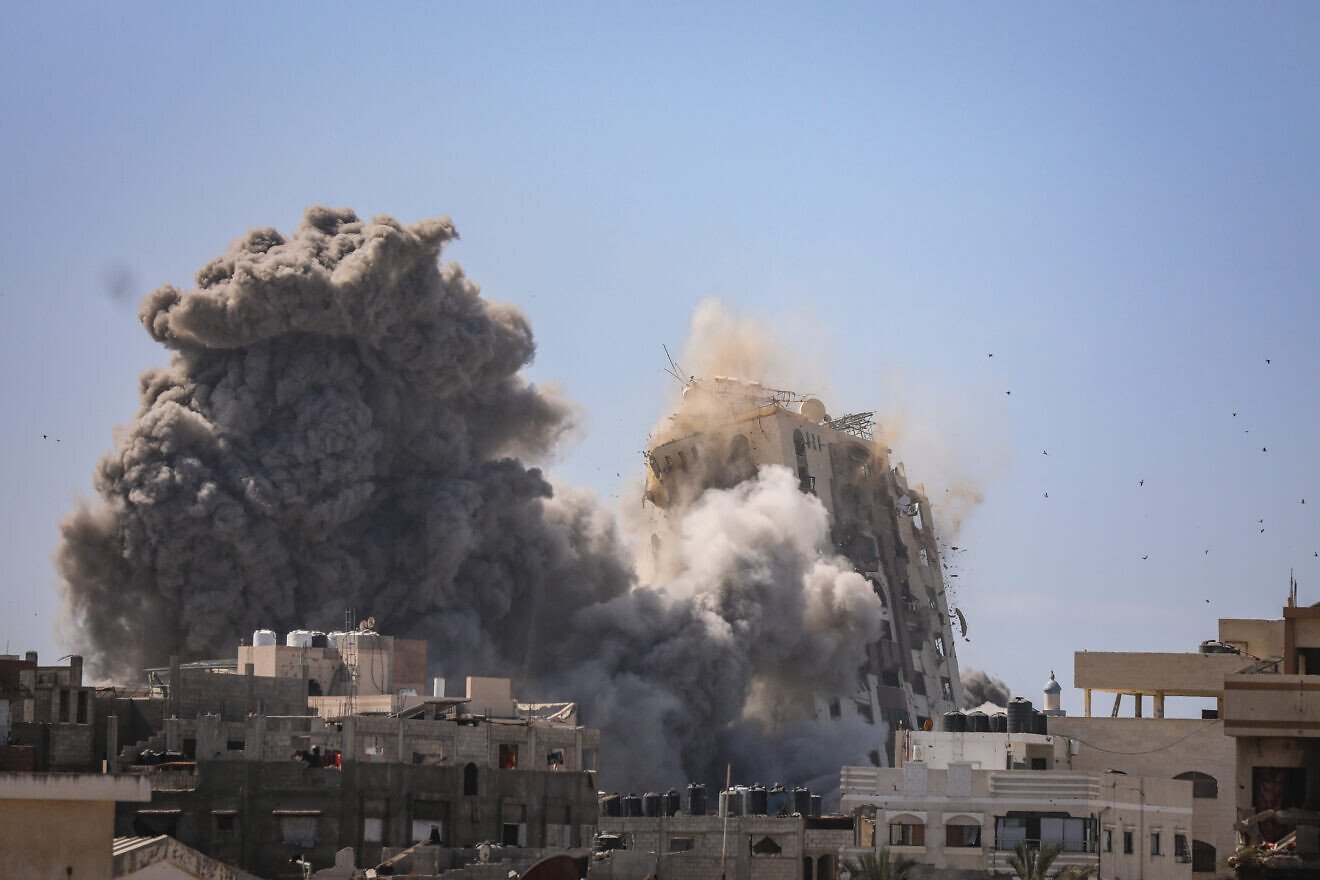
Smoke rises from the Hamas-controlled Al-Ghafri Tower in Gaza City after it was hit by an Israeli airstrike, Sept. 15, 2025. Photo by Omar Mohammed/Flash90.

Defense Minister Israel Katz said on Tuesday that “Gaza is burning” as the Israel Defense Forces confirmed that it had started broader operations to destroy Hamas terror infrastructure in Gaza City.

Jerusalem “will not relent and we will not turn back until the mission is complete,” the defense minister declared.

“Gaza is burning,” Katz said. “The IDF strikes with an iron fist at the terror infrastructure, and IDF soldiers fight with courage to create the conditions for the release of the hostages and the defeat of Hamas.”

Col. Avichay Adraee, the head of the Arab media division of the IDF Spokesperson’s Unit, subsequently confirmed on X that the army “began destroying Hamas’s infrastructure in Gaza City.”

“Gaza City is considered a dangerous combat zone, and staying in the area puts you at risk,” Adraee added, urging Palestinians to join “the more than 40% of the city’s residents” who have already evacuated.

U.S. Secretary of State Marco Rubio, speaking as he departed Israel for Doha on Tuesday morning, also suggested that the IDF offensive to capture Gaza City had already started.

“The Israelis have begun to take operations there,” Rubio stated. “So we think we have a very short window of time in which a deal can happen.

“We don’t have months anymore, and we probably have days and maybe a few weeks to go,” Washington’s top diplomat continued.

“Our preference, our No. 1 choice, is that this ends through a negotiated settlement,” he added. “At some point, this has to end. At some point, Hamas has to be defanged, and we hope it can happen through a negotiation. But I think time, unfortunately, is running out.”

Israeli Prime Minister Benjamin Netanyahu weighed in later on Tuesday, saying the military had launched an ” intense operation” in Gaza.

Israel “is at a critical stage in this struggle and there are consequences,” Netanyahu said, according to a statement from his spokesman.

On Monday night, the IDF said it had eliminated 21 senior operatives of the Iranian-controlled Palestinian Islamic Jihad terror organization, which participated in the Oct. 7, 2023 massacre alongside Hamas.

The operation—led by the IDF’s Southern Command in coordination with its Military Intelligence Directorate, the Israeli Air Force and the Israel Security Agency (Shin Bet)—targeted commanders, weapons experts and field operatives.

Among those killed were key terrorists responsible for arms production, artillery, sniper and sector command positions, including Mohammad Radwan Ramadan Mushtaha, the head of military armament in Gaza’s north, and Amir al-Shaam Faiz Wadi, commander of the terror group’s sniper array in the Khan Younis Brigade, the IDF stated on Monday.

Other high-ranking commanders killed include Jamal Mahmoud Salem Ma’amar, who oversaw artillery operations in Rafah, as well as Fazel Zakariya Ahmad Abu al-Ata, a Gaza Brigade sector commander.

The IDF also eliminated five operatives with specialized knowledge of arms production, including Mansour Mahmoud Mohammad Salah and Ahmad Ziyad Qasem Qadi, as well as several field operatives who had executed direct attacks against Israeli forces. Ihab Bassam Yousef Abu al-Kheir, head of PIJ’s sniper squads, was among those killed.

“The IDF and the ISA will continue to act decisively against all terrorist organizations in the Gaza Strip,” the IDF said.

According to Israel’s Channel 12 News, the military hit dozens of targets in Gaza City on Monday night, in a wave of aerial attacks described as “intense and significant.”

Residents in central Israel reported hearing the echoes of the intense explosions.

Israeli Foreign Minister Gideon Sa’ar stressed last week that Jerusalem was still seeking to end the war based on U.S. President Donald Trump’s latest truce proposal and according to the principles set by Israel’s Cabinet.

Netanyahu on Aug. 14 outlined the Cabinet’s objectives as the disarmament of Hamas, the return of all 48 remaining hostages, the demilitarization of the Gaza Strip, Israeli security control and establishing an alternative civilian administration in the enclave.

Netanyahu on Monday evening expressed appreciation for the Trump administration’s “unflinching support for Israel’s battle against Hamas and the release of all our hostages.”

The prime minister was responding to Trump stating that he just read a news report that “Hamas has moved the hostages above ground to use them as human shields against Israel’s ground offensive” in Gaza City.

“I hope the leaders of Hamas know what they’re getting into if they do such a thing,” he had written on his Truth Social platform. “This is a human atrocity, the likes of which few people have ever seen before. Don’t let this happen or all bets are off. Release all hostages now.”

Forty-eight hostages remain in terror captivity in the Strip, 711 days after the Hamas-led Oct. 7 cross-border attack. According to Israeli estimates, up to 20 are believed to be alive.


Zawartość publikowanych artykułów i materiałów nie reprezentuje poglądów ani opinii Reunion’68,
ani też webmastera Blogu Reunion’68, chyba ze jest to wyraźnie zaznaczone.
Twoje uwagi, linki, własne artykuły lub wiadomości prześlij na adres:
webmaster@reunion68.com


Abraham Accords Tested on 5th Anniversary as Arab Leaders Gather to Condemn Israel’s Strike on Hamas in Qatar


Abraham Accords Tested on 5th Anniversary as Arab Leaders Gather to Condemn Israel’s Strike on Hamas in Qatar

Debbie Weiss


Qatar’s Prime Minister and Minister for Foreign Affairs Sheikh Mohammed bin Abdulrahman bin Jassim Al-Thani, attends the preparatory ministerial meeting for emergency Arab-Islamic summit in Doha, Qatar, Sept. 14, 2025. Photo: Qatar Ministry of Foreign Affairs/Handout via REUTERS

The fifth anniversary of the Abraham Accords was overshadowed on Monday as top Arab diplomats gathered in Doha for an emergency summit after Israel’s strike on Hamas leaders in Qatar last week.

Five years on, experts say that, despite war and political shocks, the US-brokered deals that normalized relations between Israel and several Araba countries have endured, though not without setbacks, and many argue that strengthening them is the most effective way to defeating the hatred and terrorism that led to Hamas’s Oct. 7, 2023, massacre across southern Israel.

Trade between Abraham Accord countries in 2025 increased from the year before, though it remained well below the levels seen before the Hamas-led attack. The UAE, Israel’s most significant new trading partner, has dominated the commerce generated by the accords, signed on the lawn of the White House on Sept. 15, 2020.

Hundreds of Israeli companies now operate in the UAE, with Emirati investors channeling capital into Israeli tech startups and sovereign funds taking stakes in gas and technology ventures, though a planned $2 billion acquisition was shelved after the outbreak of the Gaza war. Recent figures show trade between Israel and the UAE reached $293 million in July 2025, a 4 percent rise from the year before, while trade with Morocco grew 32 percent in the same month to $8.7 million, according to data published by the Washington DC-based Heritage Foundation. Over the first seven months of 2025, Israel–Morocco trade totaled $71 million, a 7 percent increase from the same period in 2024, the report said.

Israel’s Prime Minister Benjamin Netanyahu, then-US President Donald Trump, and United Arab Emirates (UAE) Foreign Minister Abdullah bin Zayed display their copies of signed agreements as they participate in the signing ceremony of the Abraham Accords, normalizing relations between Israel and some of its Middle East neighbors, in a strategic realignment of Middle Eastern countries against Iran, on the South Lawn of the White House in Washington, US, Sept. 15, 2020. Photo: REUTERS/Tom Brenner

Asher Fredman, a visiting fellow at the Heritage Foundation who also served as Israel director of the Abraham Accords Peace Institute — a nonprofit founded by former White House adviser and US President Donald Trump’s son-in-law Jared Kushner to promote and expand the accords — said the agreements had “proven their resilience.”

He noted that the war had exposed how Hamas, with its ties to the Muslim Brotherhood, continues to threaten the region’s stability.

“Many regional leaders appreciate Israel’s efforts to remove Hamas, a terrorist group affiliated with the Muslim Brotherhood, from power, even if they are critical of Israel’s tactics,” he told The Algemeiner.

But he went on to say that the war had resulted in diminishing many aspects of the “warm peace and people-to-people cooperation that made the accords so unique” and that restarting momentum will require “regional projects with tangible benefits,” with strong US backing, and ensuring Hamas can no longer undermine progress toward peace.

“Lasting regional integration will depend on removing Hamas as the dominant military and governing power in Gaza,” he said.

Defense trade has also expanded, with Abraham Accords countries accounting for 12 percent of Israel’s $15 billion in arms exports last year, and major defense projects, including the UAE’s co-production of Israeli drones, continuing in 2025 – though many are now under wraps.

Middle East experts Elie Podeh and Yoel Guzansky, from the Hebrew University and Tel Aviv University, respectively, noted in The Jerusalem Post that Washington’s 2021 decision to place Israel within US Central Command signaled Arab states’ readiness to work with Israel openly, not just behind closed doors. Israel had already taken part in joint drills with regional neighbors, but its integration into CENTCOM created what they described as a qualitative shift in collaboration — a shift that was evident during Iranian attacks on Israel in April and October 2024 and again in June 2025.

But the UAE’s decision to bar Israeli defense firms from a major global defense and aerospace expo in Dubai later this year – reportedly in response to Israel’s strike in Doha – highlighted the political strains now testing the accords.

Podeh and Guzansky agreed with Fredman that people-to-people ties have suffered during the war but emphasized the particular impact on younger Arabs. “The gap between elite positions and Arab public opinion – especially among younger generations – continues to widen across all countries, placing pressure on ruling elites to respond,” they said.

Earlier this month, the UAE also issued a rare public rebuke to Israel over reports of renewed annexation ambitions in the West Bank. A senior Emirati official, Lana Nusseibeh, warned that any Israeli move to apply sovereignty would constitute a “red line” for Abu Dhabi that “would severely undermine the vision and spirit of the Abraham Accords” – marking the Gulf country’s toughest criticism of Israel since the war began.

On Friday, the UAE said it had summoned Israel’s deputy ambassador over the strike on Hamas leaders in Qatar and Prime Minister Benjamin Netanyahu’s subsequent “hostile and unacceptable” remarks, in another sign of strain between the two countries with close economic and defense ties. The Emirati foreign ministry said it told David Ohad Horsandi that “the continuation of such hostile and provocative rhetoric … solidifies a situation that is unacceptable and cannot be overlooked.”

Speaking from the emergency summit three days later, Egypt’s President Abdel-Fattah al-Sisi addressed Israel, saying that its decision to strike in Doha harms “the future of peace, threatens your security and the security of the peoples in the region, and adds obstacles to chances for any new peace agreements and even aborts existing ones.”
A draft resolution from the Arab-Islamic summit in Doha, a day before Monday’s emergency summit, warned that Israel’s “brutal” strike in Qatar and other actions “threaten prospects of peace and coexistence in the region, and threaten everything that has been achieved on the path of normalizing ties with Israel, including current agreements and future ones.”

The text accused Israel of “genocide, ethnic cleansing, starvation, siege, and colonizing activities and expansion policies,” and said such conduct jeopardized efforts to expand normalization with Arab nations.

Saudi Crown Prince Mohammed bin Salman with Emir Of Qatar Sheikh Tamim bin Hamad Al Thani and GCC representatives pose for a group photo ahead of an emergency Arab-Islamic leaders’ summit convened to discuss the Sept. 9 Israeli attack on Hamas on Qatari territory, in Doha, Qatar, Sept. 15, 2025. Photo: Saudi Press Agency/Handout via REUTERS

Podeh and Guzansky noted that Saudi Arabia, once seen as the most likely next signatory to the Abraham Accords, is “treading very carefully” since the outbreak of the Gaza war. As the guardian of Islam’s holiest sites and a leading voice in the Sunni world, Riyadh is reluctant to proceed without “significant progress on the Palestinian issue” or firm American commitments on security and civilian nuclear cooperation.

Fleur Hassan-Nahoum, Israel’s special envoy for trade and innovation and co-founder of the UAE-Israel Business Council, struck a more positive note, saying that the Abraham Accords have been “game changing for Israel and the Middle East,” and stressing that even after an extensive regional war they have “stood strong.” She noted that the signatory states have consistently condemned Hamas, blocked boycott efforts against Israel at the Arab League, and made no overtures toward unilateral recognition of a Palestinian state, unlike Canada, the UK, France and Australia.

“Even with the current tensions, it is the Abraham Accords countries who are clearly calling for the end of Hamas, as European countries remain silent,” Hassan-Nahoum told The Algemeiner.

“I am extremely optimistic about the long-term viability and even expansion of the Abraham Accords in the next ten years,” she concluded.


Zawartość publikowanych artykułów i materiałów nie reprezentuje poglądów ani opinii Reunion’68,
ani też webmastera Blogu Reunion’68, chyba ze jest to wyraźnie zaznaczone.
Twoje uwagi, linki, własne artykuły lub wiadomości prześlij na adres:
webmaster@reunion68.com


Nowa wystawa w Auschwitz, sztuka kobiet w Warszawie, tkanina w Łodzi – oferta na jesień i zimę

Wystawę „Na fali czasu” będzie można ogladać w Muzeum Miasta Gdyni od 22 września 2025 r. do 6 stycznia 2026 r. Fot. muzeumgdynia.pl


Nowa wystawa w Auschwitz, sztuka kobiet w Warszawie, tkanina w Łodzi – oferta na jesień i zimę

zzp/ pdo/ rpo/ bap/ szf/ ren/ pm/ mis/


Muzea w całej Polsce zapraszają na wystawy sezonu jesienno-zimowego. To okazja, aby obejrzeć m.in. sztukę japońską z MN w Szczecinie, przegląd kobiecej sztuki w stołecznym MSN, instalacje z tkanin na Międzynarodowym Triennale Tkaniny w Łodzi i nową wystawę główną w Muzeum Auschwitz w Oświęcimiu.

3 października w Muzeum Sztuki Nowoczesnej w Warszawie zostanie otwarte Kijowskie Biennale, projekt łączący wojnę w Ukrainie z innymi konfliktami w regionie Europy i na Bliskim Wschodzie. Wystawa pt. „Bliski Wschód, daleki Zachód” przedstawiać będzie zarówno prace artystów ukraińskich, jak i m.in. palestyńskich. Opowiada o tym, jak współczesne konflikty i okupacje splatają się z historiami przemocy kolonialnej i ludobójstw. Kuratorzy podważają tradycyjny podział na Wschód i Zachód, wskazując, że przyszłość Europy kształtuje się dziś na jej wschodnich rubieżach. Artyści proponują alternatywne spojrzenie – odrzucają dominację zachodnich narracji i otwierają nowe perspektywy dla Europy. Publiczność zobaczy m.in. instalację ukraińskiego artysty Nikity Kadana bazującą na przykładach prac awangardowych powstałych w Ukrainie.

To niejedyny nowy pokaz przygotowany na jesień przez MSN. 21 listopada rozpocznie się tam duża wystawa historyczna „Kwestia kobieca. 1550–2025”; będzie to przegląd rozwoju ikonografii sztuki kobiet od XVI w. do dzisiaj. Będą mu towarzyszyły cztery mniejsze projekty wystawiennicze prezentujące różne perspektywy wystawiania sztuki feministycznej.

Jeszcze do 21 grudnia w Muzeum Warszawy można się zapoznać z wystawą „Lato, które zmieniło wszystko. Festiwal 1955”. Jej twórcy przedstawiają przygotowania i przebieg festiwalu na tle społecznym, politycznym i kulturowym. Pojawiają się tu takie wątki, jak odwilż polityczna, dekolonizacja Afryki i Azji, koniec doktryny socrealizmu w sztuce, odbudowa Warszawy i znaczenie przestrzeni publicznej stolicy. Na wystawie można oglądać materiały archiwalne, pamiątki, fotografie, socrealistyczne rzeźby i malarstwo, a także współczesne dzieła sztuki.

Muzea Narodowe

Muzeum Narodowe w Warszawie otwiera jesienny sezon wystawą „Czarny karnawał. Ensor/Wojtkiewicz”. Ekspozycja powstała we współpracy Polski i Belgii koncentruje się na prekursorach ekspresjonizmu. James Ensor i Witold Wojtkiewicz tworzyli na przełomie XIX i XX w., w swoich pracach poruszali problematykę maskarady, teatru, cyrku, sennych marzeń, erotyki i śmierci. Wyróżnia ich skłonność do fantazji, ironii i groteski, zakorzeniona w modernistycznych kręgach Młodej Belgii i Młodej Polski. Publiczność będzie miała okazję zapoznać się również z obrazami, rysunkami i grafikami innych polskich i belgijskich twórców współczesnych głównym bohaterom ekspozycji.

We Wrocławiu jesienny sezon wystawienniczy w Muzeum Narodowym otworzy ekspozycja pt. „Waldemar Cwenarski. Czułość. Powroty i poszukiwania”, którą od 28 września będzie można zobaczyć w Pawilonie Czterech Kopuł. To wystawa poświęcona legendarnemu malarzowi i rysownikowi Waldemarowi Cwenarskiemu zorganizowana z okazji 100. rocznicy jego urodzin i 70. rocznicy otwarcia Ogólnopolskiej Wystawy Młodej Plastyki „Przeciw wojnie, przeciw faszyzmowi” w warszawskim Arsenale.

Od 1 października po raz kolejny będzie można zobaczyć w gmachu głównym Muzeum Narodowego we Wrocławiu Skarb Średzki. Ten jeden z najcenniejszych skarbów odnalezionych w Europie w XX w. – kolekcja średniowiecznych monet i klejnotów, które należały do monarchów czeskich – będzie prezentowany do końca roku. 9 grudnia otwarta zostanie tam też ekspozycja pt. „Mikroświaty. Obrazy w małych formatach”. Na wystawie będzie można zobaczyć dzieła nieprzekraczające wymiarów 40 na 40 cm takich malarzy, jak Artur Grottger, Jan Matejko, Aleksander Gierymski, Bolesław Biegas, Eugeniusz Geppert, Henryk Stażewski, Stanisław Dębicki, Stanisław Janowski czy Maria Dulębianka.

Z kolei w Muzeum Etnograficznym we Wrocławiu od 25 października prezentowana będzie indywidualna wystawa rzeźbiarza samouka Jana Giejsona. W grudniu natomiast tradycyjne zwiedzający obejrzą tam wystawę szopek bożonarodzeniowych.

W Szczecinie

W Szczecinie od 2 września w Muzeum Narodowym – Centrum Dialogu Przełomy zostanie pokazana m.in. wystawa „ZŁO/EVIL” Lexa Drewinskiego. To 46 plakatów o charakterze antytotalitarnym nawiązujących do istoty i efektów działania totalitaryzmów w XX i XXI w. Wystawie towarzyszy instalacja tego samego artysty pt. „Aleja hańby” stworzona na wzór hollywoodzkiej Alei Gwiazd, która przypomina nazwiska największych zbrodniarzy XX i XXI w.

Jeszcze do 31 października w głównym gmachu MN w Szczecinie można oglądać wystawę „Traumy wojny”. Zorganizowana w 80. rocznicę zakończenia II wojny światowej, nawiązuje do doświadczenia wojny jako jednego z najbardziej traumatyzujących przeżyć egzystencjalnych. Zestawienie obiektów z epoki – militariów, przedmiotów życia codziennego, dokumentów i archiwaliów – ze współczesnymi dziełami sztuki ma inspirować do refleksji nad tym, czy i jakie odczucia wywołuje dziś II wojna, a także jak związane z nią zjawiska są przetwarzane przez współczesnych artystów, aktualną wrażliwość, estetykę i środki wyrazu.

Do 19 kwietnia 2026 roku w Muzeum Narodowym przy Wałach Chrobrego w Szczecinie publiczność ma okazję zobaczyć japońską sztukę na wystawie „Japonia w miniaturze. Kościane netsuke i okimono. Kolekcja Danuty Pawłowskiej-Seydy i Marka Seydy w zbiorach MNS”. Muzeum prezentuje kolekcję azjatyckich figurek wykonanych z kości zwierzęcych, którą w 2022 r. małżeństwo przekazało w darze muzeum. Są tam m.in. rzeźby netsuke, okimono i inro. Każdy z eksponowanych przedmiotów ma inną historię, pełni inne funkcje i pokazuje fragment historii Japonii, pozwala poznać kulturę tego kraju, wierzenia i życie codzienne.

W Łodzi

W poznańskim Muzeum Narodowym natomiast do 18 stycznia 2026 r. prezentowana jest wystawa „Ukryte znaczenia. Motyw wnętrz w sztuce polskiej od XIX do XXI wieku”, na którą składa się ponad 130 obrazów. Widzowie mogą się poruszać w otoczeniu najpiękniejszych salonów, gabinetów, buduarów, jadalni czy dziecięcych pokoi stworzonych na przestrzeni różnych epok – od biedermeieru i realizmu do współczesności. Na ekspozycję składają się dzieła Aleksandra Gierymskiego, Józefa Mehoffera, Konrada Krzyżanowskiego, Wojciecha Weissa, Tytusa Czyżewskiego, Józefa Czapskiego, Jerzego Nowosielskiego, Jarosława Modzelewskiego i Wilhelma Sasnala.

Otwarcie wielu nowych wystaw w najbliższych miesiącach zaplanowały też łódzkie placówki. W Muzeum Miasta Łodzi od 3 października będzie można oglądać ekspozycję „Karski – Margolis – Edelman”. Tych troje wybitnych łodzian walczyło o godność i prawa człowieka w czasie największej próby, jaką była II wojna światowa i zagłada Żydów. Z kolei wystawa „Łodzianki inicjatorki” w połowie listopada będzie kluczowym punktem obchodów Roku Łodzianek Inicjatorek. Jej bohaterkami będą kobiety, które kształtowały oblicze Łodzi, m.in. Katarzyna Kobro, Michalina Wisłocka, Irena Tuwim czy Zofia Hertz. Zaprezentowane zostaną biografie i twórcze dokonania ponad stu kobiet.

Muzeum Sztuki w Łodzi zaplanowało wystawę o relacjach polsko-wietnamskich i obecności kultury Wietnamu w świadomości ludzi Zachodu -„Nguyen Quoc Thanha i Nha San Collective” (od 3 października) i wystawę ukazującą twórczość Jerzego Trelińskiego, artysty i pedagoga związanego z Akademią Sztuk Pięknych w Łodzi – „Jerzy Treliński – wystawa indywidualna” (od 21 listopada). Powróci tu również wystawa stałej kolekcji sztuki XX i XXI w. „Sposoby widzenia” (od 17 października).

Muzeum Włókiennictwa w Łodzi przygotowuje się do 18. Międzynarodowego Triennale Tkaniny – największego i najstarszego na świecie wydarzenia poświęconego sztuce tkaniny współczesnej. Tegoroczna edycja (od 11 października) będzie miała szczególny wymiar, ponieważ Triennale obchodzi 50-lecie. Głównym punktem będzie wystawa „Dekonstrukcja/Rekonstrukcja” i towarzysząca jej ekspozycja „Portale rizomatyczne: drogi poznania” oraz instalacja artystyczna „Tkająca inteligencja”. Zaplanowano też spotkania z artystami, debaty, warsztaty i projekty edukacyjne.

Jesienią dużo będzie się działo także w EC1 Łódź-Miasto Kultury. W planach różnych instytucji działających w tym kompleksie są filmowe premiery i festiwale, widowiska naukowe, wydarzenia edukacyjne oraz nowe wystawy komiksowe i artystyczne. W ramach 36. edycji Międzynarodowego Festiwalu Komiksu i Gier w Centrum Komiksu i Narracji Interaktywnej otwarta zostanie monograficzna wystawa „TRUST the Process” łódzkiego ilustratora, grafika i jednego z najważniejszych twórców współczesnego polskiego komiksu Przemysława Truścińskiego.

Na Śląsku

Do odwiedzin zapraszają także śląskie instytucje. Na początku września Muzeum Śląskie w Katowicach ponownie udostępniło zwiedzającym Galerię Polskiej Sztuki Nowoczesnej 1800-1945 oraz wystawę „Poza Edenem. Sztuka współczesna ze zbiorów Muzeum Śląskiego w Katowicach”. Do 25 stycznia 2026 r. otwarta jest wystawa „Etnoalternatywa. Nowe spojrzenie na modę ludową”, na której zaprezentowano m.in. współczesne aranżacje tradycyjnych strojów ludowych z Górnego Śląska.

Muzeum Górnośląskie w Bytomiu zapowiedziało otwarcie wystawy „Od dinozaurów do człowieka. Historia życia na Ziemi” 19 września, a 17 października „Co cię nie zabije, to cię wzmocni. Dawna medycyna ludowa”. Obie zostaną zaprezentowane w tzw. zameczku przy ul. Wojciecha Korfantego.

W Malopolsce

Ważnym wydarzeniem będzie otwarta najpóźniej w grudniu pierwsza z trzech części nowej wystawy głównej w Muzeum Auschwitz. Przybliży los około 400 tys. więźniów niemieckiego obozu. Osią narracji jest polityka dehumanizacji realizowana przez załogę SS. Na ekspozycji będzie można zobaczyć m.in. rysunki i obrazy potajemnie tworzone przez więźniów w obozie, dokumenty zawierające ich dane oraz fotografie wykonane podczas rejestracji. Docelowo ta część będzie kończyła całą ekspozycję główną. W kolejnych latach otwarte zostaną pozostałe dwie części: w 2027 r. poświęcona Zagładzie oraz w 2030 r. opisująca obóz jako instytucję.

W Krakowie zaś Muzeum Narodowe na wystawie „Lwowianki” prezentuje 15 biografii artystek, których życie i twórczość splotły się z nowoczesną historią Lwowa – wojną, Zagładą, masowymi przesiedleniami i rozpadem granic państwowych. Ekspozycja skupia ponad 20 prac nieznanych dotąd szerokiej publiczności, różnorodnych pod względem treści i technik wykonania. Wśród nich są obrazy olejne, rzeźby, fotografie, a także techniki cyfrowe. Ekspozycję można oglądać do 1 marca 2026 r.

Muzeum Nikifora w Krynicy-Zdroju jeszcze do 23 listopada zaprasza na pokaz „Dwurnik – Drowniak. Inspiracje” – o relacji między twórczością łemkowskiego artysty nieprofesjonalnego Nikifora i jednego z najbardziej rozpoznawalnych współczesnych polskich malarzy Edwarda Dwurnika.

W Lublinie, Toruniu, Bydgoszczy, Trójmieście

W Muzeum Narodowym w Lublinie na koniec listopada planowana jest wystawa pt. „Monachijczycy. Gierymscy, Stryjeńska, Wierusz-Kowalski, Chełmoński i inni” prezentująca dorobek polskich malarzy pobierających naukę w Monachium. Na ekspozycji znajdzie się ponad 250 obrazów 67 artystów, m.in. Teodora Axentowicza, Adama Chmielowskiego, Ludomira Benedyktowicza, Olgi Boznańskiej, Józefa Brandta, Maurycego Gottlieba. Celem ekspozycji jest przedstawienie środowiska monachijskiego malarzy i jego znaczenia dla kształtowania nowych nurtów w sztuce europejskiej II poł. XIX i początku XX w.

Trójmiejskie instytucje także zapraszają publiczność do udziału w przygotowanych na jesień i zimę wydarzeniach. Od 19 września w Muzeum Narodowym w Gdańsku odbędzie się prezentacja twórczości Bruno Paetscha, gdańskiego artysty związanego z modernizmem i ekspresjonizmem. Będzie to trzecia odsłona cyklu „Osiem i pół tygodnia”, który prezentuje grafiki i rysunki z kolekcji muzeum.

Pod koniec września w Muzeum Miasta Gdyni w trakcie 50. Festiwalu Polskich Filmów Fabularnych zostanie zaprezentowana wystawa „Na fali czasu” pokazująca 50 lat historii festiwalu, m.in. niepublikowane dokumenty, pamiątki, zdjęcia czy nagrody.

Do końca roku warto się także wybrać do Centrum Sztuki Współczesnej w Toruniu na wystawę „Bill Viola: Visions of Time / Wizje Czasu” towarzyszącą zaplanowanemu na listopad 33. Międzynarodowemu Festiwalowi Filmowemu EnergaCAMERIMAGE. Ekspozycja została podzielona na dwie części – wczesnych prac artysty prezentowanych w CSW oraz późniejszych, w siedzibie Fundacji Tumult. Viola to jeden z najważniejszych przedstawicieli sztuki nowych mediów XX wieku – jego prace wideo-art oparte są na studiach filozoficznych i analizach dzieł dawnych mistrzów malarstwa.

Natomiast w Galerii Sztuki Nowoczesnej Muzeum Okręgowego w Bydgoszczy od 19 września do 19 listopada odbędzie się 11. edycja Vintage Photo Festivalu. Będzie można tu zobaczyć wystawę „A Dual Gaze” prezentującą – po raz pierwszy w Polsce – wspólny dorobek fotografa Helmuta Newtona i jego żony June Newton (znanej pod pseudonimem Alice Springs). To wizualna podróż przez świat sztuki, mody i kultury XX wieku, a także przez bardziej intymny wymiar życia artystów, dzięki ich portretom i autoportretom. (PAP)


Zawartość publikowanych artykułów i materiałów nie reprezentuje poglądów ani opinii Reunion’68,
ani też webmastera Blogu Reunion’68, chyba ze jest to wyraźnie zaznaczone.
Twoje uwagi, linki, własne artykuły lub wiadomości prześlij na adres:
webmaster@reunion68.com


Israel Intensifies Gaza City Bombing as Rubio Arrives


Israel Intensifies Gaza City Bombing as Rubio Arrives

Reuters and Algemeiner Staff


Displaced Palestinians, fleeing northern Gaza due to an Israeli military operation, move southward after Israeli forces ordered residents of Gaza City to evacuate to the south, in the central Gaza Strip September 14, 2025. Photo: REUTERS/Mahmoud Issa

Israeli forces destroyed at least 30 residential buildings in Gaza City and forced thousands of people from their homes, Palestinian officials said, as US Secretary of State Marco Rubio arrived on Sunday to discuss the future of the conflict.

Israel has said it plans to seize the city, where about a million Palestinians have been sheltering, as part of its declared aim of eliminating the terrorist group Hamas, and has intensified attacks on what it has called Hamas’ last bastion.

The group’s political leadership, which has engaged in on-and-off negotiations on a possible ceasefire and hostage release deal, was targeted by Israel in an airstrike in Doha on Tuesday in an attack that drew widespread condemnation.

Qatar will host an emergency Arab-Islamic summit on Monday to discuss the next moves. Rubio said Washington wanted to talk about how to free the 48 hostages – of whom 20 are believed to be still alive – still held by Hamas in Gaza and rebuild the coastal strip.

“What’s happened, has happened,” he said. “We’re gonna meet with them (the Israeli leadership). We’re gonna talk about what the future holds,” Rubio said before heading to Israel where he will stay until Tuesday.

ABRAHAM ACCORDS AT RISK

He was expected to visit the Western Wall Jewish prayer site in Jerusalem on Sunday with Prime Minister Benjamin Netanyahu and hold talks with him during the visit.

US officials described Tuesday’s strike on the territory of a close US ally as a unilateral escalation that did not serve American or Israeli interests. Rubio and US President Donald Trump both met Qatar’s Prime Minister Mohammed bin Abdulrahman Al-Thani on Friday.

Netanyahu signed an agreement on Thursday to push ahead with a settlement expansion plan that would cut across West Bank land that the Palestinians seek for a state – a move the United Arab Emirates warned would undermine the US-brokered Abraham accords that normalized UAE relations with Israel.

Israel, which blocked all food from entering Gaza for 11 weeks earlier this year, has been allowing more aid into the enclave since late July to prevent further food shortages, though the United Nations says far more is needed.

It says it wants civilians to leave Gaza City before it sends more ground forces in. Tens of thousands of people are estimated to have left but hundreds of thousands remain in the area. Hamas has called on people not to leave.

Israeli army forces have been operating inside at least four eastern suburbs for weeks, turning most of at least three of them into wastelands. It is closing in on the center and the western areas of the territory, where most of the displaced people are taking shelter.

Many are reluctant to leave, saying there is not enough space or safety in the south, where Israel has told them to go to what it has designated as a humanitarian zone.

Some say they cannot afford to leave while others say they were hoping the Arab leaders meeting on Monday in Qatar would pressure Israel to scrap its planned offensive.

“The bombardment intensified everywhere and we took down the tents, more than twenty families, we do not know where to go,” said Musbah Al-Kafarna, displaced in Gaza City.

Israel said it had completed five waves of air strikes on Gaza City over the past week, targeting more than 500 sites, including Hamas reconnaissance and sniper sites, buildings containing tunnel openings and weapons depots.

Local officials, who do not distinguish between militant and civilian casualties, say at least 40 people were killed by Israeli fire across the enclave, a least 28 in Gaza City alone.


Zawartość publikowanych artykułów i materiałów nie reprezentuje poglądów ani opinii Reunion’68,
ani też webmastera Blogu Reunion’68, chyba ze jest to wyraźnie zaznaczone.
Twoje uwagi, linki, własne artykuły lub wiadomości prześlij na adres:
webmaster@reunion68.com


Noa Cochva: From beauty queen to pro-Israel influencer


Noa Cochva: From beauty queen to pro-Israel influencer

Amelie Botbol


“Since when did we become a society that not only cancels people for their beliefs but seeks to annihilate them for their opinions?” Says Noa Cochva.

(From left) Former Israeli Ambassador to the United Nations Gilad Erdan, the new global president of Magen David Adom; actress and activist Debra Messing; former Miss Israel and former IDF combat medic Noa Cochva; and Australian actor and pro-Israel advocate Nathaniel Buzolic (better known as Nate Buzz) at the American Friends of Magen David Adom’s gala in New York City on Sept. 18, 2024. Credit: David Khabinsky and Michael Turek/American Friends of Magen David Adom.

“Seeing so many people express joy over Charlie Kirk’s murder shows how deeply we are failing as a society to protect free speech and the right to hold an opinion,” pro-Israel advocate and influencer Noa Cochva, told JNS this week.

Cochva, a model, who represented Israel at Miss Universe in 2021, said the assassination of U.S. conservative media personality Kirk highlights the rise of violence in society, mentioning the death threats she herself received for expressing her views.

“I’ve gotten used to seeing messages like ‘I want you dead’ and ‘Hitler was right.’ People want me dead—not necessarily because they know who I am, but because they hate my opinion,” she said.

“Since when did we become a society that not only cancels people for their beliefs but seeks to annihilate them for their opinions? It’s intimidating, but I don’t see myself stopping what I’m doing,” she continued.

Noa Cochva. Source: Screenshot/Beauty Blender.

Cochva, who served as a combat medic in the IDF reserves and has been active in advocacy since Hamas’s Oct. 7, 2023, massacre of 1,200 Israelis, spoke about how she decided to take up the role of speaking on behalf of the Jewish people.

About a week and a half after the Gaza war began, a friend jokingly suggested that Cochva should fulfill her role as a beauty queen by contributing to world peace. Soon after, she recorded her first advocacy video from her IDF base, propping up her phone on a pile of chairs as a makeshift tripod.

“We had no expectations, but the video went viral and reached millions of views,” she said. “That’s when I realized I had a very strong platform. I began sharing my experiences in the military, and one thing led to another. It made me understand that perhaps this was the reason God put me on the path to becoming Miss Universe Israel—so I would have the stage and the platform to speak about Israel and my military service.

“My message is that Israeli women are both soldiers and beauty queens—strong and feminine at the same time,” she added. “What I want to do is talk about my country, and it felt completely natural to me.”

In 2021, the Miss Universe pageant was held in Israel with about 83 contestants from around the world participating.

“They were here for the first candle of Chanukah. I remember explaining the holiday to them, and we lit a beautiful menorah together,” Cochva said. “I thought to myself that God hadn’t put me in this position to win the crown—I wasn’t even a model back then—but to show these girls what it truly means to be an Israeli.”

Cochva spoke about being an army commander and leading male soldiers, noting that it surprised the visiting beauty queens and demonstrated that Israel is a leader in women’s empowerment.

The year after the pageant, Cochva began modeling. In 2023, when Hamas launched the Oct. 7 attack, she was called up as a reservist just five hours after it began.

Cochva explained that she tried to maintain contact with the beauty queens, and on Oct. 7, some of them reached out to ask how she was doing. She sent back a picture of herself in uniform and spent the next three days sharing all the information she had, hoping they would speak up for Israel. Despite collectively having tens of millions of followers, she said none of them took any action.

She added that most of the women ignored her, and when they did respond, they accused Israel of committing genocide. 

Cochva said she urged them to raise awareness about the hostages, pointing out that it could have been them if they had been in Israel on Oct. 7, but they remained indifferent despite the data she provided.

Last month, Cochva toured the Gaza side of the Kerem Shalom crossing, where she saw trucks of humanitarian aid waiting to be collected and distributed by relief organizations. She noted that the tour included not only influencers, but also foreign journalists from around the world.

“People claim that Israel is starving Palestinians and blocking aid, when in reality Israel is facilitating so much assistance that it’s absurd to suggest there is a famine. Once you set foot there, you realize how outrageous those lies are. All this food could feed so many people—you see oil, flour, lentils, corn, literally everything, even cookies,” she said.

Cochva recalled using these experiences to debunk misinformation, including over a year ago when she filmed a video in Central Park in New York City blindfolded and tied to a chair to raise awareness about the hostage issue.

Cochva recounted that a group of students once approached her to discuss events in Gaza, repeating familiar claims such as the genocide of Palestinians. She shared her experience as a combat medic in the military, explaining that she had treated Palestinians injured in Gaza, including Hamas fighters.

She said she asked the students whether they thought a country committing genocide would actually instruct its medics to save enemy lives. While the conversation did not make them pro-Israel, they said they would start consulting a broader range of sources about the country.

Cochva also reflected on the impact of her advocacy on Jewish youth abroad.

“I once spoke at a Jewish school about what it means to be Miss Israel, serving in the military, being at Israel’s border with Gaza, and growing up in Israel. Three months later, I attended a gala where someone approached me to thank me—because the same day I spoke, his daughter came home from school and said she wanted to make aliyah, join the military, and be like me,” she continued.


Zawartość publikowanych artykułów i materiałów nie reprezentuje poglądów ani opinii Reunion’68,
ani też webmastera Blogu Reunion’68, chyba ze jest to wyraźnie zaznaczone.
Twoje uwagi, linki, własne artykuły lub wiadomości prześlij na adres:
webmaster@reunion68.com