Archives

Newly-discovered 1945 letter reveals how Tel Aviv survived a British siege

Newly-discovered 1945 letter reveals how Tel Aviv survived a British siege

SHAI BEN-ARI / NATIONAL LIBRARY OF ISRAEL
[ NOVEMBER 14, 2018 ]


An anonymous letter, recently discovered in the National Library archives, offers a glimpse into a time of crisis when the residents of Tel Aviv were prisoners in their own homes.
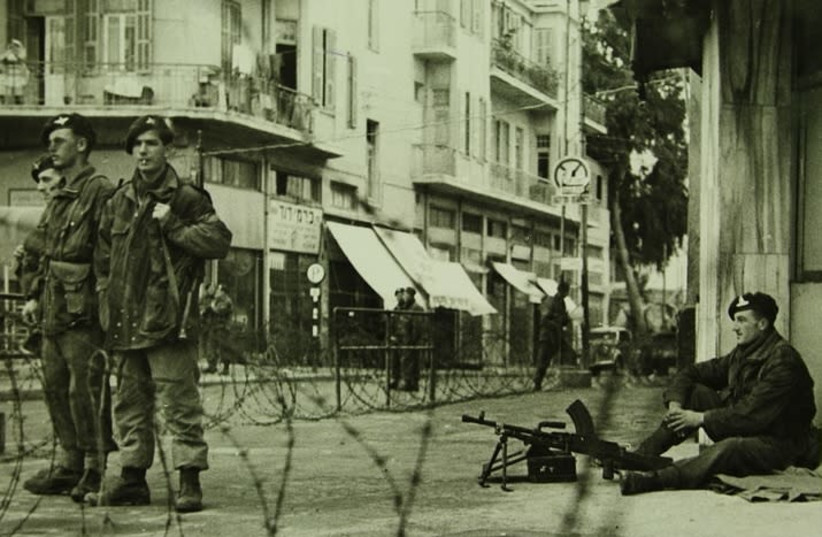
British soldiers enforcing a curfew in Tel Aviv during the 1940s (Haim Fein at the Emanuel Harussi Photograph Collection) / (photo credit: NATIONAL LIBRARY OF ISRAEL)

The streets of Tel Aviv are nearly empty but they are not quiet. The unnatural churn of steel on asphalt shatters the stillness of night, as tanks roll through residential neighborhoods. Every few blocks, British soldiers position themselves on street corners, armed with machine guns. A curfew has been set. Those who venture outdoors are, at best, arrested. The inhabitants of the first Hebrew city find themselves under the distrusting glare of their supposed protectors.

The reason for this state of affairs? – Riots, deadly ones. Two men lay dead, and dozens of others wounded, after the city had erupted in fury. On November 14th, fifty thousand people came to protest the British government’s decision to keep in place the strict limitations on Jewish immigration to Mandatory Palestine. The horrors of the Holocaust, the details of which were now becoming clear, were not enough to change that.

There had been high hopes. World War II was now over and ahead of the July 1945 elections in the UK, British Labour Party politicians promised to remove the restrictions on immigration to Palestine. But those promises seemed to evaporate into thin air once the party came to power. Foreign Secretary Ernest Bevin put an end to any lingering optimism on November 13th: He stated in Parliament that the restrictions would continue, adding that the vast majority of Holocaust survivors should instead contribute to “rebuilding the prosperity of Europe”. To add insult to injury, Bevin even declared that Britain had never committed itself to the establishment of a Jewish State, only to a National Home for the Jewish people. True perhaps, but it was not what the citizens of Tel Aviv wanted to hear.

Bevin’s statement was the breaking point, but British intentions were clear even before. The Jewish underground organizations, Haganah, Irgun and Lehi, formed the United Resistance Movement in October as a response. Its first act was a massive sabotage operation on the night of November 1st: Over a hundred mines and bombs were set off simultaneously, paralyzing the British railway system throughout Mandatory Palestine, in what became known as “The Night of the Trains.”

The decision by the Haganah, affiliated with the moderate Jewish establishment, to join the Irgun and Lehi in open rebellion against the British was a bold one, but even the moderates had now had enough.

“Bevin’s treason completes Hitler’s genocide of the Jewish people, which murdered millions of our brothers!” cried the announcer on Haganah radio ahead of the November 14th protest, as he called on Jews around the world to rise up and take action against British policy.

The huge rally was organized quickly, for the day after Bevin’s statement. Tensions were at a climax and public outcry now reached its peak. The speakers raged against the British, condemning the desertion of Europe’s suffering Jews and the appeasement of Arab leaders who were opposed to further immigration. The organizers called to refrain from provocations, but once the rally had ended, bands of young protesters began to channel their anger into violence.

The riots broke out on Levontin Street and spread quickly to surrounding areas including Allenby Street and Rothschild Boulevard. The youths clashed with soldiers, threw stones at military vehicles and set fire to government buildings. The British soldiers eventually responded with gunfire, killing two youths: Aryeh Basdomsky (21) and Yehoshua Friedman (18). Meyer Levin, a Jewish-American correspondent writing for the New York Post, described what he saw as the “battle of His Majesty’s forces versus the children – yes, literally children – of Israel.” By 10:00 p.m. the city-wide curfew had been announced, and by midnight the streets were empty. Those working the late shift at the newspaper bureaus spent the night in their offices, unable to go home.

This was the setting for the letter.

Recently discovered in the archives of the National Library is a mysterious pamphlet, written during the period described above. The identity of the writer is unknown; the letter is signed only “A Citizen of Tel-Aviv.”
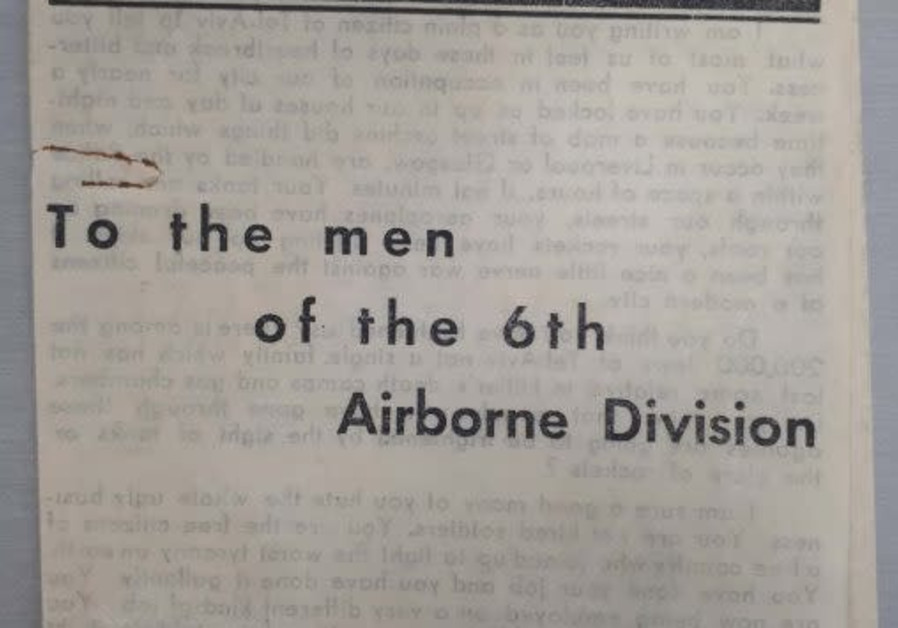
The cover of the small pamphlet, discovered in the archives of the National Library, which contains the anonymous letter

It is unclear exactly how it arrived at the library and who donated it. Unusually, it is written in English, and addressed to the British 6th Airborne Division, then stationed in Tel Aviv. The text is a powerful one. It appears below, in full:

To the men of the 6th Airborne Division

I am writing you as a plain citizen of Tel-Aviv to tell you what most of us feel in these days of heartbreak and bitterness. You have been in occupation of our city for nearly a week. You have locked us up in our houses at day and nighttime because a mob of street urchins did things which, when they occur in Liverpool or Glasgow, are handled by the Police within a space of hours, if not minutes. Your tanks are rolling through our streets, your aeroplanes have been droning on our roofs, your rockets have been lighting up our skies. It has been a nice little nerve war against the peaceful citizens of a modern city.

Do you think you have frightened us? There is among the 200,000 Jews of Tel-Aviv not a single family which has not lost some relative in Hitler’s death camps and gas chambers. Do you think that people who have gone through these agonies are going to be frightened by the sight of tanks or the glare of rockets?

I am sure a good many of you hate the whole ugly business. You are not hired soldiers. You are the free citizens of a free country who joined up to fight the worst tyranny on earth. You have done your job and you have done it gallantly. You are now being employed on a very different kind of job. You have been sent to this country, so you have been told, “to fight the Jews”, in other words, to break the resistance of a desperate people against a most horrible betrayal.

It is nearly thirty years since a British Government, with the support of all of the Allied Nations, pledged itself to help the Jews to rebuild their national home in Palestine. To what developments that policy has given rise in this country you can see with your own eyes. It has produced nothing less than a new civilization. A new spirit has revived this ancient land, the evidence of which you see in this town of Tel-Aviv, in the Jewish agricultural settlements, in the new Jerusalem and Haifa, in the Hebrew University and in the innumerable colleges and public institutions, in the new standards of life among both Jews and Arabs. For the first time, after centuries of dispersion and degradation, Jews are again walking erect on the ancient soil of their race. They have only one aim and one desire: to bring over to this country the remnant of the persecuted and tortured Jewries of other lands give them a home among themselves.

The British Government have decided that this shall not be. The Jews, Mr. Bevin says, are to remain in Europe and help “rebuild its civilization”. Never mind that they want to flee as fast as they can from the countries which are covered with the graveyards of their nearest and dearest. Never mind that all Europe is full of their enemies and that six months after the fall of the Nazis Jews are still being killed and persecuted in the countries liberated from the Nazi yoke. Never before have the Jews been so bitterly in need of this National Home and never before have its doors been so effectively bolted in their faces.

No commission of inquiry, such as promised by Mr. Bevin, is needed to establish the fact that the Jewish survivors of the Nazi terror want to shake the dust of blood-stained Europe off their feet and find a refuge and home among their own people in this country. No Commission of Inquiry is needed to prove that Palestine can absorb these survivors better and more speedily than any other country on earth and turn them from wrecks into useful members of society. No man who knows anything about the facts has any doubts that Mr. Bevin’s commission represents nothing but an old bankrupt device to gain time for something to turn up.

We have no illusions of what is in store for us. We know that your aeroplanes and tanks can turn Tel-Aviv, within a few hours, again into the sandy desert which it was before we began to build it thirty years ago. We know that you can turn the whole of Jewish Palestine, our towns and settlements our schools and colleges, into dust. Might is on your side, but yours is no longer a good cause. You are fighting for the Arab Pashas who want to see Palestine reduced again to the condition of desolation and stagnation in which our pioneers found it fifty years ago. You are fighting for the oil magnates who, for the sake of their profits are ready to sacrifice to the Pashas and Effendis all that we have built up in this country with our sweat and tears. What do they care for progress and development? They want you to finish the job that Hitler and Himmler began – to crush the Jews. This prosperous young city which gave refuge to many thousands who would otherwise have died in the Nazi gas chambers – is it to be smashed up by your bombs and tanks? Our agricultural settlements about which so much has been spoken and written and where so many of your comrades found rest and recreation in the darkest hours of the war are they to be turned again into swamps and stony deserts as in the good old days of Arab misrule?

You are armed well enough to carry out that ugly job, though you are likely to meet with the desperate resistance of a people which has no longer anything to lose. But neither your tanks nor your aeroplanes will break our determination to rebuild this country which remains our National Home whatever Mr. Attlee and Mr. Bevin may say. You may smash up all we have built and in the wake of your tanks and batteries the Pasha and the Beduin will re-establish their blighted rule. But that won’t be the end, though it will certainly be the end of British rule and glory in this country. Others will come from the four corners of the earth and will rebuild what you have destroyed. No force on earth can prevent our returning to the land where history has cast our destiny.

Tel-Aviv, November 1945

A Citizen of Tel-Aviv

Three more people were killed in riots which broke out again on November 15th. The curfews continued for six nights in a row. Violent clashes carried on throughout the rest of the month across Palestine. By the end of November, fourteen members of the Jewish Yishuv had been killed. The United Resistance Movement lasted less than a year before being disbanded in August, 1946.


Ariel Viterbo, of the National Library’s ephemera collection, assisted in the preparation of this article.


Zawartość publikowanych artykułów i materiałów nie reprezentuje poglądów ani opinii Reunion’68,
ani też webmastera Blogu Reunion’68, chyba ze jest to wyraźnie zaznaczone.
Twoje uwagi, linki, własne artykuły lub wiadomości prześlij na adres:
webmaster@reunion68.com
Remembrance Day: How Israel cares for the families of fallen soldiers


Remembrance Day: How Israel cares for the families of fallen soldiers

ANNA AHRONHEIM


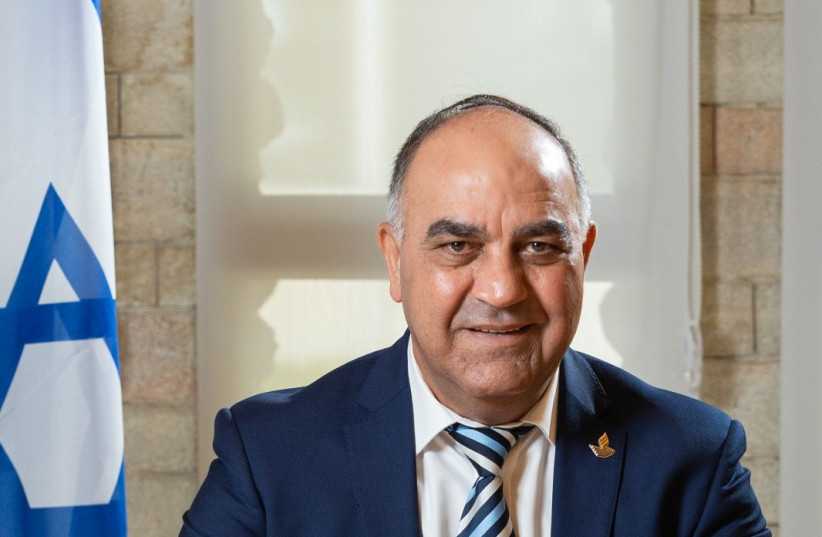
The Defense Ministry’s Department of Families and Commemorations cares for all bereaved families, in Israel and abroad.
.

Arye Mualem /  (photo credit: DEFENSE MINISTRY)

As Israel remembers its fallen who gave their lives protecting the country throughout its 74 years of independence, the Defense Ministry’s Department of Families and Commemorations is reaching out to all bereaved families, including those living abroad.

“Everyone is with the bereaved families right now,” Arye Mualem, head of the Department of Families and Commemoration, told The Jerusalem Post. “These are complicated and sensitive days.”

Remembrance Day for the Fallen of Israel’s Wars, in my eyes, is one of the most meaningful days in Israel,” he said. “The whole of Israel is connected, understands and salutes those who have fallen while at the same time are embracing the families, across the country. So many citizens are standing together on this one day for a specific goal to get to cemeteries to support the bereaved families.”

In total, 24,068 IDF soldiers, police officers, prison wardens, Shin Bet (Israel Security Agency) security service and Mossad agents have been killed since 1860 defending the pre-state Yishuv and Israel. That number also includes members of the pre-state militias and the Jewish Brigade, who served in the British army during World War II.

According to the National Insurance Institute, some 3,199 civilians were killed in hostilities since the establishment of the state.

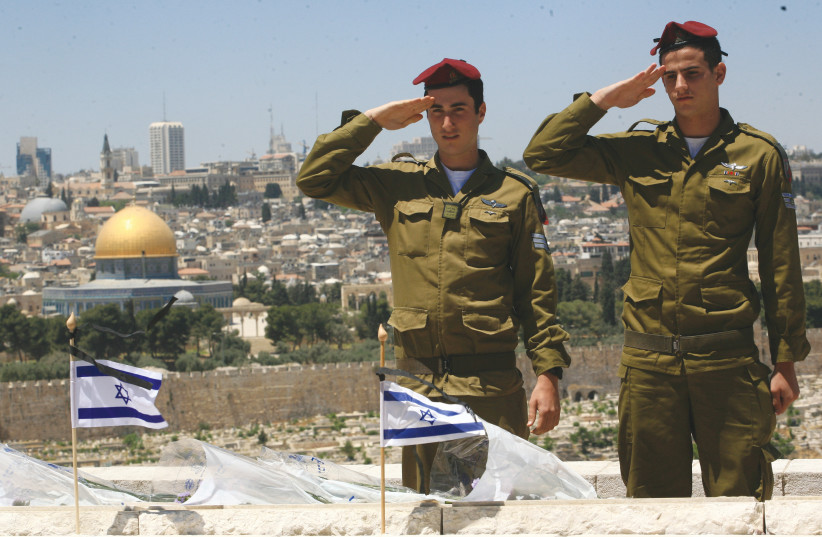
PARATROOPERS SALUTE after placing flags on the graves of fallen soldiers, during preparations for Remembrance Day ceremonies on the Mount of Olives. (credit: NATI SHOHAT/FLASH90)

Remembrance Day will begin at 8 p.m. on Tuesday, May 3 when a one-minute-long memorial siren will sound across the country. Immediately after the siren, memorial ceremonies will take place across the country with the main one to be held at the Western Wall in the Old City of Jerusalem in the presence of President Isaac Herzog and Chief of Staff Lt.-Gen. Aviv Kohavi.

On Wednesday, May 4, a two-minute-long siren will sound at 11:00 a.m. followed by official state memorial services at 52 military cemeteries across the country and at memorial sites.

The ministry’s Department of Families and Commemoration is responsible for all Remembrance Day events.

Mualem, who has spent the past 15 years as the head of the department, said that there is “no other moment” that encapsulates Israel than the two-minute-long siren and the lowering of the flag.

“The two moments of silence have a lot of power and give a lot of respect to the fallen,” he added.

Under Mualem, the department works to reach every bereaved family-in Israel and abroad- and customizes support as per the need of each family. In addition to the financial support provided to families and widows, the ministry provides social workers, psychologists and other means of mental support.

According to him, the social and emotional support given to families is so comprehensive that other countries look to Israel when building plans to support their own bereaved families.

“The country has understood that the loss experienced by bereaved families has affected them,” he said, adding that while “we can’t bring back their sons, we can be there for the family and embrace them along this long road of mourning.”

Along with the memorial events in Israel, and as an ongoing effort to strengthen the connection with bereaved families living abroad, the Department of Families and Commemoration and the World Zionist Organization produced a joint online hybrid memorial ceremony.

The ceremony includes a video of the memorial service in Mount Herzl’s Memorial Hall which will be available on the Defense Ministry’s YouTube channel. The ministry said that there will also be “customizable online content that each community can use individually, available on the Department of Families and Commemoration’s website.”

The ceremony will be shared with Jewish communities around the world and is available in Hebrew, English, Spanish, French, and Russian.

Mualem told the Post that “it’s important to have a direct connection” with families who live abroad. He said that a few hundred families come to Israel supported by the ministry every year to commemorate their son or daughter.

“We can’t forget these families,” he said, explaining the importance of the hybrid ceremony for the families who could not make it this year to Israel.

In addition, Mualem said that the ministry has initiated a project called “Communities Embracing Families” where Diaspora Jewish communities “adopt” bereaved families in their communities. As part of the project, which will be launched on May 19th in Miami, Florida by Defense Minister Benny Gantz, communities will provide families with the emotional support needed throughout the year.

“This way we continue to strengthen our ties with families abroad,” he said.

While Jewish communities across the world understand the importance of Remembrance Day and have a strong connection to Israel, there is a growing number of Diaspora Jewish youth who are moving away from their Jewish identity and Israel.

And that is just “one of the reasons that we are doing this project of ‘Communities Embracing Families,’’’ Mualem said. “We are inviting teenagers and youth in diaspora communities and talk with them about those who gave their lives for the country because we believe that the more we talk about them, the more we will remember them and not forget.

We believe that the ethos of the IDF, the country and of fallen and their stories will make the youth understand what it means to love the country and fight for it and protect it.”


Zawartość publikowanych artykułów i materiałów nie reprezentuje poglądów ani opinii Reunion’68,
ani też webmastera Blogu Reunion’68, chyba ze jest to wyraźnie zaznaczone.
Twoje uwagi, linki, własne artykuły lub wiadomości prześlij na adres:
webmaster@reunion68.com


Israel looking for ways to prepare against terror – Dr. Nachman Shai

Israel looking for ways to prepare against terror – Dr. Nachman Shai

ILTV Israel News


Joining us with more on the latest news in Israel… Minister of Diaspora Affairs, Dr. Nachman Shai.

Dr. Nachman Shai | Israeli Minister of Diaspora Affairs


Zawartość publikowanych artykułów i materiałów nie reprezentuje poglądów ani opinii Reunion’68,
ani też webmastera Blogu Reunion’68, chyba ze jest to wyraźnie zaznaczone.
Twoje uwagi, linki, własne artykuły lub wiadomości prześlij na adres:
webmaster@reunion68.com


Live Broadcast of Holocaust Remembrance Day 2022 Opening Ceremony at Yad Vashem

Live Broadcast of Holocaust Remembrance Day 2022 Opening Ceremony at Yad Vashem

Yad Vashem


The central state ceremony, marking the start of Holocaust Martyrs’ and Heroes’ Remembrance Day in Israel, will be held at Yad Vashem on Wednesday night, April 27th at 20:00 (UTC +3). The ceremony will be held in the presence of the President of the State of Israel and the Prime Minister, dignitaries and Holocaust survivors.


Zawartość publikowanych artykułów i materiałów nie reprezentuje poglądów ani opinii Reunion’68,
ani też webmastera Blogu Reunion’68, chyba ze jest to wyraźnie zaznaczone.
Twoje uwagi, linki, własne artykuły lub wiadomości prześlij na adres:
webmaster@reunion68.com


Modern technology records smells meant to accompany ancient Egyptians into afterlife

Modern technology records smells meant to accompany ancient Egyptians into afterlife

JUDITH SUDILOVSKY


Transportable mass spectrometer detected and analyzed scents in non-invasive way.

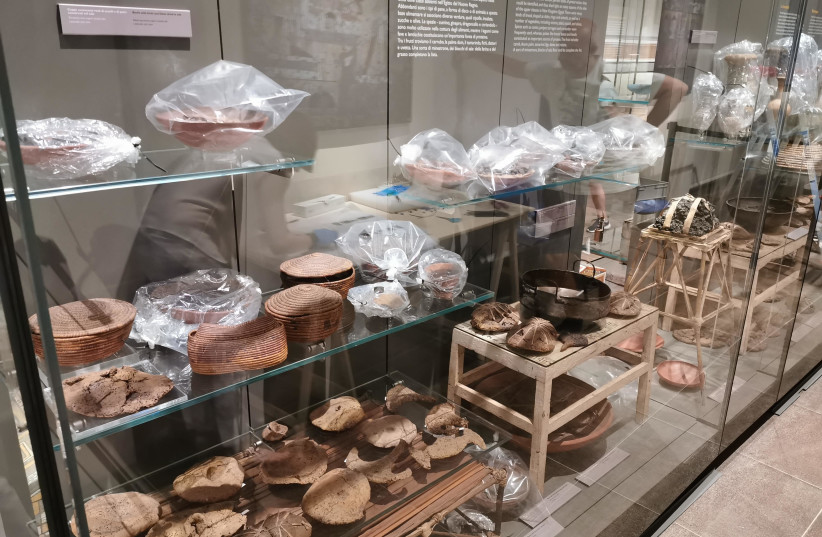
Researchers captured volotaile molecules (smell) from organic material from an Egyptian tomb using pastic bag for a week before measuring them with cutting-edge technology. / (photo credit: EGIZIO MUSEUM OF TURIN)

Ancient Egyptians sent off their dead into the afterlife accompanied by jars of beeswax, dried fish, ritual ointments and other foods, according to a study by Italian researchers using cutting-edge technology which analyzed the scent of foods left in jars 3,400 years ago in an Egyptian tomb.

The research was conducted on 50 intact vessels from the rich burial assemblage of two high ranking individuals in the Deir el-Medina Necropolis at Luxor, West Bank, the “chief-of-works,” or foreman, Kha and his wife, Merit, who lived during the second half of 18th dynasty, about 1450–1400 BCE.

Discovered in 1906 and now preserved at the Egizio Museum in Turin, Italy, the collection constitutes the most abundant, complete, and well-preserved non-royal Egyptian burial assemblage ever found.

As an added bonus, the tomb had never been plundered because it had been sealed shut by a landslide in ancient times.

Fortunately, the discoverer of the tomb and director of the Egizio Museum, Ernesto Schiaparelli, conducted limited investigations on a few non-unique items, leaving most of the assemblage untouched. This farsighted decision has enabled contemporary scholars to study such exceptional archaeological findings with non-invasive approaches that could not have been foreseen at the time, the researchers noted in their report which appeared in the recent edition of Journal of Archaeological Science.

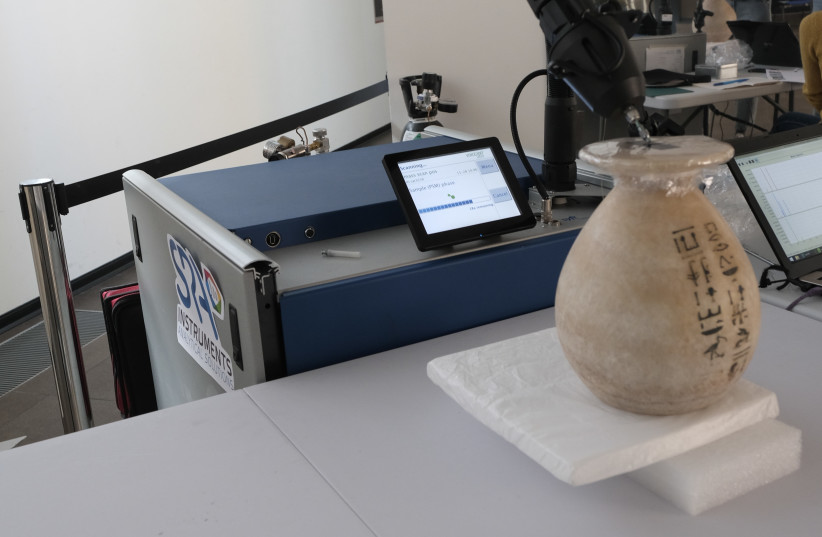
Researchers used cutting-edge noninvasive SIFT mass-spectrometer to analyize the volatile organic molecules–the scent–of organic remains from a 3,400 year old Egyptian tomb (credit: EGIZIO MUSEUM OF TURIN)

Using a transportable mass spectrometer, known by the initials SIFT-MS, the researchers were able to show that the volatile compounds—the scent—still emitted by organic materials in the vessels can be chemically analyzed and detected in a completely non-invasive way directly in museums without having to move the valuable items.

“The experimental design and the analytical approach that we used does not need to sample the investigated material itself, because the SIFT-MS analyses the volatile organic molecules that are in the air that is in contact with the material,” explained researcher Francesca Modugno of the department of chemistry and industrial chemistry of the University of Pisa.  “We concentrated the released volatiles by enclosing the vessels in inert plastic bags for about one week before the measurements.”

The researchers said this proved that the use of this technology is a reliable fast-screening method for archaeological investigations directly in museums, allowing for the unique possibility of extending the research of vessels and jars

“Identifying the materials associated to burial assemblages provides a unique possibility to complement, confirm and extend the archaeological research on ancient rituals and on the use and purpose of archaeological vessels and jars,” said Modugno.   

The ability to analyze  the released volatile molecules  gives information on their chemical composition and the nature, of the material emitting the smell, she said, so that researchers can learn more about which materials were included in the burial assemblage without sampling them.

“Sampling such type of archaeological objects is absolutely impossible, they are unique and generally too precious to be submitted to extensive conventional destructive chemical analysis,” she said.

The research is part of a larger international research project begun in 2017 by the Egizio Museum in honor of the bicentennial of the collection in 2024, which aims to publish a digital data repository and a full study of the tomb.


Zawartość publikowanych artykułów i materiałów nie reprezentuje poglądów ani opinii Reunion’68,
ani też webmastera Blogu Reunion’68, chyba ze jest to wyraźnie zaznaczone.
Twoje uwagi, linki, własne artykuły lub wiadomości prześlij na adres:
webmaster@reunion68.com