Archives

News From Israel- January 12, 2022

News From Israel- January 12, 2022

ILTV Israel News


A pair of terror attacks grip the West Bank overnight

An Israeli police officer’s tenure terminated after offering the worst possible advice. Ever.

The massive Yad-Vashem holocaust memorial archives now going up online for the world to see


Zawartość publikowanych artykułów i materiałów nie reprezentuje poglądów ani opinii Reunion’68,
ani też webmastera Blogu Reunion’68, chyba ze jest to wyraźnie zaznaczone.
Twoje uwagi, linki, własne artykuły lub wiadomości prześlij na adres:
webmaster@reunion68.com


4,000-year-old gameboard uncovered by Polish, Omani archaeologists

4,000-year-old gameboard uncovered by Polish, Omani archaeologists

JERUSALEM POST STAFF


A general view of the Al Hajar mountains near Ibri, Oman, November 27, 2019. / (photo credit: REUTERS/CHRISTOPHER PIKE)

A joint team of Polish and Omani archaeologists discovered multiple artifacts including a tower, evidence of copper smelting and a stone gameboard from between 2500 and 2000 BCE in excavations at the site of an ancient settlement in Oman’s Qumayrah Valley.

The team, led by Prof. Piotr Bieliński from the Polish Centre of Mediterranean Archaeology at the University of Warsaw (PCMA UW) and Dr. Sultan al-Bakri, director-general of Antiquities at the Ministry of Heritage and Tourism of the Sultanate of Oman, is conducting the excavations as part of a project called “The development of settlement in the mountains of northern Oman in the Bronze and Iron Ages.” According to PCMA UW, which published the findings on its website on Tuesday, the project investigates the development of settlements in Oman’s Northern Hajar mountain range.

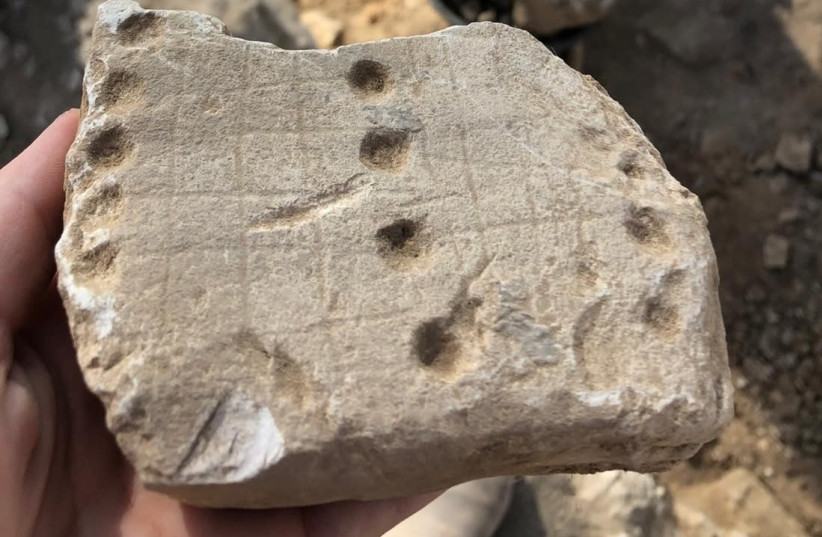
The archaeologists found a stone gameboard with markings and holes – indicating concepts similar to those of other games played during the Bronze Age. Though such items are rare, other gameboards have been found from Mesopotamia, India and the Eastern Mediterranean basin, according to Bieliński.

The most recent work focused specifically on settlements from the Umm an-Nar period, about 4,000 years ago. The excavation site was located at a strategically significant junction of routes, along which other sites from this period had been previously discovered. There, the archaeologists hoped to unearth evidence of another settlement.

The team found this evidence in the form of a large tower which was previously hidden beneath the surface, copper objects and an ancient gameboard.

The discovery of the tower followed earlier digs revealing three other towers. Though the most recently-excavated tower is up to 20 meters (about 66 feet) wide, “[i]t was only discovered during [the latest] excavations,” according to PCMA UW’s Dr. Agnieszka Pieńkowska. “The function of these prominent structures present

Another gameboard found at the site was called “Hounds and Jackals,” or “58 Holes” (credit: EMIL ALADJEM/ISRAEL ANTIQUITIES AUTHORITY)

The team also discovered copper items and additional evidence of copper working. Prof. Bieliński cited these finds as proof that residents of the settlement “participated in the lucrative copper trade for which Oman was famous at that time, with mentions of Omani copper present in the cuneiform texts from Mesopotamia.”


Zawartość publikowanych artykułów i materiałów nie reprezentuje poglądów ani opinii Reunion’68,
ani też webmastera Blogu Reunion’68, chyba ze jest to wyraźnie zaznaczone.
Twoje uwagi, linki, własne artykuły lub wiadomości prześlij na adres:
webmaster@reunion68.com


Israel’s Military Reports It Shot Down Hezbollah Drone

Israel’s Military Reports It Shot Down Hezbollah Drone

i24 News


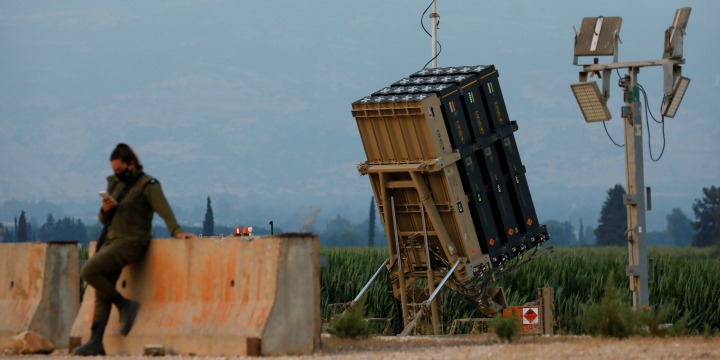
An IDF soldier stands next to an Iron Dome aerial defense battery, near Israel’s northern border with Lebanon, July 27, 2020. Photo: Reuters / Amir Cohen.

 Israel’s military on Tuesday announced it shot down a Hezbollah drone, according to an announcement from the army’s official Twitter account.

“The drone was tracked by the aerial control units for the entire duration of the event,” the country’s armed forces explained, adding that the device crossed into Israel after crossing Lebanon’s border.

There was no immediate response on the matter from Hezbollah or media outlets linked to the organization.

“The IDF will continue to act in order to prevent any violation of Israel’s sovereignty,” the military declared following the incident.


Zawartość publikowanych artykułów i materiałów nie reprezentuje poglądów ani opinii Reunion’68,
ani też webmastera Blogu Reunion’68, chyba ze jest to wyraźnie zaznaczone.
Twoje uwagi, linki, własne artykuły lub wiadomości prześlij na adres:
webmaster@reunion68.com


Palestinian gunman killed in gunfire exchange with IDF soldiers in Nablus

Palestinian gunman killed in gunfire exchange with IDF soldiers in Nablus

JERUSALEM POST STAFF


The gunman, Bachar Hashash, was shot dead at the entrance to the Balata refugee camp.

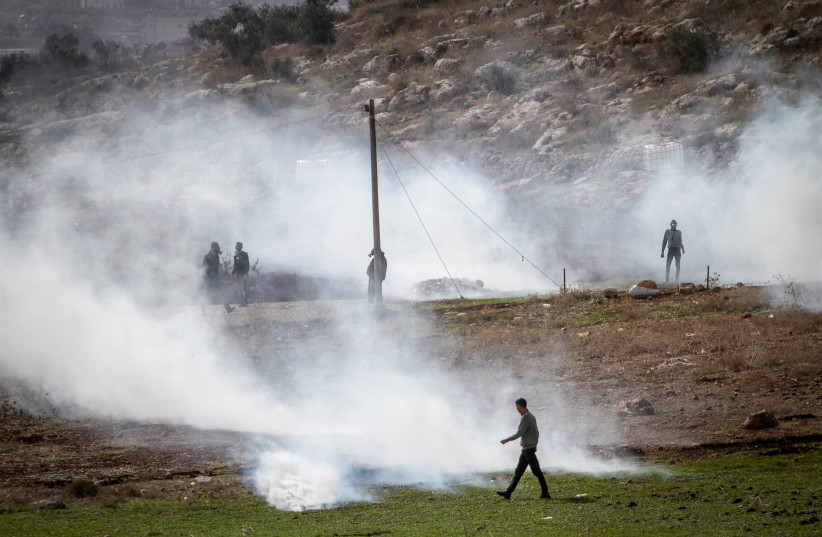
Palestinians clash with Israeli security forces during a protest in the village of Beit Dajan, near the West Bank city of Nablus on December 10, 2021.
(photo credit: NASSER ISHTAYEH/FLASH90)

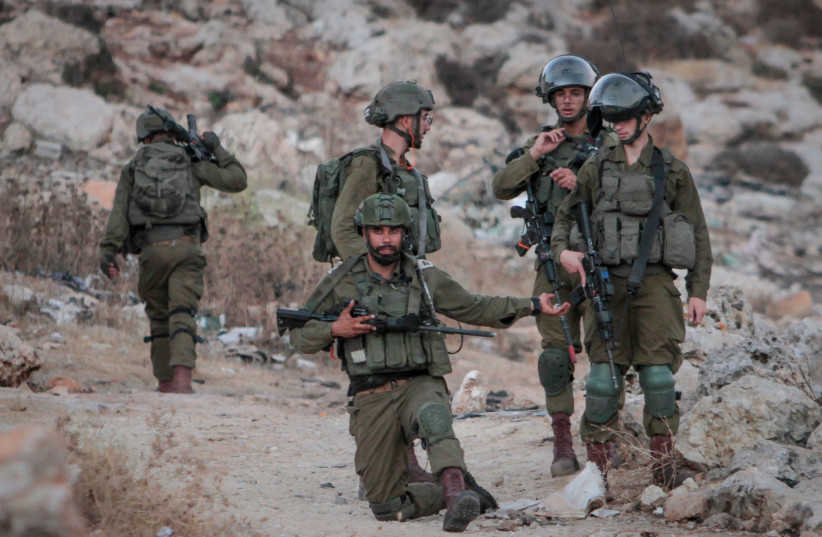
A Palestinian gunman was killed in a gunfire exchange with IDF soldiers during an operation to arrest a wanted man in Nablus early Thursday morning, according to an IDF spokesperson.

The gunman, Bachar Hashash, initiated the gunfight and was shot dead at the entrance to the Balata refugee camp, according to reports from the Palestinian media.

Hashash’s brother claimed that he had been wanted by Israel for some time according to a Ynet report.

There were no IDF casualties in the incident and the wanted man was captured.

Another terror incident occurred in Nablus last month, where another Palestinian gunman was killed following an operation by border police undercover fighters along with IDF forces.

Palestinians clash with Israeli security forces during a protest in the village of Deir al-Hatab, near Nablus, September 22, 2021. (credit: NASSER ISHTAYEH/FLASH90)

As security forces left the scene, rioters threw explosives, who were met with gunfire response by officers. This occurred after an operation conducted by Israel Police at the home of a man previously wanted for his involvement in a prior attack on security forces.

Three other Palestinians were wounded in the skirmish as well.


Zawartość publikowanych artykułów i materiałów nie reprezentuje poglądów ani opinii Reunion’68,
ani też webmastera Blogu Reunion’68, chyba ze jest to wyraźnie zaznaczone.
Twoje uwagi, linki, własne artykuły lub wiadomości prześlij na adres:
webmaster@reunion68.com


Early Zionist Pioneers Adhered to the Same Founding Ethos as Today’s Settlers

Early Zionist Pioneers Adhered to the Same Founding Ethos as Today’s Settlers

Shlomo Sand


Kibbutz members of Ein Herod in 1941.Credit: Government Press Office

I am a loyal reader of Haaretz editorials, and I am imbued with admiration over the audacity of those who write them. Not many of the world’s newspapers feature such consistent and courageous liberal positions, in concise and sharp columns, for years on end. So I felt uneasy reading the article “Bar-Lev Is Right” (Dec. 16).

The editorial writer notes that Interior Minister Ayalet Shaked is lying when she claims that “the settlers are the salt of the earth, the successors to the [early Zionist] pioneers,” decisively concluding instead that “the settlers are not the successors of the pioneers.”

I would very much like to join in this statement, but as a historian, as a matter of principle, I am supposed to seek historical truth, even if I know I’ll never attain it. So I will try to begin our little story, which is no fable, from the beginning.

In 1891, before the publication of Theodor Herzl’s “The Jewish State” and long before the Balfour Declaration, a loyal lover of Zion who for some reason preferred to be called Ahad Ha’am – one of the people – visited the country. A famous Zionist theoretician by then, he sought to check out the work of his admirers and disciples, whom he called colonists, as the Hebrew terms for pioneer and settler had not yet been invented. He made the arduous journey to the country to assess the pace of “imigratzia” (the use of the word aliyah had not yet become common), as well as progress in the establishment of Jewish “colonias” (as neither the Hebrew “moshava” nor the modern Hebrew word for settlement was yet in use).

Make no mistake. Ahad Ha’am was inventing and writing a marvelous Hebrew and some of our writing today owes him a great debt of gratitude. But a modern language is created slowly and in stages, and one of the fathers of modern Hebrew should be forgiven for using foreign terms – and even worse, insufficiently national ones.

On his return from his tour, this father of spiritual Zionism publishes his brilliant essay “Truth From Eretz Israel” in his own newspaper, Hashiloach. The truth that Ahad Ha’am reveals is rather shocking and unfortunately bears out some of Interior Minister Shaked’s comments.

The colonists, Ahad Ha’am states, “conduct themselves with the Arabs with hostility and cruelty, unjustifiably trespassing against them, shamefully beating them without sufficient reason and even boasting of doing so, and there was no one who would stem the tide of this despicable and dangerous tendency.”

We’re in 1891, at the very beginning of the Zionist redemption of the land, and the editor of Hashiloach writes what he does with great pain. “Slaves they were in the land of their exile and suddenly they find themselves in boundless freedom, a wild freedom that can only be found in a land such as Turkey,” Ahad Ha’am asserts, in reference to an area that was then part of the Ottoman Empire. “This sudden change bred a tendency in their hearts for despotism, as will always happen to ‘a slave who becomes a king’ ….”

The West Bank is no longer in the Ottoman Empire, but it is still the same land, the same hills, almost the same villages, and of course with the descendants of the same Arabs. The conflict with our neighbors didn’t begin in 1967 or in 1948. It began with the onset of Zionist settlement, at the end of the 19th century.

It’s not only today’s settlers who are certain all the land is theirs. The first pioneers also always adhered to that same founding ethos. But the major difference between the forebears and the contemporary settlers is what motivated them.

The early pioneers uprooted themselves and left their countries of origin as a result of Judophobia, massacres and pogroms. The newer version uprooted themselves from where they were born mainly as a result of a dizzying concept of power, with official encouragement and primarily to fulfill the dream of a house with a pristine view.


The writer is a historian and professor emeritus at Tel Aviv University.


Zawartość publikowanych artykułów i materiałów nie reprezentuje poglądów ani opinii Reunion’68,
ani też webmastera Blogu Reunion’68, chyba ze jest to wyraźnie zaznaczone.
Twoje uwagi, linki, własne artykuły lub wiadomości prześlij na adres:
webmaster@reunion68.com