Archives

Excavations reveal ancient synagogue in Turkish town near tourist hotspot

Excavations reveal ancient synagogue in Turkish town near tourist hotspot

DAVID KLEIN/ JTA


The synagogue was found recently in the town of Side, not far from the tourist hotspot of Antalya, in southern Turkey.
.

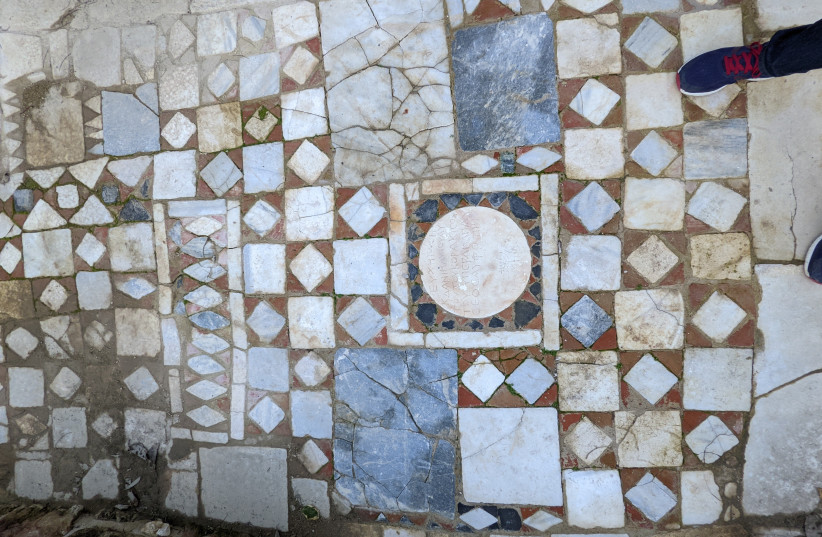
The floor of the synagogue in Side, Turkey, features a plaque with Greek and Hebrew inscriptions. /  (photo credit: TWITTER)

The remains of an ancient synagogue dating back as far as the 7th century have been discovered in a resort town on Turkey’s Mediterranean coast.

The synagogue was found recently in the town of Side, not far from the tourist hotspot of Antalya, in southern Turkey.

Among the remains was a plaque with a menorah motif and an inscription in Hebrew and Greek stating that it was donated by a father in honor of a son who passed away at a young age. The plaque ends with the Hebrew word “Shalom.”

The town was home to Jews for centuries, but until this discovery, there was little evidence of Jewish life there beyond a few records from the late Byzantine period.

Since 2014, Turkish authorities and the town’s own citizens have worked together to try to preserve some of its history.

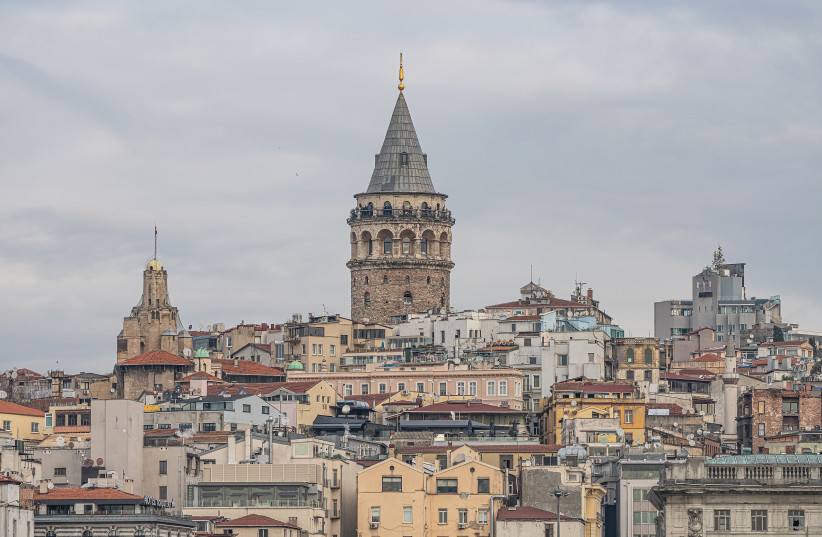
Remote view of Galata Tower in Istanbul, Turkey (credit: VIA WIKIMEDIA COMMONS)

That year was “a turning point for Side in terms of research and conservation,” said Feriştah Alanyali, an archeologist from Anadolu University who is leading the excavations, according to the Turkish Jewish news outlet Avlaremoz. “Many works have been done that could not be done until now.”

Though today Side is a popular destination for Russian and European tourists, in ancient times it was an important Mediterranean port city, adopting Greek culture after its conquest by Alexander the Great in 333 B.C.E. It maintained a Greek identity until it was abandoned in the 12th century after the conquest of Anatolia by the Seljuk Turks.

The city was ultimately repopulated at the end of the 19th century by Turkish Muslim immigrants from Crete and saw a building boom during the 20th century, thanks to the rise of tourism in the Antalya region.

It was that uncontrolled building that covered up much of the ruins of ancient Side, including the synagogue, which was found beneath an old house.

Alanyali hopes that when more structures in Side are removed over the next 4 to 5 years that its ancient ruins, including the synagogue, will be intertwined with the town’s infrastructure like they are in other ancient cities such as Rome.


Zawartość publikowanych artykułów i materiałów nie reprezentuje poglądów ani opinii Reunion’68,
ani też webmastera Blogu Reunion’68, chyba ze jest to wyraźnie zaznaczone.
Twoje uwagi, linki, własne artykuły lub wiadomości prześlij na adres:
webmaster@reunion68.com


‘Christians in Israel mark Christmas in safety, unlike the rest of Mideast’

‘Christians in Israel mark Christmas in safety, unlike the rest of Mideast’

JNS and ILH Staff


“Many Christian families living in Iraq and Syria are in poverty, and cannot afford proper celebrations, while in the Jewish democratic State of Israel, people enjoy beautiful co-existence, safety, prosperity, and freedom,” says Capt. (res.) Shadi Khalloul, spokesman of the Christian Israel Defense Forces Officers Forum.
.

“A man dressed as Santa Claus rides a camel near the Jaffa Gate in the Old City of Jerusalem, Israel, Dec. 23, 2021”

Marking Christmas, Israeli Christians are ‘thriving’ while Middle Eastern brethren face persecution

While Christians are facing persecution and shrinking numbers throughout the Middle East, in Israel Christians are enjoying a different reality with growing numbers and high quality of life.

The number of Christians in Israel grew by 1.4% in 2020 reaching 182,000 people with 84% saying they are satisfied with life in Israel, according to the Central Bureau of Statistics.

Christian Israelis make up about 1.9% of the state’s population, most of them speaking Arabic. Christians make up 7% of Israeli Arabs and 76.7% of Christians in the country are Arab.

The number of Christians in Israel grew by 1.4% in 2020 reaching 182,000 people with 84% saying they are satisfied with life in Israel, according to the Central Bureau of Statistics.

Christian Israelis make up about 1.9% of the state’s population, most of them speaking Arabic. Christians make up 7% of Israeli Arabs and 76.7% of Christians in the country are Arab.

Most Maronites live in Lebanon; their numbers decreased from around 29% of the population in 1932 to around 22% in 2008.

There are Maronite Christian communities in Israel with former members of the South Lebanon Army militia among them. The militia was allied with Israel during its invasion of Southern Lebanon. About 2,000 of the 10,000 Maronite Christians in Israel derive former militia fighters who fled to Israel when its forces withdrew from Southern Lebanon.

According to a journal article by Israeli Syria and Lebanon expert Eyal Zisser, Maronite ties to the Jewish community in Israel began as early as the 1930s and continued through independence in 1948. The alliance against the Muslim Arab world was built on the belief that Israel was to serve as the national home for Jews and Lebanon for Maronites.

“While Middle Eastern Christians are [for the most part] oppressed, in Israel, they are thriving,” Khalloul said.

Israel recently announced that it would allow 500 Christian community members from the Gaza Strip to enter Israel and the West Bank to celebrate the holidays.

Gaza’s community maintains around 1,000 Christians, and in the West Bank, a dwindling number remains as many have emigrated. According to the CIA Facebook, Christians and other small non-Muslim and non-Jewish religions make up 8 % of the West Bank population.

According to a 2018 NBC News report, the Christian population of Bethlehem had dropped from 80% in 1950 to around 12%.

However, Christian leaders sought to blame Israel for the decline in Christians in the disputed territories.

In an article in last weekend’s Sunday Times, written jointly by the Archbishop of Canterbury, Justin Welby, and the Archbishop of Jerusalem, Hosam Naoum, warned about a crisis of Christian survival “in the Holy Land.” The church leaders blamed Christian’s shrinking numbers in the disputed territories to the “growth of settler communities” and “travel restrictions brought about by the West Bank separation wall.”

Alastair Kirk, of Christians United For Israel UK, disputed this portrayal and accused the church leaders of demonizing Israel.

“While there are serious issues to address in the context of Christians in the Holy Land, Christians living in Israel proper enjoy the same freedoms as other Israelis,” Kirk said. “There are real concerns for those Christians living in the West Bank who, like so many, are caught in a conflict, but rather than examine the challenges faced by Christians in the West Bank in a manner that may bring the British public closer to understanding them, the archbishops ignore key facts, effectively demonizing Israel in the process.

“Across the globe in 2021, Christians have been killed simply because of their faith. Millions of Christians have been uprooted. Many have been imprisoned,” Kirk continued. “Churches have been attacked or forced underground. It is somewhat disturbing that the archbishops have thought it timely to publicly use the occasion of Christmas, in which Bethlehem plays such an important role, to raise contentious issues that some will use to further vilify Israel.”

Bishara Shlayan, a Christian Israeli Arab from Nazareth, told JNS that Israel defends Christians and provides security.

The Palestinian Authority is very weak and cannot provide adequate security to Christians living in the West Bank, he said.

“The difference between Christians in Israel and the Arab world is obvious. We are citizens and have equal political rights, while the situation in Arab countries is not good,” he said.

Shlayan, who has headed a party that failed to pass the electoral threshold in past elections, points out that “at least we have the right to run.”


Zawartość publikowanych artykułów i materiałów nie reprezentuje poglądów ani opinii Reunion’68,
ani też webmastera Blogu Reunion’68, chyba ze jest to wyraźnie zaznaczone.
Twoje uwagi, linki, własne artykuły lub wiadomości prześlij na adres:
webmaster@reunion68.com


Sarah Silverman Expresses Support for Zionism, Existence of a ‘Jewish State’ on Podcast Episode

Sarah Silverman Expresses Support for Zionism, Existence of a ‘Jewish State’ on Podcast Episode

Shiryn Ghermezian


Sarah Silverman during the Dec. 16 episode of her show “The Sarah Silverman Podcast.” Photo: YouTube screenshot.

Sarah Silverman talked on Friday’s episode of her podcast about the existence of a “Jewish state,” the misplaced criticism that Israelis and American Jews face, and her support for a two-state solution in the Middle East.

“Zionism by definition means that you believe Israel has the right to exist; that there should be a Jewish state. And hey, there are many Muslim states, many Muslim countries. We here in America, we are basically a Christian country. So there can’t be one, just one, Jewish state?” the host of “The Sarah Silverman Podcast” told her listeners.

The comedian and actress, whose sister Susie lives in Jerusalem, began by saying that she believes the term “pro-Israel” has become “very muddied” and “co-opted by the far-right.” She thinks there is a “spectrum of pro-Israel and a spectrum of Zionism that makes it very unfair to blanket define everyone under the definition of Zionism.”

She then added, “I have very close brilliant, warm, loving, liberal family [members] that consider themselves liberal Zionists. And then there’s the Democratic Socialists of America, which I am a member [of], and they consider themselves to be anti-Zionists, which makes me sad and feel nervous. In their mind, it equals anti-racism.”

On Monday, former Miss Iraq Sarah Idan applauded Silverman for explaining Zionism “so beautifully and courageously, knowing people from her party might disagree.”

Idan said in an Instagram post, “When I was in Israel I spent almost every day with the Silvermans and they made me feel at home. They’re passionate loving activists who not only care for Israel but human rights and equality. I wish to see more progressives follow in their footsteps and not fall for the propaganda and fake narratives media benefits from. Being a Zionist doesn’t mean you don’t care for Palestinians, it means you care for co-existence between two people but with extremists that always seem to be forgotten.”

During her podcast episode, Silverman, whose location on Twitter is marked as “Palestine,” also reiterated her longstanding support for a two-state solution between Israel and the Palestinians while accusing Israel of “occupation.” She told listeners, “In my far away view, I say King Solomon that s–t. Cut her in half, half Palestine and half Israel. Side by side. … Occupation is wrong, any way you slice it. I believe there should be a state of Palestine as much as I believe there should be an Israel. … The occupation must end.”

Silverman was born Jewish but now identifies as an atheist. She explained on her podcast that when she posts anything Jewish-related on social media, she is flooded with comments from people asking “What about Palestine?” She then questioned why Jews in America and Israelis are being faced with such harsh backlash for actions of the Israeli government.

“Let me put it this way, the Chinese government has one million Uyghurs Muslims in concentration camps in China and thank God people don’t hate Chinese people in China, or Chinese-Americans here, or wherever they are, for what their psycho government is doing. That would be insanely racist and very sh—y. But boy when it comes to Israel … Jews that have nothing to do with Israel or Israelis that have nothing to do with what their government is doing [are being criticized].”

Addressing calls to sanction Israel, she said, “let’s do that maybe with China too. My sister Susie says, ‘Why demonize everyone in Israel?’ She said so much of this is not about the occupation, it’s about our existence. And I can see her point of view, very, very well.”

Listen to Sarah Silverman’s full podcast episode below.


Zawartość publikowanych artykułów i materiałów nie reprezentuje poglądów ani opinii Reunion’68,
ani też webmastera Blogu Reunion’68, chyba ze jest to wyraźnie zaznaczone.
Twoje uwagi, linki, własne artykuły lub wiadomości prześlij na adres:
webmaster@reunion68.com


Rabbis exploited Holocaust to promote Tenth of Tevet – opinion

Rabbis exploited Holocaust to promote Tenth of Tevet – opinion

ELI KAVON


The connection of the Holocaust to the destruction of Jerusalem exploits the murder of the six million to promote a fast day in the Jewish world.

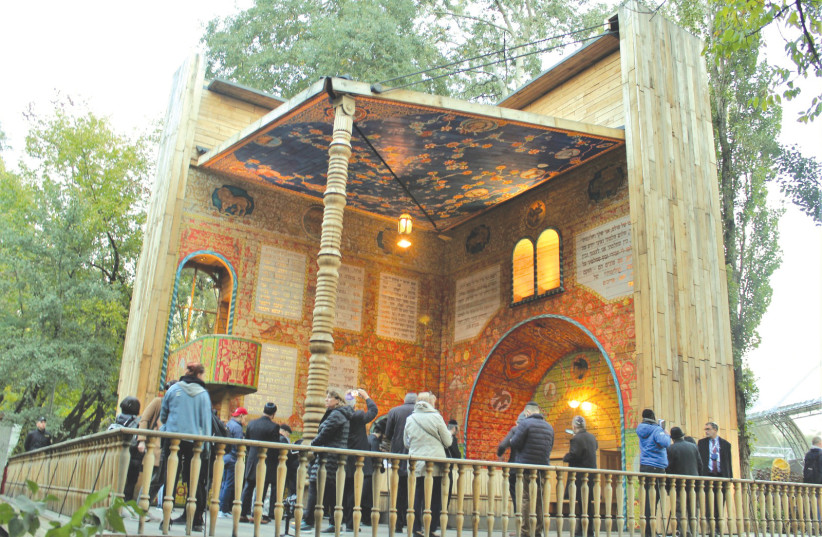
WORSHIPERS PRAY at a Babyn Yar synagogue in October. / (photo credit: ORI LEWIS)

On September 29-30, 1941 in Babyn Yar, a ravine northwest of Kyiv, some 33,000 Jews were murdered by automatic weapons fired by the German Einsatzgruppen, with the aid of Ukrainian collaborator policemen. It was a slaughter in the course of two days that Jews had never before experienced in such numbers and brutality.

Stripped of their clothes, their valuables, and their dignity, the Jews were shot, lined in a row, by the killers. The corpses fell into the ravine, only to be covered by the next row of the dead.

According to one eyewitness account, “The policemen took the children by the legs and threw them alive into the Yar.” Later, as the Germans were sure to lose the war, they tried to cover up their heinous crimes, by having Jewish commandos burn the corpses. Babyn Yar eventually became central to oppressed Soviet Jews to gather and remember the Jewish dead, whose ethnicity was denied by the Soviets.

We move from recent history to ancient history. Judah’s King Zedekiah ignored the warnings of the great prophet Jeremiah and rebelled against the Babylonian superpower in 586 BCE. The result was a disaster: Jerusalem was razed and the Temple of Solomon was destroyed. The suffering of the besieged Jews is chronicled in the Book of Lamentations, ascribed to Jeremiah. It is a story of great suffering and horror.

The rabbis commemorated different stages of the destruction with fast days, most prominently the Ninth of Av – the day the Temple was destroyed – but also declared minor fast days for the events surrounding the destruction. Today is the Tenth of Tevet, the day of mourning that remembers the beginning of the initial siege of Jerusalem that ended with the holy city’s destruction.

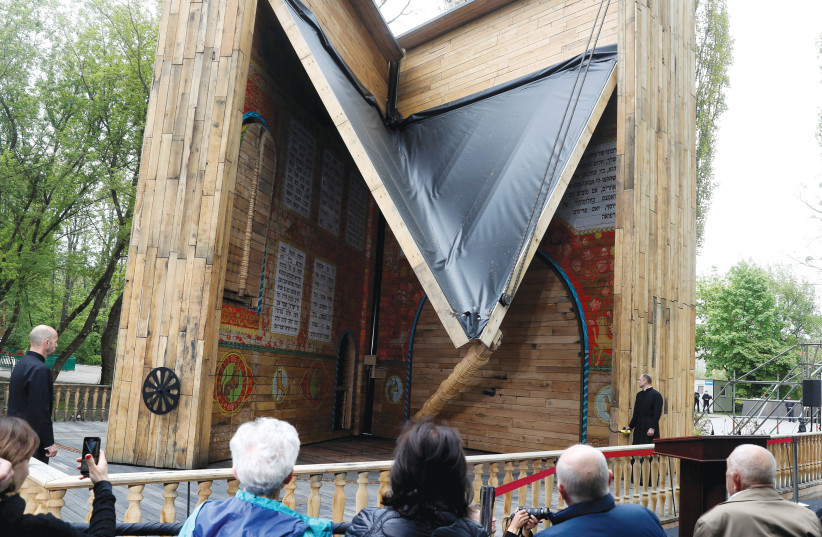
People attend the opening ceremony of a symbolic synagogue in the form of a collapsible wooden structure commemorating the victims of Babyn Yar (credit: GLEB GARANICH/REUTERS)

NO DOUBT, Jews have suffered throughout history – although there were golden ages and success religiously, economically, and culturally – and Jews suffered in Babyn Yar in 1941 and Jerusalem in 586 BCE. But there is a disturbing aspect to all of this: The Chief Rabbinate chose the Tenth of Tevet as the day Jews would recite the Mourner’s Kaddish for those Jews murdered in the Holocaust who had no surviving family to say the prayer in their memory. While this connection of Babyn Yar and Auschwitz to the destruction of Jerusalem is well-intentioned, it exploits the murder of the six million to promote a little-known fast day in the Jewish world.

Rabbi Irving “Yitz” Greenberg is right on the mark in his The Jewish Way: Living the Holidays (1988): “Clearly, its selection reflects the idea of incorporating the newest tragedy into the chain of tradition without introducing any halachic innovation.” Later, he continues, “In short, the choice of the Tenth of Tevet for a Holocaust commemoration day was designed to shore up the dwindling fortunes of the day.” This choice of the Tenth of Tevet as a day of mourning for the Holocaust reeks of desperation and a lack of imagination.

We already have a day that commemorates the six million: Holocaust Remembrance Day. The cowardice of the Chief Rabbinate is the failure to formulate a theology that confronts the worst tragedy in Jewish history, advancing with a theology that truly faces the questions the Holocaust poses. Why not declare Holocaust Remembrance Day a fast day – although it was first a Knesset-mandated commemoration – and face the tough questions that the Chief Rabbinate will not recognize.

What does the mass murder of Babyn Yar have to do with the Babylonian siege of Jerusalem? This connection is an insult to the Jews slaughtered at Babyn Yar and Ponary, gassed at Auschwitz and Treblinka. And no matter what Jeremiah writes in the Book of Lamentations, the destruction of the two Temples in Jerusalem is not the genocide carried out by Nazi Germany.

But to acknowledge this means that the rabbinate has to deal with some earthshaking questions. Ancient Jerusalem was destroyed twice due to the sins of its inhabitants. Will anyone in his right mind believe Hitler was Nebuchadnezzar, a tool of God to punish millions? The most venerated Satmar Rabbi Yoel Teitelbaum believed that the Holocaust was punishment for the sin of Zionism. I wonder if he ever read the Book of Job.

I hope you have a meaningful fast. But leave Babyn Yar and Birkenau out of it.


The writer is rabbi of Congregation Anshei Sholom in West Palm Beach, Florida.


Zawartość publikowanych artykułów i materiałów nie reprezentuje poglądów ani opinii Reunion’68,
ani też webmastera Blogu Reunion’68, chyba ze jest to wyraźnie zaznaczone.
Twoje uwagi, linki, własne artykuły lub wiadomości prześlij na adres:
webmaster@reunion68.com


News From Israel- December 26, 2021

News From Israel- December 26, 2021

ILTV Israel News


New coronavirus restrictions taking effect at midnight, Monday morning

As Jerusalem tightening its grip around the country, it’s loosening the one it has around Gaza. But will the outcome be as intended?

Covid not the only plague to worry about in Israel. Nearly 30 metric tons of animal carcasses already piling up in the north.


Zawartość publikowanych artykułów i materiałów nie reprezentuje poglądów ani opinii Reunion’68,
ani też webmastera Blogu Reunion’68, chyba ze jest to wyraźnie zaznaczone.
Twoje uwagi, linki, własne artykuły lub wiadomości prześlij na adres:
webmaster@reunion68.com