Archives

News From Israel- August 02, 2021

News From Israel- August 02, 2021

ILTV Israel News


#Israel finally stepping closer to passing its first official state #budget in years

#UN watchdog organization ‘UN Watch’ releasing a scathing new #report on #UNRWA, or the UN relief and works agency for Palestinian refugees

Another incredible day at the #Olympics for team Israel – with commentary from special guest, Peter Kurz


Zawartość publikowanych artykułów i materiałów nie reprezentuje poglądów ani opinii Reunion’68,
ani też webmastera Blogu Reunion’68, chyba ze jest to wyraźnie zaznaczone.
Twoje uwagi, linki, własne artykuły lub wiadomości prześlij na adres:
webmaster@reunion68.com


Plans Unveiled for New Royal Air Force Exhibit on Jewish Bomber Command Personnel

Plans Unveiled for New Royal Air Force Exhibit on Jewish Bomber Command Personnel

Shiryn Ghermezian


Planes on display outside the Royal Air Force Museum in London. Photo: Wikimedia Commons.

As part of the British soccer team Chelsea FC’s “Say No to Antisemitism” campaign, the Chelsea Foundation and the Royal Air Force (RAF) Museum have partnered on a project that will highlight Jews who served in the RAF.

The Chelsea Foundation and the museum announced an expansion of the museum’s “Hidden Heroes” project featuring a new Bomber Command exhibition, focusing on the previously little-known stories of Jewish personnel in the RAF during World War II and the vital role they played in defeating the Luftwaffe (Nazi Germany’s air force) in the Battle of Britain.

The new Bomber Command exhibition at the museum’s London and Cosford sites will open in 2023. The partnership is sponsored by Chelsea FC owner and Russian-Israeli businessman Roman Abramovich.

New additions to the “Hidden Heroes” project will include in-gallery screens that explain contributions by Jewish personnel to the Bomber Command. The Avro-Lancaster — a British World War II heavy bomber on display at the museum — will be accompanied by a large augmented reality screen that will show Jewish RAF members sharing personnel stories.

According to the announcement by Chelsea FC, “The partnership will also bring to life the Jewish ‘Hidden Heroes’ Community Outreach Program, which will extend to the wider community through school networks in London, sharing the positive narrative of the Jews fighting for their country and the survival of their race.”

RAF Museum CEO Maggie Appleton said, “More than ever we need to challenge prejudice in all its ugly forms, and more than ever we need to educate young minds as to the experiences of previous generations – those who suffered as well as those who fought back. I am incredibly proud of our partnership with the Chelsea Foundation and the Jewish Hidden Heroes project and hope that it goes some way to challenging the rise of antisemitism and wider racism in society. These are inspiring stories of courage and human spirit which will endure and resonate.’


Zawartość publikowanych artykułów i materiałów nie reprezentuje poglądów ani opinii Reunion’68,
ani też webmastera Blogu Reunion’68, chyba ze jest to wyraźnie zaznaczone.
Twoje uwagi, linki, własne artykuły lub wiadomości prześlij na adres:
webmaster@reunion68.com


Israeli Actress Shira Haas Speaks About Portraying Terminally Ill Teen in ‘Asia’ and New Golda Meir TV Series

Israeli Actress Shira Haas Speaks About Portraying Terminally Ill Teen in ‘Asia’ and New Golda Meir TV Series

Shiryn Ghermezian


“Asia” director Ruth Pribar, left, and actress Shira Haas. Photo: Screenshot.

Israeli actress Shira Haas discussed in two recent interviews the emotional toll of playing a terminally ill character in the film “Asia” and her upcoming collaboration with legendary singer Barbara Streisand on a TV series about former Israeli prime minister Golda Meir.

The Hebrew-language film “Asia,” which premiered in the US on June 11, centers on the relationship of a single mother named Asia (Alena Yiv), a nurse at a Jerusalem hospital, and her 17-year-old daughter Vika (Haas), whose suffers from Lou Gehrig’s Disease and finds her health rapidly deteriorating. The film earned Haas Israel’s Ophir Award for best supporting actress and when it premiered at the 2020 Tribeca Film Festival it won three awards, including the best actress award for Haas.

“I basically couldn’t stop crying after reading it for the first time,” Haas told ET Canada on Sunday about the film’s script. “And I’m not an easy crier in real life, so it says a lot.”

The film’s director, Ruth Pribar, explained that the project was inspired by her older sister, who died 15 years ago, and how the tragedy “shaped my life, and the way I see life.”

“It’s really [a story about] a mother and daughter that in a way are separating from one other, slowly but surely,” Pribar said, describing the movie’s storyline. Haas added, “It’s a story about some tough matters and subjects and yes, there’s illness and the subject of death as well. But for me it’s really about life, relationships and love.”

To prepare for her role as Vika, Haas told The Wrap on Friday that she studied people who faced terminal illness.

“I did a lot of physical research,” she continued. “At first, I met with a doctor and I met with a young girl, a very brave patient with the same disease as Vika, so I could know what it felt like. [And] I reacquainted myself with the five stages of grief [denial, anger, bargaining, depression, acceptance]. This was the closest way to learn how to experience death.”

Haas will next star as Meir, Israel’s first and only female prime minister, in an American TV series executive produced by Streisand and based on the book by Francine Klagsbrun, “Lioness: Golda Meir and the Nation of Israel.”

“She’s an amazing, difficult, interesting, complex and way ahead of her time kind of woman,” Haas told ET Canada about Israel’s legendary leader. “And I’m very exciting and honored that Barbara Streisand is part of it, which is a dream basically. We had a phone call and it was probably the most exciting phone call I’ve had. It was very very exciting to talk to her.”

Haas also updated fans about the progress of the show, saying, “It’s in the making. It’s being written, probably as we speak, so it will take time until we start filming it.”


Zawartość publikowanych artykułów i materiałów nie reprezentuje poglądów ani opinii Reunion’68,
ani też webmastera Blogu Reunion’68, chyba ze jest to wyraźnie zaznaczone.
Twoje uwagi, linki, własne artykuły lub wiadomości prześlij na adres:
webmaster@reunion68.com


Bronze figurines shed light on Egypt-Israel trade in King David’s time

Bronze figurines shed light on Egypt-Israel trade in King David’s time

ROSSELLA TERCATIN


A new study on some 3,000 years old artifacts proves that Egypt imported copper from the iconic Timna mines.
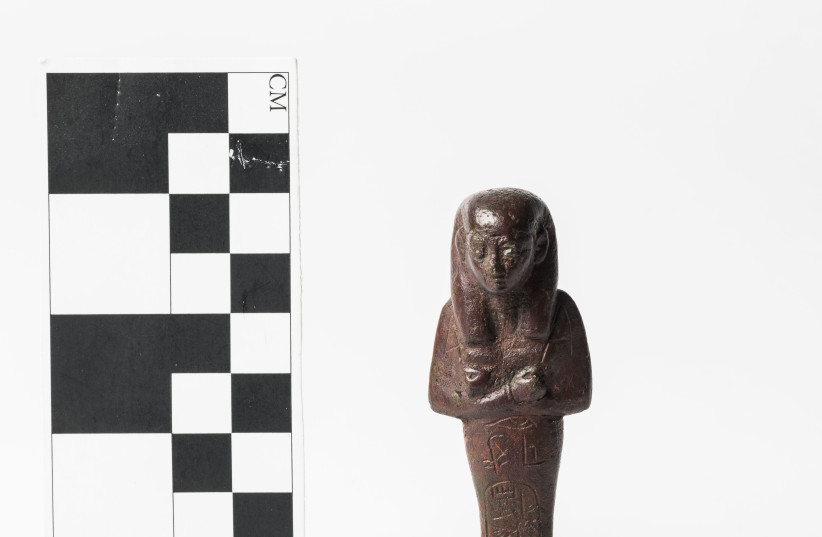
Ushabti of Psusennes I. / (photo credit: ISRAEL MUSEUM)

Did a massive trade route exist some 3,000 years ago between Egypt and Timna, home to the iconic copper mines which have become famous as “King Solomon’s Mines” located in the southern region of modern Israel?

A new innovative study led by Dr. Shirly Ben-Dor Evian, Israel Museum Curator of Egyptian Archaeology and Prof. Erez Ben-Yosef, head of the archaeometallurgical laboratory at Tel Aviv University and director of excavation at Timna, suggests that the answer is yes.

The study analyzed the bronze composition of four 3,000-year-old figurines from the museum’s collection found in the necropolis of Tanis, an Egyptian city in the Delta region that served as the capital of its regional kingdom. The researchers were able to ascertain that the copper used to produce the metal was mined at Timna.

The findings – recently published in the academic journal Journal of Archaeological Science: Reports – shed new light on the relations between Egypt and the populations of the Levant. And according to Ben Yosef, they offer an additional element to support his view that a nomadic kingdom at the time could constitute a wealthy and sophisticated society capable of entertaining complex commercial relations with foreign entities, offering important insights not only on what was happening in Timna – which he believes at the time was part of the biblical Kingdom of Edom – but also in the Jerusalem of King David and King Salomon.

The four artifacts – known as Shabti – are typical funerary figurines that were used in Egypt for millennia.

“In ancient Egypt all subjects were required to devote some time during the year to forced labor for the kingdom,” Ben-Dor Evian said. “Only the members of the elites received a special exemption from the king. However, there was a fear that this exemption would not be granted in the afterlife. For this reason, the members of the upper classes were buried with these figurines, which they thought would act as their servants and work on their behalf.”

The egyptologist noted that sometimes the shabtis in a tomb numbered in hundreds – one for every day of the year, plus some special figurines what would act and supervisors as well as a few extras, in case any of the servant was not able to work. The artifacts often featured elements such as baskets or agricultural tools.

While for several centuries shabtis were manufactured out of several materials, including faience – a primitive form of glass – pottery, and wood, during the Third Intermediate Period (1070–664 BCE) bronze became a very popular material, including for the funerary figurines.

“For decades the prevalence of bronze objects has represented an archaeological mystery because we do not know of any mining site in Egypt at the time,” Ben-Dor Evian said.

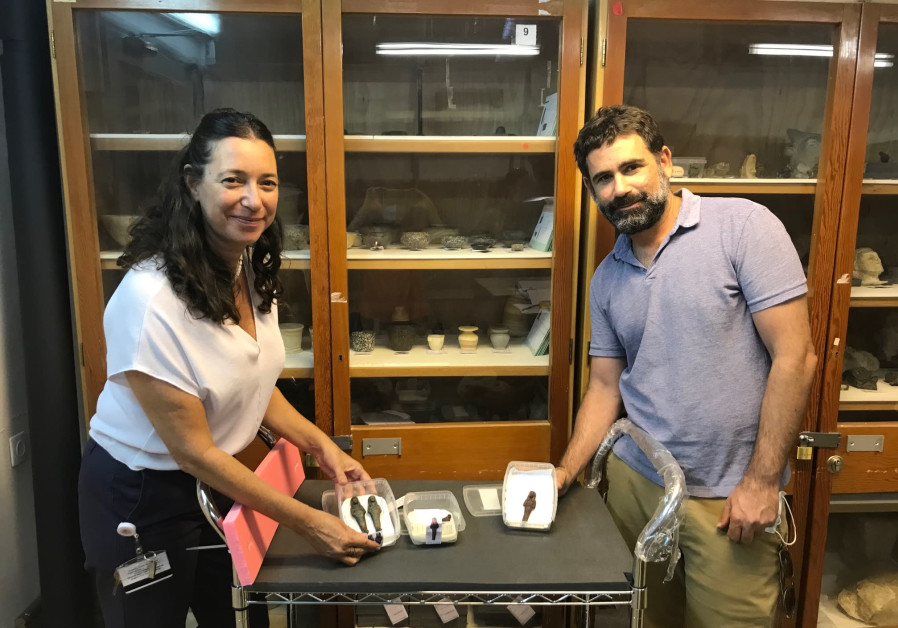
For this reason, the researcher had the idea of examining the bronze of a group of artifacts featured in the museum collection. The figurines were chosen because they carried the name of king Psusennes I, his wife and the chief of his army, well known historical figures dating to the second half of the 11th century BCE.
At the time, Egypt was divided and not as powerful as just a few centuries before.

“Yet, we see how it continued to influence the Levant region, as it emerges for example in the iconography of the area, including in some of the seals used by the King of Judah,” Ben-Dor Evian said. “We could describe it as cultural influence. We know that trade can be a powerful source for it.”
The expert contacted Ben Yosef and with a group of PhD students they conducted the lead isotope analysis on the figurines. For all of them, the copper was traced to Timna.

“Before our study, only one other similar study had been conducted, on an individual bronze object in Germany,” Ben Yosef said. “Also in this case, the copper came from Timna.”

While it might still be premature to affirm that the vast amount of copper used in Egypt at the time was all mined at Timna, the fact that five objects analyzed all came back with the same result offers a strong argument to suggest that an important trade route between the two regions existed.

According to Ben Yosef, this development shed further light on the sophistication of the society present at Timna.

The mines at Timna were traditionally associated with King Solomon and the Kingdom of Israel, until an excavation at the end of the 1960s revealed a small Egyptian temple which was brought as evidence that the mining activity was related to Egypt, and dated back to the 13th century BCE some 200 years before King David.

After Ben Yosef began to excavate again in 2013, radio-carbon dating of organic material found proved that the most intense activity of the site happened around 1,000 BCE, the time of David and Solomon, when Egypt was not powerful any more.

While the archaeologist believes that Timna was part of the Edomite Kingdom, which is prominently featured in the Bible, he has also suggested that what was happening at Timna was still very connected to the vicissitudes of contemporary Jerusalem.

Jerusalem could have indirectly controlled the mines – as the biblical text itself suggests when it narrates how David conquered Edom.

Some scholars think that the kingdom of David and Solomon could not have been as powerful as described in the Bible – since the archaeological remains from the time are very scarce. However, according to Ben Yosef, findings at Timna as well as the massive scale of its mining operation without any evidence of prominent buildings offer proof that a rich and powerful territorial entity could have existed without leaving behind such archaeological remains.

Ben-Dor Evian does not believe that at this juncture the cultural affiliation at Timna can be proven, but agrees on the importance of its operations.

For the future, the researchers hope to understand more about the centuries that followed, and especially what happened in terms of the relations between Egypt and the Levant under Sheshonq, who descended to the throne of Tanis around 950 BCE and is known to have launched a military campaign against the Kingdom of Israel, both from archaeological evidence and the biblical text.

“In the fifth year of King Rehoboam, King Shishak of Egypt marched against Jerusalem and carried off the treasures of the House of the LORD and the treasures of the royal palace. He carried off everything; he even carried off all the golden shields that Solomon had made,” reads a passage in the Book of Kings.

How did the war influence the copper trade? A lead isotope analysis of contemporary artifacts might be able to provide answers.


Zawartość publikowanych artykułów i materiałów nie reprezentuje poglądów ani opinii Reunion’68,
ani też webmastera Blogu Reunion’68, chyba ze jest to wyraźnie zaznaczone.
Twoje uwagi, linki, własne artykuły lub wiadomości prześlij na adres:
webmaster@reunion68.com


News From Israel – July 29, 2021

News From Israel – July 29, 2021

ILTV Israel News


#Nigeria finally releases the three Israelis they’ve been illegally detaining for nearly three weeks.

Investigations begin in the north, with the Nature and Parks Authority searching for the culprit or culprits behind a disastrous case of poisoning.

An incredible showing of faith, love, and cross-border cooperation. Three families from Israel and the United Arab Emirates enter into a precedent-setting organ swap agreement.


Zawartość publikowanych artykułów i materiałów nie reprezentuje poglądów ani opinii Reunion’68,
ani też webmastera Blogu Reunion’68, chyba ze jest to wyraźnie zaznaczone.
Twoje uwagi, linki, własne artykuły lub wiadomości prześlij na adres:
webmaster@reunion68.com

