Archives

Is Itamar Ben-Gvir the real winner of Israel’s elections?

Is Itamar Ben-Gvir the real winner of Israel’s elections?

AMOTZ ASA-EL


MIDDLE ISRAEL: Activist, rabble-rouser and lawyer Itamar Ben-Gvir, is the politician who outsmarted Benjamin Netanyahu himself.

.

Head of the Otzma Yehudit Party MK Itamar Ben-Gvir speaks to supporters as the results of the Israeli elections are announced, at the party’s campaign headquarters in Jerusalem, November 1, 2022. / (photo credit: YONATAN SINDEL/FLASH90)

Napoleon would have thus joined the pundits who crowned Itamar Ben-Gvir as our latest election’s winner. Chaos, the veteran provocateur’s claim to fame, is where the Jewish state has just arrived, and it has the 46-year-old zealot’s name written all over it.

As an activist, Ben-Gvir played tag with cops; as a rabble-rouser he provoked street fights; and as a lawyer, he dashed to any Jewish terrorist’s defense, all of which proved useful when he morphed into the politician who outsmarted Benjamin Netanyahu himself.

Promising a restoration of “personal security,” Ben-Gvir decried last year’s Israeli Arab violence in Arab-Jewish towns like Acre, Ramle and Lod, as well as Bedouin Israelis’ burglaries, robberies and protection rackets in the South. Both scourges brewed under Netanyahu’s watch, and Ben-Gvir knew he was attacking the man who will soon be his boss.

The problem, from Ben-Gvir’s viewpoint, is that he will now have to assume an executive office and actually get things done. Before that, he will have to negotiate his path to the booty he craves, a task that will require delicate bargaining opposite the man who now sees in him as a personal rival.

Netanyahu’s aim will be to bury Ben-Gvir in a ministry where he will be marginalized – tourism, agriculture or maybe religious affairs. Netanyahu will be assisted in this by others who feel threatened by Ben-Gvir, from the latter’s ticket-mate Bezalel Smotrich to Shas leader Arye Deri. Somewhere between his appointment and its aftermath, the limits of Ben-Gvir’s success will become apparent, as will his failure to control the chaos from which he has emerged.

Napoleon, for his part, after understanding who more than anyone else benefits from that same chaos, would have crowned Netanyahu as this election’s winner. He would be wrong.

Ben-Gvir is the winner. Who are Israel’s losers?
NETANYAHU HAS just avoided his career’s unceremonious end. At 73, another inconclusive result would have resulted in Netanyahu’s removal by his own party. His victory seems ever sweeter when one considers this contest’s many losers.

No, Yair Lapid is not among the losers, considering that his electorate grew by 40%. The big loser is Benny Gantz, whose two moves – teaming up with Justice Minister Gideon Sa’ar and recruiting Lt.-Gen. (res.) Gadi Eizenkot – delivered no results, as the configuration’s combined 14 seats in the outgoing Knesset failed to grow, and in fact shrank.

Eizenkot is a loser in his own right, having had sufficient time to formulate ideas and plans that would reflect a vision concerning the country’s problems and direction. Alas, like so many generals before him, he failed to discuss social, economic, constitutional, structural and cultural issues, sticking instead to defense and foreign affairs, thus failing to understand what troubles voters and how elections are won.

Losers were also the parties that inverted this attitude, most notably former accountant general Yaron Zelekha’s New Economic Party, and MK Abir Kara’s Economic Freedom Party, both of whom failed to enter the Knesset. The two’s alarmist suggestions that the Israeli economy is in deep crisis are factually unfounded, and now also proved electoral non-starters.

Netanyahu initially also tried to play this card, but unlike this pair he quickly understood people realized the economy was fine, certainly when compared to the rest of the world, and thus abandoned this theme, displaying the kind of agility a politician out to control chaos must possess.

This list of losers is besides this election’s biggest loser: Ayelet Shaked.

At this writing, several parties are teetering on the brink of the electoral threshold, but Shaked is not even near it. The charismatic electrical engineer who for several years was seen as a potential prime minister now collapsed because her quest – to present a nicer right-wing party – lacked an explanation of what she found wrong with Likud and because she did not present any original ideas.

Having served as Netanyahu’s bureau chief before falling from grace and abandoning him, Shaked’s downfall is to many of Netanyahu’s groupies the sweetest proof that he is back on the saddle, in full control of his battlefield’s chaos, and thus this election’s big winner. He isn’t.

NETANYAHU’S FIRST act as the reinstalled prime minister will seem to most people esoteric and harmless, as he will heed ultra-Orthodoxy’s demand to cancel the outgoing government’s religious reforms. Making new immigrants’ conversion harder and restoring thousands of party hacks to state-paid positions as kashrut supervisors in restaurants are the kind of currency he pays happily and generously.

In fact, this will be but a subplot in a tragedy dominated by three reactionary coalition partners, who collectively defy the Israeli majority’s liberalism, patriotism and feminism.

There will be very few women in the next coalition, and some of its members will be self-declared homophobes. Three of its four parties’ leaders will be men who made a mockery of their own military service through assorted draft-dodging arrangements. This background will not prevent their demanding, and obtaining, key ministries.

United Torah Judaism leader Yitzhak Goldknopf already said he wants to be finance minister, a statement no ultra-Orthodox politician ever previously made. His chances of getting this position are low, but someone else with an equally sectarian agenda – possibly Arye Deri – may well get to clutch the national chest.

Meanwhile, if Ben-Gvir lands the Public Security Ministry, he can be counted on to bring into this sensitive agency’s corridors the chaos that is its enemy and his expertise.

This is all besides what will happen in the Justice Ministry, where the assault on the judiciary that the Right has been demanding for years will now be launched across a broad front, in broad daylight.

And that is when this election’s real winner – chaos – will emerge all by itself atop the political podium: unopposed, unabashed and uncontrolled.

www.MiddleIsrael.net


The writer, a Hartman Institute fellow, is the author of the bestselling Mitzad Ha’ivelet Ha’yehudi (The Jewish March of Folly, Yediot Sefarim, 2019), a revisionist history of the Jewish people’s political leadership.


Zawartość publikowanych artykułów i materiałów nie reprezentuje poglądów ani opinii Reunion’68,
ani też webmastera Blogu Reunion’68, chyba ze jest to wyraźnie zaznaczone.
Twoje uwagi, linki, własne artykuły lub wiadomości prześlij na adres:
webmaster@reunion68.com


‘Bibi’ Offers Close-Up Look at Israeli Politician in Family Context

‘Bibi’ Offers Close-Up Look at Israeli Politician in Family Context

Ira Stoll


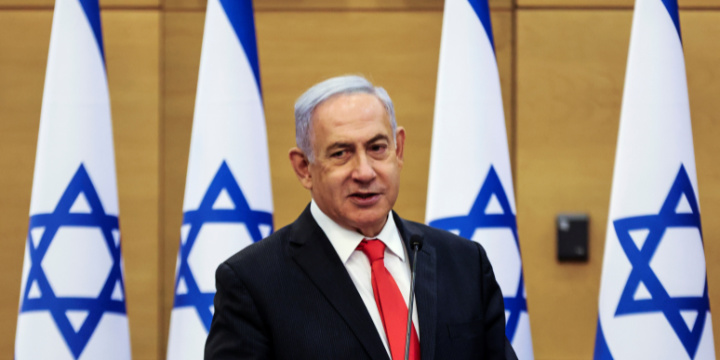
Leader of Israeli opposition Benjamin Netanyahu speaks during a meeting with his Likud party in the Knesset, the Israeli parliament, in Jerusalem June 14, 2021. Photo: REUTERS/Ronen Zvulun

Every Jewish American home library should have at least two books by authors named Netanyahu.

“Self-Portrait of a Hero,” the collection of letters by Jonathan Netanyahu, originally published in 1980, is a Zionist classic.

“The Origins of the Inquisition in Fifteenth Century Spain,” Benzion Netanyahu’s 1995 masterpiece, is one of the best works ever written about antisemitism.

What makes Benjamin Netanyahu’s new book “Bibi: My Story,” worthy of being added to the shelf in a place of honor alongside the other two is, strangely enough, precisely the light it sheds on how the author—Israel’s longest-serving prime minister—exists in relation to his older brother and father.

Benjamin Netanyahu’s challenge as an author is in some ways the same challenge he faced as a soldier and as a Zionist activist and leader: his older brother and his father got there earlier, and in such a profoundly excellent way, that their achievements are nearly impossible for Benjamin Netanyahu to top.

It’s worth remembering that due to Benjamin Netanyahu’s constant media spotlight, the other Netanyahus have receded. Jonathan Netanyahu died in 1976 after leading a successful Israeli military raid to liberate hostages held by terrorists in Entebbe, Uganda. Benzion Netanyahu died in 2012, and his activism—as opposed to his scholarship—took place in the 1930s and 1940s.

The genius of Benjamin Netanyahu’s new book, though, is the way it makes the other two Netanyahus, and their influence on him, come alive. Benjamin Netanyahu quotes his father warning in 1933 about “the Holocaust facing the Jewish people.” As Benjamin Netanyahu tells it, in the 1940s, his father figured out that “influencing Republican policy was the best way to influence Democratic Party.” Benzion Netanyahu briefed Senate Republican Leader Robert Taft on the case for a Jewish state, and in 1944, the Republicans adopted a platform “calling for unrestricted Jewish emigration to the Land of Israel and for the establishment of a Jewish state there.”

As for Jonathan Netanyahu, or Yoni, Benjamin served in the same elite special forces combat unit as his older brother. They both were educated in part in Cambridge, Massachusetts. The closest analogy in American history would be President Kennedy. JFK’s father was also a significant public figure. And Kennedy’s older brother and fellow Harvard graduate was killed in action in World War II, while JFK narrowly survived his own combat perils.

This is, in other words, not a standard, instantly forgettable, self-serving, score-settling campaign biography. It’s better than that, not only for its insight into what makes Netanyahu tick, but also for the insights into his policies. The account of how Israel’s GDP per capita grew to 19th in the world from 50th—surpassing Britain, France, Japan, Italy, and Spain—is a case study: tax cuts, welfare reform, deregulation, privatization. Netanyahu describes it as the transformation of Israel from a semisocialist country to a capitalist one.

It’s not a perfect book. There are more minor errors than there should be: a reference to the “diplomatic core,” to political consultant “David Shrum,” to lunching with Henry Kissinger at the “Four Seasons Hotel” (rather than the Four Seasons restaurant at which Kissinger was a regular). And while Netanyahu does own up to some tactical and political errors, I wish he’d have been a little less defensive, and a little more reflective, when it came to the assassination of Yitzhak Rabin.

But those are quibbles. If Netanyahu emerges from Israel’s November 1 election as again the prime minister of Israel, the world will understand him and his country better as a result of this book. And if he remains in opposition, or retires from politics, at least he will have the satisfaction of having succeeded as an author alongside his late brother and father. He’s added his telling of his own story—unfinished, but remarkable nonetheless—to the narrative of the Jewish people.


Ira Stoll was managing editor of The Forward and North American editor of The Jerusalem Post. His media critique, a regular Algemeiner feature, can be found here.


Zawartość publikowanych artykułów i materiałów nie reprezentuje poglądów ani opinii Reunion’68,
ani też webmastera Blogu Reunion’68, chyba ze jest to wyraźnie zaznaczone.
Twoje uwagi, linki, własne artykuły lub wiadomości prześlij na adres:
webmaster@reunion68.com


News From Israel- November 02, 2022

News From Israel- November 02, 2022

ILTV Israel News


The votes finally tallied – and the results coming in. Israel’s 25th Knesset now that much closer

Meantime, right wing parties celebrating as it appears they’ll likely form a government

But finally… as the last votes counted; changes may still arise. ILTV and expert panelists discussing the possibilities and what’s to come


Zawartość publikowanych artykułów i materiałów nie reprezentuje poglądów ani opinii Reunion’68,
ani też webmastera Blogu Reunion’68, chyba ze jest to wyraźnie zaznaczone.
Twoje uwagi, linki, własne artykuły lub wiadomości prześlij na adres:
webmaster@reunion68.com


Will a Netanyahu-Ben-Gvir gov’t change Israel as a Jewish state?

Will a Netanyahu-Ben-Gvir gov’t change Israel as a Jewish state?

ZVIKA KLEIN


The Religious Zionist Party has doubled its seats in the next government: The surge from seven seats to 14 or 15 will dramatically affect the possible right-wing government.

Jewish Power party leader Itamar Ben-Gvir?arrives at his party headquarters on the day of Israel’s election in Jerusalem November 1, 2022. / (photo credit: REUTERS/CORINNA KERN)

Both the Religious Zionist Party (RZP) and the Otzma Yehudit party looked very similar on Tuesday evening after the polls offered that their joint list received between 14 and 15 seats in Tuesday’s election.

Party members on both sides were singing and dancing while modern Jewish music was playing in the background, dancing in circles and displaying signs of joy and pride. Both parties are comprised of men wearing kippahs and tzitziot, yet they see themselves as very different from each other.

The RZP has doubled (and possibly more than doubled) its seats in the next government. The surge from seven seats to 14 or 15 will dramatically affect the possible right-wing government if they actually join it as a bloc of the two smaller parties that have joined forces with the support of former prime minister Benjamin Netanyahu.

RZP head Bezalel Smotrich ran in the list with extreme right candidate Itamar Ben Gvir, an individual with ties to Kach, a radical, Orthodox Jewish ultranationalist party that existed in Israel until 1994. According to polls, RZP be the third-largest party in the upcoming Knesset.

RZP holds newfound parliamentary power

The RZP has a few main topics that it wishes to promote, but the ones most relevant to diaspora Jews and secular Israelis are putting forward very conservative views regarding security, religion and state, and of course Israel-Diaspora relations.

Smotrich has said that he will strengthen Judea and Samaria and preferably ask for the Defense Ministry portfolio. In addition, Ben-Gvir is interested in leading the Public Security Ministry.

The second dramatic agenda has to do with a broad topic of issues regarding religion and state. Both Smotrich, his party members and Ben Gvir’s clan have a very conservative, and at times extreme, agenda in order to “strengthen Israel’s Jewish character.”

The Jewish character that the RZP party is looking to promote in Israel is at times even more extreme than the ultra-Orthodox; RZP members such as MK Avi Maoz, who represents the tiny Noam party, Rabbi Amichai Eliyahu and Smotrich himself would like to strengthen the Chief Rabbinate, totally cancel the Kotel deal, then distance the Reform and Conservative movements in Israel and try to freeze the small amount of funds that they received to date.

MK ITAMAR Ben-Gvir, head of the Otzma Yehudit political party, and MK Bezalel Smotrich, chairman of the Religious Zionist Party, at an election campaign event in Sderot earlier this month (credit: FLASH90)

Part of their agenda regarding religion and state is demanding the Diaspora Affairs Ministry portfolio. There are a number of party members that have begun quietly campaigning for the opportunity to become diaspora affairs minister if they join the government.

Possible candidates would be Eliyahu, the son of Safed’s Chief Rabbi Shmuel Eliyahu or former World Bnei Akiva CEO Ohad Tal. 

“We will amend the Law of Return and its different stipulations to reflect current trends in Israel and ensure Jewish continuity in the land of Israel,” the RZP platform states. According to the official document, the Religious Zionist party wants to “annul” the “Grandchild Clause,” which was legislated in 1970, allowing those with at least one Jewish grandparent to make aliyah and become Israeli citizens.

Many of the olim to Israel from Russia and Ukraine aren’t halachically Jewish, but they are still entitled to become Israelis because they have at least one Jewish grandparent. Will this change in a Netanyahu-Smotrich-Ben-Gvir government? It would be more probable than ever before. 

All of the reforms that former religious affairs minister Matan Kahana promoted such as Kashrut and conversion will be sent back in time, yet the party has said that they will insist on electing a Religious Zionist rabbi as the next chief rabbi of Israel.

“We will take a strong stand against the legal loopholes exploited by the Supreme Court with regard to Shabbat, conversions, kashrut, the independent functioning of rabbinical courts and defining the State of Israel as a Jewish state,” the RZP platform states. 

In addition, the RZP platform specified that it will “shore up the conversion system by passing the National Conversion Bill that will ensure that all conversions are conducted in accordance with Torah law and under the auspices of the Chief Rabbinate.”

In addition to making amendments in the Law of Return, RZP plans to “abolish”  what they call Yisrael Beytenu head Avigdor Liberman’s “Passport Law” and “stop handing out Israeli passports to non-Jews who exploit the law to scam the State of Israel,” according to the platform.

The Passport Law allows olim to receive Israeli passports without having to actually live in Israel. The RZP wants to make an amendment to this law. 

Regarding the promotion of traditional family values, RZP said it will “block laws that seek to undermine the fundamental foundations of the family unit.” This, supposedly, is referring to laws for same-sex couples and the like. In addition, it was stated that the RZP will “work to promote the birthrate and reduce the cost of living, specifically the cost of food and daycare.”

Future MK Tal told the Post a week ago that his party hopes to make changes in issues regarding the aliyah programs and benefits. According to Tal, there are “50,000 French Jews who, according to a recent study, would like to emigrate to Israel as soon as possible, but cannot make the move in the absence of a proactive plan to promote their aliyah.”

He also said that most of the aliyah benefits aren’t relevant to olim from western countries, rather for immigrants from Russia and Ethiopia. 

Both the White House and senior American Jewish figures have stressed that they won’t meet with Ben Gvir if he is elected as any sort of minister. Many American Jewish organizations have said off record that they would not only have a difficult time meeting with ministers from this party, they will have extreme discomfort with accepting this type of a government.

A Netanyahu-Smotrich-Ben-Gvir government will be very problematic for most American Jews who are for the most part progressive and liberal. 

Smotrich, who was asked by the UK’s Jewish community umbrella organization to leave their country because of his views, has been seen as of late as less of an extreme politician than he used to be, especially since Ben-Gvir began to stand to his right.

Even though the RZP wasn’t enthusiastic about running together with Otzma Yehudit, Ben-Gvir was good for Smotrich. The criticism that is directed toward Ben-Gvir and Smotrich enjoys a more mainstream approach towards the latter.


Zawartość publikowanych artykułów i materiałów nie reprezentuje poglądów ani opinii Reunion’68,
ani też webmastera Blogu Reunion’68, chyba ze jest to wyraźnie zaznaczone.
Twoje uwagi, linki, własne artykuły lub wiadomości prześlij na adres:
webmaster@reunion68.com


News From Israel- November 01, 2022

News From Israel- November 01, 2022

ILTV Israel News


Israelis from all walks finally head back to the polling booths for the fifth serial election in fewer than 4 years

Meantime, ahead of the results – a panel discussion on what’s most important to voters on election day

And finally… A stark election message from the President of the Jewish state to the leaders of North American Jewish groups


Zawartość publikowanych artykułów i materiałów nie reprezentuje poglądów ani opinii Reunion’68,
ani też webmastera Blogu Reunion’68, chyba ze jest to wyraźnie zaznaczone.
Twoje uwagi, linki, własne artykuły lub wiadomości prześlij na adres:
webmaster@reunion68.com