Archives

Film Festival Gives Gazans a Rare Taste of the Movies

Film Festival Gives Gazans a Rare Taste of the Movies

Reuters and Algemeiner Staff


Palestinian volunteers participate in organizing the sixth edition of the Red Carpet Film Festival, at a newly renovated theatre in Gaza City, October 13, 2022. Photo: REUTERS/Ibraheem Abu Mustafa

Film buffs in the Gaza Strip, who for decades have been deprived of going to the movies due to the destruction of cinemas during bouts of unrest in the enclave, are enjoying a rare chance to see a slate of films on the big screen.

Cinema once flourished in Gaza, with audiences flocking to see Arab, Western and Asian films, but the movie houses were torched in the First Intifada in 1987 and then burned down again in 1996 during another wave of internal violence.

Since then, Gazans have had to rely on television and online streaming services and the chance to see films on the big screen offered a rare treat for people living under a border blockade imposed by neighboring Israel and Egypt.

The Red Carpet Human Rights Film Festival, which opened on Thursday, is showing around 40 films at a recently renovated culture center, around half dealing with the decades-long conflict with Israel and the rest dealing with human rights issues around the world.

While Gazans have been able to go to movie screenings which are held from time to time at theatres and other venues, such a full bill of films is a rare treat.

The festival’s executive manager, Montaser Al-Sabe, said he was proud of the festival in Gaza but that he hoped cinemas would open up again.

“We have cinemas in Gaza that are closed, open them,” he said.

Around 300 films from 60 countries were submitted before organizers made their selection, which included films by four young local filmmakers who had the rare opportunity to show their work to local audiences.

All the films had to be reviewed ahead of screening by local authorities in Gaza, which has been controlled by the militant Hamas group since 2007.

Among the films on show was “Eleven Days in May,” co-directed by Gaza director Mohammed Sawwaf and British director Michael Winterbottom, which tells the story of 66 children killed in the 11-day war between Israel and Gaza militants in May 2021.

“We focused on their beautiful memories, their jokes and their dreams,” Sawwaf said. “Cinema is a civilized and important means to get the voice of children and the people of Gaza to the world.”

He said the movie was narrated by Hollywood actress, Kate Winslet, who starred in the world-famous movie “Titanic,” and music by Max Richter.

But for some, the festival will be all about the simple pleasure of going to the cinema and watching a movie with loved ones.

“Outside Gaza, I had stood in line and bought a ticket. I hope I go through the same experience here in Gaza Strip and that I can take my little family and watch a movie at a cinema together,” said Amira Hamdan, who was there with her husband.


Zawartość publikowanych artykułów i materiałów nie reprezentuje poglądów ani opinii Reunion’68,
ani też webmastera Blogu Reunion’68, chyba ze jest to wyraźnie zaznaczone.
Twoje uwagi, linki, własne artykuły lub wiadomości prześlij na adres:
webmaster@reunion68.com

Israeli archaeologists reveal cache of guns Arabs used against British

Israeli archaeologists reveal cache of guns Arabs used against British

JERUSALEM POST STAFF


The weapons cache, which included the remains of around 100 guns, will be presented at a special conference for police officers and archaeologists.
.

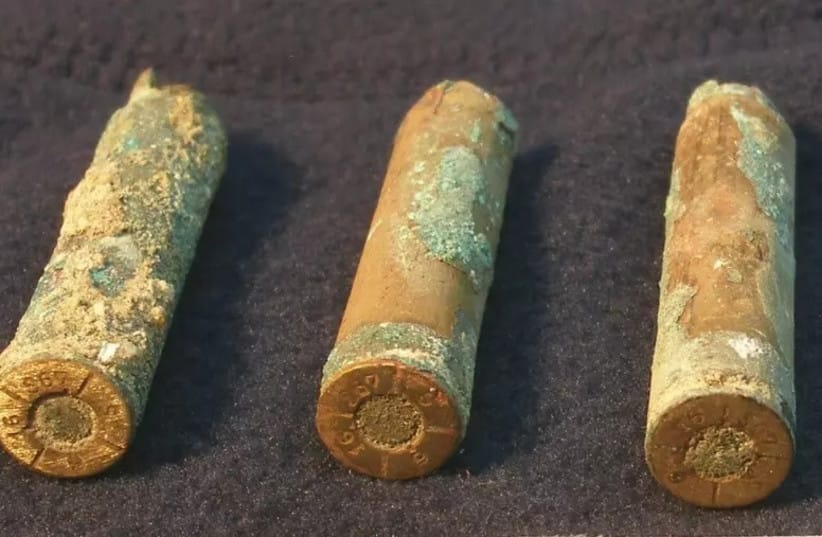
Bullets that were among the finds in the Arab militia weapons cache found in Jaffa. / (photo credit: Israel Antiquities Authority)

A long-lost cache of weapons was discovered in Jaffa, which was originally meant to be used by local Arabs against the British, the Israel Antiquities Authority (IAA) announced Wednesday.

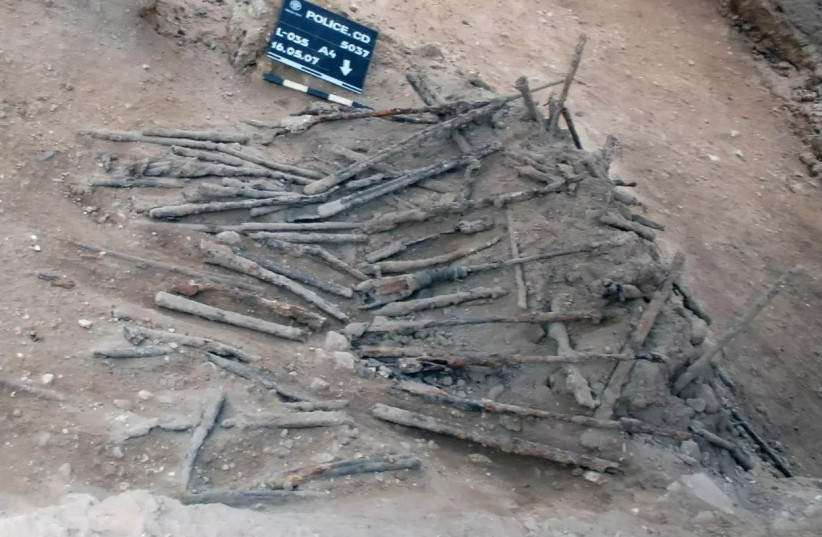
The weapons cache, which included the remains of around 100 guns, will be presented Thursday at a special conference for police officers and archaeologists and highlights the difficult battle the police of the British Mandate era waged against the illegal arms trade and armed Arab militia groups.

Jaffa Arab guns: Where were they found, what were they for?

The weapons cache was discovered at an old and infamous police station and detention center in Jaffa, located near the Jaffa clock tower square.

This was an area of major importance for both the British and the Ottomans, and thus had a very high police and military presence over the years.

Examples of the guns found in the Arab weapons cache in Jaffa. (credit: Israel Antiquities Authority)

Consequently, it’s also been home to a number of interesting archaeological discoveries.

This includes the aforementioned weapons cache of around 100 different guns, ranging from World War I military rifles to double-barreled hunting guns. 

First World War-era bullets, artillery shells and military equipment were also found.

The illegal weapons were bought by the Arab militias from merchants who themselves sourced them from a number of suppliers, such as Bedouin tribes that would scavenge them off of battlefields.

Oddly enough, some of these weapons seemed to have been broken on purpose, according to IAA researchers Alexander Glick and Dr. Yoav Arbel, who also speculated that they were seized by police from local Arab militias. 

There is also considerable interest in what kind of guns were included, such as manufacturer information, country and year of origin and so on, as it lends valuable data about the international illegal arms trade of the era.

This is why the cache will be presented at the joint police-archaeologist conference, which itself is meant to highlight the similarities in policework like forensic science to the techniques employed by archaeologists.


Zawartość publikowanych artykułów i materiałów nie reprezentuje poglądów ani opinii Reunion’68,
ani też webmastera Blogu Reunion’68, chyba ze jest to wyraźnie zaznaczone.
Twoje uwagi, linki, własne artykuły lub wiadomości prześlij na adres:
webmaster@reunion68.com


News From Israel- October 30, 2022

News From Israel- October 30, 2022


ILTV Israel News


One Israeli civilian murdered and at least three more injured in a deadly terror attack near Hebron, Saturday night.

Meantime… campaigns heating up with just 2 days remaining ahead of elections…

And finally – the Saltiest art you’ll ever see. the Israel museum opening an exhibit some 20 years in the making.


Zawartość publikowanych artykułów i materiałów nie reprezentuje poglądów ani opinii Reunion’68,
ani też webmastera Blogu Reunion’68, chyba ze jest to wyraźnie zaznaczone.
Twoje uwagi, linki, własne artykuły lub wiadomości prześlij na adres:
webmaster@reunion68.com


Graffiti of knight from Middle Ages discovered in King David’s Tomb

Graffiti of knight from Middle Ages discovered in King David’s Tomb

JERUSALEM POST STAFF


IAA researchers discovered an inscription bearing the name and family emblem of a Swiss noble who made a pilgrimage to Jerusalem in 1466.

.
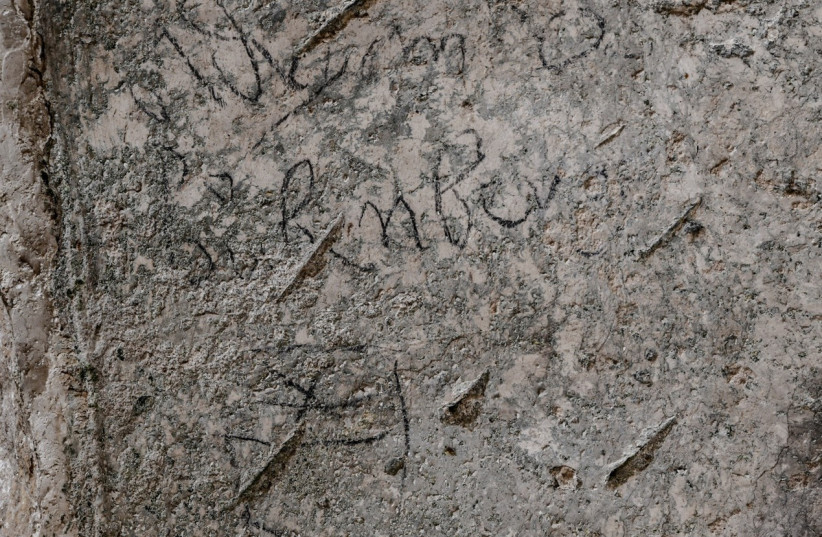
An inscription bearing the name of Swiss noble Adrian von Bubenberg, discovered in King David’s Tomb in Jerusalem / (photo credit: SHAI HALEVI / ISRAEL ANTIQUITIES AUTHORITY)

A piece of graffiti bearing the name of Knight Adrian von Bubenberg along with his family emblem was discovered on the wall of King David’s Tomb on Mount Zion, in Israel’s capital of Jerusalem, the Israel Antiquities Authority announced on Thursday.

Found as part of the IAA’s research project documenting pilgrims’ inscriptions, the researchers discovered the graffiti bearing the name of the Swiss noble, who was dubbed a Knight of the Holy Sepulchre following his pilgrimage to Jerusalem in 1466.

More than 40 inscriptions belonging to both Christian and Muslim pilgrims, in several languages, were discovered during the IAA’s project.

The research results were announced in a conference titled New Archaeological Studies in Jerusalem and the Vicinity, jointly held with the Hebrew University of Jerusalem and Tel Aviv University on Wednesday.

Who was Adrian von Bubenberg?

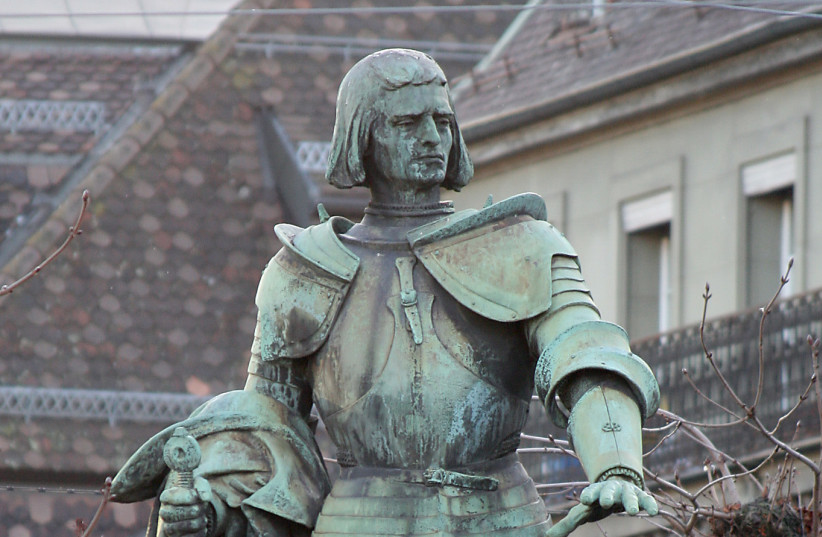
Bubenberg, born in 1424, was labeled a Swiss national hero for military conquests across Europe, specifically in the Battle of Morat, fought as part of the Burgundian Wars of the 15th century.

He died in 1479 and was buried in the Bern Minster, the cathedral of Switzerland’s de-facto capital Bern, where he was mayor for three separate terms.

A bronze monument displaying the likeness of von Bubenberg can be found in the Swiss capital’s old city, in the Bubenbergplatz Plaza, named after the Middle Ages nobleman.

Statue of Adrian von Bubenberg, in Bern, Switzerland (credit: Wikimedia Commons)

Why was his name inscribed on the walls of King David’s Tomb?

The IAA project leaders, Michael Chernin and Shai Halevi, explained that “in the Mamluk period [of control of the Land of Israel], the building complex adjacent to the traditional tomb of King David was owned by the monks of the Franciscan Catholic Order.

“The building served as a monastery and a hostel for the Western pilgrims, who left their mark on the walls,” they said, noting that “technological methods developed today enable reading the faded inscriptions.”

These technologies use multispectral photography, the IAA said. By using different wavelengths invisible to the human eye, these ancient inscriptions that have since faded and been erased can be viewed.

“Believers, pilgrims and visitors seeking to make contact with sanctified Jerusalem, left traces that the IAA researchers reveal and record on a daily basis,” according to authority director Eli Escusido. 

“All these remains contribute to the fascinating picture,” he said: “Research carried out in Jerusalem embraces religions and cultures worldwide.”


Zawartość publikowanych artykułów i materiałów nie reprezentuje poglądów ani opinii Reunion’68,
ani też webmastera Blogu Reunion’68, chyba ze jest to wyraźnie zaznaczone.
Twoje uwagi, linki, własne artykuły lub wiadomości prześlij na adres:
webmaster@reunion68.com

‘Diplomatic Achievement’: Israel Signs Lebanon Border Agreement, Ending Decades-Long Dispute

‘Diplomatic Achievement’: Israel Signs Lebanon Border Agreement, Ending Decades-Long Dispute

Sharon Wrobel


Israeli Prime Minister Yair Lapid at a signing ceremony for the Israel-Lebanon Maritime Border Argreement Credit: Amos Ben-Gershom (GPO)

Prime Minister Yair Lapid on Thursday signed the US-mediated maritime border agreement with Lebanon resolving a decades-long dispute over territorial rights and the exploitation of gas reserves in the Mediterranean Sea.

“This agreement strengthens Israel’s security and our freedom of action against Hezbollah and the threats to our north,” Lapid remarked at the start of the special cabinet meeting for the approval of the maritime agreement. “There is rare consensus in the security establishment regarding the necessity of this agreement.”

Lapid noted that Defense Minister Benny Gantz, the IDF, the Mossad, and the security establishment backed the agreement and its necessity for Israel’s security and operational needs. The breakthrough of the landmark deal mediated by US envoy Amos Hochstein comes just days before Israel is headed to its fifth election within three and a half years on Nov. 1.

The signing ceremony was held at the Prime Minister’s Office in Jerusalem after Israel’s cabinet convened to vote on the approval of the maritime boundary agreement between the two countries which don’t have diplomatic relations. Earlier Lebanese President Michel Aoun signed a letter approving the deal in Baada.

Lapid hailed the agreement as a “historic” and “tremendous achievement” by the government contributing to national “security, economically, diplomatically, and in energy.”

“It is not every day that an enemy country recognizes the State of Israel, in a written agreement, in view of the international community,” Lapid asserted. “It is not every day the United States and France stand behind us and provide security and economic guarantees for an agreement.”

During the ongoing indirect talks leading up to the formulation of the agreement, the head of Iranian-backed Hezbollah terrorist organization Hassan Nasrallah escalated threats to attack Israeli targets in the Karish gas field, located south of the previously contested sea border area, if there is no understanding on the maritime border demarcation.

According to Orna Mizrahi, a senior analyst at the Institute for National Security Studies, the agreement is a compromise but serves the interests and benefits of both countries in terms of regional stability and security that in turn may attract more investment to develop gas reserves.

A permanent demarcation of the maritime border between two countries can be viewed as Lebanese recognition of Israel, according to Mizrahi.

“Despite the indirect talks and the Lebanese effort to prevent any sign of normalization, due to Hezbollah’s determined opposition, the agreement reflects a fundamental change in the relations between the two states,” Mizrahi said. “It pulls the rug out from under Hezbollah’s claims that Israel is an illegitimate entity that should not be recognized; proves that Hezbollah is not omnipotent in Lebanon and is also forced to compromise; and may contribute to a positive change in the Lebanese public’s perception of Israel and create an opening for future progress in relations.”


Zawartość publikowanych artykułów i materiałów nie reprezentuje poglądów ani opinii Reunion’68,
ani też webmastera Blogu Reunion’68, chyba ze jest to wyraźnie zaznaczone.
Twoje uwagi, linki, własne artykuły lub wiadomości prześlij na adres:
webmaster@reunion68.com