 The Arabs of Palestine
Martha Gellhorn | October 1961 Issue
ACCORDING to Arab politicians and apologists, this is what happened, this is the authentic view, these are the facts. Doubt is treasonous. There can be only one truth, according to Arab politicians and apologists, and it belongs to them:
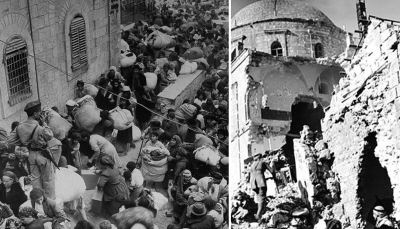
In 1948, war took place between five Arab nations of the Middle East and the Jews in Palestine. This war was caused by the United Nations, whose General Assembly resolved to partition Palestine into two states, one for the Palestinian Arabs, the other for the Jews. The Arab nations and the Palestinian Arabs would not accept this monstrous decision. They were obliged to protect themselves against it, with force. The United Nations operated as the tool of the Western Imperialists, notably Great Britain and the United States. The United Nations wanted the Jews to proclaim the upstart state of Israel. Because of the Western Imperialists, who favored Israel, the Arabs lost the war. By massacre, threatening broadcasts, pointed bayonets, and the murderous siege of cities, the Jews drove hundreds of thousands of Arabs out of their homeland. For thirteen years, these Arab refugees have languished in misery around the borders of Israel. The United Nations (Western branch) bears the blame for these events and must repair the damage. The condition of the refugees is a sore on the conscience of honorable men. The Israeli government refuses to welcome back to their homeland the refugees, now swollen to more than a million in number. This refusal demonstrates the brutality and dishonesty of Israel, an abnormal nation of aliens who not only forced innocent people into exile but also stole their property. There is no solution to this injustice, the greatest the world has ever seen, except to repatriate all Palestinian refugees in Palestine. Palestine is an Arab country, now infamously called Israel. Israel has no right to exist, and the Arab nations will not sign peace treaties with it but will, by every means possible, maintain the state of war.
The details of the Arab case vary, depending on the political climate of the moment and the audience. However, the Palestinian refugees always remain the invaluable, central theme. The case is painted the color of blood in the Arab countries: Revenge and Return. For the Western public, tears replace blood; the Arab case rests on the plight of the refugees and is a call to conscience rather than to arms. But no Arab statesman has ever promised final peace with Israel if only the million Palestinian refugees may return to their former homes.
The best way to consider this case is close up, by looking at the Palestinian refugees themselves, not as a “problem,” not as statistics, but as people. The Palestinian refugees, battered by thirteen years in the arena of international politics, have lost their shape; they appear as a lump and are spoken of as one object. They are individuals, like everyone else.
Despite the unique care and concern they have received, despite the unique publicity which rages around them, the Arab refugees, alas, are not unique. Although no one knows exactly how many refugees are scattered everywhere over the globe, it is estimated that since World War II, and only since then, at least thirty-nine million non-Arab men, women, and children have become homeless refugees, through no choice of their own. Their numbers grow every year; Angolans are the latest addition to the long list. The causes for this uprooting are always different, but the result is the same: the uprooted have lost what they had and where they came from and must start life again as handicapped strangers wherever they are allowed to live.
The world could be far more generous to these unwilling wanderers, but at least the world has never thought of exploiting them. They are recognized as people, not pawns. By their own efforts, and with help from those devoted to their service, all but some six million of the thirty-nine million have made a place for themselves, found work and another chance for the future. To be a refugee is not necessarily a life sentence.
The unique misfortune of the Palestinian refugees is that they are a weapon in what seems to be a permanent war. Alarming signs, from Egypt, warn us that the Palestinian refugees may develop into more than a justification for cold war against Israel. We ignored Mein Kampf in its day, as the ravings of a lunatic, written for limited home consumption. We ought to have learned never to ignore dictators or their books. Egypt’s Liberation, by Gamal Abdel Nasser, deserves careful notice. It is short, low-keyed, and tells us once again that a nation has been ordained by fate to lead–this time, to lead the Arab nations, all Africa, all Islam. The Palestinian refugees are not mentioned, and today, in the Middle East, you get a repeated sinking sensation about the Palestinian refugees: they are only a beginning, not an end. Their function is to hang around and be constantly useful as a goad. The ultimate aim is not such humane small potatoes as repatriating refugees.
THE word “refugee” is drenched in memories which stretch back over too many years and too many landscapes: Spain, Czechoslovakia, China, Finland, England, Italy, Holland, Germany. In Madrid, between artillery bombardments, children were stuffed into trucks to be taken somewhere, out of that roulette death, while their mothers clung to the tailboards of the trucks and were dragged weeping after the bewildered, weeping children. In Germany, at war’s end, the whole country seemed alive with the roaming mad — slave laborers, concentration camp survivors who spoke the many tongues of Babel, dressed in whatever scraps they had looted, and searched for food in stalled freight cars though the very rail-yards were being bombed. From China to Finland, people like these defined the meaning of “refugee.”
No one could wish to see even a pale imitation of such anguish again. In the Middle East, there would be no high explosive, no concentration camps, but the imagined, expected scene was bad enough; lice and rickets and tuberculosis, bodies rotting in the heat, the apathy of despair. Why, in 1961, did I have such a picture of the Palestinian refugees? Obviously from what I had read, as one of the average absorbent reading public; notions float in the air exactly as dust does. Nothing that I had read or heard prepared me for what I found.
What do they look like, the undifferentiated mass known as the “Palestinian Refugee Problem”? What do they think, feel, say? What do they want? How do they live, where do they live, what do they do? Who takes care of them? What future can they hope for, in terms of reality, not in terms of slogans, which are meaningless if not actually fatal, as we know.
The children are as fast as birds, irreverent as monkeys, large-eyed, ready to laugh. The young girls, trained by carrying water jars or other heavy household bundles on their heads, move like ballerinas and are shrouded in modesty and silence as if in cocoons. The young men, crudely or finely formed, have in common the hopefulness and swagger of their new manhood. The middle years seem nondescript, in both sexes. After this the women, who age quickly but not as quickly as the men, wear unpainted experience on their faces; they look patient, humorous, and strong. When the men have grown visibly old, they turn into a race of grandees. Their color, infant to patriarch, ranges from golden fair to mahogany dark, all warmed by the glaze of sun. The instinct for hospitality, the elegance of manner have not been exaggerated.
UNRWA (the United Nations Relief and Works Agency for Palestine Refugees in the Near East), inheriting its role from previous caretakers, has been the splendid mother-and-father of these people for eleven years. In the course of its parenthood UNRWA has spent about $360 million on the Arab refugees, this money having been contributed by members of the United Nations, with smaller but loving donations from private charitable organizations as well. Of the total the United States provided more than $238 million, Great Britain over $65 million–but spread across the years and in varying amounts, sixty-one states, including Israel and the Holy See, have helped with cash. The Soviet Union has never paid one cent. This is a tiny note of malice: Arab refugees often express tender emotions for the Soviet Union, whereas most of the village orators blame the United States and England, or that bogey, “Western Imperialism,” for their exile.
In the so-called “host countries,” Lebanon, Jordan, Syria, and Egypt, UNRWA runs fifty-eight refugee camps. The camps in Egypt are not in Egypt but in the Gaza Strip, which is Palestine; Egypt is the de facto mandatory power, the land and the government of the Gaza Strip are Palestinian. The majority of camps in Jordan are also on what was the territory of Palestine, now annexed to Jordan.
UNRWA has never yet been allowed to make a total proper census of its refugee population, so statistics about the number of ex-Palestinians are nothing except the best estimate possible; UNRWA itself says this. Over half of the registered Palestinian refugees do not live in camps, but have made more or less comfortable private arrangements varying from first-class houses, at the top, to hand-built Hooverville shacks, at the bottom. UNRWA calculates that, at the end of June, 1960, 421,500 refugees were living in their camps, almost double their camp population ten years ago. The advantage of living in a camp is that life there is rent free; and for the poor, the standard of housing and sanitation in an UNRWA camp is better than that of the native population.
The international personnel of UNRWA, Americans and Western Europeans, is small; 128 men and women work in four countries. The mass of those who serve the Palestinian refugees are Palestinian refugees themselves, something over 10,000 of them. UNRWA is running a world, simply, a little welfare state. It makes villages, called camps, and keeps them clean and free of disease, feeds, educates, trains teachers and technicians and craftsmen, operates clinics and maternity centers, sends out visiting nurses, encourages small private enterprises with small loans, distributes clothing, soap, kerosene, blankets, provides hospitalization, footballs, youth clubs, mosques.
UNRWA is a kind, impartial parent; it has no favorites. However, people are all different, luckily; and though one man will arrive in exile as a destitute refugee and in time own a whopping Chevrolet and be a self-employed taxi driver, with a cozy home and a smiling wife in a flowered print dress and a gleaming refrigerator in the dining room, another will remain in whatever shelter UNRWA gave him, sitting either on his own floor or at a café table, waiting for nothing, or for divine intervention, or for the mailed, promised, delivering fist of Nasser. UNRWA did not invent the human condition.
Of UNRWA’s fifty-eight camps, I visited eight–in Lebanon, the Gaza Strip, and Jordan. The plan and facilities of every UNRWA camp are alike; they differ only in size and are better or worse depending on whether they are newer or older and on the character of the people who live in them. Each camp has its clinic and school (or schools), warehouse center for distributing rations, “supplementary feeding station,” where hot meals are served to those who need them, village bazaar street with small shops, market booths, cafés. The bigger the camp, the bigger the bazaar. I also went round two hospitals, two vocational training schools, and was received in two private homes, having been invited by refugees.
My guide and chaperone was an UNRWA employee, a Palestinian Arab, who served as translator when needed. My system was to say: please show me your best and your worst camp, and if time permits, let us also look at the in-between. In the camps, I knocked on any door and many. Nothing was planned. We chatted at random and went wherever I liked. In the Gaza Strip, I was accompanied for a day by a young Palestinian in a pin-striped suit; he or someone like him is a cross every foreigner has to bear. He is local Secret Service, and the refugees know this; he is an ardent Nasserite, as apparently all Palestinian government officials in Gaza are, or must appear to be; and he is by avocation a propagandist and demagogue. At one Gaza camp, besides this young gent, I had an escort of three Palestinian cops who lent an even heavier note to the proceedings. Otherwise, my visits were uncensored. I may have seen a true cross section of the Palestinian refugee population, and I may not have. I only know that I saw real people in the flesh, and a large number of them, and I know what they said. When the word “they” appears on these pages, it means those Arabs whom I saw; it means nothing more.
BEIRUT is a lovely boom town, an entrancing mixture of Asia Minor and France, with scenery to lift the heart and glamour hotels all over the lot and more abuilding. We set off, my Palestinian guide and I, in a shiny car for an UNRWA camp in the Lebanese hills. My guide, like his colleagues who accompanied me elsewhere, was an executive, responsible for an UNRWA department, dressed in a Western business suit, a self-assured, middle-class Organization Man. The refugees are not only individuals, but they come from widely different social backgrounds. Men of the class of my guides would not be living in refugee camps; they might work in them as doctors or teachers.
This camp was inhabited exclusively by Christian Arabs. I wondered aloud at a separation by creed. My guide was a Muslim and said that Christian camps were always cleaner and superior to Muslim ones, and besides, very few Christians lived in camps; they arranged their lives better on their own.
The camp consisted of little cement or frame houses rambling over the hillside, a village of poor people, disorderly and beflowered and cheerful. School was letting out for lunch; troops of children, dressed in the pinafore uniform that small boys and girls wear in Italian schools, meandered home, shouting bye-bye at friendly, giggling length. They are Roman Catholics here, but the young teachers are refugees, not priests. They have to teach the children about Palestine, since most of them have never seen the country and even the oldest cannot remember it. The children are taught hate, the Garden of Eden stolen from them by murderers; their duty is to live for Return and Revenge.
The miniature white clinic had only one customer, a nice-looking girl of twenty-one who had brought her fourth baby for a checkup. Her husband works in Libya; she too lived there for a few years but returned. Libya is very expensive; she can live here with his parents and thus save money for the future. The resident nurse, a buxom elderly woman, said they had no real sickness; in summer, the children got a bit of conjunctivitis and diarrhea; oh, no, trachoma is very rare, and besides, we cure it; there’s some chicken pox now. My guide announced that if any refugee needed an operation he was taken in an ambulance to a hospital in Beirut where UNRWA reserved beds and paid for everything; you would have to be a rich man in Lebanon to get such good and speedy treatment. Her fourth baby, I mused, and she only twenty-one. Yes, yes, said my guide, the refugees have a higher birth rate than any other Arabs, and healthier children.
Refugees receive a monthly basic food ration of flour, pulse (dried peas, beans, lentils), sugar, rice, oils, and fats; this amounts to 1500 calories a day per person, increased in winter to 1600 calories a day, and it is not enough. The refugee must find some way to earn money to increase his diet, or keep poultry or rabbits, or grow vegetables. Many had planted tiny gardens here, but charmingly and with more enthusiasm, they also grow flowers for the joy of the thing. There is a daily milk ration for children and pregnant and nursing mothers; and hot meals are served in the “supplementary feeding station,” to those who need them, on the doctor’s order. In this camp, said my guide, 85 per cent of the people have work. If there are hardship cases, when no one can bring money to the family, UNRWA’s Welfare Section steps in. This pattern is universal.
If you think it your duty, I said, to make everything seem better than it is, don’t. I’m not on an inspection tour, I only want to get some idea of what life is really like. He stopped, offended, in the middle of the stony path and explained: here, in Lebanon, 80 per cent of the refugees are better off than they were in Palestine. Twenty per cent are not. The 20 per cent were small capitalists, and there is much rivalry with the Lebanese in business, they make obstacles. Also it is political; they do not give the refugees citizenship, you understand, because the main part of the refugees are Muslims and that would upset the balance here, where the Christians rule. I do not speak to you of the rich Palestinian refugees; they are richer than before, they are very happy.
WE WENT to pay the required visite de politesse to the camp leader. Every camp leader acts as an appointed village mayor; he has to keep the place running, serve as liaison officer with UNRWA local headquarters, and handle the complaints of his own people. Sitting in his neat office, with my guide, the principal of the school (a former member of the Palestinian police), and the camp leader, I listened to the first of what became an almost daily Mad Hatter conversation.
It went like this:
“The Arab countries invaded Israel in 1948 to save the Palestine Arabs from being massacred by the Jews.”
“Were there massacres? Where?”
“Oh, yes, everywhere. Terrible, terrible.”
“Then you must have lost many relatives and friends.”
This, being a tiresome deduction from a previous statement, is brushed aside without comment.
“Israel overran the truce lines and stole our country. We left from fear. We have a right to our property, which brings in 47 million pounds a year in income. If we had our own money, we would need nothing from UNRWA. Our own money is much more. We do not have to be grateful for the little money spent on us. We should have our own.”
“Then, of course, you want to return to your property and to Israel?”
“Not to Israel. Never to Israel. To our own country, to our own part.”
“But didn’t the Jews accept Partition, while the Palestine Arabs and the Arab governments refused?”
“Yes, yes. And England protected the Jews. An Arab was arrested if he carried a pistol only to defend himself, but Jews could go through the streets in tanks and nothing happened to them. Also, England told the Arab states to attack Israel.”
The principal of the school then spoke up. “In our school, we teach the children from their first year about their country and how it was stolen from them. I tell my son of seven. You will see: one day a man of eighty and a child so high, all, all will go home with arms in their hands and take back their country by force.”
On this warlike note, we left. My guide had seemed a sober contented fellow until our little meeting, whereupon he sounded like a politician running recklessly for office. He then astonished me again.
“It can all be solved with money,” he said. “Now the people have nothing in their mouths but words, so they talk. Money fills the mouth too. If every man got a thousand dollars for each member of his family, for compensation to have lost his country, and he could be a citizen in any Arab country he likes, he would not think of Palestine any more. Then he could start a new life and be rich and happy. And those who really do own something in Palestine must be paid for what they had there. But those are not many. Most had nothing, only work.”
HIGH on a mountaintop, with a down-sweeping view of orange groves and the satin blue of the Mediterranean, is a small Muslim camp named Mia Mia. Here one whole Palestinian village, amongst others, had landed; they came from a mountaintop in Galilee, a place called Meron. Their headman, or village leader, the Muktar, plied us with Coca-Cola and Turkish coffee in his exile’s parlor. He is a beautiful man, perhaps sixty-five years old, lean, with exquisite manners. He wore the handsome white Arab headdress, held in place by the usual black double-corded crown; he was dressed in a well-preserved cream silk jacket, a white silk shirt, pressed gray flannel trousers, polished Italianate black shoes.
Read more: The Arabs of Palestine
MARTHA GELLHORN, novelist, journalist, and former war correspondent, has recently returned from a journey to the Middle East, where she went to see the “Palestinian Refugee Problem” in terms of real life, real people. Here she reports how the Arab refugees and the Arab Israelis live, and what they say about themselves, their past and their future.
twoje uwagi, linki, wlasne artykuly, lub wiadomosci przeslij do: webmaster@reunion68.com


 Yad Vashem


 Stowarzyszenie Europa i My