
Archive | August 2023

The French Riots and the Jews

The French Riots and the Jews

MARC WEITZMANN


The recent chaos is not an antisemitic intifada—it’s something worse.
.

An overturned car burns during clashes between French police forces and youths after a memorial march for French teenager Nahel Merzouk, shot by police during a traffic control stop in Nanterre, France, on June 29, 2023 / ABDULMONAM EASSA/ GETTY IMAGES

On June 30, three days after the killing of Nahel Merzouk, 17, by a police officer during a police check in the city of Nanterre, near Paris, and the ensuing riots all across the country, right-wing representative Meyer Habib, a French Israeli citizen and close associate of Israeli Prime Minister Benjamin Netanyahu, published an article on Facebook titled “INTIFADA SCENES IN FRANCE,” from which I quote:

Since the last three days France is burning in its lost territories of the Republic and way beyond!

Burned French flags, burned city halls, burned police stations, burned stores, cars and schools! (…)

The Memorial of deportation in Nanterre vandalized! Antisemitic and anti-white tags blooming! Some call for the Sharia and vengeance!

In those territories, hatred of France, hatred of whites, hatred of Jews, have been thriving for years, most often in all impunity!

Nothing justifies such chaos! Not even the tragic, abnormal passing of a 17 years old young man, who had tried to escape police several times.

When Sarah Halimi was slaughtered for 20 minutes in front of 20 policemen by an Islamist who is almost free today, nobody ransacked anything!

Every political leader worthy of the name should call to a return to calm and to the respect of the rule of law!

Sarah Halimi was a 65-year-old retired school teacher. On April, 4, 2017, she was beaten to death at home and thrown out of her window by Kobili Traoré, a 27-year-old Muslim drug addict who had broken into her home and later claimed to have been possessed by demons.

Two days after Habib’s post, on July 2, at the start of Sunday’s cabinet meeting, Netanyahu himself made a statement about the riots in France. The Israeli government, he said, saw “with utmost concern the displays and waves of antisemitism sweeping over France” and the “criminal assaults against Jewish targets. We strongly condemn these attacks and we support the French government in its fight against antisemitism,” he added.

Netanyahu’s statement was published the same day by the Jerusalem Post, along with Habib’s statement. As an example of the antisemitic attacks that both men had mentioned, an accompanying article quoted “the Holocaust memorial” of Nanterre, whose French flag had been destroyed, and on whose wall anti-cop tags had been discovered. On July 7, under the title The riots in France have become antisemitic, the J-Post published another piece, an op-ed by a German writer named Thomas Stern, who used the same memorial incident as the sole example to support his thesis. The next day, it was the turn of the English Telegraph to use the same picture of the same Nanterre memorial for an article titled “France’s Jewish community on high alert after nationwide riots.”

There is a reason why everyone is using the Nanterre memorial as evidence of the riots’ antisemitism: There is no other even vaguely plausible example. In fact, even the case of Nanterre is deceiving. First of all, the Nanterre wall is neither “a Holocaust memorial” nor a “memorial of deportation” but a monument dedicated to The martyrs of deportation and of the Resistance.” It was commissioned in the mid ’90s by the former Minister of Interior Charles Pasqua, who had been a high-ranking Resistance fighter of the Gaullist movement.

After the war, Gaullists believed that the unity of the French after the war was of the utmost importance. In order to maintain it, he denied for decades the specificity of the history of the Jews and their suffering during the years of occupation. France’s postwar Gaullist governments heavily censored the first books and films on the fate of the Jews and the role played by the French police in the deportations. The accepted version of the war was that all French citizens had experienced the same suffering and oppression. As in the USSR after WWII, Jews were invisible and their experience of the Vichy regime untold. Pasqua, an old-fashioned Gaullist with ties to the far-right, shared that version of history and commissioned the Nanterre monument accordingly.
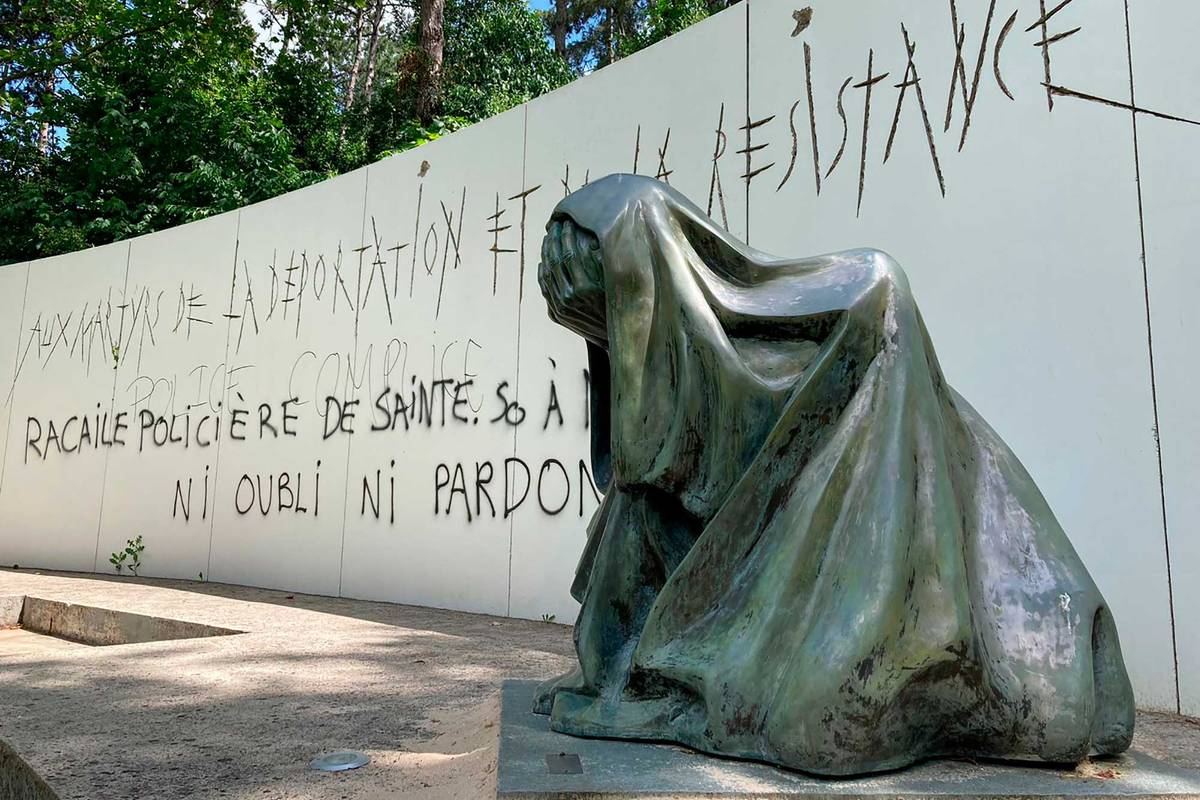
‘There is a reason why everyone is using the Nanterre memorial as evidence of the riots’ antisemitism: There is no other even vaguely plausible example.’ / AP PHOTO/CARA ANNA

If the Nanterre memorial symbolizes anything, then, it is the ambiguity of French memory regarding WWII until the end of the 1990s, when French President Jacques Chirac finally officially admitted the Vichy government’s responsibility for the fate of the Jews of France. It is not a tribute to the Jews and was never conceived as such. To read anti-cop graffiti inscribed on its wall as proof of a “wave” of antisemitism is therefore to misunderstand both France’s tortuous relationship to its own past and today’s antisemitism.

Were kosher restaurants and Jewish stores ransacked during the riots? Of course they were—but no more than nonkosher restaurants and stores that happened to be within reach of the rioters and looters. In fact, from a Jewish standpoint, if anything is remarkable, it is the almost complete lack of specificity in the choice of the businesses targeted. According to all available reports, it appears that only one business was specifically destroyed for what it was—the Happy Café, a gay-friendly bar in the city of Brest, whose owner had to close down during the riots after reading messages on Telegram calling to “burn the fags, let them die in hell by the Koran,” followed by the name of the establishment.

The example of the Happy Café shows how easy it would have been to call to attack synagogues, Jewish cultural centers, and so forth. And yet, this was not done. The vast majority of the stores ransacked or destroyed were either chosen at random or because of the alleged luxury brand they represented (in city centers, Nike or Louis Vuitton were targets of choice). Given France’s heavy record of antisemitism since the 2000s, and the unprecedented intensity of the five days and nights of rioting across the country, the real news was that Jewish businesses, synagogues, and residences were not targeted as such.

“After the J-Post article was published, we had to set up a video conference with the Jewish Agency and the Ministry of Aliyah in Israel to set the record straight,” said Yonathan Arfi, the new, young, left-wing president of the CRIF, the (secular) institution representing the Jews of France. “We realized that Israelis were watching the riots with glasses dating from 2014—when antisemitic attacks in France rose up to 800 per year—while we were looking at these events through the lens of 2005—the year the banlieues exploded out of anger and social frustration after two teenagers were killed running from the police.”

2014 marked both the peak of random antisemitic incidents across the country and the prelude to the deadly terror wave that began on Jan. 7-9, 2015, with the killings at Charlie Hebdo and the Hypercacher kosher supermarket in Paris. Throughout the spring of 2015, the French authorities counted nearly one attempted violent attack per week, culminating in the Bataclan massacre on Nov. 13. The tension began to fall only after the mass killing the following year in Nice, where a heavy truck attacked the crowd watching the fireworks display on Bastille Day, July 14, killing 86 people and injuring hundreds more.

Most of these attacks contained at least one antisemitic element—Charlie Hebdo was perceived as Zionist-controlled, the Hypercacher of course was Jewish, and the Bataclan had been on the target list of Islamist groups for years for being owned by two Jewish brothers, a fact that authorities and the media denied, but that French Jews understood only too well, especially after the decade they had been through. As a result, the number of aliyahs from France, on a constant rise since the attack on the Ozar Ha Torah school in Toulouse in 2012, reached 8,000 in 2016—an astonishing number.

Today, according to the CRIF, the number of French Jews making aliyah has fallen back to 1,500 per year, though antisemitic aggression remains frequent. There were 436 antisemitic attacks in 2022, a level reached in the early 2000s and which has never fallen since. While Jews represent less than 1% of the French population, they are the targets of 61% of anti-religious acts against persons. These numbers, provided by the Ministry of Interior, probably underestimate the level of antisemitic aggression, since verbal attacks and insults on social media are not included.

So if right-wing pessimist Meyer Habib is wrong, is left-wing optimist Yonathan Arfi right? Should we really look at today’s situation through the lens of 2005—that is to say, through an anti-racist lens, as he claims to do, and as most of the Anglo-Saxon media covering the riots have done?

It is helpful to look back to what actually happened in 2005. On Oct. 27, 2005, in the city of Clichy-sous-Bois, two kids, Zyed Benna, 17, and Bouna Traoré, 15, were electrocuted inside a substation while trying to escape the police. It is widely assumed on the left—i.e., in most of the media—that these deaths started the riots that inflamed the cités (the French equivalent of the American “projects”) that surround most of the urban centers in France and that are mainly populated today with migrant families.

According to a less popular opinion, however, it was a tear gas grenade shot three days later by a police unit targeting a group of rioters in Clichy-sous-Bois that accidentally hit a nearby mosque full of Ramadan worshippers that fueled the three weeks of riots that ensued, during which five people died (three by asphyxiation caused by fires, two beaten to death). In other words, the anger that triggered the 2005 events may have been religious as well as social. This theory is held by, among others, Gilles Kepel, a leading scholar of Islamist movements in France.

The truth may lie somewhere in between. According to their families, and contrary to what police reports later claimed, Traoré and Benna were not fleeing the police because they were about to commit a burglary but because they had no ID cards on them and feared that they would be arrested and miss Ramadan dinner. That was back in 2005, a time when “social workers could still enter the cités and manage to convince parents to bring their children back home,” as a former high school teacher named Ugo Portier told me.

Portier has spent the last 40 years in Bobigny, a city near Paris that is home to some of the worst cités in the country. He campaigned for the radical left party LFI (La France Insoumise) until 2019, when he realized how wrong LFI—and the left in general—was about the situation of disenfranchised Muslim youth in France.

“If you look at what happened this time, he added, you see that the riots took place in two stages,” he told me. “First, let’s mark our territories by burning everything that represents the French state and French authorities in our neighborhood: police stations, city halls, public services of all kinds including schools and public libraries (35 of which were burned down during the riots). Second, let’s attack all their downtown businesses. In other words, a secessionist strategy. This is one of the reasons why the police mostly focused on the very young, occasional looters downtown. The pressure was such that the police forces simply could not get into the cités during these five days.”

Seen in this light, the rioters who vandalized the Nanterre wall in the hours that followed the “white march” for Nahel Merzouk the first day of the riots appear to have been looking for French symbols—not Jewish ones. They did not go after a monument, they went after the French flag, which they took down.

It is also clear that attacks on French symbols go along with attacks on Jewish symbols and Jews, at least by implication. In Sarcelles, near Paris, for instance, according to the city’s former Mayor Francis Puponni, “when the rioters decided to go after the French luxury stores outside of their own neighborhood, the first stores they stormed were all Jewish-owned. Why? Because to them France means riches and because Jews are supposed to have money.” In other words, these stores were attacked because they were Jewish and because being Jewish means being French—being integrated.

At the heart of the present situation, then, is not just a “police problem” or a “laïcité” problem, or even an employment problem, but a crisis in what the French call “assimilation”: the process through which specific groups and communities leave much of their particularism behind in exchange for equality and political and social rights that will make them indistinguishable from the rest of the population in the public sphere. And it is a crisis that affects all sides.

Because the Jews were the first group to serve as guinea pigs for assimilation after their emancipation during the French Revolution, because they were for long its sole beneficiaries—and because assimilation is now seen by everyone from the undergraduate-level readers of Franz Fanon to the nonreaders of the cités as a scam played on poor, dark-skinned peoples by the racist colonial system—Jews are now considered to be, at best, voluntary victims of said system, or at worst its collaborators and profiteers.

In that regard, it is therefore tempting to see the random, spontaneous, antisemitic attacks that plagued France between 2000 and 2014 and beyond—that is to say before and after the terror wave—as a non- or pre-verbal designation of the enemy: the energetic condition, so to speak, for the subsequent terror to fall on everyone. Contrary to what Meyer Habib wrote, what was really scary in the antisemitic murder of Sarah Halimi is not that her killer was an Islamist—it’s that he was not.

So has more than 20 years of rabid, often Islamist-inspired antisemitism in France exhausted itself? Or is it so ingrained now that the new generation can do without the explicit reference to the Jews in its war against assimilation? Either way, what no one wants to grasp is the complete failure of the assimilationist model, which has been abandoned not only by the kids of the cités but also by the society at large.

There is a long and a short story for this lack of faith. The long story, of course, is the Vichy regime. During WWII, contrary to what the right claims today, not only did the most assimilated Jews not escape persecution, but the Consistoire—the religious Jewish structure of the era—supported the collaboration, a position that has been rightly regarded as a perverse outcome of the assimilating process. As Yonathan Arfi phrases it: “if the assimilation process had succeeded, the CRIF (a secular organization born out of the Jewish Resistance) would not exist. There would be only the Consistoire. The CRIF is the result of a failure, which is why, as an institution, we are incomprehensible and why we attract antisemitism.”

But the assimilation did not only fail the Jews. It failed postwar migrants from North Africa, too. Aside from racism, one of the most underestimated reasons for why the French failed to develop any active policy to integrate migrants from their former colonies was that this would have been seen as a casus belli by the new nationalist Algerian and Moroccan regimes, whose oil and gas were vital to the French economy. In 1993, King Hassan II from Morocco could still state on French public television that “Moroccans would never be French, did not want to assimilate, and France would be well advised not to try.” The Algerian FLN was even more nationalist. Honor was at stake.

The former colonies made a point of directly controlling their nationals on French territory, a deal to which the French state assented. As a result, the ex-colonies also controlled the mosques and migrant culture in France.

Caught between French prejudice on the one hand and the control exercised by their countries of origin on the other hand, migrants were actively prevented by both their old and new state authorities from developing their own autonomous culture inside France. This conflict of loyalties often plagued the migrants themselves, especially the fathers who in the Algerian case had fought the French during the war of independence. It is the failure of the second generation of migrants, and of the French government as well, to solve the contradictions of identity produced by this bifurcated reality during the French civil rights movements of the ’80s that led to the building of the walls enclosing the cités, to the rise of Islamist propaganda, to the riots of 2005, and to today’s crypto-secessionism.

The researcher Hugo Micheron, whose last book, Les Démocraties face au jihadisme européen, will be published in English soon, explains that today, social groups instrumentalize each and every incident to denounce Islamophobia. “Very serious matters like the killing of Nahel Merzouk are being put on the same level as superficial ones to trigger a feeling of permanent threat, paranoia, and emergency,” he explains. “They call this ‘micro-aggression,’ but in fact, this narrative produces a ready-made interpretative grid where Muslims and descendants of Muslims are natural permanent victims of the system. What is really scary is that far-right groups in France have started to mimic that strategy. They, too, exploit what they call anti-French ‘micro-aggressions’ in order to nurture ‘the Great Replacement theory.’ Both of these narratives are martyr-producing machines.”

How to resurrect an assimilation model that works in such a context is anybody’s guess. One thing is certain: Denouncing a nonexistent French Muslim intifada against French Jews won’t help. The problem here is much worse.


Marc Weitzmann is the author of 12 books, including, most recently, Hate: The Rising Tide of Anti-Semitism in France (and What It Means for Us). He is a regular contributor to Le Monde and Le Point and hosts Signes des Temps, a weekly public radio show on France Culture.


Zawartość publikowanych artykułów i materiałów nie reprezentuje poglądów ani opinii Reunion’68,
ani też webmastera Blogu Reunion’68, chyba ze jest to wyraźnie zaznaczone.
Twoje uwagi, linki, własne artykuły lub wiadomości prześlij na adres:
webmaster@reunion68.com



Kołakowski i poszukiwanie pewności

Kołakowski i poszukiwanie pewności

Hubert Czyżewski


Hubert Czyżewski śledzi intelektualną wędrówkę autora “Głównych nurtów marksizmu”: od żarliwych filipik antykościelnych z czasów stalinowskich do początku XXI w., gdy filozof deklarował, że „stoi po stronie chrześcijaństwa”.

Autor przekonuje, że przez całe życie to myśl religijna stanowiła jądro refleksji Kołakowskiego. Jego ojczyzną duchową był świat XVII-wiecznych mistyków, a nie XX-wiecznych rewolucjonistów czy liberalnych demokratów. Kołakowski przechodzi od prób zbudowania moralnej pewności na samym człowieku do uznania, iż potrzebuje on zewnętrznego, transcendentnego oparcia dla etyki. Potrzebuje hipotezy Boga, który jednak niekoniecznie jest opiekuńczym chrześcijańskim Ojcem. Ale czy fakt, że Bóg jest ludziom potrzebny, może być dowodem na Jego istnienie? Kołakowski zostawia nas z pytaniami, które wciąż niepokoją naszą wyobraźnię religijną.

Broszurowa ze skrzydełkami

Format: 144×205
Liczba stron: 304
Wydanie: pierwsze
ISBN: 978-83-240-4449-8


Zawartość publikowanych artykułów i materiałów nie reprezentuje poglądów ani opinii Reunion’68,
ani też webmastera Blogu Reunion’68, chyba ze jest to wyraźnie zaznaczone.
Twoje uwagi, linki, własne artykuły lub wiadomości prześlij na adres:
webmaster@reunion68.com


Zrabowane przez Szwedów skarby trafiły do Muzeum Historii Polski

Uroczyste przekazanie zabytków odnalezionych w zeszłym roku w wodach Wisły w Zamku Królewskim w Warszawie. Od lewej: dyrektor Zamku Królewskiego w Warszawie prof. Wojciech Fałkowski, dyrektor MHP Robert Kostro, dr Mariusz Klarecki (Zamek Królewski). 12.07.2023. Fot. MHP/Maciej Cioch. Źródło: Muzeum Historii Polski


Zrabowane przez Szwedów skarby trafiły do Muzeum Historii Polski

Marta Stańczyk


Trzy marmurowe fragmenty dolnej partii okładzin ściennych z lamperii pałacowego wnętrza oraz ceramiczny fragment kafla z wyobrażeniem syreny odnaleziony w zeszłym roku w wodach Wisły trafiły do depozytu Muzeum Historii Polski. To drobna część odzyskanych skarbów zrabowanych przez Szwedów w trakcie potopu szwedzkiego.

Muzealnicy planują na wystawie stałej odtworzyć fragment zniszczonego właśnie przez Szwedów, pałacu królewskiego Villa Regia, z którego pochodzą przekazane fragmenty. Obiekty uzupełnią zbiory Muzeum Historii Polski, w których znajduje się już przeszło 550 elementów kamieniarskich i architektonicznych tej rezydencji monarszej.

O historii pałacu i jego losach w trakcie potopu szwedzkiego opowiedziała PAP kustosz Muzeum Historii Polski Monika Żebrowska.

“Najważniejsza część pałacu Villa Regia została zbudowana w latach 1637-1641 i była to podmiejska rezydencja Władysława IV Wazy, wzniesiona najpewniej w związku ze ślubem króla z Cecylią Renatą Habsburżanką w 1637 roku” – powiedziała kustosz dodając, że potem pałac został oddziedziczony przez kolejnego króla – Jana Kazimierza, który trochę go przebudował.

Pałac Villa Regia stał na terenie, gdzie obecnie mieści się kampus Uniwersytetu Warszawskiego. W późniejszym czasie, już po potopie, kiedy Villa Regia została zniszczona przez Szwedów, Jan Kazimierz wzniósł na tym miejscu inny pałac, który nazwano Kazimierzowskim.

“Czasem zdarza się, że Villa Regia jest utożsamiana z Pałacem Kazimierzowskim, natomiast to były dwie różne budowle” – podkreśliła Monika Żebrowska.

Monika Żebrowska wyjaśniła, że podczas potopu w 1656 roku Szwedzi rozebrali pałac, ponieważ był wyjątkowy. “Został zbudowany w formie wczesnobarokowej, jego fasadę i wnętrza wykonano z bogato zdobionych marmurów i wapieni. A to był cenny materiał dla Szwedów” – dodała.

Wyjaśniła, że podczas potopu w 1656 roku Szwedzi rozebrali pałac, ponieważ był wyjątkowy. “Został zbudowany w formie wczesnobarokowej, jego fasadę i wnętrza wykonano z bogato zdobionych marmurów i wapieni. A to był cenny materiał dla Szwedów” – dodała.

W sierpniu 1656 roku Szwedzi zapakowali cały swój łup na łodzie i chcieli go spławić Wisłą do Gdańska i dalej do Szwecji. “Ale w tym czasie wojska Jana Kazimierza wkraczały już do Warszawy i cały ten transport został celowo przez Szwedów zatopiony” – wyjaśniła kustosz.

Gdy wojska koronne zajęły stolicę, Jan Kazimierz kazał wyłowić te elementy, przenieść je i zabezpieczyć przed rabunkiem. “Zakopano je w łachach wiślanych albo ponownie zatopiono” – powiedziała Monika Żebrowska.

“Przeleżały tak przez kolejne 250 lat. W 1906 roku dwóch warszawskich piaskarzy przypadkowo natrafiło na kilka elementów architektonicznych m.in był to słynny delfin z fontanny, który znajduje się w zbiorach Muzeum Warszawy oraz rzeźba putta stanowiąca najpewniej także część fontanny” – powiedziała. “Mimo, że to wzbudziło sensację, to dalej nie poszukiwano innych elementów. Było to oczywiście związane z sytuacją polityczną. Środowisko warszawskich historyków dążyło do tego, żeby dostać pozwolenia na poszukiwania, ale nie udało się to w tamtym czasie” – dodała.

W 2009 roku pod kierownictwem archeologa z Instytutu Archeologii UW prof. Huberta Kowalskiego, zaczęto poszukiwania w ramach projektu “Wisła 1655-1906-2009. Interdyscyplinarne badania dna rzeki”.

Wygląd pierwotnego pałacu Villa Regia znamy jedynie z kilku rycin, które nie pokazują jednak detali wystroju. “Badanie tych materiałów oraz fragmentów wydobytych z Wisły pozwala na próbę rekonstrukcji, chociaż częściowej, fasady pałacu. Planujemy na wystawie stałej odtworzyć, w miarę możliwości, jak największy fragment fasady Villa Regia i pokazać w przestrzeni, w której opowiadamy historię potopu szwedzkiego i XVII wieku” – przekazała Monika Żebrowska.

“Ten projekt miał na celu przebadanie terenu wyznaczonego na podstawie źródeł historycznych. Trwał kilka lat a w międzyczasie poziom Wisły bardzo się obniżył i na powierzchni zaczęły pojawiać się różne fragmenty architektury i kamieniarki. Przez 3-4 kolejne lata były one sukcesywnie wydobywane” – opowiedziała kustosz. “Udało się pozyskać ogromne skarby, o wielkiej wartości historycznej – elementy marmurowe, wapienne – głównie z fasady pałacu Villa Regia, ale również elementy posadzki czy trzon fontanny z ogrodów pałacowych. W kolejnych latach natrafiono też na kilkadziesiąt pocisków artyleryjskich: kul armatnich, granatów i bomb przeznaczonych do różnej wielkości dział. Odnaleziono też koła armatnie, fragmenty wozów taborowych i lawet armatnich. Tak więc, nie tylko sam pałac został złupiony, ale Szwedzi zabierali również wyposażenie wojskowe oraz przedmioty użytkowe, które mogą nam wiele powiedzieć o tamtych czasach” – dodała.

Podkreśliła, że oczywiście nie jest powiedziane, że wszystko zostało wydobyte, bo może się okazać, że dno Wisły skrywa jeszcze jakieś skarby, o których nie wiemy.

Wygląd pierwotnego pałacu Villa Regia znamy jedynie z kilku rycin, które nie pokazują jednak detali wystroju. “Badanie tych materiałów oraz fragmentów wydobytych z Wisły pozwala na próbę rekonstrukcji, chociaż częściowej, fasady pałacu. Planujemy na wystawie stałej odtworzyć, w miarę możliwości, jak największy fragment fasady Villa Regia i pokazać w przestrzeni, w której opowiadamy historię potopu szwedzkiego i XVII wieku” – przekazała Monika Żebrowska.

To co zostało ostatnio przekazane do Muzeum Historii Polski to trzy marmurowe fragmenty, które stanowiły okładzinę ściany – lamperię wnętrza pałacowego. “Do tego fragment kafla piecowego, który przedstawia syrenę. Może nie syrenkę stricte warszawską, bo jest to po prostu ozdobny motyw syreny. Ale być może jest to jakieś nawiązanie do symbolu miasta” – oceniła.

“Nie wiadomo ile dokładnie zrabowali Szwedzi, ale w 2015 roku prof. Hubert Kowalski podał, że do tego roku wydobyto ponad 13 ton dekoracji architektonicznych. Raczej nie jest to wszystko, być może coś jeszcze jest na dnie Wisły, pewnie też część zdołano wywieźć” – podsumowała kustosz.

Potop szwedzki z lat 1655–1660 przyniósł Rzeczypospolitej ogromne zniszczenia. Wojska szwedzkie, które opanowały znaczną część kraju, rabowały praktycznie wszystko: począwszy od biżuterii i dzieł sztuki, aż po futryny okienne czy fragmenty kamieniarki, które po wywiezieniu do Szwecji były wmontowywane w lokalne budynki. Znaleziska przekazane do Muzeum Historii Polski pochodzą z transportu, który nigdy nie dopłynął do Skandynawii – utonął w Wiśle nieopodal dzisiejszej warszawskiej Cytadeli.

Właśnie w tym miejscu dobiega końca budowa nowej siedziby Muzeum Historii Polski. Uroczysta inauguracja budynku planowana jest na koniec września 2023 r.(PAP)


Zawartość publikowanych artykułów i materiałów nie reprezentuje poglądów ani opinii Reunion’68,
ani też webmastera Blogu Reunion’68, chyba ze jest to wyraźnie zaznaczone.
Twoje uwagi, linki, własne artykuły lub wiadomości prześlij na adres:
webmaster@reunion68.com


Esther Hayut sets Israel on fire

Esther Hayut sets Israel on fire

CAROLINE GLICK


Israeli Supreme Court president Esther Hayut during a court hearing on petitions against a law to get around Prime Minister Netanyahu’s incapacitation, at the Supreme Court in Jerusalem, on Aug. 3, 2023. Photo by Yonatan Sindel/Flash90.

Outgoing Supreme Court president Esther Hayut is playing the short game. She wants to clear her desk, finish the work she set out to achieve when she took over as Supreme Court head in late 2017 and let the chips fall where they may.

Shortly before Hayut assumed office, she set out her judicial vision in an address before the Bar Association. The central challenge facing the court, she declared, was surmounting the rule of law.

Comparing herself and her colleagues to God, she bloviated: “There’s a disadvantage that we flesh and blood judges have in comparison to the Creator of the Universe. Even in the situations where we understand fairly quickly the dilemma that brought the petitioners before us, it often happens that the solution we view as just and proper isn’t possible under the practice and requirements of law. These situations in my view are among the most difficult and complex ones that we as judges are called upon to contend with.

“How do we bridge the gap between the law and what is right? Finding an answer to this question, discovering the secret … ‘spice’ is perhaps one of the greatest tasks that lies before us as judges.”

Now with a mere two months remaining to her tenure, Hayut is finishing the job. She’s found the “secret spice.” All a judge needs to rule the way he or she wants is to place themselves above the Knesset, the laws it passes and the government that is charged with executing them. She began the process two years ago and is completing it now.

Israel is a parliamentary democracy. Legally and constitutionally, this means that the Knesset is the sovereign. The government is the executive arm of the Knesset. The Knesset can oust the government any time a majority of Knesset members lose confidence in it. The Supreme Court interprets the Knesset’s laws.

The source of the Supreme Court’s power is the corpus of Basic Laws passed by the Knesset. Since they are the source of its power, the court has no legal power to amend or abrogate these laws.

This, however, is no obstacle for Israel’s godlike Supreme Court justices, who have that “special spice.”

Two years ago, Hayut began laying the markers for the actions she intended to take before her retirement. In two separate judgments, she and her associates agreed to adjudicate petitions calling for the abrogation of Basic Laws and asserted their right to do so, based on an entirely made-up rationale. The justices proclaimed that they can abrogate Basic Laws if they decide the Knesset “abused its foundational powers” in passing them.

This means that Hayut and her cronies have decided that they can annul Basic Laws if they don’t like what they say. Since the justices have the “special spice,” they know better than the public’s elected representatives what a proper law looks like. Or smells like.

In March 2020, Hayut and her comrades effectively made themselves super-legislators and asserted the power to interfere in the Knesset’s internal procedures. That month, Israeli voters had their third inconclusive election in less than a year. Benny Gantz and Yair Lapid, who led the Blue and White Party, lacked the 61-seat majority to form a coalition. But they came up with a novel idea. With the Arab anti-Israel bloc, they had a 61-seat majority in Knesset. Gantz and Lapid decided to compel interim Knesset Speaker Yuli Edelstein to call for new elections for the Knesset speaker. With their guy in place as Speaker, Gantz and Lapid would be able to run roughshod over Netanyahu’s interim government and rule the country from the Knesset.

The only problem with their plan was that they had no legal power to execute it. Under Basic Law: The Knesset, the Israeli parliament, through its speaker, develops its own procedures. Just as importantly, the Knesset speaker is only elected after a government is sworn in. By law, Edelstein was supposed to continue serving as interim speaker.

But a persnickety Basic Law was no match either for Blue and White or for Hayut. Blue and White petitioned the Court to order Edelstein to call a vote. In no time, Hayut and her colleagues did just that. When Edelstein refused—and chose to resign rather than defy the court’s illegal ruling—Hayut ordered the Knesset to convene within 24 hours and elect a new speaker.

As law professor Avi Bell from Bar-Ilan University law school explains, “The court’s decision to fire a Knesset speaker notwithstanding that there’s nothing in the law that allows them to do that, put us into a constitutional crisis. The ruling was the court’s declaration of war against the Knesset. The only reason things didn’t get worse is because Netanyahu and Gantz quickly came up with a way to avoid an open fight; they formed their joint government.”

Having seized the powers of the Knesset three years ago, on Thursday Hayut turned her guns (or spices) on the government. After Netanyahu returned to office, the left, including Attorney General Gali Baharav Miara, set out to find an excuse to oust him from power. They set upon the incapacitation clause of the Basic Law: The Government. Although the lawmakers who drafted the law reasonably viewed the clause as a means for governments to replace a premier who becomes physically incapable of performing his duties, the left began arguing Netanyahu was incapacitated because he had signed a conflict-of-interest document with Baharav Miara upon entering office due to the criminal proceedings being carried out against him.

Shortly after Justice Minister Yariv Levin announced his plan to place minimal limits on the court’s powers in January, a group of anarchists led by former Israel Defense Forces Chief of General Staff Dan Halutz petitioned the court to oust Netanyahu from office. Halutz largely disappeared from view after he was forced to resign his position at the helm of the IDF following his failed military leadership during the Second Lebanon War in 2006. He has returned to the main stage over the past seven months by calling for political violence and civil war. In his petition, Halutz called for the court to deem Netanyahu incapacitated. Baharav Miara signaled strongly that she sided with Halutz and the anarchists.

Understanding it was on the verge of a judicial coup, the Knesset coalition moved quickly to amend the incapacitation clause. The amendment, which was passed in April, stipulated that a prime minister can only be deemed incapacitated if he is physically unable to carry out the functions of the office. The left, this time through the State Department-funded Movement for Quality Government, petitioned the court to abrogate the amendment. Baharav Miara announced last week that she agrees with the petitioners.

Hayut and two associate justices convened the court on Aug. 3 to adjudicate the petition. As with the Edelstein petition, they have absolutely no legal authority to deliberate the issue. But they don’t care. Armed again with their insipid assertion that the Knesset may have “abused its foundational powers,” Hayut and her comrades insist that they have a right to abrogate the clause and so pave the way for a follow out hearing on the Halutz petition to oust Netanyahu from power.

Whether or not they rule in favor of the Movement for Quality Government and Baharav Miara, simply by adjudicating this petition, Hayut is asserting the court’s power to dictate the actions of the government and to oust the prime minister, at will.

This then brings us to Hayut’s planned coup de grace. On Sept. 15, just two weeks before she heads for the exit, Hayut will take the unprecedented step of convening the entire court—all 15 justices—to adjudicate an even more outrageous petition regarding a Basic Law. That day, Hayut and her associate justices will hear arguments regarding a petition asking them to overturn the Knesset’s amendment to the Basic Law: Judiciary from last month. That amendment bars the justices from abrogating lawful decisions by the government, prime minister and government ministers on the grounds of “reasonableness.” In other words, it limits the court’s power to set government policy based on the judges’ “special spice.”

Not only do the justices lack the legal authority to adjudicate this petition, they are in an open conflict of interest because the law relates to their own power. But that is the whole point.

By adjudicating the Edelstein and Incapacitation Clause petitions, Hayut canceled the powers of Israel’s democratically elected institutions and seized them for the court. On Sept. 15, Hayut intends to end her judicial career by asserting that there can be no limits of any sort placed on the court’s powers.

As a short-term player, Hayut sees the game ending on Sept. 30. But, of course, on Oct. 1, Israel will be left to contend with the consequences of her actions. And those will be a disaster. Indeed, they already are. Halutz’s moves put Israel on the fast track to Halutz’s civil war.

Bell notes, “A parliament asserts its authority by passing laws. By annulling the Knesset’s power to enact laws, the court is destroying the last vestiges of Israel’s democratic institutions. How are democratic institutions supposed to assert their authority if it isn’t by passing laws? All that’s left is confrontation, by actually rejecting the authority of the court.”

Consider what happened in the United States before the Civil War. In 1857, the Supreme Court passed its Dred Scott decision. The decision determined that a slave would remain the property of his owner wherever he was. If he escaped to a free state, the court insisted that he was still a slave and that the free state was required to return the slave to his owner in the South. That decision meant that state legislators had no power to abolish slavery in the separate states. As states of the United States, they were required to be complicit with slavery.

Bell notes that “it took four years from the time the Dred Scott decision was delivered until the start of the Civil War. But the war became inevitable after Dred Scott.”

So, too, the moment the Supreme Court nullifies the Knesset’s power to limit its powers, it renders civil war in Israel inevitable.

Israeli Justice Minister Yariv Levin has been harshly criticized for his handling of the judicial reform process. But whether his package was perfect or the process was properly managed is really beside the point. Levin rightly viewed his judicial reform package as a race against time to protect Israel’s democratic institutions from the court. He may have been too slow.

In media interviews last week, Netanyahu noted that the court lacks the power to adjudicate these issues. He wouldn’t say whether he would follow their decisions. He insisted instead that the government will abide by the rule of law. On Thursday, it was reported that Netanyahu is considering the option of re-legislating the Basic Laws if the court strikes them down.

In the absence of any significant political or legal figure on the left coming to his senses and rejecting Hayut’s maniacal power grab, Netanyahu’s reported plan of simply keeping the government’s nose to the grindstone, and moving forward, may be Israel’s only hope of avoiding a disaster of biblical proportions.


Caroline B. Glick is the senior contributing editor of Jewish News Syndicate and host of the “Caroline Glick Show” on JNS. She is also the diplomatic commentator for Israel’s Channel 14, as well as a columnist for Newsweek. Glick is the senior fellow for Middle Eastern Affairs at the Center for Security Policy in Washington and a lecturer at Israel’s College of Statesmanship


Zawartość publikowanych artykułów i materiałów nie reprezentuje poglądów ani opinii Reunion’68,
ani też webmastera Blogu Reunion’68, chyba ze jest to wyraźnie zaznaczone.
Twoje uwagi, linki, własne artykuły lub wiadomości prześlij na adres:
webmaster@reunion68.com


Cardi B Stirs Controversy Tweeting Photo of Hasidic Jews After Battery Charges Dropped

Cardi B Stirs Controversy Tweeting Photo of Hasidic Jews After Battery Charges Dropped

Shiryn Ghermezian


Cardi B. Photo: Chrisallmeid via Wikimedia Commons

Rapper Cardi B caused an uproar on social media for tweeting — and then deleting — a photo of two Hasidic Jewish men shortly after learning that she would not be charged for an incident that took place during her recent concert.

The Grammy-winning singer threw her microphone into the crowd at her July 29 performance in Las Vegas after someone threw a drink at her on stage, as seen in videos shared on social media. A woman who said she was hit with the microphone filed a police report for battery but the Las Vegas Metropolitan Police Department said in a statement on Thursday that due to “insufficient evidence,” no charges will be filed against the rapper, whose real name is Belcalis Marlenis Almánzar.

After police made the announcement, Cardi B tweeted the exact picture that appears for the Wikipedia entry “Jewish religious clothing.” The photo shows two Hasidic men walking in Borough Park, a religious neighborhood in Brooklyn, New York, while wearing traditional Hasidic clothing and accessories such as a shtreimel hat, tallit, a long black suit and a belt known as a gartel. Cardi B simply wrote in the photo’s caption “Remember …”

The Twitter post may be related to her 2018 song Bickenheld, which includes the lyrics: “Lawyer is a Jew, he gon’ chew up all the charges.” Cardi B’s legal team that took care of the battery charge in Las Vegas reportedly included multiple Jewish attorneys and “Lawyer is a Jew” was trending on Twitter in the US following the rapper’s tweet.

The Bodak Yellow singer shortly after deleted the photo from her Twitter account and while she may have been trying to applaud her Jewish lawyers with the post, many took offense to the photo. Jewish writer Eve Barlow said the rapper “incited violence against one of America’s most vulnerable visible communities – Orthodox Jewish people, because she believes that we Jews all look the same and have all the power.”

“Appreciate you @iamcardib but tweeting out a vague picture of a visible minority that has been subject to rising hate crimes in NYC to your 31 million followers is just not acceptable,” tweeted Dovid Bashevkin, director of education for the Jewish youth movement NCSY. “When hate is an option don’t leave anyone guessing what you meant … If you want to show gratitude to your Jewish legal counsel then clearly write it to your 31 million followers.”

International human rights lawyer Arsen Ostrovsky added: “Words have consequences. Antisemitism and violence against Jews in America, is already at an all-time high. Although she has since deleted this tweet (in reference to her lawyers), she never ought to have posted it all.”


Zawartość publikowanych artykułów i materiałów nie reprezentuje poglądów ani opinii Reunion’68,
ani też webmastera Blogu Reunion’68, chyba ze jest to wyraźnie zaznaczone.
Twoje uwagi, linki, własne artykuły lub wiadomości prześlij na adres:
webmaster@reunion68.com