 Hezbollah Belligerence Prompts Fears of Assassination Campaign in Lebanon
Ailin Vilches Arguello
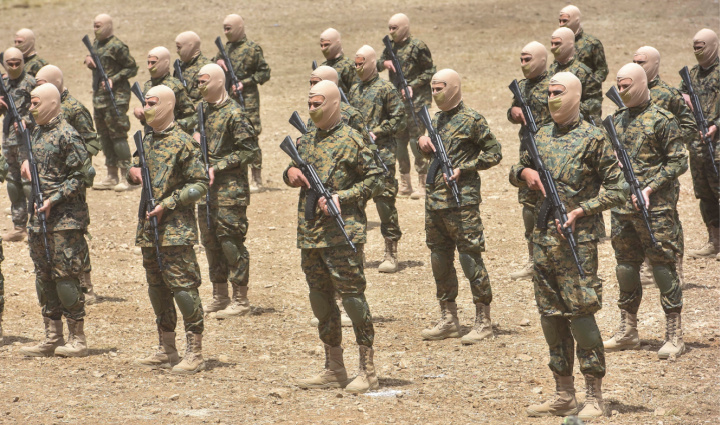 Lebanese Hezbollah fighters take part in cross-border raids, part of a large-scale military exercise, in Aaramta bordering Israel on May 21, 2023, ahead of the anniversary of Israel’s withdrawal from southern Lebanon in 2000. Photo: Fadel Itani/NurPhoto via Reuters Connect
As direct negotiations between Lebanese and Israeli officials resumed in Washington, DC on Thursday, fears continued mounting inside Lebanon that Hezbollah could unleash a new wave of political violence and destabilization efforts amid growing pressure to dismantle the Iran-backed terrorist group’s military grip.
According to a new report from the Meir Amit Intelligence and Terrorism Information Center (ITIC), an Israel-based research institute, concerns have intensified over Hezbollah’s escalating rhetoric and the prospect of internal unrest as the Lebanese government pushes to establish a state monopoly over weapons and curb the Islamist group’s influence across the country.
The Iranian proxy has accused Lebanese President Joseph Aoun and Prime Minister Nawaf Salam of betraying the “resistance” and collaborating with Israel amid ongoing direct bilateral negotiations, branding them “traitors” aligned with foreign interests.
At the same time, Lebanese officials have increasingly lashed out at Hezbollah, accusing the terrorist group, which Iran established inside Lebanon in the early 1980s, of dragging the country toward another devastating war and undermining Lebanon’s sovereignty and stability.
Against the backdrop of an increasingly hostile political climate, ITIC’s new report warns that Hezbollah could once again resort to political assassinations in an effort to block moves perceived as existential threats to the organization and restore its power.
According to Israeli intelligence assessments, the renewed direct negotiations with Israel could even place Aoun’s life at risk.
Experts point to Hezbollah’s Unit 121, a covert entity subordinate to the group’s leadership, which has been linked to a series of assassinations of Hezbollah opponents in Lebanon’s political and security arenas over the past two decades.
Given Hezbollah’s limited ability to exert broader influence within the Lebanese government — with its ministers accounting for less than a third of the cabinet — ITIC warns the group may increasingly rely on Unit 121’s operational capabilities and years of accumulated experience to drive internal destabilization and intimidate political rivals.
The terrorist group has repeatedly defied international calls to disarm, even threatening protests and civil unrest if the government tries to enforce control over its weapons.
According to a new report by the Israeli news outlet Walla, Hezbollah is now putting in place a plan of action to assert control over Beirut, the Lebanese capital, and push out more pragmatic political elements.
The group is also reportedly redistributing its forces across southern Lebanon and the Beqaa Valley, as its leadership believes Israel is preparing moves designed to divide the country, forcing a broader dispersal of its fighters accordingly.
With direct talks between Israeli and Lebanese officials resuming this week, Hezbollah has also called for a national referendum, arguing that the country’s leadership is ignoring a substantial segment of the population opposed to any future peace agreement with Israel.
“Joseph Aoun is one of the worst presidents to ever lead Lebanon because he is not a unifying figure. He ignores the concerns of a large segment of Lebanese society that rejects any peace with Israel,” senior Hezbollah official Nawaf al-Musawi told Qatari news channel Al-Arabi.
“It is a disgrace that such a handshake would be extended to someone whose hands are stained with the blood of our people while their homes are being destroyed,” he continued, referring to the possibility of a meeting between Aoun and Israeli Prime Minister Benjamin Netanyahu.
“The negotiations they are now offering are an illusion. Our roadmap is resistance on the ground that will force the enemy to retreat,” al-Musawi further said. “We are staying here, defending Lebanon, and we will not commit political suicide through direct and humiliating negotiations.”
With the third round of negotiations taking place on Thursday in Washington, Beirut is reportedly insisting that a ceasefire must precede any future talks and is even considering delaying the process unless full de-escalation is secured in advance.
Lebanese officials have also reiterated that the decision to establish a state monopoly over weapons is final, though its implementation remains contingent on securing a broader security arrangement with Israel under US guarantees.
Meanwhile, Hezbollah chief Naim Qassem reiterated on Tuesday the group’s demand for an immediate end to direct negotiations between Israel and Lebanon.
“No external party has the right to interfere in the issue of weapons or the resistance. This is an internal Lebanese matter and has nothing to do with negotiations with the enemy,” the terrorist leader said.
“We will not surrender, and we will continue defending Lebanon and its people regardless of the sacrifices required. We will not abandon the battlefield, and we will turn it into hell for Israel,” he continued.
Israel has continued its military campaign in neighboring southern Lebanon to root out Hezbollah, with strikes reaching areas roughly 20 kilometers from Beirut over the weekend in one of the deepest escalations in months.
Over the past month, more than 45 Hezbollah infrastructure sites — including weapons depots, military facilities, and rocket launchers — have been struck, with the military also reporting that around 350 operatives have been killed and approximately 1,100 affiliated targets hit.
Israeli officials are now reportedly preparing for the possibility of a major expansion of ground operations in southern Lebanon after Israeli forces crossed the Litani River last weekend and began conducting covert operations deeper inside Lebanese territory.
Hostilities between Hezbollah and Israel reignited on March 2, when the terrorist group opened fire in support of Iran two days after the start of the joint US-Israeli military campaign against the Iranian regime.
Since then, Israeli forces have established a “buffer zone” initially extending 5 to 10 km (3 to 6 miles) into Lebanese territory, which officials say is meant to shield northern residents from Hezbollah attacks amid thousands of rockets and drones fired throughout the war.
Even though a US-backed ceasefire has sharply reduced violence, negotiations and prospects for lasting peace remain fragile, with Israeli forces still launching strikes while positioned in southern Lebanon to maintain its buffer zone and dismantle Hezbollah infrastructure.
Zawartość publikowanych artykułów i materiałów nie reprezentuje poglądów ani opinii Reunion’68,
ani też webmastera Blogu Reunion’68, chyba ze jest to wyraźnie zaznaczone.
Twoje uwagi, linki, własne artykuły lub wiadomości prześlij na adres:
webmaster@reunion68.com