Archive | 2026/05/11

Marsz Żywych w hołdzie ofiarom Holokaustu i przeciw antysemityzmowi

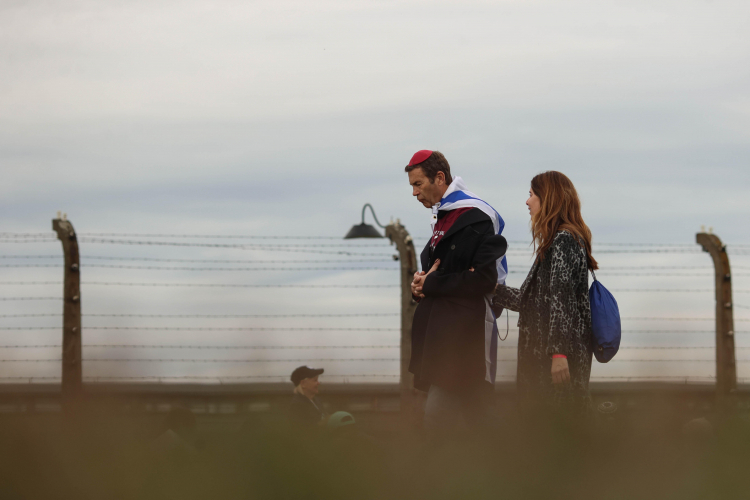
Uczestnicy Marszu Żywych w byłym niemieckim obozie Auschwitz II w Brzezince. Fot. PAP/Jarek Praszkiewicz


Marsz Żywych w hołdzie ofiarom Holokaustu i przeciw antysemityzmowi

szf/ dki/


Kilka tysięcy osób przeszło we wtorkowe popołudnie w Marszu Żywych z byłego niemieckiego obozu Auschwitz I do byłego Auschwitz II-Birkenau., by uczcić pamięć ofiar Holokaustu oraz zamanifestować sprzeciw wobec antysemityzmu.

W tegorocznym marszu uczestniczył między innymi ambasador Stanów Zjednoczonych w Polsce Thomas Rose. Dziennikarzom powiedział, że w byłym obozie Auschwitz był wiele razy. Podkreślił, że jest inspirujące, jak miejsce bezsilności, beznadziei i braku głosu, daje siłę, głos, dumę oraz nadzieję.

Dyplomata opublikował wypowiedź na platformie X – stojąc na terenie Miejsca Pamięci Auschwitz – w której wskazał, że 85 lat temu Żydzi nie mieli żadnej siły, żadnego głosu i przyjaciół, którzy stanęliby po ich stronie. Obecnie mają własne państwo zdolne do obrony. Dzięki niemu mają głos. Mają też wielu przyjaciół, wśród których szczególnym jest prezydent Stanów Zjednoczonych Donald Trump. – Prawdziwa lekcja Holokaustu, jest taka, że naród żydowski nigdy więcej nie może być pozbawiony siły, by bronić się samemu – wskazał.

W marszu uczestniczyła niewielka grupa muzułmanów z krajów arabskich. Loay Alshareef, Egipcjanin mieszkający w Zjednoczonych Emiratach Arabskich powiedział, że chce pokazać, iż w regionie są muzułmanie pokojowo nastawieni do Izraela.

Wśród uczestników marszu był Bartek, uczeń z Lublina. – W tym miejscu dokonała się wielka tragedia; zwyczajnie nie wiem, co powiedzieć. Wiem, że trafiali tu ludzie w moim wieku, także małe dzieci. Chcę im oddać hołd – powiedział. Jego nauczyciel historii Rafał Paskudzki zaznaczył, że były niemiecki obóz Auschwitz jest miejscem, które robi ogromne wrażenie na uczniach; przygnębiające i smutne, ale też skłania ich do przemyśleń. – W tym miejscu, wśród tych murów, łatwiej o refleksję nad tym, co się tutaj wydarzyło wiele lat temu – dodał.

Na trasie marszu uczestników pozdrawiała grupa Polaków z Ustronia. – Chcemy zamanifestować przyjaźń z Izraelem i szacunek dla tych, którzy zginęli – powiedział Roman Górniok.

Główną uroczystość przed pomnikiem ofiar obozu w byłym Auschwitz II-Birkenau rozpoczął dźwięk syreny i minuta ciszy, która była hołdem dla ofiar. Odczytany został Psalm 94 będący symbolicznym wezwaniem do Boga o sprawiedliwość. Zmówione zostały modlitwy kadisz i żałobna El male rachamim.

Phillis Grennberg Heideman, prezydent Międzynarodowego Marszu Żywych, mówiła do młodzieży, że ich obecność jest świadectwem siły ludzkiego ducha i zaangażowania. – Wierzę, że (…) staniecie się strażnikami pamięci i tymi, którzy rozświetlają przyszłość – mówiła.

Przewodniczący Międzynarodowego Marszu Żywych Shmuel Rosenman przypomniał o 6 mln Żydów zgładzonych w Holokauście. Podkreślił, że to nie tylko historia, ale także ostrzeżenie. Świat znów jest niespokojny, a antysemityzm nie należy do przeszłości. – Dlatego musimy mówić jasno do przywódców świata: to jest wasza chwila. Nie jutro; teraz! Nie tłumaczcie nienawiści. Walczcie z nią. Nie ignorujcie jej. Powstrzymajcie ją – mówił.

Podczas ceremonii na pomniku zapłonęło siedem pochodni, które symbolizują między innymi walkę z antysemityzmem, nadzieję i odrodzenie państwa Izrael. Jedną z nich zapalił ocalały z Zagłady 98-letni Nate Leipciger z Kanady, dla którego był to już 22. marsz. – Nie mieliśmy stąd wrócić, ale z łaski Boga jesteśmy tutaj. Spójrzcie na nas! (…) Nie będziemy więcej ofiarami. Mamy Izrael, który będzie walczył za nas i z nami. Odniesiemy zwycięstwo – podkreślił.

Ostatnim akordem ceremonii był hymn Izraela. Po nim uczestnicy – Żydzi, w tradycyjnych niebieskich kurtkach ortalionowych ze stylizowaną Gwiazdą Dawida, symbolem marszu, często otuleni flagami Izraela i swoich krajów, a także młodzi Polacy, powoli opuszczali historyczne miejsce. Pozostawili tam wiele małych, drewnianych tabliczek symbolizujących macewy – żydowskie nagrobki. Na nich umieszczali nazwiska swoich bliskich, którzy zginęli w Holokauście, lub pokojowe przesłania.

Tegoroczne wydarzenie było mniej liczne niż w poprzednich latach. Z uwagi na sytuację polityczną z udziału zrezygnowały grupy izraelskie; około 1 tys. osób.

Marsz Żywych to projekt edukacyjny, pod auspicjami którego Żydzi z różnych krajów, głównie uczniowie i studenci, odwiedzają miejsca Zagłady stworzone przez Niemców podczas wojny na okupowanych ziemiach polskich. Przemarsz między byłymi obozami w święto Jom Ha-Szoa (Dzień Pamięci o Ofiarach Zagłady) jest kulminacją. Dotychczas trasę między byłymi obozami pokonało ponad 300 tys. osób.

Niemcy założyli obóz Auschwitz w 1940 roku, aby więzić w nim Polaków. Auschwitz II-Birkenau powstał dwa lata później. Stał się miejscem zagłady Żydów. W kompleksie funkcjonowała także sieć podobozów. Niemcy zgładzili w obozie ponad 1,1 mln osób, z czego około 960 tys. stanowili Żydzi. Polski Żyd Dawid Wongczewski, deportowany 20 czerwca z więzienia w Wiśniczu Nowym, był pierwszą śmiertelną ofiarą obozu. Zmarł w nocy z 6 na 7 lipca 1940 roku. (PAP)


Zawartość publikowanych artykułów i materiałów nie reprezentuje poglądów ani opinii Reunion’68,
ani też webmastera Blogu Reunion’68, chyba ze jest to wyraźnie zaznaczone.
Twoje uwagi, linki, własne artykuły lub wiadomości prześlij na adres:
webmaster@reunion68.com

Breaking the Architecture of Iran’s Regime Power


Breaking the Architecture of Iran’s Regime Power

Ahmed Charai


  • For decades, Tehran has delayed, promised, denied, escalated, and recalibrated — all while rebuilding its capabilities… and preserving the machinery of regime survival.
  • The Iranian regime is not sustained by ideology alone. It is sustained by money, contracts, ports, banks, smugglers, foundations, front companies, privileged merchants, terrorist proxies, and commercial collaborators. Washington… must target the networks that feed it.
  • The regime does not move money through uniforms and official titles. It moves money through family members, front companies, exchange houses, shipping firms, insurance brokers, commodity traders, gold dealers, charities, banks, and offshore accounts. Every one of these channels must be mapped, exposed, and disrupted.
  • [W]holesalers, currency dealers, gold traders, import-export operators, shipping intermediaries, and commercial families who help the IRGC evade sanctions, manipulate markets, launder money, or finance repression should face direct consequences.
  • The objective is not to destroy Iranian commerce. The objective is to liberate it from the regime.
  • The [US] strategy should …reward defection.
  • [T]he regime’s networks do not stop at Iran’s borders. They extend across the region through proxies, terrorist cells, cyber units, propaganda platforms, and intelligence operations.
  • The Abraham Accords should not only be a diplomatic framework. They should become a protected strategic architecture against Iranian coercion.
  • The message to the Iranian people must remain clear: the conflict is not with Iran as a nation, nor with Persian civilization, nor with ordinary families struggling to survive. The target is the regime’s theft of Iran’s economy. Iran is not poor because it lacks resources. Iran is poor because the Islamic Republic has converted national wealth into repression, missiles, militias, corruption, and foreign adventurism.
  • Hormuz must be reopened, but the regime’s economic, financial, military, and proxy networks must be dismantled.

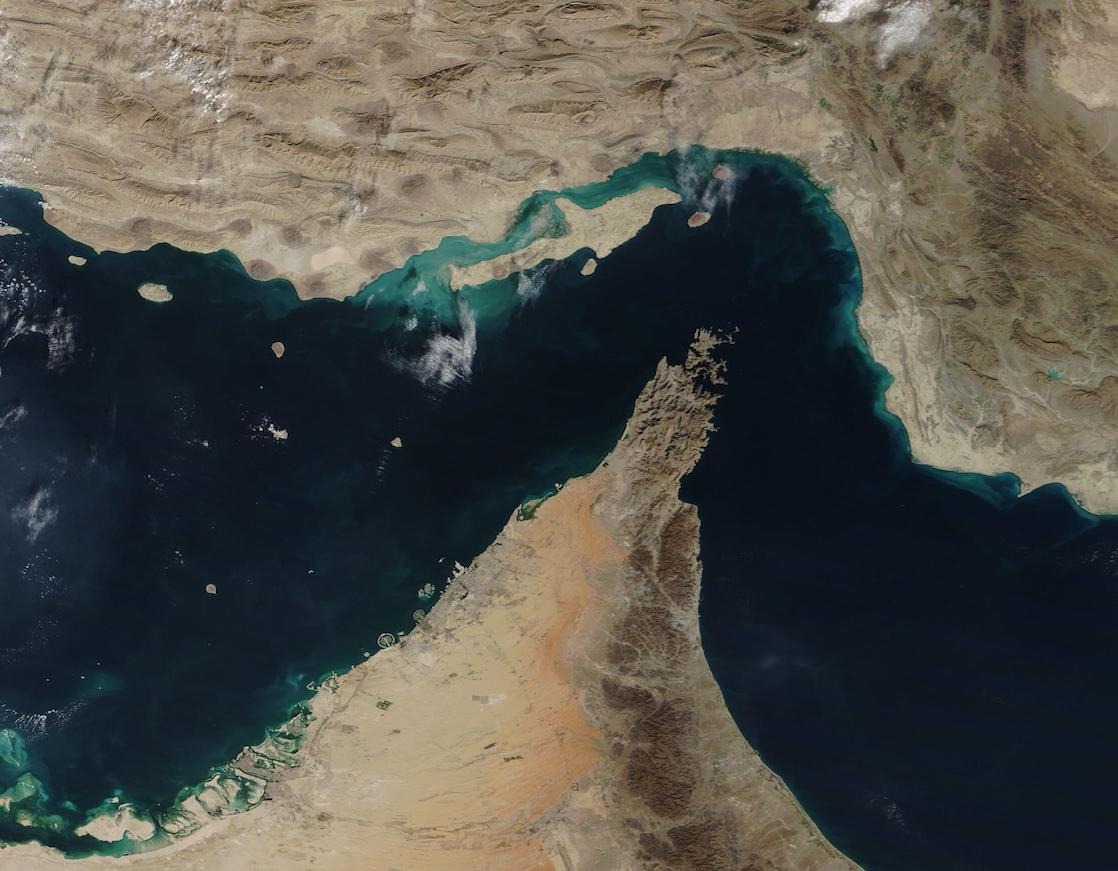
The regime does not move money through uniforms and official titles. It moves money through family members, front companies, exchange houses, shipping firms, insurance brokers, commodity traders, gold dealers, charities, banks, and offshore accounts. Every one of these channels must be mapped, exposed, and disrupted. Pictured: The Strait of Hormuz as seen from NASA’s Terra satellite (Image source: MODIS Land Rapid Response Team, NASA GSFC)

As the United States moves to reopen the Strait of Hormuz and restore freedom of navigation, Washington must not lose sight of the larger strategic reality: Hormuz is not the core issue. It is the latest instrument of Iranian blackmail.

The Islamic Republic of Iran has long mastered the politics of manipulation. It uses propaganda to project strength, disinformation to confuse public opinion, threats to intimidate the region, and negotiations to buy time. For decades, Tehran has delayed, promised, denied, escalated, and recalibrated — all while rebuilding its capabilities, consolidating its networks, and preserving the machinery of regime survival.

This is one of the regime’s most effective methods: turning the original problem upside down.

At the beginning, the issue was Iran’s nuclear program, its ballistic missiles, its terrorist proxies, and the future of the regime itself. Today, Tehran wants the world to discuss something else: how to reopen the Strait of Hormuz, how to avoid energy disruption, how to prevent escalation, and how to negotiate a temporary exit from the crisis. This is not diplomacy. It is strategy.

The regime creates a crisis, then demands to be treated as the indispensable party to solving it. It threatens regional stability, then asks for recognition when it reduces the threat. It uses escalation to shift the agenda from accountability to de-escalation.

Washington should not be fooled again.

The United States and its allies have tried nearly every approach: engagement, sanctions relief, warnings, indirect negotiations, limited pressure, and diplomatic patience. None has changed the essential nature of the Islamic Republic. The regime has used time not to moderate, but to adapt. It has used diplomacy not to reform, but to survive. That is why the next phase of Western strategy must begin from a different premise.

The Iranian regime is not sustained by ideology alone. It is sustained by money, contracts, ports, banks, smugglers, foundations, front companies, privileged merchants, terrorist proxies, and commercial collaborators. To weaken it, Washington must move beyond targeting only the men who command the regime. It must target the networks that feed it.

Break the economic architecture, and the political architecture begins to crack.

The Islamic Republic is not merely a government. It is an ecosystem of coercion. The clerics provide ideological cover. The Revolutionary Guards provide force. The security services provide repression. The propaganda machine provides fear. But the economic networks provide oxygen.

Without that oxygen, the system cannot breathe.

Iran today remains dangerous, but it is not strong. It can still threaten shipping lanes, activate proxies, repress its citizens, and destabilize its neighbors. But these are not signs of confidence. They are symptoms of a regime that has lost the ability to inspire, persuade, or govern.

The Islamic Republic survives by turning loyalty into a business model. Those who serve the regime receive contracts, licenses, access to foreign currency, import privileges, protection, and immunity. Those who oppose it face exclusion, surveillance, prison, exile, or death.

This is not ideological strength. It is organized corruption protected by violence.

At the center of this system stands the Islamic Revolutionary Guard Corps. The IRGC is not only a military institution. It is an economic empire, a political machine, a sanctions-evasion network. Its influence extends through construction, energy, ports, telecommunications, transport, procurement, smuggling, banking, and foreign operations.

To weaken the IRGC, it is not enough to sanction commanders. The commercial universe that sustains them must be dismantled.

The regime does not move money through uniforms and official titles. It moves money through family members, front companies, exchange houses, shipping firms, insurance brokers, commodity traders, gold dealers, charities, banks, and offshore accounts. Every one of these channels must be mapped, exposed, and disrupted.

This requires a shift from individual sanctions to network sanctions.

The same logic applies to the Bazaar. The United States and its allies should not punish Iran’s merchant class as a whole. Many ordinary merchants are themselves victims of inflation, corruption, currency collapse, and the IRGC’s domination of trade. But regime-linked commercial networks operating inside and around the Bazaar must be treated as part of the regime’s survival structure.

There must be a clear distinction between legitimate private commerce and collaboration with the regime economy. Ordinary traders should be separated from the system. But wholesalers, currency dealers, gold traders, import-export operators, shipping intermediaries, and commercial families who help the IRGC evade sanctions, manipulate markets, launder money, or finance repression should face direct consequences.

The objective is not to destroy Iranian commerce. The objective is to liberate it from the regime.

Pressure must also create incentives for separation. Business figures who break with the IRGC economy, expose sanctions-evasion channels, reveal corruption, or stop financing the regime’s machinery should have pathways to avoid punishment. The strategy should not only punish loyalty. It should reward defection.

That is how economic pressure becomes political pressure.

But the regime’s networks do not stop at Iran’s borders. They extend across the region through proxies, terrorist cells, cyber units, propaganda platforms, and intelligence operations.

The recent dismantling of Iran-linked networks in the UAE and Bahrain should be treated as a strategic warning. These were not isolated incidents. They were symptoms of a broader Iranian method: use commerce as cover, finance as oxygen, proxies as weapons, and regional instability as leverage.

The United States should therefore intensify intelligence cooperation with regional partners targeted by Iranian-backed networks, especially countries that have joined the Abraham Accords. These states should receive stronger intelligence-sharing, cyber defense, maritime protection, counterterrorism coordination, financial-investigation support, and early-warning capabilities.

The Abraham Accords should not only be a diplomatic framework. They should become a protected strategic architecture against Iranian coercion.

The message to the Iranian people must remain clear: the conflict is not with Iran as a nation, nor with Persian civilization, nor with ordinary families struggling to survive. The target is the regime’s theft of Iran’s economy. Iran is not poor because it lacks resources. Iran is poor because the Islamic Republic has converted national wealth into repression, missiles, militias, corruption, and foreign adventurism.

Reopening the Strait of Hormuz is necessary. But it is not enough. Freedom of navigation must not become a substitute for strategic clarity. The United States should not allow Tehran to transform a crisis it created into a diplomatic escape route. Hormuz must be reopened, but the regime’s economic, financial, military, and proxy networks must be dismantled.

The Islamic Republic survives because repression is financed, loyalty is purchased, corruption is protected, and national wealth is privatized by the regime’s guardians. That fortress can be dismantled.

Break the money machine, break the proxy machine, and the political machine begins to fail.


Ahmed Charai is the Chairman and CEO of World Herald Tribune, Inc., and the publisher of the Jerusalem Strategic Tribune, TV Abraham, and Radio Abraham. He serves on the boards of several prominent institutions, including the Atlantic Council, the Center for the National Interest, the Foreign Policy Research Institute, and the International Crisis Group. He is also an International Councilor and a member of the Advisory Board at the Center for Strategic and International Studies.


Zawartość publikowanych artykułów i materiałów nie reprezentuje poglądów ani opinii Reunion’68,
ani też webmastera Blogu Reunion’68, chyba ze jest to wyraźnie zaznaczone.
Twoje uwagi, linki, własne artykuły lub wiadomości prześlij na adres:
webmaster@reunion68.com


Israel’s Attorney General Calls to Cancel Netanyahu’s Mossad Chief Appointment


Israel’s Attorney General Calls to Cancel Netanyahu’s Mossad Chief Appointment

i24 News and Algemeiner Staff


Israeli Attorney-General Gali Baharav-Miara. Photo: Twitter

Attorney General Gali Baharav-Miara told the High Court of Justice on Sunday that Prime Minister Benjamin Netanyahu’s decision to appoint Maj. Gen. Roman Gofman as the next Mossad chief must be canceled.

Baharav-Miara filed her position ahead of a Tuesday hearing on petitions challenging the appointment, telling the court that “substantial flaws” had been found both in the process conducted by the advisory committee and in the conclusions it drew. She said Netanyahu’s decision suffered from “extreme and blatant unreasonableness” and could not stand legally.

At the center of the dispute is the case of Ori Elmakayes, who was a 17-year-old minor when he was activated in 2022 by Division 210, without going through authorized intelligence channels. At the time, the division was commanded by Gofman. Elmakayes was arrested in May 2022 under espionage charges after two officers sent him classified information and told him to post it online as part of an “influence campaign,” despite not being authorized to do so. Gofman initiated this operation. Elmakayes was then held in full detention until July, spending an extended period under electronic monitoring and house arrest before the indictment against him was canceled in late 2023.

Baharav-Miara says Gofman’s involvement in leaking the classified information to the minor, “casts a heavy shadow on Gofman’s integrity and thus on his appointment to head the Mossad.” The attorney general also identified serious procedural failings in the advisory committee’s work. She notes that the majority members signed their opinion before committee chairman and former Supreme Court president Asher Grunis had written his dissent and before two members had reviewed several classified documents significant to the full picture. Grunis concluded that integrity flaws had been found and that it was not appropriate to appoint Gofman as Mossad chief.

The attorney general also says the committee failed to hear directly from Elmakayes or from a relevant senior military intelligence officer, instead relying in part on media interviews.

Netanyahu, who appointed Gofman to head the Mossad starting in early June, for a five-year term, submitted his own response to the court on this past Friday, arguing that the decision fell within his executive authority. The Prime Minister also said that his assessment of the matter was “dozens of times superior” to that of the court, adding that Gofman’s integrity was “found pure,” and describing him as the most qualified candidate.

Other coalition figures responded to the attorney general with sharp criticism, including National Security Minister Itamar Ben-Gvir. Ben-Gvir accused Baharav-Miara of fighting the state, while Finance Minister Bezalel Smotrich said her position was “one step too far” and vowed to advance legislation splitting the attorney general’s role in the Knesset’s summer session.


Zawartość publikowanych artykułów i materiałów nie reprezentuje poglądów ani opinii Reunion’68,
ani też webmastera Blogu Reunion’68, chyba ze jest to wyraźnie zaznaczone.
Twoje uwagi, linki, własne artykuły lub wiadomości prześlij na adres:
webmaster@reunion68.com