New Poll: Majority of NYC Voters ‘Less Likely’ to Support Mamdani Over His Refusal to Condemn ‘Globalize the Intifada’

New Poll: Majority of NYC Voters ‘Less Likely’ to Support Mamdani Over His Refusal to Condemn ‘Globalize the Intifada’

Corey Walker


Zohran Mamdani. Photo: Ron Adar / SOPA Images via Reuters Connect

In a warning sign for the campaign of Democratic nominee for mayor of New York Zohran Mamdani, a majority of city voters in a new poll say the candidate’s hardline anti-Israel stance makes them less likely to vote for him.

In the survey of likely city voters conducted by American Pulse, 52.5 percent said Mamdani’s refusal to condemn the slogan “globalize the intifada” coupled with his backing of the Boycott, Divestment, and Sanctions (BDS) movement made them less likely to vote for him in November. Just 31% of city voters polled were more likely to support him because of these positions.

At the same time, a significant share of young New York City voters support Mamdani’s anti-Israel positioning, a striking sign of shifting generational views on Israel and the Palestinian cause.

Nearly half  of voters aged 18 to 44 (46 percent) said the State Assembly member’s backing for BDS and “refusal to condemn the phrase ‘globalize the intifada’” made them more likely to support him.

Mamdani, a democratic socialist from Queens, has been under fire for defending “globalize the intifada,” a slogan many Jewish groups associate with incitement to violence against Israel and Jews. While critics argue it glorifies terrorism, supporters claim it’s a call for international solidarity with oppressed peoples, especially Palestinians. Mamdani has also voiced support for BDS, a movement widely condemned by mainstream Jewish organizations as antisemitic for singling out Israel.

The generational divide exposed by the poll comes amid a broader political realignment. Younger progressives across the country are increasingly critical of Israeli policies, especially in the wake of the Gaza war, and more receptive to Palestinian activism. But to many Jewish leaders, Mamdani’s rising support is alarming.

Rabbi David Wolpe, visiting scholar at Harvard University, condemned the phrase with a sarcastic analogy.

“‘Globalize the intifada’ is just a political slogan,” he said. “Like ‘The cockroaches must be exterminated’ was just a housing authority slogan in Rwanda.”

Jewish organizations have reported a surge in antisemitic incidents in New York and across the U.S. since the outbreak of the Israel-Hamas war last fall. The blending of anti-Zionist slogans with calls for “intifada,” historically linked to violent uprisings, has deepened fears among Jewish communities that traditional red lines are being crossed.

Whether this emerging coalition reshapes New York politics remains to be seen. However, the poll indicates that among younger voters, views that were once considered fringe are quickly moving into the mainstream.


Zawartość publikowanych artykułów i materiałów nie reprezentuje poglądów ani opinii Reunion’68,
ani też webmastera Blogu Reunion’68, chyba ze jest to wyraźnie zaznaczone.
Twoje uwagi, linki, własne artykuły lub wiadomości prześlij na adres:
webmaster@reunion68.com


Qatar Must Not Be Allowed to Play Any Role in Gaza

Qatar Must Not Be Allowed to Play Any Role in Gaza

Khaled Abu Toameh


  • Allowing Qatar to be part of an Arab consortium that would replace Hamas rule in the Gaza Strip is essentially placing the alpha-fox in charge of the henhouse.
  • Al-Jazeera, Qatar’s flagship media network, operates around the clock as a propaganda outlet in the service of Hamas.
  • After America’s attack on Iran’s nuclear sites on June 22, journalists and those who shape public opinion in Qatar condemned the US and President Donald J. Trump. Al-Jazeera presenters and columnists for Qatar’s government newspapers took to social media to slam the US and Trump, calling him a “brazen liar”, “the leader of a modern crusade”, and a “war criminal”…
  • “… Israel must be destroyed and eliminated and must disappear. This should be a strategic Arab doctrine. [Operation] Al-Aqsa Flood showed us that the Israelis have no connection to the land….” — Qatari General (ret.) Mubarak Al-Khayreen, X.com, June 22, 2025.
  • In 2017, [Bahrain, Egypt, Saudi Arabia, and the United Arab Emirates] severed ties with Qatar and imposed a sea, land and air blockade on it. They accused Qatar of supporting various terrorist groups and extremist movements, including the Muslim Brotherhood, and demanded the closure of Al-Jazeera.
  • Qatar has never abandoned its goal of promoting the Muslim Brotherhood and its affiliates, including Hamas. Anyone who watches Al-Jazeera (in Arabic) can see that the Gulf state and its media outlets are fully mobilized in favor of Islamist Jihadis engaged in terrorism against Israel and the West.
  • Qatar cannot be allowed to play any role in the administration of the Gaza Strip.

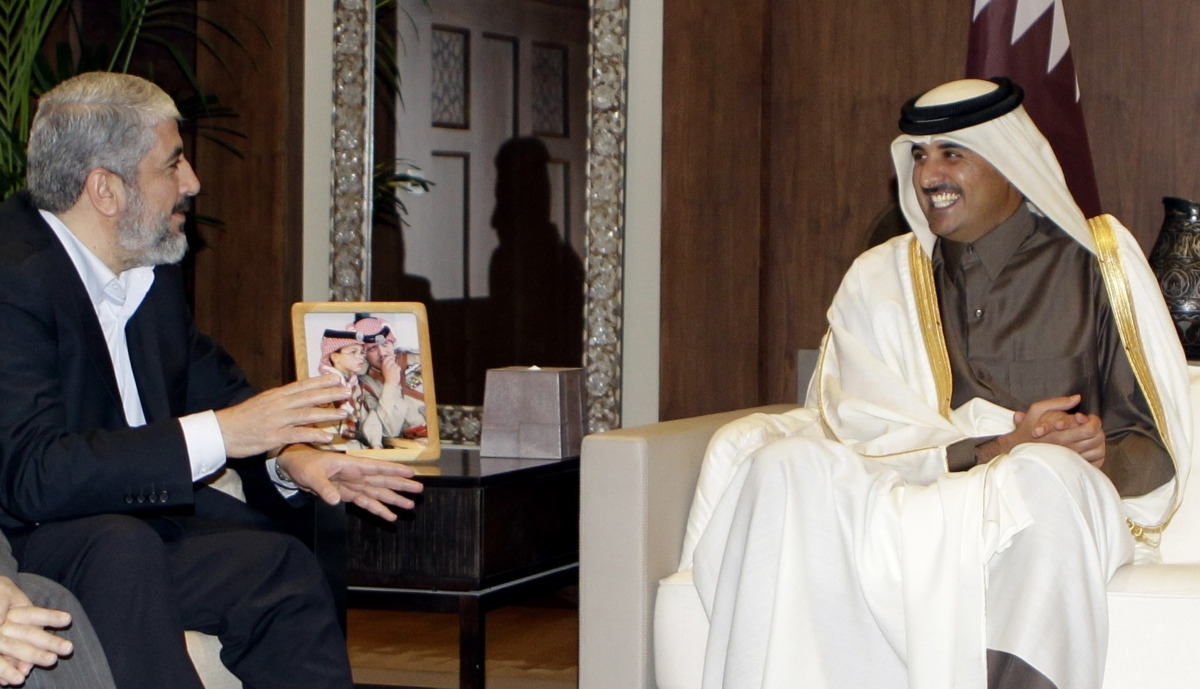
Allowing Qatar to be part of an Arab consortium that would replace Hamas rule in the Gaza Strip is essentially placing the alpha-fox in charge of the henhouse. Pictured: Hamas leader Khaled Mashaal meets with Qatar’s then Crown Prince (today’s Emir) Sheikh Tamim bin Hamad al-Thani at the Royal Palace in Amman, Jordan on January 29, 2012. (Photo by Khalil Mazraawi/AFP via Getty Images)

According to a recent report, the Trump administration is floating the idea of having four Arab states administer the Gaza Strip as part of a ceasefire agreement between Israel and the Iran-backed Palestinian terror group Hamas. On June 26, the Israeli newspaper Israel Hayom reported:

“Gaza hostilities will conclude within two weeks, ending conditions will encompass four Arab nations (including Egypt and the United Arab Emirates) to administer the Gaza Strip, replacing the murderous Hamas terrorist organization.”

Although the newspaper did not name the two other Arab countries that would take part in administering the Gaza Strip, there is speculation in the Arab world that one of them is Qatar, which has expressed readiness to help rebuild Gaza after the Hamas-Israel war ends.

The war erupted on October 7, 2023, when thousands of Hamas terrorists and “ordinary” Palestinians launched a surprise attack on Israel, murdering more than 1,200 Israelis and foreign nationals and wounding thousands. On the same day, another 251 Israelis and foreign nationals were kidnapped to the Gaza Strip, where 50 (dead and alive) are still held hostage.

Allowing Qatar to be part of an Arab consortium that would replace Hamas rule in the Gaza Strip is essentially placing the alpha-fox in charge of the henhouse.

Qatar’s longtime financial and political support for Hamas is one of the reasons the terror group managed to stay in power and carry out countless terrorist attacks against Israel over the past two decades.

Qatar’s support continued after the October 7 atrocities, as noted by the Middle East Media Research Institute (MEMRI):

“Since Hamas’s deadly attack on October 7, 2023, and throughout the war that broke out in its aftermath, the state of Qatar, its media, and institutions affiliated with it have consistently expressed unreserved support for Hamas and for terror and armed violence against Israel. This support finds expression on all levels, in statements by officials and religious clerics, in the media and in the education system. Despite its ostensible role as a mediator between Hamas and Israel, Qatar, which has for years sheltered Hamas leaders within its borders and funded this organization with billions of dollars, has taken a blatantly pro-Hamas and anti-Israel line. Qatari Shura Council member Essa Al-Nassr said that October 7 was the beginning of the end of the Zionist state, presenting this as a divine promise mentioned in the Quran. He added that there can be no peace with the Jews, because their faith condones ‘depletion, the violation of agreements and lies’ and they are ‘slayers of the prophets.'”

Qatar’s foreign ministry released a statement on October 7, 2023, holding “Israel alone responsible” for Hamas’s massacres. The ministry ignored Hamas’s war crimes and accused Israel of violating international law.

The MEMRI report pointed out that Al-Jazeera, Qatar’s flagship media network, operates around the clock as a propaganda outlet in the service of Hamas:

“It [Al-Jazeera] expresses unreserved support for Hamas, justifying its October 7 attack, showing footage it obtained from the [Hamas] terrorists’ body cams, and celebrating it as a victory that has brought pride and honor to the Islamic nation. The network has provided an unlimited platform for messages and threats by Hamas’s leaders and spokespersons, and for their calls on Muslims worldwide to join the jihad (holy war) against Israel. In fact, Hamas’s leader in the Gaza Strip, Yahya Sinwar, described Al-Jazeera as “the best pulpit that accurately gives voice to our positions.”

On June 8, the Qatari state-owned newspaper Al-Raya published an article by senior writer Babiker Issa, who praised Hamas commander Mohammed Sinwar, one of the planners of the October 7 atrocities. Under the headline “Sinwar Icon of the Palestinian Resistance,” Issa called Mohammed Sinwar “a daring fighter” and “an honorable and great warrior.” He went on to describe him as “icon of the national struggle on the land of Palestine and in Gaza,” and as “the planer and the mastermind -with his comrades the fighters -of the Al-Aqsa Flood Operation on October 7, 2023… which restored to the Palestinian issue its brilliance and its glory.”

Qatar claims that the money it delivered to Hamas in the Gaza Strip over many years was humanitarian aid, and intended for the civilian population, but evidence suggests that much of the funding has directly benefited Hamas’s political and military structures, already on record as stealing aid (for instance here, here, here, here, here, here and here). For the past two decades, Qatar has transferred more than $1.8 billion to Hamas, making it a primary financial lifeline for the terror group.

Between 2018 and 2023 alone, Qatar delivered funds, in cash, to Hamas in the Gaza Strip, amounting to $30 million each month. Didier Billion, deputy director of the French Institute for International and Strategic Affairs, said that Qatar’s financial support of $30 million per month is “proven and public.”

“These payments are [purported] to pay civil servants in Gaza, and we know perfectly well that these are members of Hamas. Doha’s money is therefore the equivalent of direct support for this organisation which has held the Palestinian enclave with an iron fist for many years.”

Documents recently found by the Israel Defense Forces in the Gaza Strip indicate that Hamas leaders describe Qatar as the group’s “main artery,” and Qatari money as crucial for Hamas’s operations, including its military wing.

The Qatari funds were “the main lifeline of the [Hamas] movement,” Hamas’s then politburo chief Ismail Haniyeh told then-Qatari Foreign Minister Mohammed bin Abdulrahman Al-Thani (today prime minister) in a face-to-face meeting in 2019, according to the documents.

Haniyeh, according to the documents, revealed in 2021 that the emir of Qatar had agreed to covertly fund Hamas’s armed “resistance” efforts. “So far, $11 million has been raised by the emir for the [Hamas] leadership.” Haniyeh wrote in a letter to Yahya Sinwar.

“In a private meeting between us, we reassured [the emir] regarding the resistance. We agreed on discreet financial support [from Qatar to Hamas]. I would ask that you write a letter focusing on the military campaign [against Israel] and your urgent needs.”

Reports suggest that Qatari intelligence officials discussed with Hamas representatives the possibility of establishing training camps for Hamas fighters in Qatar and Turkey. Qatar, in addition, supported the integration of Palestinian refugees from Syria into Hamas battalions in Lebanon.

After America’s attack on Iran’s nuclear sites on June 22, journalists and those who shape public opinion in Qatar condemned the US and President Donald J. Trump. Al-Jazeera presenters and columnists for Qatar’s government newspapers took to social media to slam the US and Trump, calling him a “brazen liar”, “the leader of a modern crusade”, and a “war criminal” who has “revealed his ugly face” and is “looking for false personal glory.” They also described the Americans as “infidels” and “plotters” seeking to “ignite wars and destroy peoples.”

Retired Qatari general Mubarak Al-Khayreen wrote on his X account:

“There is [some] benefit in the US being strong alongside Russia and China, in order to maintain the global balance [of power], but Israel must be destroyed and eliminated and must disappear. This should be a strategic Arab doctrine. [Operation] Al-Aqsa Flood showed us that the Israelis have no connection to the land and that they admit they are occupying the land of others and that they are transient.”

Qatar’s support for Hamas aligns with its broader foreign policy of leveraging the Muslim Brotherhood organization to enhance its regional influence. Qatar’s support for the Muslim Brotherhood dates back to the 1950s and ’60s, when the Gulf state offered refuge to members of the organization fleeing political repression in other Arab countries. In recent years, Qatar has hosted Hamas’s political leaders, including Khaled Mashaal, Ismail Haniyeh, Musa Abu Marzouk, and Khalil al-Hayya.

Qatar’s support for the Muslim Brotherhood has often created tensions with other Arab countries. The Muslim Brotherhood has been designated as a terrorist organization by several countries, including Bahrain, Egypt, Saudi Arabia, and the United Arab Emirates. In 2017, the four Arab states severed ties with Qatar and imposed a sea, land and air blockade on it. They accused Qatar of supporting various terrorist groups and extremist movements, including the Muslim Brotherhood, and demanded the closure of Al-Jazeera.

The crisis ended in 2021 after mediation by Kuwait and Oman, and pressure from the United States.

Qatar has never abandoned its goal of promoting the Muslim Brotherhood and its affiliates, including Hamas. Anyone who watches Al-Jazeera (in Arabic) can see that the Gulf state and its media outlets are fully mobilized in favor of Islamist Jihadis engaged in terrorism against Israel and the West. Qatar will doubtless once again use humanitarian aid as a tool to ensure Hamas’s continued rule over the Gaza Strip. This patronage will pave the way for more October 7-style massacres.

Qatar cannot be allowed to play any role in the administration of the Gaza Strip.


Khaled Abu Toameh is an award-winning journalist based in Jerusalem.


Zawartość publikowanych artykułów i materiałów nie reprezentuje poglądów ani opinii Reunion’68,
ani też webmastera Blogu Reunion’68, chyba ze jest to wyraźnie zaznaczone.
Twoje uwagi, linki, własne artykuły lub wiadomości prześlij na adres:
webmaster@reunion68.com


Hamas Warns Against Cooperation with US Relief Efforts In Bid to Restore Grip on Gaza

Hamas Warns Against Cooperation with US Relief Efforts In Bid to Restore Grip on Gaza

Ailin Vilches Arguello


Hamas terrorists carry grenade launchers at the funeral of Marwan Issa, a senior Hamas deputy military commander who was killed in an Israeli airstrike during the conflict between Israel and Hamas, in the central Gaza Strip, Feb. 7, 2025. Photo: REUTERS/Ramadan Abed

The Hamas-run Interior Ministry in Gaza has warned residents not to cooperate with the US- and Israeli-backed Gaza Humanitarian Foundation, as the terror group seeks to reassert its grip on the enclave amid mounting international pressure to accept a US-brokered ceasefire.

“It is strictly forbidden to deal with, work for, or provide any form of assistance or cover to the American organization (GHF) or its local or foreign agents,” the Interior Ministry said in a statement Thursday.

“Legal action will be taken against anyone proven to be involved in cooperation with this organization, including the imposition of the maximum penalties stipulated in the applicable national laws,” the statement warns.

The GHF released a statement in response to Hamas’ warnings, saying the organization has delivered millions of meals “safely and without interference.”

“This statement from the Hamas-controlled Interior Ministry confirms what we’ve known all along: Hamas is losing control,” the GHF said.

The GHF began distributing food packages in Gaza in late May, implementing a new aid delivery model aimed at preventing the diversion of supplies by Hamas, as Israel continues its defensive military campaign against the Palestinian terrorist group.

The initiative has drawn criticism from the UN and international organizations, some of which have claimed that Jerusalem is causing starvation in the war-torn enclave.

Israel has vehemently denied such accusations, noting that, until its recently imposed blockade, it had provided significant humanitarian aid in the enclave throughout the war.

Israeli officials have also said much of the aid that flows into Gaza is stolen by Hamas, which uses it for terrorist operations and sells the rest at high prices to Gazan civilians.

According to their reports, the organization has delivered over 56 million meals to Palestinians in just one month.

Hamas’s latest threat comes amid growing international pressure to accept a US-backed ceasefire plan proposed by President Donald Trump, which sets a 60-day timeline to finalize the details leading to a full resolution of the conflict.

In a post on Truth Social, Trump announced that Israel has agreed to the “necessary conditions” to finalize a 60-day ceasefire in Gaza, though Israel has not confirmed this claim.

Israeli Prime Minister Benjamin Netanyahu is expected to meet with Trump next week in Washington, DC — his third visit in less than six months — as they work to finalize the terms of the ceasefire agreement.

Even though Trump hasn’t provided details on the proposed truce, he said Washington would “work with all parties to end the war” during the 60-day period.

“I hope, for the good of the Middle East, that Hamas takes this Deal, because it will not get better — IT WILL ONLY GET WORSE,” he wrote in a social media post.

Since the start of the war, ceasefire talks between Jerusalem and Hamas have repeatedly failed to yield enduring results.

Israeli officials have previously said they will only agree to end the war if Hamas surrenders, disarms, and goes into exile — a demand the terror group has firmly rejected.

“I am telling you — there will be no Hamas,” Netanyahu said during a speech Wednesday.

For its part, Hamas has said it is willing to release the remaining 50 hostages — fewer than half of whom are believed to be alive — in exchange for a full Israeli withdrawal from Gaza and an end to the war.

While the terrorist group said it is “ready and serious” to reach a deal that would end the war, it has yet to accept this latest proposal.

In a statement, the group said it aims to reach an agreement that “guarantees an end to the aggression, the withdrawal [of Israeli forces], and urgent relief for our people in the Gaza Strip.”

According to media reports, the proposed 60-day ceasefire would include a partial Israeli withdrawal from Gaza, a surge in humanitarian aid, and the release of the remaining hostages held by Hamas, with US and mediator assurances on advancing talks to end the war — though it remains unclear how many hostages would be freed.

For Israel, the key to any deal is the release of most, if not all, hostages still held in Gaza, as well as the disarmament of Hamas, while the terror group is seeking assurances to end the war as it tries to reassert control over the war-torn enclave.


Zawartość publikowanych artykułów i materiałów nie reprezentuje poglądów ani opinii Reunion’68,
ani też webmastera Blogu Reunion’68, chyba ze jest to wyraźnie zaznaczone.
Twoje uwagi, linki, własne artykuły lub wiadomości prześlij na adres:
webmaster@reunion68.com


Trump: Izrael zgodził się na rozejm w Gazie. Koniec wojny już w najbliższych dniach?

Benjamin Netanjahu i Donald Trump (Fot. REUTERS/Kevin Mohatt)


Trump: Izrael zgodził się na rozejm w Gazie. Koniec wojny już w najbliższych dniach?

Marta Urzędowska


Donald Trump ogłosił, że Izrael zgodził się na dwumiesięczny rozejm w Strefie Gazy, w czasie którego wypracowany zostanie trwały pokój. “Ameryka będzie współpracować ze wszystkimi, by zakończyć tę wojnę” – zapewnił prezydent USA.
„Moi przedstawiciele odbyli dziś długie i produktywne spotkanie z Izraelczykami na temat Gazy – ogłosił Donald Trump we wtorkowym wpisie w swoim serwisie społecznościowym Truth Social. – Izrael zgodził się na warunki niezbędne, by sfinalizować 60-dniowe zawieszenie broni, w czasie którego będziemy współpracować ze wszystkimi stronami, by zakończyć tę wojnę. Katarczycy i Egipcjanie, którzy ciężko pracowali, by pomóc zaprowadzić pokój, przedstawią ostateczną propozycję. Mam nadzieję, że – dla dobra całego Bliskiego Wschodu – Hamas ją przyjmie, bo lepszej oferty nie dostanie, dostanie tylko gorszą” – zagroził amerykański przywódca.

Realna szansa na rozejm? Trump spotka się z Netanjahu i będzie “bardzo zdecydowany”

Oświadczenie Trumpa pasuje do pojawiających się od kilku dni doniesień, że rosną szanse na rozejm w Strefie Gazy. W enklawie trwa wojna rozpoczęta przez Hamas atakiem na Izrael z 2023 r., w którym terroryści zabili 1,2 tys. osób, a 250 porwali do Gazy. W izraelskich odwetowych nalotach i operacjach lądowych zginęło już ponad 56 tys. Palestyńczyków, enklawa została niemal zrównana z ziemią, a sytuacja humanitarna dwóch milionów jej mieszkańców jest dramatyczna, bo Izrael poważnie ogranicza dostarczanie na miejsce jedzenia, wody i leków.

Dziś wygląda na to, że pojawiła się realna szansa na zawieszenie broni. Trump nie tylko zapewnia, że Izraelczycy już zgodzili się na rozejm, ale w najbliższych dniach spotka się w tej sprawie w Waszyngtonie z premierem Benjaminem Netanjahu i zapowiada, że podczas tej rozmowy będzie „bardzo zdecydowany”.

Według Trumpa również Netanjahu jest za szybkim zawieszeniem broni. – On tego chce, mówię wam, naprawdę tego chce – zapewniał Amerykanin we wtorek 1 lipca. – Myślę, że w przyszłym tygodniu będziemy mieli deal.

Pojazdy izraelskiej armii (widoczne w chmurze pyłu) operujące na granicy Strefy Gazy Fot. REUTERS/Amir Cohen

Wcześniej Waszyngton w tej samej sprawie odwiedził izraelski minister ds. strategii Ron Dermer, który spotkał się z przedstawicielami administracji Trumpa.

Izrael i Hamas nie potwierdzają, że są bliskie rozejmu. Wcześniej stanowiska radykalnie się różniły

Według źródeł CNN Katarczycy przekazali już obu stronom nową propozycję rozejmu, ale na razie nie wiadomo, na co dokładnie zgodzili się Izraelczycy i co myśli o niej Hamas.

Poprzednie próby dogadania się przynosiły albo krótkie rozejmy, albo w ogóle kończyły się fiaskiem. Izraelczycy żądali od terrorystów kapitulacji i rozbrojenia, co Hamas zawsze wykluczał, domagając się z kolei pełnego wycofania izraelskiej armii i trwałego zakończenia wojny, co zdecydowanie odrzucał Izrael.

Nie jest też jasne, co proponowany przez Trumpa rozejm oznacza dla izraelskich zakładników nadal przetrzymywanych w Gazie. Na miejscu pozostaje ok. dwudziestu żyjących osób i ok. trzydziestki ciał zabitych zakładników. W poprzednich negocjacjach Hamas proponował zwolnienie dziesięciu osób, Izrael domagał się zwolnienia wszystkich.

Na razie optymistyczne zapewnienia płyną niemal wyłącznie z Waszyngtonu – Izrael i Hamas nie potwierdzają oficjalnie, że są bliskie rozejmu. Jedynie ambasador Izraela przy ONZ Danny Danon przekonywał we wtorek w rozmowie z BBC, że Izrael jest „absolutnie gotowy na zawieszenie broni”. Jednocześnie zastrzegł, że jeśli Hamas nie zgodzi się na porozumienie, „jedyną opcją będzie większa presja militarna”.

Rozejm w Strefie Gazy. Hamas bardziej skłonny do ustępstw, bo Izrael i USA osłabiły Teheran

Amerykański prezydent nie bez powodu chwali się, że lada dzień zakończy ciągnącą się od blisko dwóch lat wojnę. Tydzień temu skutecznie zakończył inną, jeszcze groźniejszą bliskowschodnią eskalację. Przez blisko dwa tygodnie trwała izraelsko-irańska wymiana ciosów rozpoczęta atakiem Izraela na Iran, podczas którego Izraelczycy zniszczyli Irańczykom wojskowe i nuklearne obiekty i pozabijali najważniejszych dowódców i naukowców od atomu. Do wojny na chwilę włączyli się Amerykanie, bombardując trzy ważne irańskie ośrodki nuklearne potężnymi bombami, zdolnymi niszczyć także ukryte pod ziemią instalacje, choć do końca nie jest jasne, jak duże są zniszczenia.

Choć przez chwilę wydawało się, że amerykański atak może nasilić eskalację, a nawet wciągnąć USA w bliskowschodnią awanturę, sytuację udało się uspokoić – Irańczycy odpowiedzieli jedynie symbolicznie, Amerykanie ogłosili, że kończą konfrontację, a Trump w wyjątkowo ostrych słowach zmusił obie strony do zawieszenia broni.

Osłabienie Iranu to jeden z powodów, dla których dziś może być łatwiej o rozejm w Gazie. Teheran to najważniejszy sojusznik i sponsor Hamasu, a dziś ma za dużo własnych problemów, żeby upominać się o palestyńskich podopiecznych. Może to oznaczać, że hamasowcy będą bardziej skłonni do ustępstw, szczególnie że w ub. roku kilkumiesięczną wojną Izrael mocno osłabił też ich drugiego sojusznika, libański Hezbollah.

Palestyńczycy w drodze po pomoc humanitarną w Chan Junis w Strefie Gazy Fot. REUTERS/Hatem Khaled

Źródła w izraelskiej armii przekonują w rozmowie z CNN, że także Izraelczycy są dziś bardziej gotowi do zawarcia porozumienia, bo choć nie udało im się w pełni pokonać terrorystów, Hamas jest dziś tak osłabiony i zdziesiątkowany, że izraelska armia nie jest już w stanie skutecznie polować na niedobitki grupy.

Izrael nasila ataki. Eksperci od pomagania alarmują: Pomoc sprzeczna ze standardami

Na razie sytuacja na miejscu pozostaje daleka od spokoju. W ostatnich dniach izraelska armia wydała nakazy ewakuacji dla mieszkańców miasta Gaza i innych obszarów na północy enklawy, po czym rozpoczęła serię ataków, w których zginęło kilkadziesiąt osób, wśród nich ponad dwadzieścia w zbombardowanej w poniedziałek nadmorskiej kawiarni.

W ostatnich tygodniach regularnie dochodzi też do ataków na Palestyńczyków gromadzących się w okolicach ośrodków dystrybucji pomocy humanitarnej. Chodzi o centra, w których dystrybucję prowadzi Gaza Humanitarian Foundation (GHF), wspierana przez USA i Izrael organizacja pośrednicząca w dostarczaniu pomocy prywatnymi kanałami, przy udziale izraelskiej armii. Izrael pozwolił na taką formę pomagania kiedy zablokował pomoc świadczoną tradycyjnymi kanałami, za pośrednictwem ONZ. Według Izraelczyków taka zmiana to jedyny sposób, by pomoc nie trafiała w ręce Hamasu.

Z izraelską oceną nie zgadzają się czołowe organizacje pomocowe, które we wtorek wystosowały wspólny apel, w którym proszą o zlikwidowanie GHF. Przekonują, że taka forma pomagania jest sprzeczna z międzynarodowymi standardami i niebezpieczna. Tłumaczą, że potrzebujący Palestyńczycy są zmuszeni do przychodzenia pod ośrodki pomocy, często na niebezpieczne, zmilitaryzowane tereny, gdzie dochodzi do groźnych incydentów – od maja zginęły w nich setki osób. Apel podpisali przedstawiciele ponad 170 organizacji, wśród nich światowi liderzy w pomaganiu, jak Oxfam czy Save the Children.


Redagowała Ludmiła Anannikova


Zawartość publikowanych artykułów i materiałów nie reprezentuje poglądów ani opinii Reunion’68,
ani też webmastera Blogu Reunion’68, chyba ze jest to wyraźnie zaznaczone.
Twoje uwagi, linki, własne artykuły lub wiadomości prześlij na adres:
webmaster@reunion68.com


Israel owes Trump, but that can’t mean Hamas’s survival

Israel owes Trump, but that can’t mean Hamas’s survival

Jonathan S. Tobin


The president wants an end to the war in Gaza so he can make more regional deals in the region. But as much as Jerusalem must defer to him, there must be limits to that gratitude.

Israeli Prime Minister Benjamin Netanyahu visits the scene where a ballistic missile fired from Iran hit and caused damage at the Weizmann Institute in Rehovot, June 20, 2025. Credit: Itai Ron/POOL.

President Donald Trump’s decision to order a strike on Iranian nuclear targets was yet another example of how he has proven to be a reliable friend of the State of Israel. If, as both Jerusalem and the Pentagon say, Tehran’s quest for a bomb have been set back at least two years—and can again be smashed by subsequent Israeli and American military efforts as needed—then it’s clear that the president has altered the strategic equation in the region in favor of the Jewish state and against its enemies. He has also continued to supply Israel with the arms it needs, rather than slow-walk them, and to encourage its campaign to destroy Hamas in Gaza, rather than to hamstring its efforts, as the Biden administration did.

Put in context to his groundbreaking pro-Israel decisions during his first term, the president added to a record that eclipses the support offered by any other administration since the founding of the modern-day Jewish state in 1948. All of which means that Prime Minister Benjamin Netanyahu is obligated to Trump above and beyond the normal deference owed to Israel’s superpower ally.

A price too high?

Yet exactly how far should Netanyahu go to pay that debt when the president demands that he go along with plans that may or may not be in his country’s best interests?

It may be that in the coming days, weeks and months, the world will find out the answer to that question.

It is now being widely reported that Israel has agreed to the terms of another ceasefire-hostage release deal with the Hamas terrorists that is being pushed by the president. If leaks about America’s offer to the Islamist group are true, it will mean the release of 10 of the remaining living hostages (without being first humiliated by revolting ceremonies in which they would be forced to thank their kidnappers) and 18 bodies of deceased captives in exchange for the release of Palestinian Arab terrorists and a 60-day halt to fighting.

If that’s all there is to it, that’s a deal that Netanyahu, who will visit Washington next week, can live with, as can even the most right-wing members of his government. But as the prime minister has stated, he believes that any deal must not obligate Israel to end the war on Hamas without forcing the surrender of all remaining hostages and bodies, as well as the leaders of the end of the Islamist terror group’s rule in Gaza and the exile of all of its leaders. Should the United States force an end to the conflict without that happening, no amount of rhetoric from Trump or Netanyahu will prevent Hamas from claiming victory. And despite all the losses they have sustained since starting this war while committing unspeakable atrocities on Oct. 7, 2023, such boasts will be largely accurate.

Will the post-Oct. 7 war against Hamas end in that fashion? We don’t yet know.

In keeping with the eliminationist beliefs that have been at the core of the Palestinian national movement since its inception in the 20th century, Hamas could well refuse to accept the terms that Trump’s envoys have exchanged with them, and with Egyptian and Qatari intermediaries that have been part of the negotiations. Even if they do, their intransigence—and ideological and religious commitment to violence and the shedding of Jewish blood—could prevent any talks during the 60 days of a ceasefire from blossoming into a long-term agreement that could be represented as the end of the war.

The willingness of Hamas to postpone the achievement of its commitment to Israel’s destruction and the genocide of its population is not the only variable here. There are other factors to consider.

Pressure on Netanyahu

One is the constant domestic pressure on Netanyahu from both the families of some of the hostages and his political opponents to end the war and to achieve the release of all the captives, regardless of whether it means allowing Hamas to snatch victory from the jaws of defeat.

Just as important as the back-and-forth among Israelis about whether it’s time to end the fighting without first securing the defeat of Hamas is what Trump wants out of all this. The president has openly expressed a desire to end the war in Gaza and to use that, along with the crippling of Iran and its terrorist proxies, to expand the Abraham Accords. That is the X factor in the negotiations that could well force Netanyahu to make concessions he wouldn’t otherwise be inclined to give up.

To date, Netanyahu has reiterated that he won’t allow that to happen. But if Hamas is prepared to act in accordance with its best interests as opposed to its bloodthirsty ideology and Trump demands it, would he be forced to give in?

That’s likely the assumption in Trumpworld. It’s also something that many of Netanyahu’s supporters fear.

There’s no question that the U.S. president is willing to pressure Israel, whether publicly or privately, when he thinks that it’s in his interests. His profane demand that Israeli planes be turned around before striking Iran again when Tehran violated the ceasefire is an example.

Expanding the Abraham Accords

It’s also necessary to reiterate the obvious fact that, as much as the interests of the two allies are aligned, they are not identical. Perhaps the president thinks that holding Israel back from finally finishing the job against Hamas in Gaza can lead to what he wants: an expanded Abraham Accords with, as its centerpiece, Saudi Arabia formally recognizing the State of Israel.

That’s something Netanyahu has also stated as the main goal of his diplomatic plans. If it happens, it would be a remarkable achievement considering that the desert monarchy is the guardian of Islam’s holiest places and, for the first seven decades of Israel’s existence, was the lynchpin of the Arab and Muslim world’s unflinching hostility to the existence of the Jewish state.

It also fits perfectly into Trump’s transactional vision for the Middle East, in which all nations act in their self-interest, and prioritize trade and good relations with the West while turning their backs on rogue terrorist regimes like that of Iran.

While the prospect of such a game-changing diplomatic event has been endlessly talked up by both the Trump administration and Netanyahu’s government as not merely possible but inevitable, some skepticism about this is warranted.

If, as we have every reason to believe, not only the nuclear threat but the power of Iran to create mayhem in the Middle East has been seriously degraded, that effectively removes a key incentive for the Saudis to recognize Israel.

Their shift toward a productive, albeit under-the-table relationship with Israel dates back to the Barack Obama administration’s attempt to appease Iran. Far from being motivated by the royal family’s conversion to Zionism from the extreme Wahabi strain of Islam that was the driving force behind its rise to power in the Arabian peninsula, it was fear of being left at the mercy of the Shia mullahs in Tehran that led them to reach out to the Jewish state as a military ally. The ties between Israel and the Saudis have grown since then as Crown Prince Mohammed bin Salman’s efforts to modernize his nation have moved in tandem with a decision to stop funding Islamist fundamentalists around the globe. That’s an unfortunate practice that has been taken up by Qatar, despite Trump’s embrace of that emirate as a supposed U.S. ally.

But if the Saudis now have fewer reasons to fear Iran, that also means they are bound to be less interested in full peace with Israel.

What the Saudis want

The cost-benefit analysis of normalization of relations with Jerusalem for the Saudis is not as simple as optimists about an expanded Abraham Accords like to pretend. There are real risks for the Saudis to give their seal of approval to Israel as a permanent addition to the Middle East. It goes against the Saudis’ faith and ideology, as well as the prevailing anti-Jewish sentiments of most Muslims and Arabs. That’s true even if many of their governments have come to the logical conclusion that peace with Israel is to the benefit of everyone except the Palestinian Arabs and their supporters, who still cling to fantasies about its annihilation.

The Saudis like their sideline relationship with Israel just fine since it gives them the benefits of a strategic alliance without the cost of undermining its stature as the regime most associated with Muslim legitimacy. The only thing that might tempt them to risk normalization would be if the United States were to give what they requested when Riyadh told the Biden administration in March 2023 what its price for such a move would be.

The Saudis asked for the moon. They not only wanted the United States to formally guarantee their security; they also wanted aid to start their own nuclear program. Neither request is ever likely to be granted, as Congress is unlikely to pass such a treaty, and no conceivable American administration would go along with letting them go nuclear.

Since then, the Saudis have publicly spoken about adding to their wish list by demanding that Israel agree to start a diplomatic process that could lead to the creation of a Palestinian state. Riyadh is opposed to such an outcome since another failed Arab state in the regime would likely fall into the hands of Islamist fundamentalists—something not in their interests. But since Oct. 7, greater pressure has been exerted on the Saudis to at least pretend to support the Palestinians.

The administration believes the Saudis may be willing to agree to normalization without granting their extravagant requests. But that brings us back to the first step toward expanding the Abraham Accords: a deal that would end the war in Gaza.

It’s important to remember that the war aims of the Israeli government—the defeat of Hamas and the return of all of the hostages—are still mutually exclusive. As has been obvious since the terrorist invasion of southern Israel, getting all the remaining live hostages back will require Netanyahu to let Hamas survive in Gaza. He has rightly stated that means giving the terrorists the opportunity to rebuild and rearm, and to make good their pledges to commit more assaults like those that occurred on Oct. 7.

The future of Gaza and Israel

Like the wildly unrealistic plans for a state in Judea and Samaria to be given to the Palestinian Authority and its corrupt Fatah leadership, which was embraced by the Biden administration and European nations, the prospect of a withdrawal from Gaza without the eradication of Hamas is inconsistent with any idea of preserving Israeli security.

It’s also inconsistent with Trump’s vision for Gaza’s future, which, whether or not the idea of the coastal enclave being turned into a resort is possible, relies on Hamas being destroyed. That would be true of even far less grandiose schemes. No progress toward peace of any sort is imaginable until the end of the terrorist organization is secured.

That’s something that Trump—and his foreign-policy team—have periodically shown signs of understanding despite promoting ceasefire agreements with the terrorists. It is to be hoped that Trump is prepared to assure Netanyahu that Israel will be free to resume the war against Hamas if its demands for their surrender of Gaza are not met by the time the proposed 60-day halt in the war is concluded. If so, Netanyahu will likely go along with it.

However, if Trump’s appetite for putative peace deals is great enough for him to buy into the idea that there is no point in continuing the fight against Hamas, then Netanyahu will eventually be forced to make a difficult choice.

The president has reason to think Israel owes him a lot for what he has done. But that gratitude cannot take the form of agreeing to measures that are not merely antithetical to its security but the realities of its post-Oct. 7 existence. Netanyahu is loath to say “no” to Trump. Doing so could spoil an essential relationship with an irreplaceable ally, further isolate the Jewish state abroad and put him in a difficult political position at home. No one in Israel wants to find out how Trump, despite his consistent support for Israel, will react to being thwarted when he thinks a deal is on the table.

Friends of Israel have to hope it never comes to that.

Hamas may prove again to be too wedded to its insane dreams of annihilating Israel to agree to the sort of deal Trump might propose. And the president may, despite the expectations of so many of his Jewish detractors and the noises coming from him and the White House about wanting the war to end now, be too sensible ever to go along with something that will let Hamas survive. But if not, it will be up to Netanyahu to hold his ground, however difficult that might be.

Jonathan S. Tobin is editor-in-chief of the Jewish News Syndicate, a senior contributor for The Federalist, a columnist for Newsweek and a contributor to many other publications. He covers the American political scene, foreign policy, the U.S.-Israel relationship, Middle East diplomacy, the Jewish world and the arts. He hosts the JNS “Think Twice” podcast, both the weekly video program and the “Jonathan Tobin Daily” program, which are available on all major audio platforms and YouTube. Previously, he was executive editor, then senior online editor and chief political blogger, for Commentary magazine. Before that, he was editor-in-chief of The Jewish Exponent in Philadelphia and editor of the Connecticut Jewish Ledger. He has won more than 60 awards for commentary, art criticism and other writing. He appears regularly on television, commenting on politics and foreign policy. Born in New York City, he studied history at Columbia University.


Zawartość publikowanych artykułów i materiałów nie reprezentuje poglądów ani opinii Reunion’68,
ani też webmastera Blogu Reunion’68, chyba ze jest to wyraźnie zaznaczone.
Twoje uwagi, linki, własne artykuły lub wiadomości prześlij na adres:
webmaster@reunion68.com