Archives

Will Israel Find Itself on the Wrong Side of the ‘Changing’ World Order?

Will Israel Find Itself on the Wrong Side of the ‘Changing’ World Order?

Alex Traiman /JNS.org


The UN Security Council in session. Photo: Reuters/Lev Radin/Sipa USA

With fighting raging in Ukraine, Israel finds itself torn between supporting independent Ukrainian sovereignty and not wishing to anger a newly belligerent world power in Russia.

Should the Jewish state support a diminishing world order led by the United States and Western European powers, or an emerging order in which a China- and Russia-led axis now seeks to dominate international affairs? Must Israel choose?

For Israel, the stakes are high.

“The world order as we know it is changing,” Israeli Prime Minister Naftali Bennett told an IDF officers’ graduation ceremony on Feb. 25. “The world is much less stable, and our region too is changing every day. These are difficult, tragic times. Our hearts are with the civilians of eastern Ukraine who are caught up in this situation.”

Bennett’s statement was carefully crafted.

Support for Ukraine

Sympathizing with the citizens of Ukraine, who have come under attack, is the correct moral position, regardless of politics.

Jerusalem also has strong ties with Kyiv. Ukraine’s President Volodymyr Zelensky is Jewish. Over 40,000 Jews live in the country and approximately 200,000 Ukrainians have direct Jewish lineage and qualify for Israeli citizenship under the Law of Return. In addition, Israel and Ukraine have robust economic ties. In just one example, Ukraine is a primary supplier of wheat to Israel, accounting for nearly half of the Jewish state’s wheat consumption.

Since the outbreak of hostilities, Jewish organizations have rushed to offer humanitarian aid to the Ukrainian Jewish community.  The State of Israel is working to facilitate the absorption of Ukrainian refugees.

But coming out in support of Ukraine is a risky strategy.

The larger conflict being waged by Russia is against Europe, the United States and a NATO alliance the worth of which will now be put to the test.

Lapid’s lapses

Just a day prior to Bennett’s statement, Israel’s Foreign Ministry was less careful in its wording than the prime minister.

On Thursday, Foreign Minister Yair Lapid (who is also Israel’s prime minister-in-waiting) said, “The Russian attack on Ukraine is a serious violation of the international order. Israel condemns the attack.” He added that Israel “is ready and prepared to provide humanitarian assistance to the citizens of Ukraine.”

On Wednesday, Lior Haiat, a spokesman for Lapid’s ministry, tweeted: “Israel supports the territorial integrity and the sovereignty of Ukraine.” Haiat added that “Israel is continuing to engage in dialogue with its partners on ways to get the diplomatic efforts back on track.”

Israel’s backing for Ukrainian sovereignty was made at the request of the United States, Israel’s closest ally.

From Russia with love

Russia was not pleased with Israel’s position, and quickly let the Jewish state know.

Russian Ambassador to the United Nations Dmitry Polyanskiy said in a statement, “We are concerned over Tel Aviv’s announced plans for expanding settlement activity in the occupied Golan Heights, which directly contradicts the provisions of the 1949 Geneva Convention. Russia doesn’t recognize Israel’s sovereignty over [the] Golan Heights that are part of Syria.”

In referring to “Tel Aviv,” Russia was indicating that it does not view Jerusalem, the seat of Israel’s parliament, Supreme Court and the prime minister’s official residence, as the recognized capital of the Jewish state.

More importantly, for the last several years, Russia has been a dominant force in a war-torn Syria. Russian forces are a heartbeat away from Israel’s northern border. Just two weeks ago, Russian planes were seen flying together with Syrian planes. Russian air defense systems are stationed in the country.

Russia suddenly refusing to acknowledge Israel’s sovereignty over the Golan, and considering the strategic hills overlook Israel’s primary water supply — the Kinneret — as “part of Syria,” would be a message anything but subtle. If disagreements continue, Israel and Russia could find themselves entangled in a complicated and dangerous diplomatic row.

Good relations with Russia are a major strategic imperative.

‘Don’t have 100 rubles, have 100 friends’

Diplomatic relations between Israel and Russia have grown warmer over the past decade, to the point that the two nations are considered allies. Mutual respect was developed between Russian President Vladimir Putin and former Israel premier Benjamin Netanyahu. Netanyahu has visited Moscow, and Putin has visited Israel. Bennett met Putin in Sochi this past October.

Putin has been very friendly to the Jews of Russia compared to Russian leaders of the past. Historically, the words “czar” and “pogrom” have been synonymous. Not so under Putin. Russia’s Chief Rabbi Berel Lazar is known to be a confidante and advisor to the Russian leader. Putin himself donated to Russia’s Jewish museum.

Then there is the issue of Israel’s military campaign in Syria, where Iranian fighters have been active in recent years, and to which the Islamic Republic has been importing arms.  Weapons traveling into Syria often make it to Lebanon, where Iranian proxy Hezbollah has over 150,000 rockets and missiles, many precision-guided, pointed at the Jewish state.

To limit Iran’s hegemonic aspirations and to protect its own security interests, Israel has conducted numerous military actions against Iranian fighters and weapons convoys in Syria, mostly by air, and even some on the ground. Sophisticated de-escalation measures with Russia are in place to ensure that Russian military adventures don’t instigate any retaliation from Israel and vice versa. It is imperative that these understandings between Israel and Russia remain in place.

Recognizing that it may have erred in openly siding with Ukraine, Israel refused to back a UN Security Council resolution on Friday night condemning Russia’s invasion. While it is true that resolution had no chance to succeed due to Russia’s own permanent Security Council veto, it is similarly unlikely that Israel will support a UN General Assembly resolution, which Russia cannot veto, due to the sensitivities involved.

Poking the Chinese bear

Back in June, Lapid and the Foreign Ministry made a similar diplomatic error.

Then, Israel voted at the UN Human Rights Council (UNHRC) to condemn China for its treatment of the Uyghurs.

At the time, I wrote, “Jews should undoubtedly be the first to express deep concern over grave human rights abuses. Yet, the Israeli government should know better than to give any credence to a forum that unfairly singles out Israel for censure more than all the world’s countries put together. Secondly, Israel should think twice about angering an ascending global superpower.”

Why did Israel vote against China, in a vote that passed by large margin — meaning that Israel’s own vote was of no consequence to the outcome? Because the United States asked Israel to do it.

Lapid, who was all-too eager to please the Biden administration, allowed his foreign policy establishment to make a rookie mistake.

The United States has been repeatedly pushing Israel to temper its relations with China, and the suggestions indeed have merit.

China is a nation on the offensive, and their business practices are often less than scrupulous. They regularly steal technology and data, and undercut national and company interests by offering low-interest financing that ultimately ends up weakening the nations and companies they do business with. China is also a surveillance state that commits numerous human rights violations.

Yet China is a nation that has no history of antisemitism, and has something of an affinity with the Jewish state. They value Israel’s status as the “startup nation” and an incubator of the technology they crave. As China becomes the dominant world superpower, it behooves Israel to remain on China’s good side.

With friends like these…

At the same time, it is worth reevaluating Israel’s alliance with the United States and Europe.

Though Israel, as a liberal democracy, sees its values as being closely aligned with the West, there are two major challenges. The first is that the United States and Europe are diminishing world powers.

The economic and moral foundations of the United States are cracking. Lengthy campaigns to undercut American values are proving effective, while the economic might of the United States is dwindling. The United States no longer acts like a moral superpower.

One of the messages being heard through Russia’s aggression in Ukraine is that the United States has dropped the banner it has carried since World War II as the foremost leader of the free world.

The United States may have the world’s largest and most powerful army, but in recent campaigns in Iraq and Afghanistan, as in Vietnam, it did not prove victorious. America’s recent hasty withdrawal from Afghanistan demonstrated tremendous weakness. Firepower is well and good, but if one does not have the will to fire, let alone the will to win, might is lacking.

Europe is in a similar position. The withdrawal of Great Britain from the European Union was a serious blow to Europe’s dominant position.

Secondly, as allies both the United States and Europe are double-edged swords.

The international community frequently condemns the Jewish state for applying sovereignty in lands it controls between the Jordan River and the Mediterranean Sea, despite strong legal, moral and historical claims to that land.

Empowering and enriching Israel’s enemies

Western powers are heedlessly and senselessly rushing towards a renewed pact with Iran that would lift sanctions on the Islamic Republic and infuse the world’s largest state sponsor of terror with billions in capital to fund its hegemonic aspirations.

This despite the fact that Iran violated the terms of the first nuclear agreement, the 2015 Joint Comprehensive Plan of Action (JCPOA) and has been enriching uranium to levels that are only necessary for developing nuclear weapons. At best, even if Iran signs a new deal, the deal’s terms would be set to expire in barely two and a half years, at which point Iran will legally be able to become a nuclear power.

It is unclear what the West is getting in return for its negotiating position.

The United States and Europe are also the primary sponsors of the Palestinian Authority, despite the PA’s constant incitement to violence and convoluted multimillion-dollar terror financing schemes.

Similarly, the United States, Europe and United Nations constantly censure Israel over its settlement policies, and even its military responses to terror flareups.

A window of friendship

The Trump administration, by contrast, was a brief window of true friendship. Trump recognized Israeli sovereignty in Jerusalem and the Golan Heights, and insisted that settlements were not inherently illegal. Trump pulled out of the JCPOA and installed crippling sanctions on the Iranian regime. He similarly defunded the PA and expelled the PLO mission to Washington.

Furthermore, the Trump administration protected Israel at the United Nations after the Obama administration secretly brokered and then allowed UN Resolution 2334 to pass, censuring Israel and calling settlements a “flagrant violation of international law.”

More importantly, the Trump administration helped Israel broker the Abraham Accords normalization agreements with Arab-majority nations, including the United Arab Emirates, Bahrain, Morocco, Sudan and Kosovo.

Among the strongest lessons of the accords should be that Israel has no choice but to align its interests with nations in its own neighborhood.

The Biden administration is back to the behavior of the Obama administration, in which the United States continuously undercut the positions of several allies, including those in the Middle East.

Meanwhile, Democrats continue to blame Israel for working well with a president — Trump — who arguably did more to advance Jewish interests than any other American leader.

Now, while American and European leaders consistently pledge their support for the Jewish state, many of their actions prove otherwise. Israel finds itself forced over and over again to beg for friendship. Such behavior is not what Israel should expect from countries it calls allies.

Israel must defend itself by itself

Israel should take several lessons from the early days of fighting in Ukraine. The first is that Western allies cannot be counted on to defend its sovereignty.

To survive and thrive in a dangerous region and a dangerous world, Israel must maintain its military doctrine of being able to defend itself, by itself. Relying on the guarantees of others for security is foolish.

Yet the doctrine must not apply only to troops and technology. Israel must strive to be self-sufficient with regards to weapons and munitions. A primary example is the replenishment of its Iron Dome missile interceptor system.

The system was used to shoot down a significant portion of the 4,000 rockets fired at Israeli population centers from Gaza during the May flare-up, as a result of which Israel launched Operation Guardian of the Walls.

The US administration had promised Israel in June to provide the funds necessary to replenish the Iron Dome, just weeks after fighting concluded. Yet the funding has been delayed for months in Congress, leaving Israel’s missile defense system dangerously undersupplied.

A nation that stands alone

The second lesson is that the world order is indeed changing. Rapidly. Military power, economic power and diplomatic power are shifting.

Israel has always been, both historically and prophetically, a nation that stands alone. Israel must be on good terms with the West, but it is not a Western country — despite its democratic and liberal values. Israel may not approve of Russia or China’s behavior, but it must remain on good terms with them as well.

The third is that the United Nations cannot be counted on to bring peace to the world. Proof of this is the world body’s frequent condemnation of Israel, and its newly minted open-ended international investigation into Israeli treatment of Palestinians.

Israel is a nation that craves peace and stability more than any other. To achieve that peace, Israel must be dependent on no foreign power, must use savvy to navigate between world powers with their own sordid interests, and be both willing and able to use force when necessary to protect its sovereignty.

As world powers sort out their positions in a changing world order, ultimately Israel must stand alone.


Alex Traiman is CEO and Jerusalem bureau chief of Jewish News Syndicate.


Zawartość publikowanych artykułów i materiałów nie reprezentuje poglądów ani opinii Reunion’68,
ani też webmastera Blogu Reunion’68, chyba ze jest to wyraźnie zaznaczone.
Twoje uwagi, linki, własne artykuły lub wiadomości prześlij na adres:
webmaster@reunion68.com

Russian troops enter Ukrainian city of Kharkiv as war expands across the country

Russian troops enter Ukrainian city of Kharkiv as war expands across the country

JERUSALEM POST STAFF, REUTERS


Fierce fighting in the Kyiv area * Russian forces frustrated by resistance * Casualties continue to climb * NATO allies send aid to Ukraine

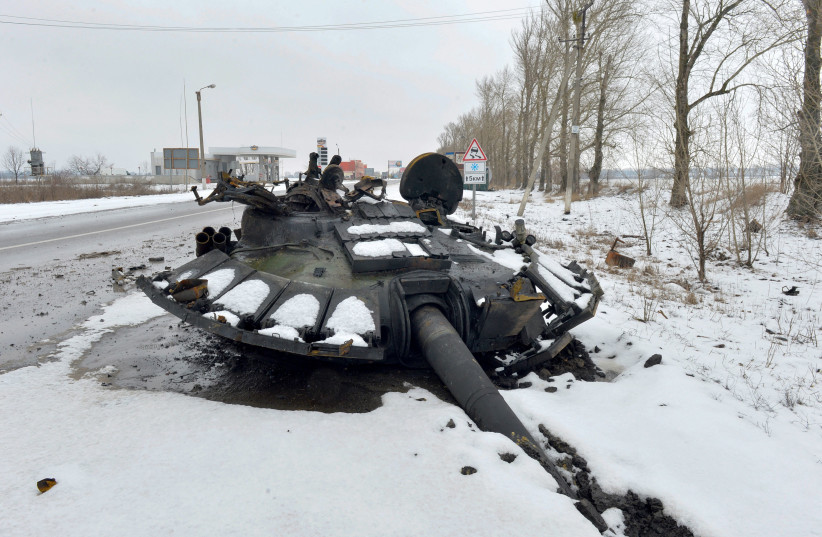
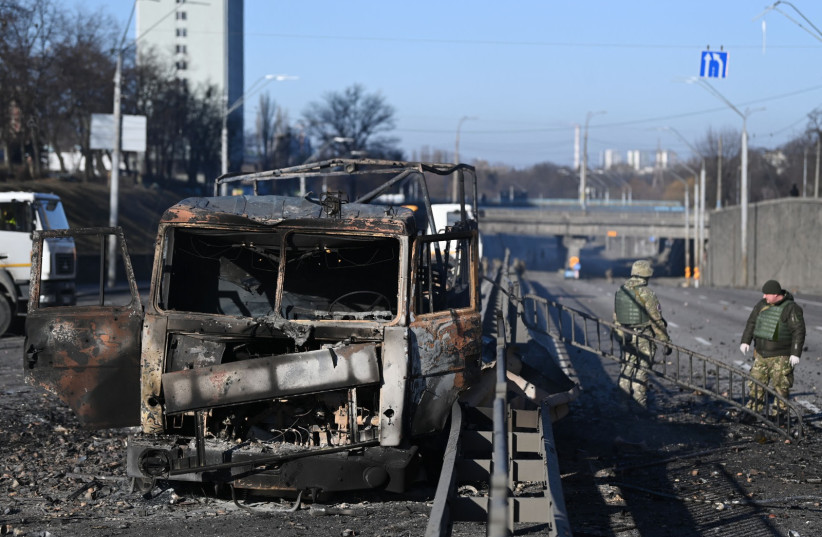
A fragment of a destroyed Russian tank is seen on the roadside on the outskirts of Kharkiv on February 26, 2022, following the Russian invasion of Ukraine. / (photo credit: SERGEY BOBOK/AFP via Getty Images)

Fighting between Russian and Ukrainian forces entered its fourth day on Sunday as Russian forces continued to push into the Ukrainian capital of Kyiv and the city of Kharkiv in the northeast.

Russian forces advanced over the weekend towards Ukraine’s major cities, but on Sunday morning the Ukrainian Armed Forces claimed that the Russian military movement had slowed due to the need to replenish fuel and ammunition.

The Ukrainian military also claimed that enemy troops, mostly young conscripts, are exhausted from the previous military exercises they had participated in just prior to the invasion. They claim that there is desertion and low morale, but this assessment may itself be psychological warfare.

“The main goal of the opponent is to block the capital of our homeland, the city of Kiev, which remains unfulfilled,” said the Ukrainian military.

“Where are all those who promised to capture Kyiv in 72 hours? Where are they?” Ukrainian Defense Minister Oleksii Reznikov said in a Sunday morning statement.

The Battle of Kyiv

A series of blasts were heard to the west of the Ukrainian capital Kyiv’s center on Sunday, minutes after air raid sirens sounded, a Reuters correspondent reported.

Ukrainian media reported explosions and a gunfight in a nearby town.

According to the Ukrainian news website Segodnya.ua, a bridge has been blown up near the town of Bucha west of Kyiv. It was unclear whether it had been bombed by Russian troops or destroyed by the Ukrainian side.

Anton Herashchenko, an advisor to Ukraine’s interior minister, said fighting was underway in Bucha with Russian forces that were trying to advance towards Kyiv.

Gunfire and the sound of explosions echoed through Kyiv on Saturday night as well.

Kyiv’s mayor Vitali Klitschko said on Saturday that there was no major Russian military presence in the capital, but that saboteur groups were active and he was imposing a curfew from Saturday evening until Monday morning. Klitschko, a former world heavyweight boxing champion, later told Germany’s Bild tabloid the city was “nearly encircled.”

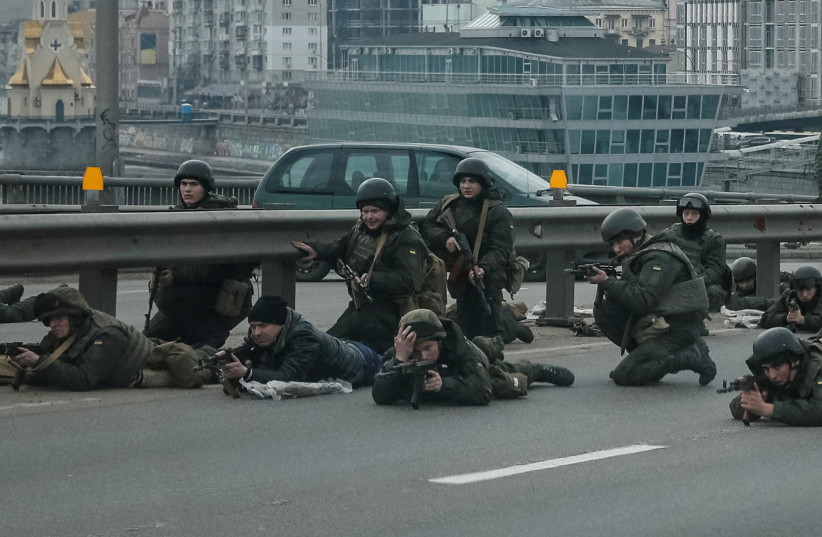
Servicemen of the Ukrainian National Guard take positions in central Kyiv, after Russia launched a massive military operation against Ukraine, February 25, 2022. (credit: REUTERS/GLEB GARANICH)

Chechen leader Ramzan Kadyrov, a close Putin ally, said on Saturday his fighters were also deployed in Ukraine. He said Russian forces could easily take Kyiv and other large cities but their task was to avoid loss of life.

However, Defense Minister Oleksii Reznikov was defiant on Sunday morning, extolling Ukrainian success in repelling Russian advances in the city.

Instead of seeing Russian forces in the capital, Reznikov said that all he saw was a “heroic army, a civil guard, fearless border guards, selfless rescuers, reliable police officers, tireless medical rescuers who all do their duty.”

Authorities have handed thousands of assault rifles to residents and told citizens to make petrol bombs to help repel the invaders. The government press has also issued instructions on how to sabotage the Russian advance through non-military means.

“I see thousands and thousands of citizens who have taken arms, and have become a level of territorial defense,” Reznikov said Sunday.

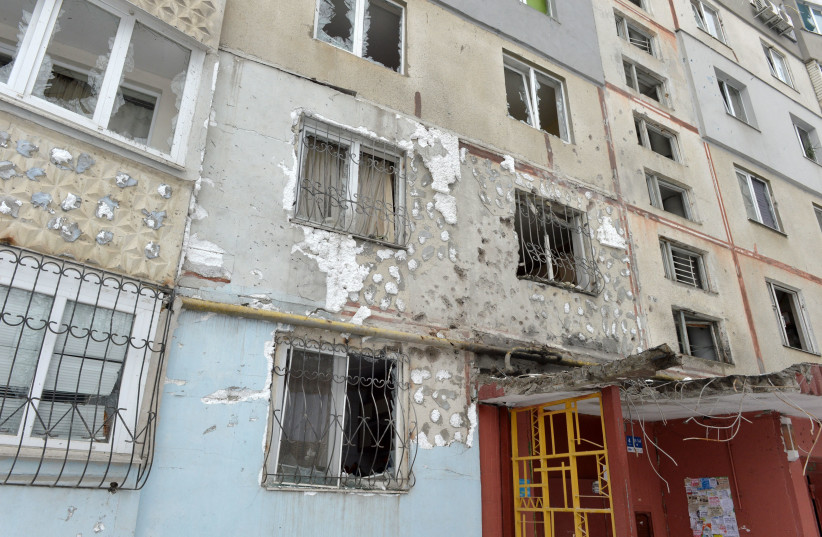
A view of a residential building damaged by recent shelling in Kharkiv on February 26, 2022. (credit: SERGEY BOBOK/AFP via Getty Images)

Fighting across Ukraine

“The main tactics of the occupiers’ actions remain to move and capture small cities, villages and connecting roads,” the Ukrainian armed forces said on Sunday. “Attempts to take control of major cities were unsuccessful.

“Russian occupants are actively deploying sabotage intelligence groups that destroy civilian infrastructure facilities and kill civilians in major cities,” the statement continued.

Russian troop vehicles were seen on the streets of Ukraine’s northeastern city of Kharkiv on Sunday, Anton Herashchenko, an adviser to Ukraine’s interior minister, wrote on Telegram.

Videos published by Herashchenko and Ukraine’s State Service of Special Communications and Information Protection showed several light military vehicles moving along a street and, separately, a burning tank.

“We know that (Russian forces) have not made the progress that they wanted to make, particularly in the north. They have been frustrated by what they have seen is a very determined resistance,” a US official said, without providing evidence.

Putin on Sunday thanked Russia’s special forces, singling out those who are “heroically fulfilling their military duty” in Ukraine, in a televised address that was also published on the Kremlin website.

Russia and Ukraine casualties and refugees

The Ukrainian Defense Ministry has claimed that as of Sunday morning there were over 3000 Russian soldiers killed in combat, and 200 captured as prisoners of war.  A Ukrainian presidential advisor put the number as high as 3500. The ministry also claimed to have destroyed 102 tanks, 540 armored vehicles, 10 aircraft, 18 helicopters, and one anti-aircraft emplacement. 

At least 198 Ukrainians, including three children, have been killed and 1,115 people wounded so far in Russia’s invasion, Interfax quoted Ukraine’s Health Ministry as saying. It was unclear whether the numbers comprised only civilian casualties. 

Interfax later cited the regional administration in Donetsk, eastern Ukraine, saying 17 civilians had been killed and 73 wounded by Russian shelling.

Zelensky said on Sunday that Russian actions verged on “genocide.”

“This is terror. They are going to bomb our Ukrainian cities even more, they are going to kill our children even more subtly. This is the evil that has come to our land and must be destroyed,” Zelensky said on a short video message.

Russia has not released casualty figures and it was impossible to verify tolls or the precise picture on the ground. Both Ukrainian and Russia casualties are suspect of inflation and downplaying by both sides, for morale and propaganda purposes.

About 100,000 people have crossed into Poland from Ukraine since Thursday, including 9,000 who have entered since 7 a.m. on Saturday, Polish Deputy Interior Minister Pawel Szefernaker said. 

Romania announced on Sunday that in cooperation with Ukrainian border authorities, Romanian ambulances will pick up children, pregnant women and the elderly waiting in long queues to cross the border into Romania at the northeastern Siret crossing, speeding up the process.

Humanitarian and military aid to Ukraine

“The world has seen – Ukrainians are strong, Ukrainians are powerful, Ukrainians are brave. So it is not surprising that such people always have more powerful friends than enemies,” Ukrainian President Volodymyr Zelensky said in an address on Saturday night. “During the day, I spoke every hour with the leaders of Ukraine’s friends.”

Zelensky said that he had spoken with the leaders of Italy, India, Azerbaijan and others about how they could aid Ukraine.

NATO countries have been “boosting their support for our partner Ukraine.” NATO said Saturday night.

Ukrainian soldiers stand past a burnt Ukrainian army vehicle on the west side of the Ukrainian capital of Kyiv on February 26, 2022. (credit: DANIEL LEAL/AFP via Getty Images)

“Allies Belgium, Canada, Czech Republic, Estonia, France, Germany, Latvia, Lithuania, Netherlands, Poland, Slovakia, United Kingdom and United States have sent or are approving military aid such as guns, ammo and missiles, including air defense and anti-tank equipment,” NATO said in a Saturday night Instagram post. “Italy is preparing financial support and Spain humanitarian aid. Turkey is deepening defense ties with our Ukrainian partners.”

“We keep our word on defense,” The Czech Defense Ministry said on Sunday morning, sharing a video of a train presumably full of military supplies and headed for Ukraine. “We’re sending machine guns, assault rifles, pistols, ammunition and artillery shells. Further assistance will be approved by the Sunday government.”

Romania said on Sunday that it will send provisions and equipment worth 3 million euros ($3.38 million) to Ukraine and has offered to care for the wounded in military and civilian hospitals, government spokesperson Dan Carbunaru said on Sunday.

Provisions to be sent include fuel, ammunition, bullet-proof vests, helmets, military equipment, food and water, he added.

Ukraine is also receiving financial support from individuals around the world, even as crowdfunding site Patreon closed a campaign raising funds for Ukrainian soldiers and gear over the weekend.  The General Staff of the Ukrainian Armed Forces thanked supporters on Sunday morning, saying that they had received 1.160 billion Ukrainian hryvnias, or $39 Million US dollars from supporters, which included 900,000 transactions from personal sources.

Sanctions

Western nations have also announced new sanctions on Russia, including blacklisting its banks and banning technology exports.

One of the biggest results in Zelensky’s eyes was the limited disconnection of SWIFT from some Russian institutions. They have so far stopped short of forcing Russia out of the SWIFT system for international bank payments, though Germany’s foreign and economic ministers and French presidential official indicated on Saturday that such a move may come soon.

“Our diplomats fought around the clock and with inspiration for all European countries to agree on a strong and fair decision to disconnect Russia from the international interbank network. We also have this victory. This is billions and billions of losses for Russia – a concrete price for this vile invasion of our state,” Zelensky said on Saturday night.

Background on the war

After amassing some 190,000 troops to the north, east and south of Ukraine, Putin on Monday signed a decree to recognize two breakaway regions of eastern Ukraine, the Donetsk People’s Republic and the Lugansk People’s Republic, as independent entities in a signing ceremony shown on state television.

On Thursday Russia finally launched what Putin called a “special military operation” after weeks of denying its intention to invade Ukraine. Putin argued that Ukraine, a democratic nation of 44 million people, is an illegitimate state carved out of Russia, a view Ukrainians see as aimed at erasing their more than thousand-year history.

It is unclear what is Putin’s endgame for the conflict.


Zawartość publikowanych artykułów i materiałów nie reprezentuje poglądów ani opinii Reunion’68,
ani też webmastera Blogu Reunion’68, chyba ze jest to wyraźnie zaznaczone.
Twoje uwagi, linki, własne artykuły lub wiadomości prześlij na adres:
webmaster@reunion68.com

Jewish Ukrainian-Russian Singer Says ‘My Heart Hurts,’ Wishes for ‘Lasting Peace’ Amid Russian Invasion

Jewish Ukrainian-Russian Singer Says ‘My Heart Hurts,’ Wishes for ‘Lasting Peace’ Amid Russian Invasion

Shiryn Ghermezian


Regina Spektor. Photo: Wikimedia Commons.

Grammy-nominated singer-songwriter Regina Spektor talked about her Jewish Russian and Ukrainian heritage while commenting on the ongoing conflict in Ukraine in an Instagram post on Thursday, following Russian President Vladimir Putin’s military invasion of the country.

“Today my heart hurts because no matter how many great works of art and music (Guernica…. Masters Of War… Most of Okudzhava and Vysotsky… Vonnegut… Remarque… all those films in all those languages…) portray the horrors of war, new Masters of War seem to rise up again in all the nations… Sending new children to slaughter each other,” she wrote. “Yes there’s nothing funny about Peace, Love and Understanding… it’s so needed right now.”

Spektor shared in the Instagram post a photo that her father took of a young girl wearing a bow in her hair while sitting on a float during a celebration in the former USSR marking the end of World War II.

“All the “frontoviki” (people who fought Nazis in the war) fought the real Nazis together,” she said. “The Russians and the Ukrainians, and many others-all together. People can love both cultures and be grateful for both cultures and respect each other … And all of us go floating in search of one thing: Peace.”

The singer, who was born in Russia but said most of her grandparents are from Ukraine, also compared Putin’s actions to those of the Nazis during World War II.

“There were, and still are, real Nazis in the world. But in Ukraine that are just millions of civilians being pulled into a war, and in Russia there are children being sent to fight and die for no reason other than the bottomless and horror filled ‘more more more more more more more’ of politicians and corporations,” she wrote. “And it’s terrifying… this part of being a grownup sucks. Being this aware of how endless these circles seem to be. My grandparents with their eyes full of hunger and war and wisdom are all gone now, and I can’t ask them the important questions anymore … I look at that kid with her white ‘bantiki’ [big hair bow] and I wish her, and all the little kids of the past, present, and future, some lasting peace.”


Zawartość publikowanych artykułów i materiałów nie reprezentuje poglądów ani opinii Reunion’68,
ani też webmastera Blogu Reunion’68, chyba ze jest to wyraźnie zaznaczone.
Twoje uwagi, linki, własne artykuły lub wiadomości prześlij na adres:
webmaster@reunion68.com

Can Israel help UAE improve air defenses? – Middle East expert

Can Israel help UAE improve air defenses? – Middle East expert

DEBBIE MOHNBLATT/THE MEDIA LINE


Israel president’s visit to the Emirates could mean relations are rising to a strategic level.

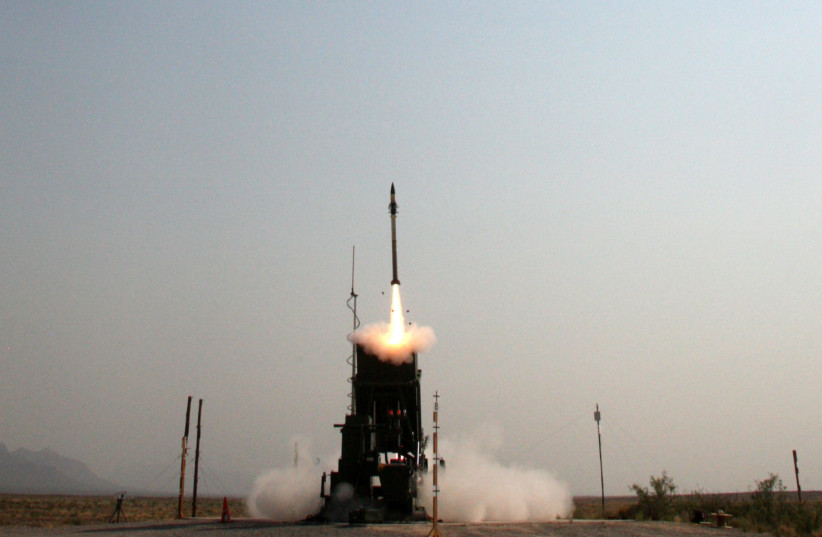
The Iron Dome missile defense system in action. / (photo credit: Israel Defense Ministry Spokesperson’s Office)

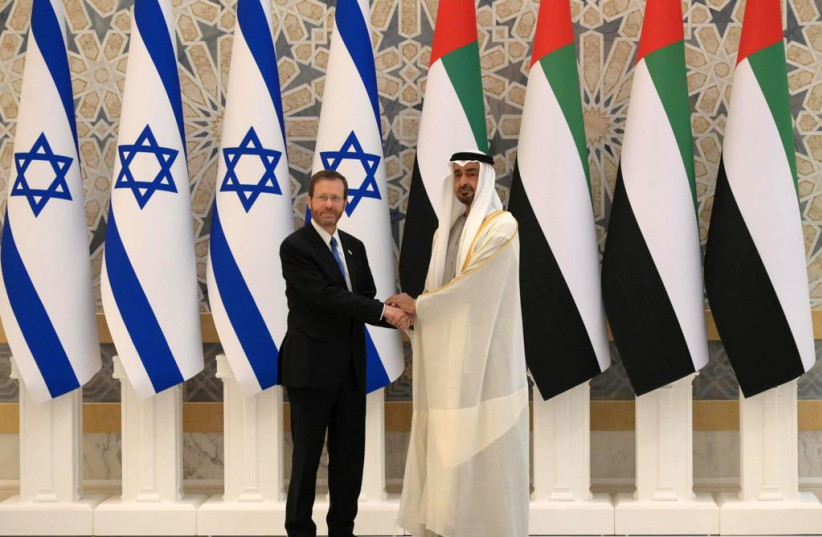
Israeli President Isaac Herzog and first lady Michal Herzog arrived in Abu Dhabi Sunday for a historic two-day visit at the invitation of UAE Crown Prince Mohamed bin Zayed Al Nahyan.

Herzog was greeted upon arrival by United Arab Emirates Foreign Minister Abdullah bin Zayed bin Sultan Al Nahyan.

The Herzogs’ route also marked an important first. It was the first time that an Israeli presidential airplane had flown over Saudi Arabia, a nation does that does not have formal relations with the Jewish state. The pilot took a moment to make the remarkable announcement, saying, “We are now right over Saudi Arabia. We are making history! We shall soon fly over the capital city [Riyadh].”

Prof. Joshua Teitelbaum, from Bar-Ilan University’s Department of Middle Eastern Studies, pointed out to The Media Line that Israeli Prime Minister Naftali Bennett already visited the United Arab Emirates last month to deal with concrete policy issues.

Israeli President Isaac Herzog and UAE Crown Prince Mohammed bin Zayed Al Nahyan meet in Abu Dhabi, Jan. 30, 2022. (credit: AMOS BEN-GERSHOM/GPO)

Teitelbaum explained that the Israeli presidency is a ceremonial post, and this particular president comes from a long line of important people. “They are an important family in Israel: His father [Chaim Herzog] was president and head of Israeli [Military] Intelligence, and he represents a very important family.”

And Chaim Herzog’s brother, Yaakov Herzog, was ambassador to Canada and later director-general of the Prime Minister’s Office. Their father and Isaac’s grandfather, Yitzhak Halevi Herzog, was Ashkenazi chief rabbi of the British Mandate of Palestine and later of Israel.

This is relevant, Teitelbaum said, because in the Gulf countries familial connections are especially prized.

Teitelbaum said the full diplomatic ties agreed upon in August 2020 need to be constantly reinforced.

“The relations are freshly established and need a kind of maintenance to keep things going,” he continued. “Since this is Israel’s ceremonial head of state, this is an important gesture.”

However, there may be more behind this week’s visit.

The situation in the region is rapidly changing and every country, including Israel, is trying to adapt, the professor noted.

“The US is trying to withdraw from the region, Iran is playing a lot of diplomacy in the area, and Israel wants to make its positions known,” Teitelbaum said. “It [the UAE hosting Herzog’s visit] certainly sends a message to Iran.”

Prof. Steven Wright from the Middle Eastern Studies Department at Hamad Bin Khalifa University in Doha, Qatar, said the visit underlines that both states view the other as a strategic partner. Additionally, he said, “It shows that there is political will on both sides to see the relationship expand in all areas.”

Wright added, “Herzog’s visit will be viewed as a clear statement of support for the UAE’s security against both the Houthis and Iran.”

Over the past few weeks, the UAE has been subject to missile and drone attacks from the Houthis, an Iran-backed rebel group in Yemen.

During his visit, Herzog will also visit Dubai, where he will open Israel Day at Expo 2020. This after the Houthi military spokesperson, Brig. Gen. Yahiya Saree, threatened that the rebels might target the World Expo.

Teitelbaum said, “President Herzog’s presence at Expo 2020 is certainly a statement of support and a suggestion that he feels safe enough being there despite the Houthi’s threats.”

Wright suggested that the president’s visit, so closely following the recent missile attack on Abu Dhabi, likely has concrete implications. “There is every reason to think the UAE will look at Israel’s Iron Dome defense system and consider how its own defense sector can collaborate with Israel to achieve a similar level of protection from Iran and the Houthis,” he said.

But Sawsan Hasson, director of the Middle East Economic Relations Department in Israel’s Foreign Ministry, told the Media Line, “The mere fact of the visit by Israel’s ‘first citizen,’ the president, is a tangible outcome. There are no agreements to be signed.”

When asked about the possibility of Israel supplying the UAE with an anti-missile defense system, she declined to comment.

After the Houthi attacks, Bennett was quick to telephone the UAE crown prince to demonstrate solidarity and offer Israel’s support to the Emirates.

All this could signify that ties between the countries are shifting from a diplomatic to a strategic relationship. During his visit, Herzog told Prince Mohamed, “We completely support your security requirements.”

As the official Emirates News Agency (WAM) stated, “The visit of the Israeli president to the UAE confirms that the relationship is moving forward.”


Zawartość publikowanych artykułów i materiałów nie reprezentuje poglądów ani opinii Reunion’68,
ani też webmastera Blogu Reunion’68, chyba ze jest to wyraźnie zaznaczone.
Twoje uwagi, linki, własne artykuły lub wiadomości prześlij na adres:
webmaster@reunion68.com


Amar’e Stoudemire Takes Questions About Finding a Jewish Partner, Says He’s Open for a ‘Shidduch’ Date

Amar’e Stoudemire Takes Questions About Finding a Jewish Partner, Says He’s Open for a ‘Shidduch’ Date

Shiryn Ghermezian


Amar’e Stoudemire praying in his sukkah in an episode of HBO’s “Real Sports with Bryant Gumbel.” Photo: HBO.

Amar’e Stoudemire shared what he’s looking for in a life partner and his hopes for remarrying in a flash Q&A Thursday on his Instagram Story.

The former NBA player is now a member of the coaching staff for the Brooklyn Nets and currently lives in New York, after spending two years in Israel to study at a yeshiva, or a men’s religious seminary, and complete his formal conversion to Judaism. When he retired from the New York Knicks in 2016, Stoudemire moved to the Jewish state. From 2016 to 2019, he played for the Israeli basketball team Hapoel Jerusalem and later for Maccabi Tel Aviv.

Stoudemire, who has four children with ex-wife Alexis Welch, now lives a modern Orthodox lifestyle and said on Thursday he is searching for a Jewish partner.

“It would make life easier, because she will understand me a little better,” he said when asked if he’s looking to date someone who is also Jewish.

Asked by a user whether it has been difficult to find a Jewish woman, Stoudemire responded, “it’s hard, but the best women [sic] is worth waiting for.” He added that “honesty” is one of the qualities he’s looking for in a partner, and that he would “God willing” like to remarry. He also gave out his email address so people could send any leads on a “shidduch” (match) for him.

The former athlete declined to answer whether he would date someone who isn’t Jewish, or whether he’s already in a relationship. He later described his style of expressing and receiving affection, saying, “I express my love by action … Giving and making sure that she feels more important to men then [sic] anything. I love to receive love through affection and honesty.”

Stoudemire also answered questions related to Judaism as well as inquires about basketball. He said his children embrace their Jewish lifestyle, and that his favorite aspects of Shabbat are reading from the Torah and Friday night dinner. When asked if there is something from his previous, less observant lifestyle that he misses, he said, “Funny thing is I can do everything I love to do, being Jewish.”

Asked why he decided to specifically follow Orthodox Jewish practices, he replied, “I don’t put a title on my belief, all I do is try my hardest to follow the Eliohim/God’s law.”

Stoudemire noted that he has no trouble balancing his religious life and coaching position with the Brooklyn Nets. “I enjoy every bit of life, I find time to give my thanks to the creator,” he wrote.” Once your [sic] able to balance the two, then you will find your peace.”

On the other hand, he also said he is “ready” to return to Israel and play for Hapoel Jerusalem again.

The former Phoenix Suns player has previously said that his mother claimed they were from “the lost tribes of Israel,” referring to an African Hebrew Israelite group. He told Instagram users on Thursday that after what his mother told him, he never considered converting to any religion other than Judaism because “being a Jew/Israelite isn’t a chose [sic] for me … [it’s] my heritage from birth.”


Zawartość publikowanych artykułów i materiałów nie reprezentuje poglądów ani opinii Reunion’68,
ani też webmastera Blogu Reunion’68, chyba ze jest to wyraźnie zaznaczone.
Twoje uwagi, linki, własne artykuły lub wiadomości prześlij na adres:
webmaster@reunion68.com