Archives

Jerusalem is ready for Christmas – a journey in the Christian quarter of the City. Merry Christmas

Jerusalem is ready for Christmas – a journey in the Christian quarter of the City. Merry Christmas


Zahi Shaked. Israeli tour guide צחי שקד. מורה דרך


Unfortunately, I have not been able to work as a tour guide as from Feb 2020
Should you wish to support me and my videos please subscribe to my channel and let me guide you through the Holy Land via my videos. In this way, I will be able to continue to do my work of uploading to YouTube. Upon your request and in return I am very much happy to pray for you at the Western Wall and/or light a candle in your name at the Church of the Holy Sepulchre or anywhere else in the Holy Land of Israel.

Should you have a personal request I will be more than happy to respond and even film it in a personal video.
Donations: https://www.buymeacoffee.com/zahishaked
Kindly share this site with your other friends/family that are interested in the rich and sacred history of Israel.

Thank you so much
Your tour guide
Zahi Shaked


Zawartość publikowanych artykułów i materiałów nie reprezentuje poglądów ani opinii Reunion’68,
ani też webmastera Blogu Reunion’68, chyba ze jest to wyraźnie zaznaczone.
Twoje uwagi, linki, własne artykuły lub wiadomości prześlij na adres:
webmaster@reunion68.com


Israel’s Iran question: To strike or not to strike? – opinion

Israel’s Iran question: To strike or not to strike? – opinion

YAAKOV KATZ


Will an overt airstrike on Iran really achieve so much more for Israel in terms of a delay than continued covert operations?

An Israeli F-15 fighter jet is seen from behind at Uvda Airbase in southern Israel. / (photo credit: AMIR COHEN/REUTERS)

The targets in Iran would vary.

The first would be Natanz, Iran’s main uranium enrichment facility. The complex consists of two large halls, roughly 300,000 square feet each dug somewhere between eight and 23 feet below ground and covered by several layers of concrete and metal. The walls of each hall are estimated to be approximately two feet thick. The facility is also surrounded by surface-to-air missiles.

The next facility would be the heavy-water plant under construction near the town of Arak, which could be used one day to produce plutonium. Iranians say the material will be used for medical and research isotope production, but in reality could have the ability to produce plutonium for nuclear weapons.

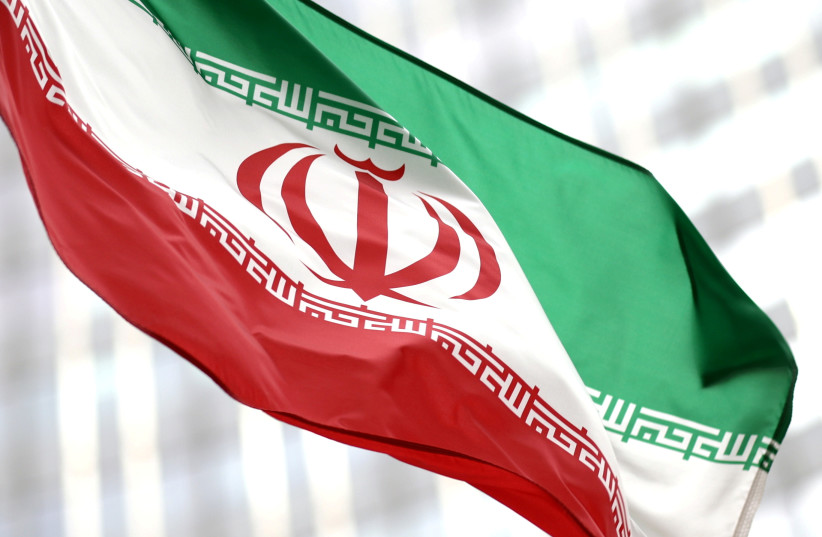
Iranian flag flies in front of the UN office building, housing IAEA headquarters, amid the coronavirus disease (COVID-19) pandemic, in Vienna, Austria, May 24, 2021. (credit: LISI NIESNER/ REUTERS)

Military planners would also likely feel compelled to attack Iran’s centrifuge fabrication sites, since their destruction would make it extremely difficult for Iran to reestablish its program – although the destruction of Natanz, Arak and Isfahan on their own would be enough to set back the ayatollah’s dream of obtaining the bomb.
In addition to these key targets, the attacker would also want to bomb Iranian radar stations, missile bases, silos and launchers as well as air bases, with the aim of knocking out Iran’s ability to strike back with its long-range missiles or combat aircraft.

* * *

This plan on how Israel might attack Iran was published in 2012, in a book entitled Israel vs. Iran – The Shadow War, authored by Yoaz Hendel, at the time a columnist with Yediot Aharonot, and me, at the time this paper’s defense analyst.

Back then, some Israeli officials also called for bombing Iran’s oil fields and energy infrastructure. Such strikes, they believed, could have a demoralizing effect on Iran and influence the regime’s decision-making process. Oil revenues provide a significant portion of Tehran’s government income. The oil facilities are also vulnerable and lack surface-to-air missile protection.

One former IDF general claimed at the time that in total, Israel would have to strike close to 100 primary targets, possibly in sorties lasting two days.

But, we asked then, can Israel do it?

The main problem Israel would encounter in attacking Iran’s nuclear facilities, we pointed out, is the physical distance that is over 700 miles from Israel, with the main targets even further at distances ranging between 1,000 and 1,500 miles from Israel.

According to most estimates, Israel is capable of unilaterally attacking Iran’s nuclear facilities with its F-16 and F-15 aircraft. Israel’s vaunted 25 F-15Is – Ra’am (Thunder) in Hebrew – that are based in the Negev are believed to be capable of striking Iran in a non-stop operation like Operation Opera against Iraq in 1981, with a combat range of over 2,000 miles. Israel in 2010 also finished receiving 102 F-16Is – Sufa (Storm) in Hebrew – that it procured in the late 1990s. These too are capable of long-range missions, with a combat radius of over 1,000 miles.

There were three possible routes that we outlined in 2012 for Israel to fly to Iran. The northern route, which skirts along the Turkish-Syrian border into Iran; the central route, which is the most direct but entails serious diplomatic obstacles; and the southern route, which would take Israeli planes over Saudi Arabia and into Iran.

Back then, the IAF had some of the munitions needed to destroy the Iranian facilities and penetrate the fortified bunker in Natanz, either developed domestically or purchased over the years from the United States, such as the GBU-27 and GBU-28 that can carry anywhere from 1,000 to 3,000 pounds of explosives. While Natanz is one of the most difficult targets, even if the missiles on their own will not succeed in penetrating, Israeli pilots could glide them in.

Former Israeli Air Force commander Maj.-Gen. Eitan Ben-Eliyahu, who participated in the strike on Osirak in 1981, explained how this would happen. Even if one bomb would not suffice to penetrate a target, he explained in 2005, Israel could guide other bombs into the area of where it has attacked to eventually destroy the target.

Israel, according to foreign reports, could also – we noted at the time – potentially utilize its Jericho road-mobile, two-stage solid-propellant missile, which has a range varying from 1,200 to over 3,000 miles, and is capable of carrying a one-ton conventional or non-conventional warhead. The latest version of the missile called Jericho III and tested in early 2008 has enhanced accuracy, and puts every Arab capital, including Tehran, within striking distance of Israel.

NEEDLESS TO say, a lot has changed since that was written 10 years ago.

  1. Israel has upgraded its weapons and platforms, like the F-35 that is capable of covertly flying into Iranian airspace and taking out radar stations, which would then enable non-stealth aircraft to enter with a fuselage loaded with bombs without risk.
  2. There are new munitions the IAF has acquired, and as illustrated by recent covert operations, the country’s intelligence on Iran is deep and extensive.
  3. The route possibilities themselves have completely changed. Flying over Syria today is not like it was in 2012, when Bashar Assad still had an advanced military, and Israel rarely entered his airspace; America is no longer deployed in Iraq the way it was then; and the Abraham Accords have changed the dynamic between Israel and Saudi Arabia. El Al planes today openly fly over Saudi Arabia. Does that mean Riyadh would let IAF fighter jets do the same? Maybe.
  4. But what has also changed is Iran, and the progress it has made in its nuclear program. What people often overlook when considering whether Jerusalem can go it alone against Tehran is that the technical know-how is Iranian. It is not from a foreign source, like was the case of the Syrian reactor destroyed by Israel in 2007 (North Korea), or the Iraq reactor destroyed by Israel in 1981 (French).
  5. What this means is that even if Israel attacks and succeeds in causing extensive damage, Iran will not need help to rebuild it – Tehran will be able to do it all over again on its own. Now one could argue that due to domestic and international pressure, Iran might be slow to rebuild its nuclear infrastructure after a strike, but there is another case to make as well: that the ayatollahs will be emboldened by the Israeli strike as the world instead cracks down on Israel for acting unilaterally.

The other main difference is that in 2012, Israel’s option was viable and real. The Air Force was sharp, and the pilots were trained and knew their targets. But they were never given the green light, and that capability instead fell to the side; and Israel missed its window of opportunity to act.

Is it too late now? I don’t know. In the IDF, the generals are confident – as illustrated by the arrogance the incoming commander of the IAF exhibited in the media this week – that they can get the job done. And they are, God willing, probably right.

Israel’s military is powerful, and could definitely deal Iran a blow that would set back and delay its nuclear progress. But there are questions that need to be asked: will an overt airstrike really achieve so much more in terms of a delay than continued covert operations? Is the war that will ensue worth just a few years delay? And is the diplomatic fallout something Israel can sustain for an undefined achievement?

Ten years have passed since Hendel and I wrote that plan. Parts of it are still relevant. Others are not. What is for certain is that in the time that has passed since then, Iran has not been stopped. It has grown stronger, more audacious, more advanced – and Israel failed to prevent that from happening.

How much longer?


Zawartość publikowanych artykułów i materiałów nie reprezentuje poglądów ani opinii Reunion’68,
ani też webmastera Blogu Reunion’68, chyba ze jest to wyraźnie zaznaczone.
Twoje uwagi, linki, własne artykuły lub wiadomości prześlij na adres:
webmaster@reunion68.com


Israeli drone defense saves Pope Francis from rogue threat

Israel21cIsraeli drone defense saves Pope Francis from rogue threat

Abigail Klein Leichman


EnforceAir anti-drone solution from Israel’s D-Fend neutralized a suspicious UAV flying over a large public Mass in Slovakia, without any disruption.

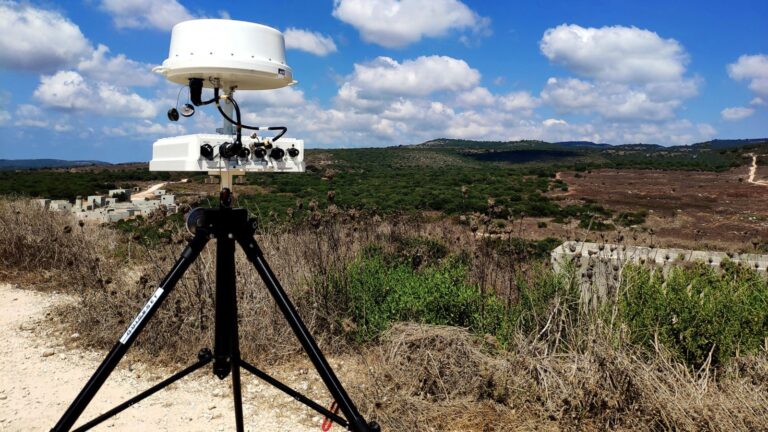
D-Fend’s EnforceAir anti-drone ground-level tactical solution. Photo courtesy of D-Fend Solutions

When a rogue drone appeared over a large public Mass led by Pope Francis in Slovakia on September 15, the threat was neutralized — without any disruption to the worshipers — by the EnforceAir anti-drone ground-level tactical solution from Israel’s D-Fend.

According to newly available information reported by the Jerusalem Post, the suspicious drone flew over the religious ceremony attended by 90 bishops, 500 priests and 60,000 Catholics in Šaštín, site of the National Marian Shrine.

“EnforceAir fended off the rogue drone, sending it back to its original takeoff position, far away from the large crowd,” a D-Fend spokesman told the Jerusalem Post.

Working in coordination with the Slovakian Interior Ministry, D-Fend deployed its technology at several outdoor appearances by the pope in Slovakia from September 12 to 15.

“Our system, in either autonomous or manual mode, detects, locates and identifies rogue drones in your airspace and then neutralizes the threat by allowing you to take full control over the drone and land it safely in a predefined zone,” the company explains.

“Since the system does not rely upon jammers or kinetic technology, EnforceAir avoids collateral damage, interference, disruption and disturbance. Continuity prevails as communications, commerce, transportation, and everyday life smoothly proceed.”

A representative of the pope’s security team said that the EnforceAir solution “took control of the rogue drone that threatened the potential safety of the pope, the crowd and the VIPs in attendance, quickly and easily.”

One day before that incident, the Ra’anana-based D-Fend Solutions announced that its Multi-Sensor Command & Control (MSC2) system won Security Today’s “New Product of the Year” award in the unmanned aerial vehicle (drone) category.

Organizers of the G7 Summit held last June in Cornwall, England, also chose D-Fend’s technology to protect the visiting world leaders.

The video below shows how EnforceAir was used in a joint three-day exercise led by INTERPOL and the Norwegian Police.


Zawartość publikowanych artykułów i materiałów nie reprezentuje poglądów ani opinii Reunion’68,
ani też webmastera Blogu Reunion’68, chyba ze jest to wyraźnie zaznaczone.
Twoje uwagi, linki, własne artykuły lub wiadomości prześlij na adres:
webmaster@reunion68.com


Enjoying Christmas as a Jew – no place like ‘Home for the Holidays’ – opinion

Enjoying Christmas as a Jew – no place like ‘Home for the Holidays’ – opinion

DANIEL S. MARIASCHIN


Looking back, I recall what it was that we as children really enjoyed: the snow, the ice skating, the hot chocolate and “the time of the season.”.
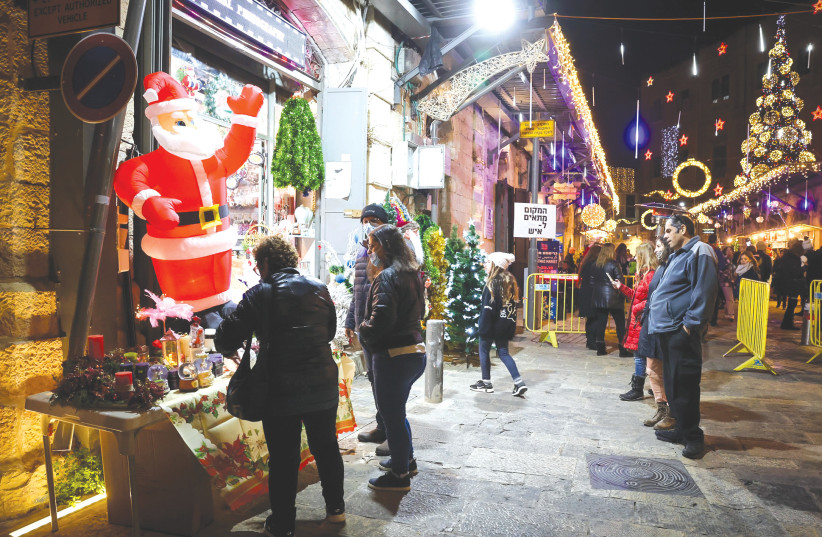
A CHRISTMAS FESTIVAL at the New Gate in Jerusalem’s Old City last week. / (photo credit: NATI SHOHAT / FLASH 90)

Once the local radio stations begin playing Perry Como’s “Home for the Holidays”, just before Thanksgiving, nostalgia for my New England childhood goes into high gear.

Como’s hit song, which continues to be played right through the Christmas season, is in a category which is properly secular, and could easily be enjoyed by Jewish families without the uneasiness about other holiday music that tends to the religious side of the spectrum. But more on the music later.

We lived in a real Currier and Ives setting, in southwestern New Hampshire. Snow would often come early, in November, and the pond in front of our house would usually freeze over, and be safe enough to ice skate on, by mid-December.

There were only 25 Jewish families living within a 25-mile radius of where we lived, and only four in my hometown, Swanzey. My parents owned a small women’s clothing store on Keene’s Central Square. My father was in charge of decorating the display windows. A very artistic fellow, he painted, on specially-sized paper, a floor to ceiling winter backdrop mural that imagined looking out a window onto a winter scene, complete with icicles and snow drifts.

Some years, we would take a slight detour when driving home from the store to drive around Keene’s Edgewood neighborhood to look at the Christmas lights and decorations that we thought were the city’s best.
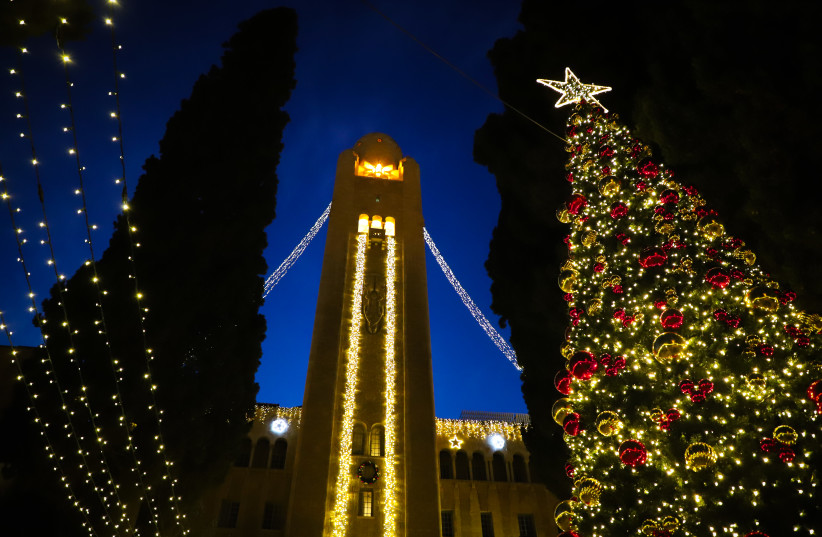
YMCA’s lit-up Christmas tree in Jerusalem. (credit: JERUSALEM INTERNATIONAL YMCA)

Christmas can be a difficult time for Jewish children raised in an environment where almost everyone else, including my schoolmates, was not Jewish. That said, I was pretty well-grounded by my parents in our traditions, and the build-up to Hanukkah was a time I enjoyed, as well. For us, it was much less about the gift giving than it was about the story of the Maccabees, the excitement of lighting the menorah, my mother’s truly outstanding latkes, and for me, receiving those gold-wrapped chocolate coins in those little mesh bags.

When it came to school, though, it was a different story. In the younger grades, especially, the weeks leading up to Christmas were dominated by talk amongst my schoolmates of long lists of Christmas presents that had been requested, and the uneasiness of wondering whether or not their wishes, and their entreaties to Santa (or their parents), would be granted.
I understood that this kind of gift-giving did not apply to me, but I admit to speculating about what I might ask for, if I could. We always had a big Sears, Roebuck holiday catalog in the house that had a large section on toys. I always had my eye on a toy gas station, complete with pumps and service bays, and especially, a Tonka Toys road construction set, which came with a dump truck, bulldozer and a tiny “Men at Work” sign.

Alas, my parents’ idea of gifts for Hanukkah were more in the vein of books and clothing.

When I was a third-grader, I was the only Jewish student, and only one of three Jews, in the entire school. So when my teacher, Mrs. Phippard, approached me to come to class the next day and tell the story of Hannukah – to use the Yiddish word – I nearly “plotzed.” At that age, and with that holiday, I didn’t want to appear different. But well-prepped by my parents, I summoned up the courage, and told the story (a fight for religious freedom is a tough concept for eight-year-olds) as best I could.

About 10 days before we broke for Christmas vacation, we would draw names in class for gift-giving. Each student would give a gift, and receive one, which was an equitable way to make sure no one went away empty-handed. In the seventh grade, I received something extra: My teacher, Mr. Main, knowing I was by then a sports fanatic, gave me a college basketball media guide for the 1961-1962 season. It was one of the best gifts I have ever received, for any occasion.

IN GRADE SCHOOL, I sang in a boys choir. Our music teacher, Mrs. Howard, was a perfectionist, and drew the best out of those untrained voices. There was always a well-attended annual Christmas concert, and the program included the usual carols and seasonal songs. It usually concluded with, O Holy Night, with its sweeping, powerful build-up, so well-suited for a choral presentation. Mindful of exactly what I was singing about, I was always careful to lip-sync or simply avoid some of the Christological references in the song’s lyrics.

For sure, no one noticed.

In my senior year in high school, my social studies class hosted a group of Head Start kids for a Christmas party. I was asked if I’d be Santa Claus and gladly agreed. Though, they found a costume for me, which fit fine, it was the scratchy fake beard that I recall being unusually irritating.

Someone took a photo, which wound up in our yearbook, with the caption: “It was the night before Hanukkah.”

Some years later, when I worked as a disc jockey at one of our local radio stations, Christmas music – unlike today – began being played after Thanksgiving, and even then, on an escalating schedule leading up to Christmas Day. In the winter, I worked weekends and holidays, and on December 25th, I probably was on the air for 8 hours or so.

There were no commercial announcements on Christmas Day, but local businesses could sponsor, PBS-style, albums of holiday music. So I would introduce a segment with something like: “And now, more music of the season, with “Merry Christmas” with Andy Williams brought to you with warm holiday wishes by the Cheshire Tire Company.”

Since, at the time, I was usually studying for final exams at the University of New Hampshire, I would often bring my course notebooks with me to the radio station and use the time to study, with the holiday music in the background. An early exercise in multi-tasking!

The holiday season was pervasive; it was everywhere: in the music, the decorations, the chimes in the church belfry at the head of Central Square – about a block away from our store – pealing carols every evening, and especially, in the weather. Indeed, meteorology was very much a part of the moment. The cold, brisk air, snowflakes occasionally drifting down, and sometimes snowstorms – only added to the winter-like setting that most folks, even in warmer climes, associate with the holidays.

Growing up, most folks didn’t realize Jews celebrated a holiday this time of year; they just knew that we didn’t celebrate Christmas. Today, because of greetings to us on TV (we’ve all heard the anchor at the end of the newscast say “… and to our Jewish friends, a Happy Hanukkah!”) and through the internet, many more non-Jews know about Hanukkah – if not the story of the Maccabean uprising, then that it, and the Christmas season, usually coincide.

Looking back, I recall what it was that we as children really enjoyed: the snow, the ice skating, the hot chocolate and “the time of the season.” We shared that excitement with our non-Jewish friends.

But I knew exactly who I was, and today, as then, I stand in awe of the Maccabees and the miracle of the oil burning for 8 days. Still, I was happy for my friends, enjoyed seeing the trees lit up in their living rooms, hearing carols on the radio and learning that being different, and respecting those differences, in fact drew us closer to our classmates and neighbors. The overlap of the holidays on the calendar was an unintended catalyst that nudged us to a more understanding place.

Indeed, Perry Como sang it best:

“Oh, there’s no place like home for the holidays,
“Cause no matter how far away you roam,
“If you want to be happy in a million ways,
“For the holidays,
“You can’t beat home, sweet home.”

Only in America.


The writer is B’nai B’rith International CEO.


Zawartość publikowanych artykułów i materiałów nie reprezentuje poglądów ani opinii Reunion’68,
ani też webmastera Blogu Reunion’68, chyba ze jest to wyraźnie zaznaczone.
Twoje uwagi, linki, własne artykuły lub wiadomości prześlij na adres:
webmaster@reunion68.com


Ancient Hasmonean artifacts found in east Jerusalem at end of Hanukkah

Ancient Hasmonean artifacts found in east Jerusalem at end of Hanukkah

JERUSALEM POST STAFF


The items were examined by officials of the Israel Antiquities Authority, and the suspect was arrested and taken in for questioning.

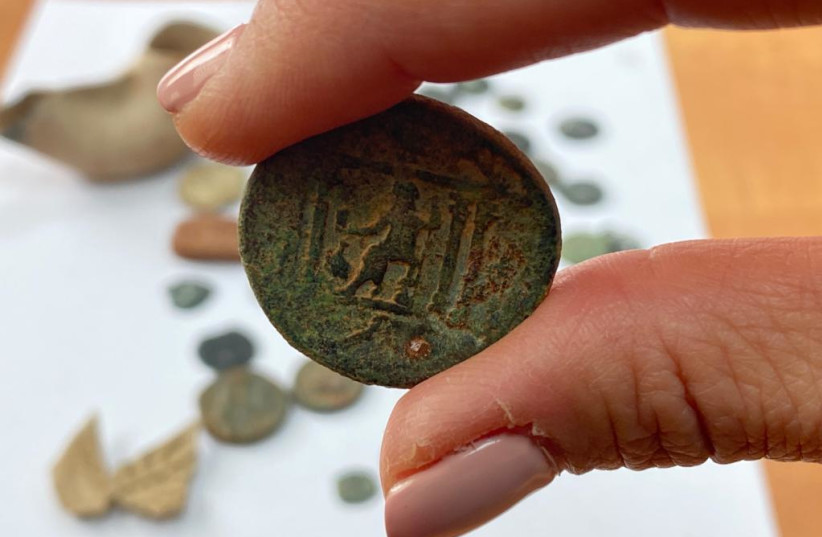
An ancient coin is seen among the artifacts seized from the home of an east Jerusalem resident on the last night of Hanukkah, on December 5, 2021. / (photo credit: POLICE SPOKESPERSON’S UNIT)

Ancient archaeological artifacts thousands of years old, including a coin from the Hasmonean era, were discovered by police in east Jerusalem on Sunday, the last day of Hanukkah.

The artifacts were discovered in a search of the home of an east Jerusalem resident in his 30s. The items were examined by officials of the Antiquities Authority (IAA), and the suspect was arrested and taken in for questioning.

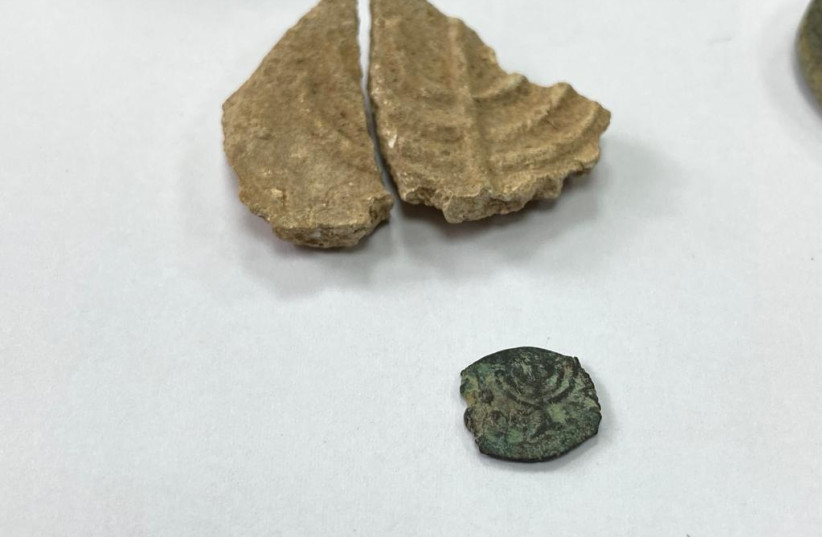
Among the artifacts were a coin dated back to the time of Antigonus II Mattathias, the last Hasmonean king, as well as a Hasmonean-era oil candle and a biblical-era seal ring with ancient Hebrew inscriptions.

The discovery of the Hasmonean-era artifacts came just before the last night of Hanukkah, a holiday celebrating the Hasmoneans’ victory over the Seleucid Empire and the subsequent establishment of independent Jewish rulership of the land.

The Temple Menorah is seen on ancient artifacts seized from the home of an east Jerusalem resident on the last night of Hanukkah, on December 5, 2021. (credit: POLICE SPOKESPERSON’S UNIT)


Zawartość publikowanych artykułów i materiałów nie reprezentuje poglądów ani opinii Reunion’68,
ani też webmastera Blogu Reunion’68, chyba ze jest to wyraźnie zaznaczone.
Twoje uwagi, linki, własne artykuły lub wiadomości prześlij na adres:
webmaster@reunion68.com