Archives

News From Israel- December 20, 2021

News From Israel- December 20, 2021

ILTV Israel News


Israeli Prime Minister Naftali Bennett announcing that the fifth wave of the coronavirus has already begun

Winter storm Carmel hits Israel in full force with heavy rain, strong winds and even snow

Israel and Morocco marking one year this week since restoring diplomatic ties


Zawartość publikowanych artykułów i materiałów nie reprezentuje poglądów ani opinii Reunion’68,
ani też webmastera Blogu Reunion’68, chyba ze jest to wyraźnie zaznaczone.
Twoje uwagi, linki, własne artykuły lub wiadomości prześlij na adres:
webmaster@reunion68.com


Jews Were Massacred in 1948 Too, So Why Dwell Only on the Nakba?

Jews Were Massacred in 1948 Too, So Why Dwell Only on the Nakba?

Uri Misgav


Aftermath of the attack on the Hadassah hospital convoy, April 13, 1948. Eighty of the 105 passengers were murdered. Credit: Marlin Levin

On April 13, 1948, an aid convoy left the center of Jewish Jerusalem for the besieged and isolated enclave on Mount Scopus, site of Hadassah Hospital and the campus of the Hebrew University. The convoy consisted of ambulances, armored vehicles, supply trucks and buses carrying physicians, nurses, medical students and academic faculty. Near the village of Sheikh Jarrah, the convoy hit a land mine and was attacked by machine-gun fire, before being stormed by Palestinian militiamen who shot the passengers individually and torched the buses. Eighty of the 105 travelers were massacred.

Three weeks earlier, a similar fate had befallen an aid convoy that tried to reach Kibbutz Yehiam, in the north of the country, which was under siege and being shelled. That convoy was attacked by Arab gangs near Kibbutz Kabri, and 47 of its 86 passengers were killed. Some of the bodies could not be identified because they had been mutilated. In January 1948, all 35 fighters from the Palmach strike force of the Haganah militia, and from Hish, the Haganah’s field corps, were similarly killed on their way to bring aid and reinforcements to the besieged Etzion Bloc settlements south of Jerusalem.

A number of additional aid convoys dispatched to the Etzion Bloc also did not manage to escape a bitter fate. Kibbutz Kfar Etzion fell on May 13, 1948, the day before the termination of the British Mandate; 242 members of the kibbutz and Palmach and Hish fighters were killed in the battle. A few dozen more fighters and civilians, including women, were slaughtered by Palestinian fighters after the battle had been decided; only four managed to flee. The three other kibbutzim in the area surrendered, and their residents were spared a slaughter thanks only to the intervention of Jordan’s Arab Legion, which took them to POW camps in Jordan. Immediately afterward, the four settlements were razed to the ground.

In the total war of existence that began to rage in Palestine following the adoption of the United Nations’ partition resolution of November 1947, that was the certain fate of every Jewish settlement that fell to the Arabs: the killing of fighters and civilians alike, mutilation of their bodies, looting of property and destruction of the houses and other buildings. The pattern repeated itself at Beit Ha’arava, Nitzanim, Moshav Atarot, in Jewish neighborhoods of Jerusalem that were attacked and in other mixed cities.

In some cases, this was part of a chain of events and reactions, a bloody cycle typical of the militia and local warfare that characterized the war’s first half year, until the invasion of seven Arab armies into the territory of the Jewish state upon its declaration. Thus, for example, it’s argued that the attack on the Hadassah convoy was perpetrated in reaction to the massacre in the Arab village of Deir Yassin. And after members of the Irgun underground threw bombs from a moving vehicle at Arab workers in the Haifa oil refineries, murdering 11 of them, their friends, aided by local reinforcements, fell upon the Jewish workers – most of them clerks and white-collar staff – killing 39 of them with sticks and stones in a massacre that went on for about an hour.

It was a life-and-death war, brutal and bloody. The Jewish community lost fully 1 percent of its population (6,000 killed out of a population of 600,000), and a 10th of the remainder became refugees in their own country. Their unknown and suppressed story is documented in a 2014 book by the historian Dr. Nurit Cohen-Levinovsky, “Jewish Refugees in Israel’s War of Independence” (in Hebrew). However, with time’s passage, it has become politically incorrect to talk about Jewish fighters who were killed (some of them were young, others were older and had families, there were new immigrants with no military training who hadn’t even managed to learn Hebrew, Holocaust survivors, women and in some cases teenagers), or about civilians who were murdered or settlements that were evacuated and destroyed, and whose residents became refugees.

Representatives of the Arab Legion and the IDF meet near Latrun for a prisoner exchange, November 11, 1948.Representatives of the Arab Legion and the IDF meet near Latrun for a prisoner exchange, November 11, 1948.Credit: GPO
.

Today there is apparently only the Nakba: It consists of the killing and expulsion of Arabs, Palestinian villages that were destroyed and Palestinian refugees. This historiographic distortion, with its absurd and immoral lack of symmetry, is the apple of the eye among certain circles in Israel, Arabs and Jews alike.

Haaretz serves as a generous and enthusiastic platform for this willful blindness. It enables the Palestinian citizens of Israel, like my colleagues Odeh Basharat and Hanin Majadli, speaking on behalf of Arab society, to shirk off all responsibility for its fate – from the 1948 war up until the present day. The Palestinians, since then and for all time to come, are solely passive, innocent victims of the Zionist project of evil. There are of course also Jews who see it this way, in academia and in the media. Gideon Levy is a prime example.

Adam Raz, whom I like and esteem, is definitely an industrious and serious historian. There is no reason to doubt the sincerity of his striving to clarify the historical truth – not when it comes to the Israeli nuclear program, and not in regard to the events of the 1948 war, which occupies him in the context of Jewish looting and Jewish acts of massacre. Raz’s latest article on the latter subject (“Classified docs reveal massacres of Palestinians in ‘48 – and what Israeli leaders knew,” Dec. 9) is based largely on newly declassified cabinet discussions that were held in the wake of reports about a number of massacres perpetrated in Arab villages in the final stage of the war. To his credit it should be said that Raz made it clear that most of the material and the facts remain redacted, and the quotes of the ministers that appear in the investigative report are actually based on oral testimonies, which there is no other possibility to prove.

However, for Haaretz that was more than enough. The editorial published two days later already stated, categorically and sweepingly: “Soldiers of the Israeli army committed war crimes during the War of Independence, chief among them were massacres in Palestinian villages that were captured in the decisive battles in the lowland plain between the coast and Jerusalem, in the Galilee and in the Negev. People who were alive then described mass murders of Palestinian civilians by the troops who conquered their villages; execution squads; dozens of people being herded into a building that was then blown up; children’s skulls smashed with sticks; brutal rapes and villagers who were ordered to dig pits in which they were then shot to death.”

And Gideon Levy, in a column on the very same editorial page, went, as could have been expected, one step further: “What we did then to the Palestinians we continue to do now, only more forcefully… the mechanisms of whitewash and justification will cover up any disclosure from 1948… Please don’t disturb us, we are carrying on – with the same crimes, or similar ones.” In other words, according to the recent recipient of the Sokolow Prize, Israel’s top award for journalism, today, too, Israel Defense Forces soldiers in the territories murder Palestinians in their masses, smashing children’s skulls, committing violent rape and ordering villagers to dig pits before shooting them to death in those same pits.

What we have here is a truly ecstatic celebration of exaggeration, falsehoods and self-undermining and flagellation, and wallowing in feelings of guilt. If we truly want to pursue a serious discussion of the 1948 war, it must be balanced. If the truth, then the whole truth. If one is quoting historian Benny Morris, please also quote his factual and superb book “1948,” and not only the breakthrough “Birth of the Palestinian Refugee Problem.” And without evading the basic facts: The Palestine Arabs launched murderous acts of hostility immediately after the adoption of the partition plan, which they opposed, by means of 400 armed local militias. Arab armies invaded the Jewish state immediately upon the termination of the British Mandate in order to destroy it and to erase any memory of its existence; those armies included expeditionary forces from distant Iraq and also thousands of volunteers of the Arab Army of Salvation.

If the ideal is the sanctity of historical research and truth, we need to ask where the Palestinian versions of Adam Raz, Akevot Institute and Zochrot are. In any event, my Haaretz colleagues don’t make do with clarifying the facts and often seem to feel that Israelis are required to offer an “apology.” It’s disheartening to be dragged back there again 74 years after the war erupted, but the apology was already formulated by Ephraim Kishon in his genius: “So sorry we won.”


Zawartość publikowanych artykułów i materiałów nie reprezentuje poglądów ani opinii Reunion’68,
ani też webmastera Blogu Reunion’68, chyba ze jest to wyraźnie zaznaczone.
Twoje uwagi, linki, własne artykuły lub wiadomości prześlij na adres:
webmaster@reunion68.com


Humanity’s missing link: 2-million-year-old bones shed light on human spine

Humanity’s missing link: 2-million-year-old bones shed light on human spine

JERUSALEM POST STAFF


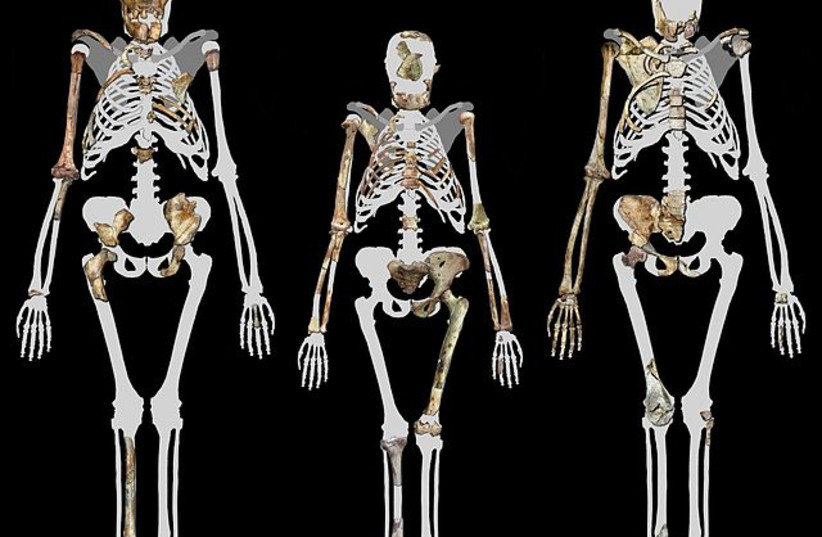
The Australopithecus sediba is estimated to have lived nearly two million years ago and is thought to be a predecessor to the Homo genus, to which modern humans – Homo sapiens – belong.

Malapa Hominin 1 (MH1) left, Lucy (AL 288-1 (Centre), and Malapa Hominin 2 (MH2) right. Image compiled by Peter Schmid courtesy of Lee R. Berger, University of the Witwatersrand. /  (photo credit: Wikimedia Commons)

Modern humans have been evolving and developing the ability to walk upright for over two million years, new research into a fossilized spine of an early human ancestor has revealed.

A peer-reviewed study published by eLife and led by New York University paleoanthropologist Scott Williams looks to shed new light on the development of bipedalism – walking on two legs – through examining the near-complete fossilized lower back of a female Australopithecus sediba.

A. sediba is estimated to have lived nearly two million years ago and is thought to be a predecessor to the Homo genus, to which modern humans, Homo sapiens, belong – but this is contested by some who suggest it may be a sister species.

The first A. sediba fossil was discovered in 2008 at the Malapa Fossil Site near Johannesburg, South Africa, but the fragments were too incomplete to determine whether or not the species had been bipedal or quadrupedal. However, a more recently discovered fossil specimen from the same location, labeled MH2, has provided a more complete picture of this early human ancestor.

Human bipedalism is achieved through the forward curve of the lower section of the spine, enabling an upright posture. This differs from other ape species – chimpanzee, orangutan and gorilla – all of whom lack this curvature and walk on four limbs when not up in the trees.

The cranium of Malapa hominid 1 (MH1) from South Africa, named ”Karabo”. The combined fossil remains of this juvenile male is designated as the holotype for Australopithecus sediba. (credit: Wikimedia Commons)

The structure of the fossilized A. MH2 vertebrae suggests that the A. sediba would have walked comfortably on two legs, but other aspects of the species’ bone structure indicate that it would probably still have spent a significant amount of time climbing trees.

The knee and ankle bones of the A. sediba “demonstrate clear evidence for bipedal locomotion,” the study states, explaining that they possess human-like traits such as the ankle joint and the angle of the femur bone. Most importantly, the well-preserved MH2 spine indicates a clear curvature, more so than any other early human fossil, backing up the hypothesis that the species was well adapted to walking on two legs.

That is not to say that the species’ spine had fully evolved into the spine of a modern human, however. The study notes that although it is “somewhat human-like in overall shape, its costal processes [a section of the cervical vertebrae] are long and cranially oriented, unlike modern humans,” and that it is somewhere between the spine of the modern Homo sapien or extinct Homo neanderthalensis and the great apes.

The upper body of the A. sediba was still well-equipped for climbing, with powerful trunk musculature that would have been suited for climbing and traveling via treetops rather than on the ground. Its shoulder blade is most similar to that of an orangutan, and it has an elongated humerus bone much like non-human ape species.

What is notable, however, is that, as mentioned in a 2011 study, the hand features a relatively long thumb and short fingers, similar to modern humans, indicating the ability to create complex stone tools.

“The findings provide new insights into our evolutionary history – and ultimately our place in the natural world around us,” Williams said.
“Our lower back is prone to injury and pain associated with posture, pregnancy and exercise (or lack thereof),” he said. “Therefore, understanding how the lower back evolved may help us to learn how to prevent injuries and maintain a healthy back.”


Zawartość publikowanych artykułów i materiałów nie reprezentuje poglądów ani opinii Reunion’68,
ani też webmastera Blogu Reunion’68, chyba ze jest to wyraźnie zaznaczone.
Twoje uwagi, linki, własne artykuły lub wiadomości prześlij na adres:
webmaster@reunion68.com


Yaltam: The leading IDF unit you’ve never heard of

Yaltam: The leading IDF unit you’ve never heard of

SIGAL BEN DAVID


While most of the details of Yaltam operations are confidential, what we do know is that the 100-member unit of female and male soldiers is responsible for disabling bombs underwater and more.
.
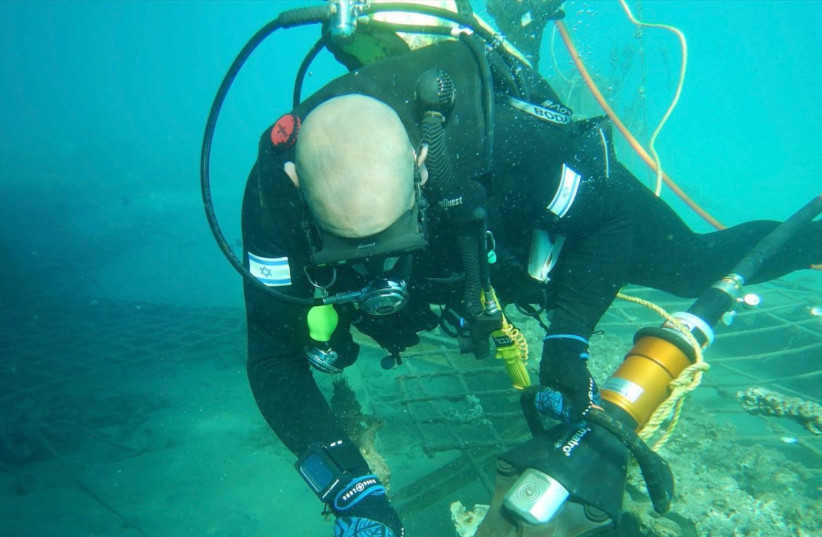
Probing the deep sea: The Yaltam Unit / (photo credit: IDF SPOKESMAN’S OFFICE)

Not many people know about the IDF’s Yaltam Unit, an underwater force specializing in diving and special missions in the deep sea. Last month, the unit celebrated 40 years of operations, with the participation of former and current commanders.

Much of the discussion centered on the great danger the unit’s soldiers face when carrying out heroic rescue missions.

“We should all be very proud of the fact that Yaltam is still improving, and is one of the IDF’s leading and most professional units that utilizes innovative technologies and has integrated women,” said Maj.-Gen. Yaron Mor, 65, a former commander of the Yaltam Sabotage Unit.

While most of the details of Yaltam operations are confidential, what we do know is that the 100-member unit of female and male soldiers is responsible for evacuating rockets, disabling bombs underwater, locating and neutralizing explosives near Israel’s beaches, operating advanced naval equipment and carrying out rescue missions for missing persons.
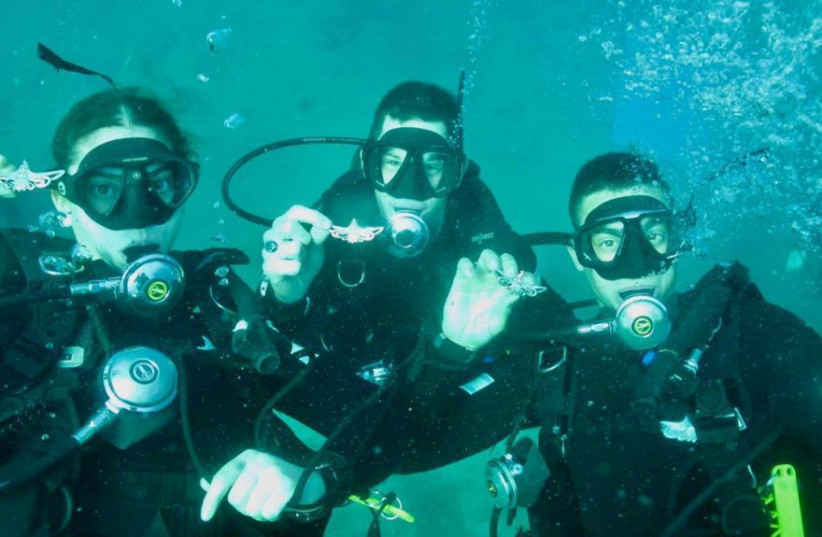
Probing the deep sea: The Yaltam unit (credit: IDF SPOKESMAN’S UNIT)

YALTAM WAS founded in 1963, known then as Unit 707. In 1976, the unit was merged with Shayetet 13 (Navy Special Forces), and continued to function as the unit’s sabotage arm. Later it became clear the units required different skills, so they were separated and became independent units once again in 1981. Yaltam often carries out joint missions with other naval units, such as Shayetet 13 and Shayetet 7 (the submarine unit).

“In the 1980s, two armed terrorist boats infiltrated Nitzanim Beach,” recalls Mor. “We were all at our respective homes enjoying the Shavuot holiday when we received the urgent message to return immediately to our unit’s headquarters. A helicopter picked me up, along with Itai, another sapper. From the helicopter, we were lowered down onto an IDF missile boat, and from there we jumped from one boat to another.

“We were able to overtake the terrorists’ boats, which were loaded with 30-mm. cannons. These cannons are now on display at the Israeli National Maritime Museum. There were also RPGs, anti-tank missiles and lots of explosives on the boats.”

What’s the protocol for approaching a vessel that is most likely booby-trapped?
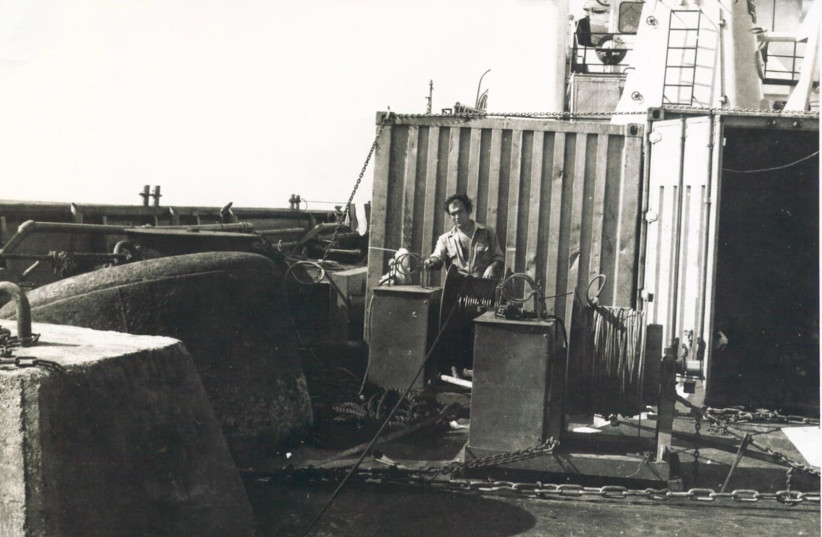
Past Yaltam mission (credit: IDF SPOKESMAN’S OFFICE)

“The first thing we do is look for a timer or electronic cables,” continues Mor. “We work extremely slowly until we’ve disabled everything. In this case, we were extra careful since there were bullets in the barrel and the RPG was connected to the projectile. We were using tweezer-like tools. And of course, everything is much more complicated when you’re doing all of this underneath the water.

“In the late 1980s, a terrorist riding a jet ski attempted to disembark on the beach at Rosh Hanikra. He had a vest full of explosives strapped to his body. He was neutralized by a Dabur patrol boat, and we were brought in to disable the explosive vest. I put on my scuba gear and swam underneath him all by myself to carry out the initial check. That way, if something happened, none of the other members from our unit would be harmed by the explosives.

“There are many decisions we need to make on the spot, so we operate by assessing the level of danger and the effectiveness of each option. First, I checked to see if the vest was connected to any electronic devices. Then I very carefully dismantled the explosives in the vest, as a surgeon does during an operation. Back in the day, we didn’t have any underwater robots with cameras that could assist us to dismantle explosives, so we had to do everything ourselves.”

While the Arrow Missile was being developed, Yaltam members were constantly being brought in to test out new functions. This made it much easier for engineers to know what was going to work best. “I dove down 36 m. to attach the missile to the helicopter so we could bring it up to the beach and dismantle the electronic system. It was important for the engineers to figure out why the missile had malfunctioned,” explains Mor. “Another time, they shot the missile from inside the water, and I needed to neutralize it before they could dissect it. And it was not a small missile.”
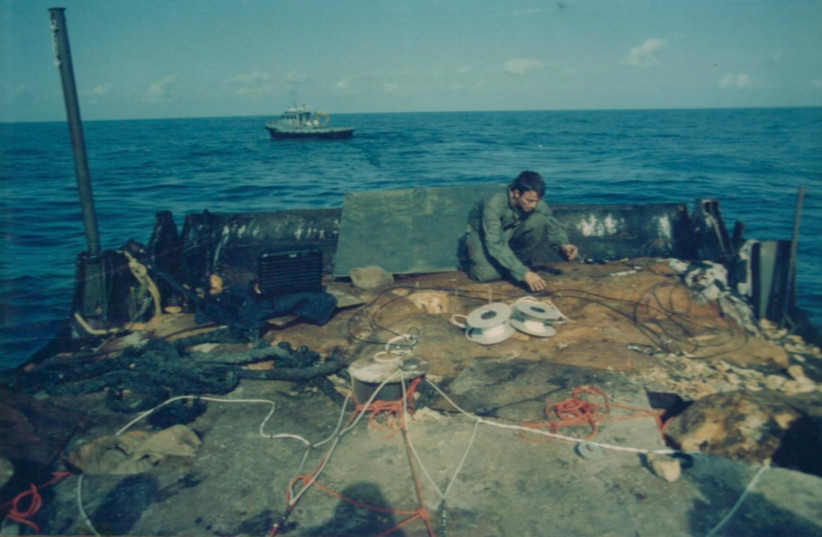
Past Yaltam operation (credit: IDF SPOKESMAN’S OFFICE)

MOR WAS one of the soldiers injured in the Kishon affair; he was released from his military service at the age of 38. These days, he continues to carry out reserve duty in Yaltam whenever he’s needed, though he is still critical about the way the IDF has treated the Israel Navy divers.

“The searches for Israel’s Dakar submarine, which continued for decades and cost a lot of money, were carried out by Yaltam,” continues Mor. “With regard to the soldiers from the Kishon who developed cancer, the country unfortunately has forgotten them. These soldiers gave their heart and soul to their country, yet they are still not receiving proper medical treatment.

“This does not, however, affect the way we carry out our work in Yaltam. We are all willing to do everything we need to do to carry out each operation to the absolute best of our ability without any hesitation. Yet I expect the IDF to do the right thing and take care of the families that need help.”

Every descent into the depths of the sea poses a danger to the Yaltam soldiers. “When I joined the unit, we were working in Sharm e-Sheikh,” explains Lt.-Col. Moti Keren, who served as commander of the unit from 1996 through 2002, and served a total of 25 years in Yaltam. “Our job there was to dismantle the base’s underwater fence. You need to love doing this type of professional work underwater.

“In the 1980s, we were part of the team that pulled out an Israeli missile boat that had ended up near the coast of Saudi Arabia,” recounts Keren. “We were often called upon to carry out operations like retrieving a helicopter that had crashed and fallen to a depth of 800 m. below sea level near Achziv Beach. Every single time you dive down to such depths you are risking your life. Another time, we participated in an operation in which our navy destroyed a motorcycle being driven by two terrorists in Lebanon. We dove down to retrieve their weapons. It was very close to the coast. Every single time you approach a mine underwater, you are putting yourself in danger.”
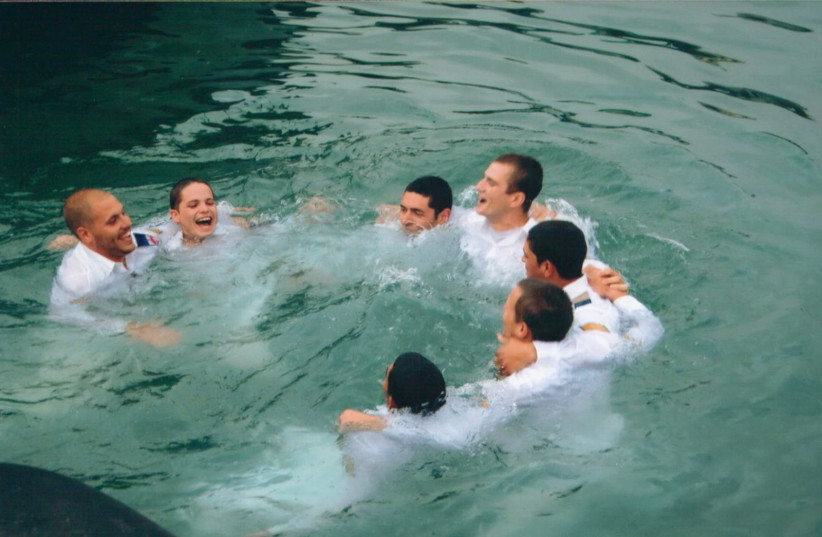
Yaltam today (credit: IDF SPOKESMAN’S OFFICE)

Nowadays Yaltam uses extremely advanced technological devices, but in the early days, this was not the case. “We used to dive with life vests, and we didn’t have any buoyancy control devices. In addition, we didn’t have any sonars or cameras. When we were done with our dive, we would come back up and tell the team what we had seen. Today, everything is filmed in real time.”

What qualifications are needed to get into Yaltam?
“Young people need to first pass an Israel Navy course, and only afterward they can try out for Yaltam or the Snapir unit,” explains Maj. Matan Bar, the current Yaltam diving commander. “If you pass, then you begin a long and strenuous year-long training course. There are many female soldiers now in Yaltam, which is great. Every position is completely integrated.

“All of our work is underneath the water, so of course, you have to love the sea. No previous diving experience is required.”

Last June, Yaltam carried out a joint training exercise with teams from the US, UK, France and Canada, which was deemed a great success. “We practiced a number of scenarios involving sabotage of complex vessels, which was very successful,” Bar states. “The goal of the joint training exercise was to share knowledge and strengthen our relationships. Some of our activities are highly confidential. Another essential part of our job is to search for missing people.

“We recently found a pilot who’d crashed over the Kinneret in the 1960s. Searches had continued on a monthly basis for two decades until we finally located his body. That was a very exciting moment.”

What are your hopes for Yaltam following the 40th-anniversary celebrations?
“That the unit continues to remain a vital and influential part of the Israeli military, and that it maintains its exceptional feeling of being a family.”


Translated by Hannah Hochner.


Zawartość publikowanych artykułów i materiałów nie reprezentuje poglądów ani opinii Reunion’68,
ani też webmastera Blogu Reunion’68, chyba ze jest to wyraźnie zaznaczone.
Twoje uwagi, linki, własne artykuły lub wiadomości prześlij na adres:
webmaster@reunion68.com


The Spielberg Jewish Film Archive – Yemen Music of the Yemenite Jews (English)

The Spielberg Jewish Film Archive
– Yemen Music of the Yemenite Jews (English)

   Hebrew University of Jerusalem


Abstract: Part of the Israel Music Heritage Project. The rhythms and traditions of Yemenite music.

The Spielberg Jewish Film Archive –
The 500 films, selected for the virtual cinema, reflect the vast scope of documentary material collected in the Spielberg Archive. The films range from 1911 to the present and include home movies, short films and full length features.

שם: מסורת יהודי תימן
שנה: 1992
אורך: 00:28:16
שפה: אנגלית

תקציר: חלק מפרויקט מורשת המוסיקה של ישראל “עם וצליליו”. המקצבים והמסורות במוסיקה התימנית.

ארכיון הסרטים היהודיים על שם סטיבן שפילברג –
חמש מאות הסרטים שנבחרו עבור הקולנוע הווירטואלי משקפים את ההיקף הנרחב של החומר התיעודי בארכיון שפילברג. באתר ישנם סרטים משנת 1911 ועד ימינו אלה ביתיים, קצרים ובאורך מלא.

כל הזכויות שמורות לארכיון הסרטים היהודיים על שם סטיבן שפילברג ולאוניברסיטה העברית בירושלים 2010; דף הבית; www.spielbergfilmarchive.org.il


Zawartość publikowanych artykułów i materiałów nie reprezentuje poglądów ani opinii Reunion’68,
ani też webmastera Blogu Reunion’68, chyba ze jest to wyraźnie zaznaczone.
Twoje uwagi, linki, własne artykuły lub wiadomości prześlij na adres:
webmaster@reunion68.com