YAAKOV KATZ
There are a number of top members within Likud who hope and pray that after the budget passes, Netanyahu will finally step down.
.
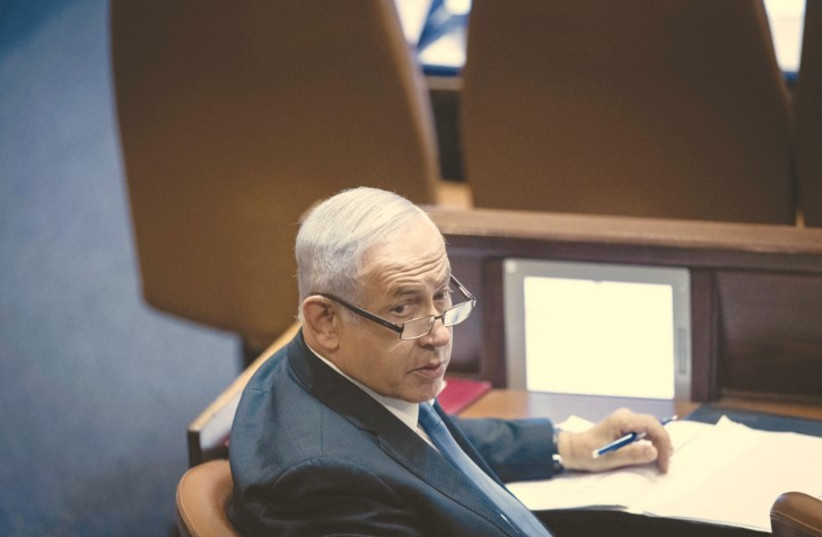 Opposition Leader Benjamin Netanyahu in the Knesset in June.
(photo credit: YONATAN SINDEL/FLASH90)
In the middle of August, former prime minister Benjamin Netanyahu flew to Hawaii, together with his wife, Sara, and their older son Yair.
The trip was memorable for a few reasons. At the time, the Israeli government was warning its citizens against flying overseas due to the onset of the fourth wave of corona.
Netanyahu ignored the warning and boarded a flight to San Francisco, the first time in 12 years that he flew on a commercial flight. There were no charter planes or private jets. Yes, he had security with him, but he was flying like a regular citizen.
One photo in particular told the entire story. It showed Netanyahu waiting in line at what looked like a check-in counter sitting on one of those Smart Carte baggage wagons that you pay for at American airports. He did not look happy.
Inside the Likud, some members like Nir Barkat had a feeling what would happen when the Netanyahus arrived in Hawaii. A tech entrepreneur who made hundreds of millions before entering politics, Barkat had been to Hawaii twice with his family. He told some close associates at the time that there was no way Netanyahu was coming back that quickly.
 Israel’s opposition leader Benjamin Netanyahu is seen gesturing at the Knesset, on July 26, 2021. (credit: MARC ISRAEL SELLEM/THE JERUSALEM POST)
He was right. First, Netanyahu extended his trip. Then, when he returned, his wife and son decided to stay a little longer. When Sara’s time came to return to Israel, Yair still had not had enough. He wanted a little more time in paradise.
It was – as Likud members later called it – the “Hawaii Effect.”
According to some, it has not yet completely worn off. Netanyahu, these MKs say, is not the same as he was when the current government was established by Naftali Bennett and Yair Lapid in June.
In those first few weeks, Netanyahu promised anyone who would listen that the new government was going to fall within a matter of weeks. When that didn’t happen, it turned into a matter of months. As recently as last week, he was still telling party members that there was a chance the government would yet fall before the state budget passed.
This column is being written after the 2021 budget passed this week, and before the vote on the 2022 budget. Netanyahu and his associates have tried for weeks to recruit a defector from among the ranks of the so-called “change coalition” to vote against the budget, but so far they have only met failure. Netanyahu even had an embarrassing moment early Thursday morning when he – one of the three longest-serving MKs in the house – accidentally voted with the coalition for one of the budget amendments.
But even without the budget, Netanyahu seems to many in Likud to have checked out of the parliamentarian work that is expected from the leader of Opposition.
Yes, he gives the occasional fiery speech against Bennett, but he has been known to skip votes and important faction meetings, and does not meet with foreign dignitaries visiting Israel. Now this could be his way of protesting the new government – by not meeting with visiting dignitaries and heads of state, he is showing his contempt for the government that he and his followers claim is illegitimate.
On the other hand, he is missing out on an opportunity to show that he is still a statesman who is sought out by foreign officials. As head of the opposition, it is within his right and in line with protocol to ask for those meetings.
Whatever the reason, there are a number of top members within Likud who hope and pray that after the budget passes, Netanyahu will finally step down. In addition to the “Hawaii Effect,” they’re looking for other signs of this happening.
In two months, for example, the security detail that Sara and sons Yair and Avner have grown accustomed to over the last 12 years will suddenly be gone. No longer will there be a car and security guards accompanying the Netanyahus on their trips overseas and their travels throughout Israel.
And then there is Netanyahu’s ongoing trial. On November 16, Nir Hefetz, a former top Netanyahu aide and a star state witness, will begin testifying in Case 4000, the bribery part of the trial pertaining to the Bezeq-Walla affair. Despite Netanyahu’s protests, the trial is moving ahead full steam, and the picture of how he allegedly tried to manipulate coverage in exchange for regulatory benefits is coming together.
So if he wanted to try and make a deal, now might be the best time, because Attorney-General Avichai Mandelblit is set to step down in February.
The search for his replacement has already begun, and while the next attorney-general will need to continue overseeing the trial, whoever gets the job will not be as invested in the outcome. Mandelblit, on the other hand, (even outside the Justice Ministry) knows that his legacy hinges on the Netanyahu trial ending in a conviction.
It was his decision to indict the former prime minister, and whatever happens in the case will determine his legacy. But his replacement will be less dedicated – it will not matter as much to him or her if Netanyahu gets acquitted as it will to Mandelblit.
Netanyahu knows this, and as a result might be inclined to reach a plea deal with Mandelblit now before he steps down in three months. Will he? The option cannot be ruled out.
And this is where it could get really interesting. If Netanyahu suddenly steps down, Likud will need to hold primaries within a couple of months to elect a new chairman.
Party insiders expect a long list of candidates, with some having already announced they will run while others are still waiting in the wings. The leading candidates are Nir Barkat, Israel Katz, Gilad Erdan, Miri Regev and Yuli Edelstein. Others, like Danny Danon, Tzachi Hanegbi and Avi Dichter, are expected to run, but their chances are deemed slim.
The three working the hardest right now are Barkat, Katz and Edelstein. Barkat is using the vast sums of money he has and loopholes in election laws – as long as primaries have not been called there are no limits on how much private money a potential candidate can spend – and he has hired a team of top adviser and pollsters.
Edelstein is also spending a lot of money, which gives him an advantage over other candidates. He has stepped up activity within the party since making his dramatic announcement a few weeks ago that he will run against Netanyahu, and not wait for him to step down like the rest of the candidates have said.
Erdan, who leaves his post in Washington this month as Israel’s ambassador, will remain at the United Nations, but is expected to return immediately to Israel if a primary race were to be called within the party. The last year has burnished his diplomatic credentials, but it has also distanced him from the party’s members – no weddings, bar mitzvahs or central committee barbecues – and he will have an uphill battle to take the top spot. Nevertheless, Erdan is expected to run so he can secure himself a top ranking and reestablish his standing within the party.
Katz is well plugged-in within the party institutions as well as when it comes to the “shetach,” the field of regular party members where he is popular and well-received. This will give him a step up in a future battle.
Many expect that there will not be a winner after one round of voting – because of the packed field of candidates, it is unlikely that anyone will receive the necessary 40% of the vote. If so, there will be a runoff between the two who come out on top.
When a new chairman is elected, that will likely mean the end of the current government. There won’t even be a need for an election. Under Israeli law, a constructive no-confidence motion – if passed – brings down the current government and immediately installs a new one.
The breakdown will look like this: the Likud-Shas-UTJ-Religious Zionist bloc currently counts 53 MKs. New Hope Chairman Gideon Sa’ar has already said that the moment there is a new Likud leader, everything is open again; and Yamina’s Ayelet Shaked has long been praying for a right-wing government. There will also be little need to convince Defense Minister Benny Gantz to bolt the current coalition – he will not want to crown his nemesis, Yesh Atid’s Yair Lapid, as the prime minister, and so he too will likely join a new Likud-led coalition.
Last but not least is Bennett, who would have to return to being the leader of a party of six with all that comes with it – or doesn’t.
Will any of this happen? No one knows. But here is what is clear: Netanyahu’s trial is continuing, and every day that passes reduces the chances that he will ever return. He knows it, as do his fellow party members and the members of the Bennett-Lapid coalition. Passing of the budget will help keep their government together, but they are still far from being out in the clear.
 Israeli-French Television Series on Mavi Marmara Flotilla Raid Set to Film
 Palestinians hold flags as they ride a boat during a rally marking the fifth anniversary of the “Mavi Marmara” Gaza flotilla, at the seaport of Gaza City on May 31, 2015. Photo: Aaed Tayeh/Flash90

 ILTV Israel News
