Archives

US State Dept confirms: Israel would have to authorize Palestinian consulate in Jerusalem

US State Dept confirms: Israel would have to authorize Palestinian consulate in Jerusalem

LAHAV HARKOV


The US closed its consulate to the Palestinians in 2018, when it opened recognized Jerusalem as Israel’s capital and moved the embassy there.
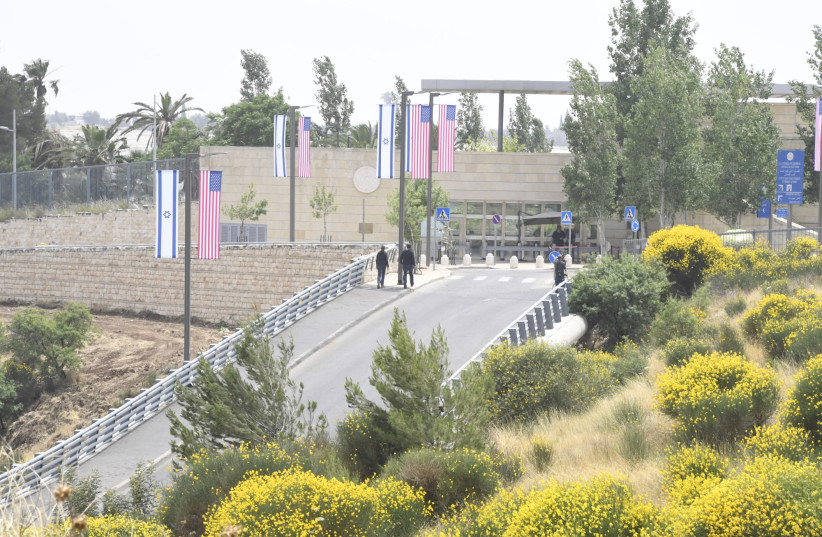
US Embassy Jerusalem / (photo credit: US EMBASSY IN JERUSALEM)

The State Department confirmed that it could not open a consulate to the Palestinians in Jerusalem without Israel’s authorization, in a Senate hearing on Wednesday.

Sen. Bill Hagerty (R-TN), who proposed a bill this week to ensure that the only American diplomatic entity in Jerusalem would be the embassy to Israel, asked Deputy Secretary of State for Management and Resources Brian McKeon about the matter in a meeting of the Senate Foreign Relations Committee.

“President [Joe] Biden’s proposal to open a second U.S. mission in Jerusalem would begin to reverse the recognition of Jerusalem, and it would divide Israel’s eternal and undivided capital city,” Hagerty said. “I just want to confirm something on the record. Is it your understanding that, under US and international law, the Government of Israel would have to provide its affirmative consent before the United States could open or reopen the US consulate to the Palestinians in Jerusalem, or does the Biden Administration believe it can move forward to establish a second U.S. mission in the Israel capital city of Jerusalem without the consent of the Government of Israel?”

McKeon responded: “Senator, that’s my understanding—that we’d need to get the consent of the host government to open any diplomatic facility.”

The US closed its consulate to the Palestinians in 2018, when it opened recognized Jerusalem as Israel’s capital and moved the embassy there, and started a department for handling Palestinian consular affairs within the embassy to Israel. The facility on Agron Street, in western Jerusalem, the part of the city that some other countries, like Russia, recognize as Israelis, was turned into a residence for the ambassador.
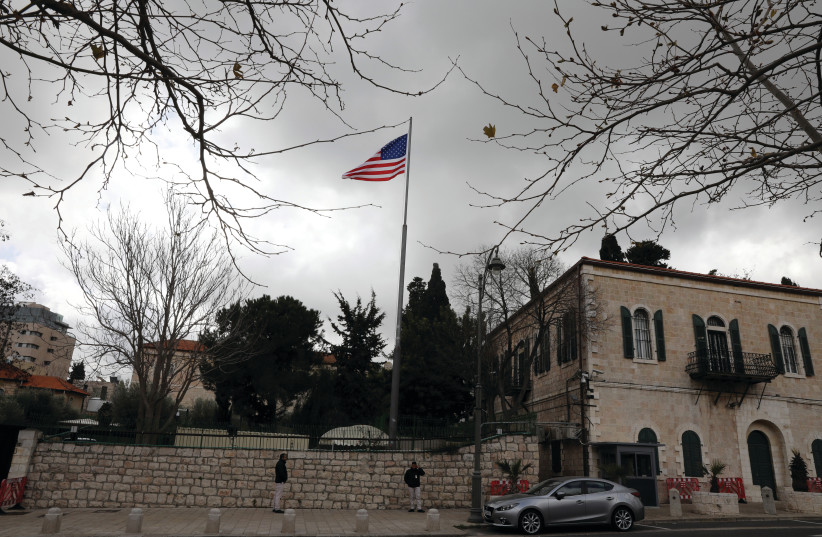
AN AMERICAN flag flutters at the premises of the former United States Consulate in Jerusalem. (credit: AMMAR AWAD/REUTERS)

Biden promised to reopen the consulate in his election campaign, and American officials have raised the issue with Israelis, but the government in Jerusalem opposes it.


Zawartość publikowanych artykułów i materiałów nie reprezentuje poglądów ani opinii Reunion’68,
ani też webmastera Blogu Reunion’68, chyba ze jest to wyraźnie zaznaczone.
Twoje uwagi, linki, własne artykuły lub wiadomości prześlij na adres:
webmaster@reunion68.com
900-year-old Crusader sword found by scuba diver off Israel’s coast

900-year-old Crusader sword found by scuba diver off Israel’s coast

ROSSELLA TERCATIN


The 1-meter-long blade was spotted among other remains such as pottery and metal anchors in a site used as a natural anchorage as early as 4,000 years ago.

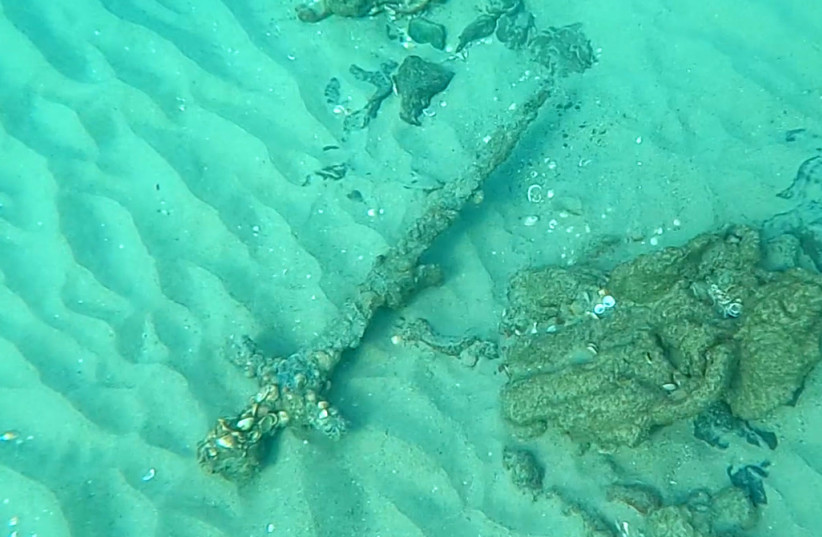
A 900-year-old Crusader-era sword is seen underwater at Israel’s Carmel Beach. / (photo credit: Shlomi Katzin/Israel Antiquities Authority)

An impressive meter-long sword dating back to the Crusader period was found by a scuba diver on the seabed off the Carmel Cost, the Israel Antiquities Authority announced Monday.

The diver, Shlomi Katzin from Atlit, spotted several ancient remains such as pottery fragments and stone and metal anchors, as well as the blade, which probably resurfaced after the shifting of sands. Fearing that the artifact might get covered up again, he brought it to the surface and contacted the IAA.

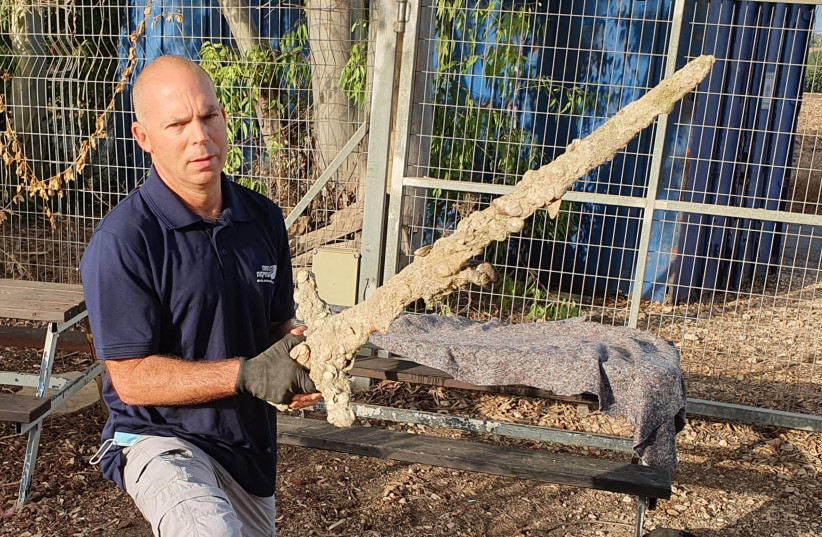
“The sword, which has been preserved in perfect condition, is a beautiful and rare find and evidently belonged to a Crusader knight,” said IAA’s Robbery Prevention Unit Inspector Nir Distelfeld. “It was found encrusted with marine organisms but is apparently made of iron. It is exciting to encounter such a personal object, taking you 900 years back in time to a different era, with knights, armor and swords.”

Over the centuries, the waters by the Carmel Coast were sailed by thousands of boats.

“The Carmel coast contains many natural coves that provided shelter for ancient ships in a storm, and larger coves around which entire settlements and ancient port cities developed, such as Dor and Atlit,” IAA’s Marine Archaeology Unit Director Kobi Sharvit noted. “These conditions have attracted merchant ships down the ages, leaving behind rich archaeological finds. The recently recovered sword is just one such find.”

The 900-year-old Crusader-era sword is seen being brandished by Israel Antiquities Authority inspector Nir Distelfeld. (credit: Anastasia Shapiro/Israel Antiquities Authority)

The specific site where the sword was found was already known by the IAA. Previous finds suggested that it was used as a natural anchorage as early as 4,000 years ago, during the Late Bronze Age.

Identifying archaeological remains on the seabed often presents challenges because of the ever-shifting conditions. For this reason, fortuitous discoveries can make a big difference.

“Underwater surveying is dynamic,” said Sharvit. “Even the smallest storm moves the sand and reveals areas on the sea bed, meanwhile burying others. It is therefore vitally important to report any such finds and we always try to document them in situ, in order to retrieve as much archaeological data as possible.”


Zawartość publikowanych artykułów i materiałów nie reprezentuje poglądów ani opinii Reunion’68,
ani też webmastera Blogu Reunion’68, chyba ze jest to wyraźnie zaznaczone.
Twoje uwagi, linki, własne artykuły lub wiadomości prześlij na adres:
webmaster@reunion68.com



News From Israel- October 25, 2021

News From Israel- October 25, 2021

ILTV Israel News


Israel is joining the fight against climate change as Prime Minister Naftali Bennett says it is a new national security interest for the country

More details coming up on the space collaboration between Israel and the United Arab Emirates

We take a look at a special JNF-USA program that integrates disabled teens into the IDF


Zawartość publikowanych artykułów i materiałów nie reprezentuje poglądów ani opinii Reunion’68,
ani też webmastera Blogu Reunion’68, chyba ze jest to wyraźnie zaznaczone.
Twoje uwagi, linki, własne artykuły lub wiadomości prześlij na adres:
webmaster@reunion68.com

Kibbutz harvests previously extinct dates eaten in Judea 2000 years ago

Kibbutz harvests previously extinct dates eaten in Judea 2000 years ago

ROSSELLA TERCATIN


Last year, one of the palms bore fruit for the first time, and now the production has increased with some of it being sold to visitors.

.
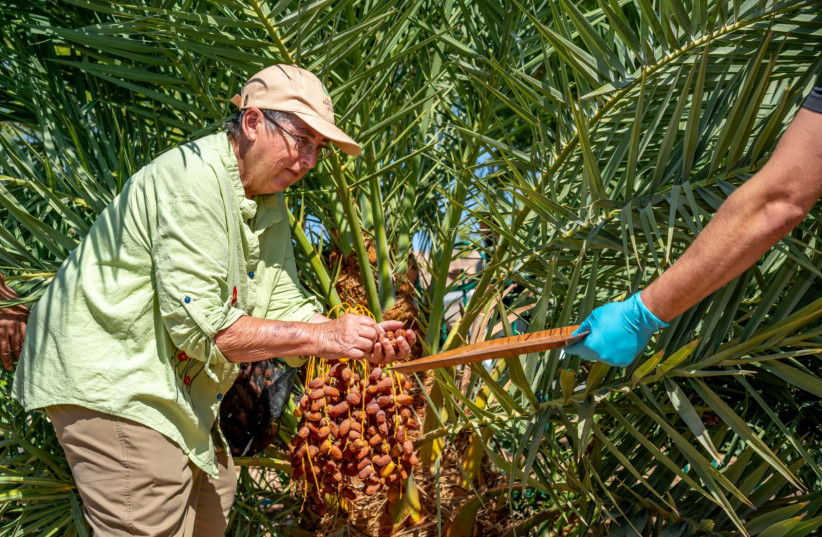
Dates from palm tree grown from 2,000 year old see at the Arava Institute for Environmental Studies. /  (photo credit: Marcos Shonholtz)

Researchers recently harvested the second crop of dates grown on palm trees from 2,000-year-old seeds retrieved from archaeological excavations in the region, the Arava Institute for Environmental Studies in Kibbutz Ketura said Monday.

After one of the trees bore fruit for the first time last September, this year’s harvest has increased. Some of the dates will be available for visitors to buy and taste a staple of the ancient Judeans’ diet.

The special fruits resemble modern species of dates and have a very sweet taste, similar to honey, according to people who have tasted them.

The ancient palm grove at Ketura has a few trees. The most senior, which researchers have named Methuselah – the oldest man who ever lived, according to the Bible – was planted in 2005 from a seed found in Masada in the 1960s during excavations led by legendary Israeli archaeologist Yigal Yadin.

Over the following years, the researchers decided to replicate the experiment, planting another 32 seeds from various excavations. About six of them eventually germinated, mostly from Masada or Qumran, another iconic site, where the world renowned Dead Sea Scrolls were unearthed.
.
Dates from palm tree grown from 2,000 year old see at the Arava Institute for Environmental Studies. (credit: Marcos Shonholtz)

While Methuselah was found to be a male tree, some of the new palms turned out to be female, allowing pollination.

“It’s very exciting to taste the dates and see such a large and significant amount of fruit because we had no guarantees that we would get a fruit-bearing female tree,” said Dr. Elaine Solowey, director of the Arava Institute’s Center for Sustainable Agriculture, who leads the project together with Dr. Sarah Sallon, director of the Louis L. Borick Natural Medicine Research Center of Hadassah-University Medical Center.

“It looks like a miracle on several levels,” she said. “Seeds from archaeological digs sprouted successfully, and against all odds, female trees sprouted among them. We are excited to revive an ancient variety of dates.”


Zawartość publikowanych artykułów i materiałów nie reprezentuje poglądów ani opinii Reunion’68,
ani też webmastera Blogu Reunion’68, chyba ze jest to wyraźnie zaznaczone.
Twoje uwagi, linki, własne artykuły lub wiadomości prześlij na adres:
webmaster@reunion68.com


Largest wine factory in the world from Byzantine period unearthed in Yavne

Largest wine factory in the world from Byzantine period unearthed in Yavne

ROSSELLA TERCATIN


The sophisticated facility was probably able to produce as many as two million liters of wine per year.
.
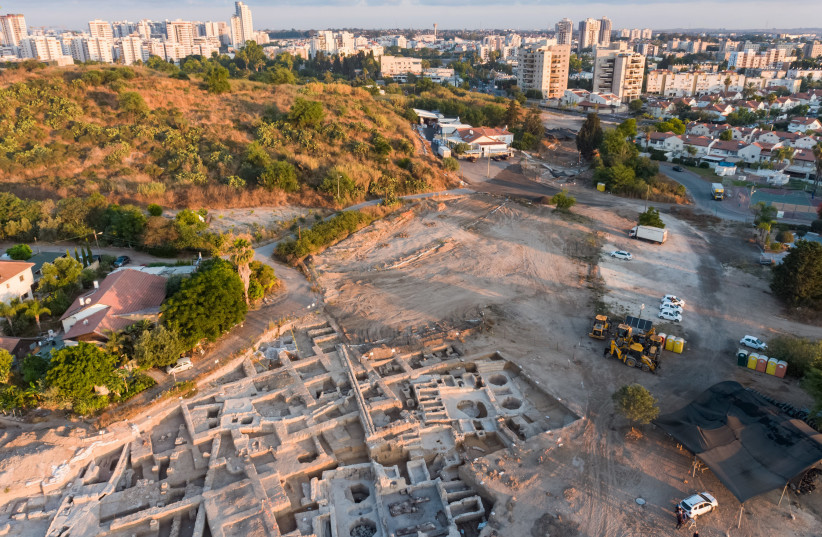
Excavation by the Israel Antiquities Authority at Yavne – Aerial view / (photo credit: Assaf Peretz/Israel Antiquities Authority)

A sophisticated wine production facility, the largest from the Byzantine period ever found in the world, was unearthed in Yavne, the Antiquities Authority (IAA) announced Monday.

The factory was used to produce the legendary regional wine, known as Gaza or Ashkelon wine after the ports from where it was exported all over the Mediterranean. It included five impressive wine presses, large treading floors where the grapes were crushed, two huge octagonal vats, storage rooms and kilns to produce jars to conserve the wine.

.
The facility is said to have produced as much as two million liters of wine annually.

Yavne is located in central Israel and was an important city some 1,500 years ago was, according to IAA archaeologist Dr. Jon Seligman, co-director of excavation with Dr. Elie Haddad and Liat Nadav-Ziv.

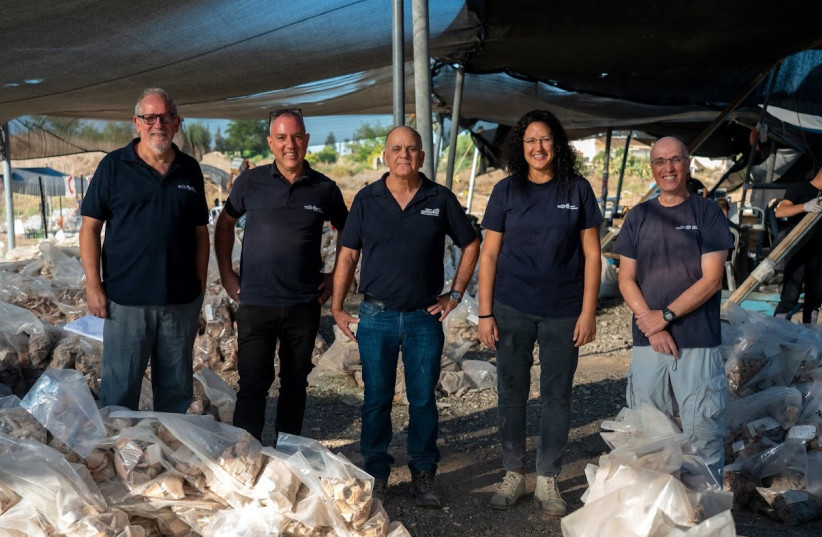
From right to left: Dr. Elie Hadad, Liat Nadav-Ziv – Yavne Excavation Directors; Eli Escozido – Director of the Israel Antiquities Authority; Diego Barkan – Tel Aviv District Archaeologist, and Dr. Jon Seligman – Yavne Excavation Director. (credit: YANIV BERMAN/ISRAELI ANTIQUITIES AUTHORITY)

“Yavne was important enough to be put in a map from the period with Jerusalem, featuring three large churches,” he said. “First and foremost, it was a Christian town. But we also know that there were populations of Jews and Samaritans living there during the same time period. It had a bishop. It was located in what at the time was on a major road, called the sea highway, which went from north to south, and on its junction with the Sorek River.”

The wine factory’s remains were first uncovered during a salvage excavation prior to the construction of a new residential and commercial neighborhood. In Israel, all development projects must be accompanied by such excavations.

“We have been exposing an industrial area of ancient Yavne,” Seligman said. “We found remains of other industries, for example, producing glass and metal. We also found remains from other periods, such as a house from the ninth century and some other buildings from the interim period between the Byzantine and Islamic periods.”

Excavation directors, from right to left: Dr. Jon Seligman, Liat Nadav-Ziv and Dr. Elie Hadad. (credit: YANIV BERMAN/ISRAELI ANTIQUITIES AUTHORITY)

In addition, the remains of another wine press was uncovered, dating back some 2,300 years ago, during the Persian period, testifying to the city’s long tradition in wine production, as stated in the Mishna, which mentions a vineyard of Yavne.

After the destruction of Jerusalem at the hands of the Romans in 70 CE, Rabban Yochanan ben Zakkai moved the Sanhedrin, the supreme court and legislative body in all matters of Halacha, to Yavne.

So far, the archaeologists have not excavated the area where the ancient city center was located, and they have not uncovered the remains of the churches, Seligman said.

“We did find some traces of their presence, such as pieces of marbles and columns,” he said.

The wine produced in Yavne was very well known and prestigious, Seligman said.

“It was a light, white wine,” he said. “We have found many wine presses in Israel, but what is unique here is that we are talking about a cluster of five huge ones, especially beautiful in their architecture.”

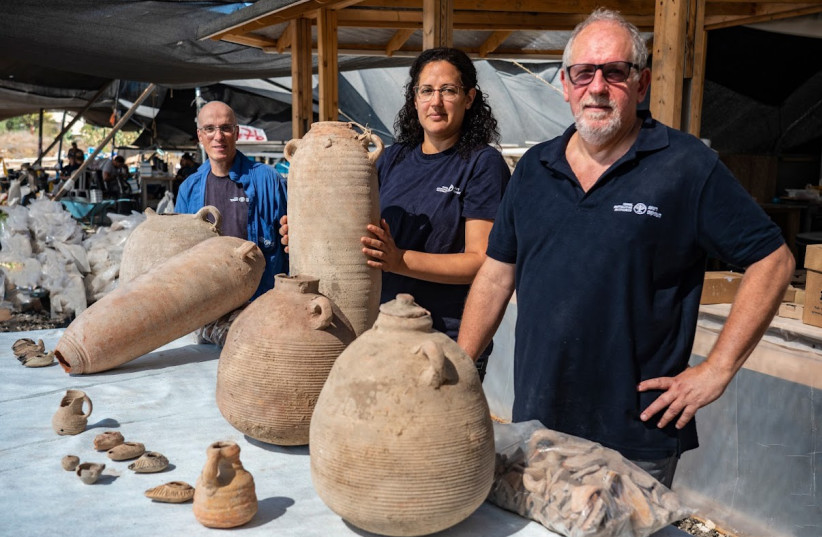
In addition, the archaeologists uncovered the remains of thousands of jars to store, age and export the wine, Seligman said.

“They have a specific and very recognizable shape,” he said. “The same jars were found in many places around the region, including Egypt, and we know that they were used for exporting the wine.”


Zawartość publikowanych artykułów i materiałów nie reprezentuje poglądów ani opinii Reunion’68,
ani też webmastera Blogu Reunion’68, chyba ze jest to wyraźnie zaznaczone.
Twoje uwagi, linki, własne artykuły lub wiadomości prześlij na adres:
webmaster@reunion68.com