Archives

News From Israel- August 29, 2021

News From Israel- August 29, 2021

ILTV Israel News


Prime Minister Naftali Bennett to return from his landmark trip to The White House.

Archaeologists revealing incredible insights into European Jewry, from before the time of the Holocaust.

Israeli Paralympians topping global headlines again, with the athletes breaking both expectations, as well as world records.


Zawartość publikowanych artykułów i materiałów nie reprezentuje poglądów ani opinii Reunion’68,
ani też webmastera Blogu Reunion’68, chyba ze jest to wyraźnie zaznaczone.
Twoje uwagi, linki, własne artykuły lub wiadomości prześlij na adres:
webmaster@reunion68.com


Afghanistan’s Lessons for Israel

Afghanistan’s Lessons for Israel

Jeremiah Rozman


A Taliban fighter looks on as he stands at the city of Ghazni, Afghanistan August 14, 2021. Photo: REUTERS/Stringer

The United States has definitively lost Afghanistan. US military power ousted the Taliban and prevented its return for 20 years. As forces withdrew, the product of two decades of nation-building melted away as if it never existed, save for the heaps of military hardware left behind. The collapse of America’s Afghanistan strategy highlights the risks that Israel would incur in creating a Palestinian state, as these projects hold key similarities.

First, both the United States and Israel were involved in nation-building. The United States sought to build an Afghan democracy capable of governing Afghanistan and maintaining peace and stability. Since the Oslo Accords, Israel has been working with America to build a Palestinian democracy capable of governing a future Palestinian state and of making peace with Israel.

Both of these efforts involved building and training armies capable of suppressing terrorists. Both involved introducing Western-style democracy into regions without prior experience with it. And both sought to defeat and marginalize well-organized Islamic fundamentalist groups with a strong sense of purpose and robust networks of support. Both attempts at nation-building ultimately failed.

In Afghanistan, the corrupt US-backed government never had much legitimacy, and its military quickly dissolved when US forces withdrew. The corrupt Palestinian Authority never enjoyed legitimacy either. Its US-trained forces were swiftly routed by Hamas when the Israel Defense Forces withdrew from the Gaza Strip in 2005, and it lost an election to the militant group in 2006. To the north, the forces that Israel backed in Southern Lebanon were quickly defeated by Hezbollah when the IDF withdrew in the spring of 2000. History demonstrates that organized, internationally-supported and motivated Islamist groups usually win in power vacuums.

Both the United States and Israel had the military ability to defeat their Islamic fundamentalist enemies, but only had sufficient political will necessary to keep them at bay and maintain a manageable status quo. For Israel, international pressure and low domestic tolerance for casualties drove it to risk its security by removing its forces from Gaza and Lebanon. The botched US withdrawal from Afghanistan was an unforced error. There was no major domestic or international demand for America to withdraw its remaining 2,500 troops immediately. In fact, international allies were left blindsided by President Joe Biden’s rapid pullout. No US soldier had been killed in combat there in more than 18 months, and the cost of maintaining an effective counterterrorism base of operations was sustainable.

The US decision to withdraw under minimal pressure bodes ominously for countries that are promised protection. Will that protection be rescinded when there really is pressure? After the United States appeared to flee before its own shadow, abandoning billions of dollars of sophisticated equipment to an enemy with no air force, no satellites and no nuclear missiles, are Taiwan and South Korea still truly confident in protection if nuclear-armed dictators come knocking?

In 2014, US Secretary of State John Kerry offered Israel technology and promises of international protection if it withdrew its military from the strategically important Jordan Valley to allow a Palestinian state to include that territory. The US withdrawal from Afghanistan suggests that Israel was right to rely on itself.

Both Democratic and Republican US administrations promoted the “two-state solution,” which in essence sought to nation-build in the Middle East. The Trump administration was the first to break with that thinking, which had persisted since Clinton. The Biden administration is back to the old playbook. It officially supports the creation of a Palestinian state. From Clinton’s Oslo Accords to George W. Bush’s “roadmap” and “disengagement,” the United States has reassured Israel that a future Palestinian state would not pose a security threat.

However, America’s poor track record at nation-building in the Middle East is mirrored by its poor track record predicting outcomes in that region. The Oslo Accords ended in a bloody intifada; disengagement from Gaza ended in Hamas capturing the coastal enclave and turning it into a terror platform. De-Ba’athification in Iraq ended in a bloody insurgency, and the withdrawal from Afghanistan yielded a rapid Taliban victory that apparently caught the Biden administration by surprise.

The world now has one more fundamentalist Islamic state: the Taliban-run Islamic Emirate of Afghanistan. There is little doubt a future Palestinian state would be the same. According to recent polls, Hamas would still win Palestinian elections, but in the Middle East, more important than ballots are bullets, as the 2021 Taliban takeover of Afghanistan and the 2007 Hamas takeover of Gaza clearly show.

The US military kept the Taliban at bay in Afghanistan, and the IDF keeps Hamas from taking over Judea and Samaria. While a fundamentalist Islamic victory is surely a tragedy for liberty, tolerance and human rights, it is first and foremost a security threat. A Taliban-run Afghanistan harbored Al-Qaeda, resulting in the attacks of Sept. 11, 2001. Many fear that it will once again become a safe haven for terrorists and that the next big attack is only a matter of time.

For Israel, a Hamas-run state bordering Israel’s major population centers, economic centers and an international airport would pose an existential threat. All of Israel would be within range of a variety of short- and long-range rockets, mortars and sniper fire, and easily infiltrated through tunnels. In the 21st century, oceans are no guarantee of national security, but at least for now, the Taliban or Al-Qaeda cannot fire volleys of rockets at Washington, DC from Afghanistan.

The US withdrawal from Afghanistan tells the world’s dictators and terrorists that America is no longer interested in its post-World War II role as the military guarantor of freedom. Any country would be wise to understand that it can ultimately only rely on its own power: “The strong do what they can, and the weak suffer what they must.” If Israel severely weakens its ability to defend itself by withdrawing its forces to create a Palestinian state, then it must understand that it will assuredly be left to suffer what it must when that state falls to Islamic fundamentalists, as history and the facts on the ground strongly predict.


Jeremiah Rozman is a publishing adjunct at The MirYam Institute. He has a Ph.D. in international relations from the University of Virginia with a focus on strategic/security studies, counter-terrorism, conflict resolution and asymmetric warfare.


Zawartość publikowanych artykułów i materiałów nie reprezentuje poglądów ani opinii Reunion’68,
ani też webmastera Blogu Reunion’68, chyba ze jest to wyraźnie zaznaczone.
Twoje uwagi, linki, własne artykuły lub wiadomości prześlij na adres:
webmaster@reunion68.com


Israel in Talks with PA to Transfer Hundreds of Millions of Shekels to Ramallah

Israel in Talks with PA to Transfer Hundreds of Millions of Shekels to Ramallah

i24 News


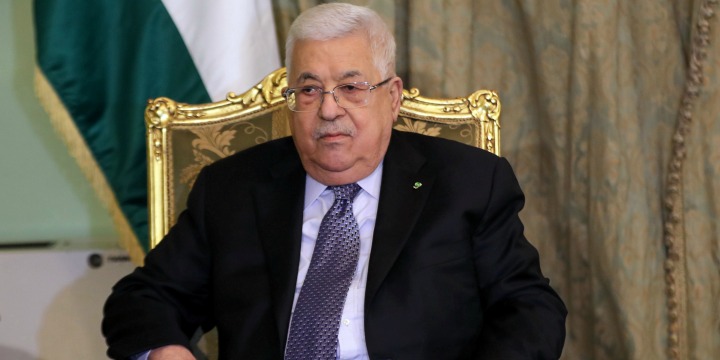
Palestinian Authority President Mahmoud Abbas meets with Arab League Secretary-General Ahmed Aboul Gheit (not pictured) in Cairo, Egypt, Jan. 31, 2020. Photo: Reuters / Mohamed Abd El Ghany

 The Israeli government is reportedly currently in talks with the Palestinian Authority to transfer hundreds of millions of shekels to Ramallah, which is facing a major financial crisis, the Times of Israel reveals.

A deal worth 800 million shekels ($248.5 million) to the Palestinian Authority has been formulated, an Israeli official said on Friday.

Another official familiar with the matter said the deal was “practically done.”

A senior PA official, Ahmad Majdalani, confirmed that discussions over financial support were ongoing between the two sides. He said the funds would not be loaned, but rather an advance on the tax revenue that Israel pays to the PA.

“There are discussions around an advance on what is owed to us and not a loan,” said Majdalani.

The West Bank is currently experiencing a financial crisis due in particular to the coronavirus pandemic. The Palestinian economy has contracted by more than 11 percent this year.


Zawartość publikowanych artykułów i materiałów nie reprezentuje poglądów ani opinii Reunion’68,
ani też webmastera Blogu Reunion’68, chyba ze jest to wyraźnie zaznaczone.
Twoje uwagi, linki, własne artykuły lub wiadomości prześlij na adres:
webmaster@reunion68.com


Top 10 Culinary Hotspots in Tel Aviv’s Levinsky Market

Top 10 Culinary Hotspots in Tel Aviv’s Levinsky Market


Top 10 Culinary Hotspots in Levinsky Market


Tel Aviv’s Levinsky Market is known for its wholesale spices, but there are many other shops to explore. Watch as Inbal Baum takes us around the top 10 culinary hotspots in Levinsky Market!


Zawartość publikowanych artykułów i materiałów nie reprezentuje poglądów ani opinii Reunion’68,
ani też webmastera Blogu Reunion’68, chyba ze jest to wyraźnie zaznaczone.
Twoje uwagi, linki, własne artykuły lub wiadomości prześlij na adres:
webmaster@reunion68.com


Iranian cyberattacks threaten our daily operations – opinion

Iranian cyberattacks threaten our daily operations – opinion

ROTEM BAR


According to a Sky News report based on classified documents allegedly from Iran, a cyber attack could sink a cargo ship or blow up a fuel pump at a gas station.

UNTIL NOW, building owners did not add nation-states into the reference threat options, a mistake that needs to be addressed. / (photo credit: KACPER PEMPEL / REUTERS)

According to a Sky News report based on classified documents allegedly from Iran, a cyber attack could sink a cargo ship or blow up a fuel pump at a gas station.

The Sky News report also details how satellite devices are used by the shipping industry globally and how a computer-based system controls lighting, heating, and ventilation in smart buildings worldwide.

According to a security source with knowledge of five research documents, the 57-page collection was gathered by an offensive cyber unit called Shahid Kaveh, part of Iran’s terrorist-linked Islamic Revolutionary Guard Corps (IRGC).

“They are creating a target bank to be used whenever they see fit,” said the source, who requested to remain anonymous for the documents to be discussed directly.

Almost all of the files include a quote that appears to be from Iran’s Supreme Leader Ali Khamenei: “The Islamic Republic of Iran must become among the world’s most powerful in the area of cyber.” Sources describe this quote as something like a “commander’s intent statement.”

The front pages of only two of the reports mention the date of completion.
The first examines what is known as a building management system – the computer technology that controls things like lights, heating, and ventilation in smart buildings – from November 19, 2020.

Companies that provide these services are listed in the documents. Several manufacturers were involved, including Honeywell in the United States; Schneider Electric, a French electrical equipment company; Siemens, a German company; and KMC Controls, another US company.

Another report, which deals with a German company called WAGO, which makes electrical components for the industrial automation market, is dated April 19, 2020 and is the most comprehensive.

The file examined vulnerabilities in a programmable logic controller or PLC – a computer control system.

“Continuing the investigation, to use these processes, we noticed the vulnerabilities within these systems are irreparable. If there is an attack, the damage will not be easy to fix,” the report said.

“Therefore, compared to other PLC brands, this brand is impenetrable once connected online. When online, the infrastructure and intelligence on engineering cannot be reached and cannot be lost.

“For our benefit, the best situation is for the PLC not to work as intended, and for that to happen, a project must be written in ‘ladder’ language and have multiple exits, as many as possible. But the problem with this project is that we wouldn’t be able to assess the damage caused. The other option is to assess the PLC’s and software’s weak points and dangerous points to attack our target. This option needs separate investigation and research before we can find the weak points.”

The Iranian attack Unit 13 is not working in a vacuum. There are many attack groups for nations, companies, and criminals, with the last two seeking money as an incentive. Governments do not follow those rules, and their agenda might not be as clear.

This is why documents describing such targets with attack openness, as those documents describe, are rarely published or exposed in such a manner.
The document provides a glimpse into the attackers’ way of thinking regarding the targets’ owners and the possible attack vectors and destruction capabilities required to harm the target.

Until now, smart building owners did not add nation-states into the reference threat options, and by closely examining the reports, it’s clear that this was a mistake that needs to be addressed.

WAGO, a German manufacturer of industrial automation, was one of the attack vectors described in the report. Many types of automation equipment are used in the industrial automation market and with Cloud-PLC service.

Many of the devices used in industrial automation and building automation are not updated. Vulnerability issues are not addressed, allowing the Iranians and other attackers to continue and hold ground on the victims’ systems for many years.

Industrial and building management systems are a key to ensuring safety. With millions of systems globally, those attack groups pose a significant risk to the modern life that we get used to in our daily lives.


The writer is a senior ICS/OT Division manager, BDO Israel.


Zawartość publikowanych artykułów i materiałów nie reprezentuje poglądów ani opinii Reunion’68,
ani też webmastera Blogu Reunion’68, chyba ze jest to wyraźnie zaznaczone.
Twoje uwagi, linki, własne artykuły lub wiadomości prześlij na adres:
webmaster@reunion68.com