Archives

News From Israel- August 22, 2021

News From Israel- August 22, 2021

ILTV Israel News


An Israeli officer critically injured in the so-called marches of return, as the Hamas-run riots resume along the Gaza-Israel border.

The number of Coronavirus victims – seen and unseen – rising ever faster in Israel; as the 4th wave hits.

The Tokyo summer Olympics part two, Israel’s Paralympic team getting stretched for the competition.


Zawartość publikowanych artykułów i materiałów nie reprezentuje poglądów ani opinii Reunion’68,
ani też webmastera Blogu Reunion’68, chyba ze jest to wyraźnie zaznaczone.
Twoje uwagi, linki, własne artykuły lub wiadomości prześlij na adres:
webmaster@reunion68.com


Government coronavirus restrictions severely impact olim

Government coronavirus restrictions severely impact olim

JEREMY SHARON


Large numbers of new immigrants have little or no close family in Israel at a time when such familial support is needed most.
.
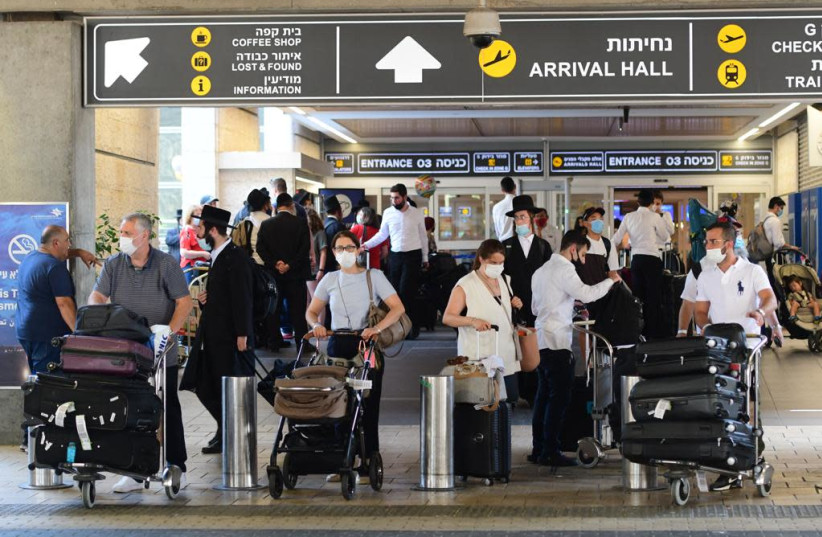
Israelis at Ben-Gurion Airport as coronavirus cases increase, August 5, 2021.
(photo credit: AVSHALOM SASSONI/ MAARIV)

It just seems that there’s no humanity,” said Mandi Brandiss, whose mother living in Australia requested an entry permit into Israel five times to assist her own mother, Mandi’s 95-year-old grandmother, after surgery, and was denied five times.

“You make aliyah because Israel is your country, but without knowing the language and without having a home. But when you get married, you at least want to have your parents there,” said Javah Levy, whose parents living in Spain were denied entry permits into Israel for Javah’s wedding.

“I have no family here. During the whole pandemic I was here completely alone. I was looking forward to this date for so long and to be together with my family in the Jewish state, and that was taken away,” said Yael Wool, who last week postponed her wedding, which was scheduled for later this month, because too many of her close family members were not able to obtain entry permits.

These three comments by three olim [immigrants], made over the course of the last five months, represent the extreme disappointment and frustration of thousands of olim over the last year and a half of the COVID-19 pandemic.Already a month ago, with coronavirus infections rising once again in Israel and abroad, the government reimposed strict entry permit conditions on numerous countries with large Jewish populations and large numbers of citizens who had immigrated to the Jewish state, including Argentina, Brazil, Mexico, Russia and South Africa, adding the UK to that list two weeks ago.

Once again, olim from many countries around the world would face renewed difficulties having their closest relatives come and see them, some for the first time since the pandemic began.

But inside Israel, the “green pass” system designed to limit infection was not instituted for gatherings of less than 100 people, and even then barely enforced.

Only this week has the green pass been instituted for a much broader swath of gatherings, although enforcement is still minimal.

Asked why internal restrictions were not being implemented and enforced faster, one adviser close to Prime Minister Naftali Bennett said it was to scare people into getting a third shot of the COVID-19 vaccine.

The pandemic has had a severe effect on many olim, large numbers of whom have little or no close family in Israel at a time when such familial support is needed most. It has been especially hard for those celebrating weddings, births, bar and bat mitzvahs and other celebrations who could not have their close family at their sides for the most joyous occasions of their lives.

SOME PROMINENT olim are, however, arguing that the coronavirus crisis is merely a symptom of a larger problem in which government officials, ministers, MKs and the public at large are not empathetic to the needs of immigrants and unaware of the difficulties they face.

Problems with professional and academic accreditation, the treatment of lone soldiers, lack of English-language assistance especially for very new immigrants, mental health concerns, appropriate out-of-school frameworks for children, and more are just some of the struggles that many olim continue to experience but have not been adequately addressed.

“Israel remains a country which loves aliyah but doesn’t necessarily love olim,” said Michal Cotler-Wunsh, a former MK in the previous Knesset who came to Israel from Canada.

“COVID has highlighted and exacerbated the situation for olim,” she continued, noting that problems faced by earlier waves of aliyah in the country’s infancy, albeit far worse than those experienced today, left lasting scars on the country.

“The lack of consideration for olim hurts the country in the long run and it builds up long-term resentments” said Cotler-Wunsh.

She said that the country needs a “complete shift in understanding” and that it must be understood that when the government makes decisions, it has to look at all possible consequences of those decisions, including the impact on immigrants.

“The perspective must be that consideration for olim is a right, not a kindness; there has to be a paradigm shift in the understanding of the government towards immigrants,” she said.

What is critical, said Cotler-Wunsh, is that olim get a place at the decision-making table in order to make their voices heard and influence decisions before they are made.

This is something with which Fleur Hassan-Nahoum, deputy mayor of Jerusalem, who made aliyah from the UK, heartily agrees with.
“There are not enough olim in the corridors of power,” she said simply.
“It’s a very disappointing thing that it takes so much convincing and cajoling for the needs of olim to be taken into account, instead of it being the first thing people think about as a country of immigrants,” said Hassan-Nahoum.

She added, however, that the Anglophone community in particular, with olim from English-speaking countries, has something of a built-in disadvantage in that such olim are “a bit more soft-spoken” and are less inclined to be as assertive as a country like Israel requires.

“Often Israelis are more abrasive than the average soft-spoken English-speaking immigrant. It’s a tough society, and those who shout loudest get the attention,” said Hassan-Nahoum.

But, she said, the problems olim have faced during the COVID-19 crisis may constitute a watershed moment, and she said she sees greater activism and organization by olim, including specifically English-speaking olim, due to the problems the pandemic has caused.

Dov Lipman, another former MK, has been assisting olim and their family members entering the country since the pandemic began, and has now created an organization, Yad L’Olim, to assist immigrants seeking to have their relatives visit them, and to deal with other concerns facing olim.
Lipman said he and his organization have dealt with thousands of cases in which the relatives of olim have sought desperately to get into the country for a celebration, to give support and assistance to their relatives in Israel, or simply to visit immediate family members they have not been able see for a year and a half.

“The current state of affairs is causing tremendous sadness. As a whole, I don’t think people in Israel understand how challenging it is to be away from family,” he said.

“And then not being able to have them be part of your lives at these important moments in life is so difficult.

Lipman said that when he sits with MKs and government officials, they often express indifference to the needs of olim at this time, until he explains the situation and they begin to understand the nature of the problem.
“When I sit with MKs and other officials and lay out the issues, they want to help. Having a voice, working with the members of Knesset, committees and ministers, is really important to advancing the interests of olim,” he said.

The COVID-19 pandemic will continue to effect change around the world in innumerable aspects of human life and behavior, with Israel no exception.
Immigrants in the Jewish state have felt the effects of the global health crisis keenly, and continue to face the ongoing impact of the absence of close family as a result of it.

Cotler-Wunsh asserted that the unique characteristics of different groups of immigrants is a fundamental part of the country’s character but one that has never been properly appreciated.

“It’s not a melting pot; it’s a mosaic. But the contribution and influence of different waves of immigration has never been acknowledged for the dignity of difference, for what they bring with them,” she said.
“We were always 12 tribes, and we could never manage in war or peace without all having proper representation.”

Perhaps the difficulties felt over the past 18 months will become a catalyst to redress the problems olim have faced during this time.


Zawartość publikowanych artykułów i materiałów nie reprezentuje poglądów ani opinii Reunion’68,
ani też webmastera Blogu Reunion’68, chyba ze jest to wyraźnie zaznaczone.
Twoje uwagi, linki, własne artykuły lub wiadomości prześlij na adres:
webmaster@reunion68.com


How a bone puzzle helped identify new type of prehistoric human in Israel

How a bone puzzle helped identify new type of prehistoric human in Israel

ROSSELLA TERCATIN


Some 17 fragments of a mandible, a tooth and a piece of skull were the key to allow researchers to find out about the ‘Nesher Ramla Homo.’

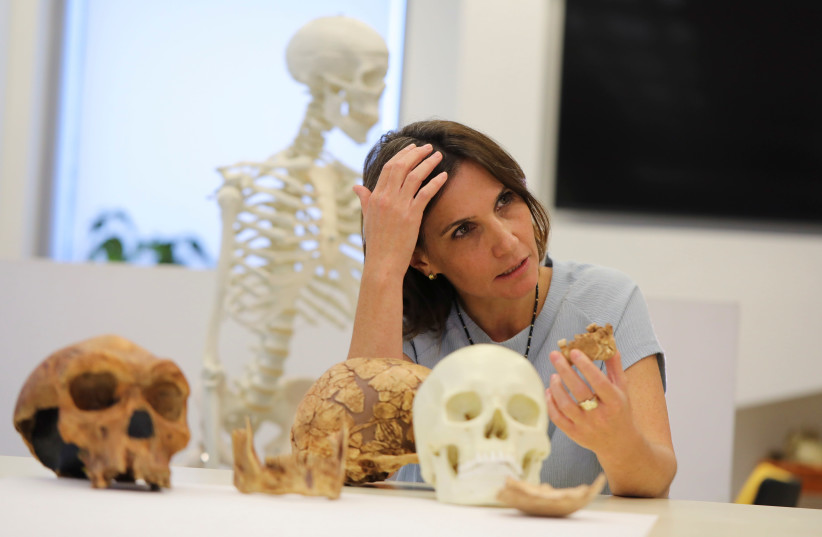
Hila May, a physical anthropologist at the Dan David Center and the Shmunis Institute of Tel Aviv University holds what scientists say is a piece of fossilised bone of a previously unknown kind of early human discovered at the Nesher Ramla site in central Israel, during an interview with Reuters at / (photo credit: AMMAR AWAD/REUTERS)

The identification of an  unknown type of ancient human in Israel  was made possible by solving a “bone puzzle” made by 17 fragments of a mandible (lower jaw bone), a molar and a bone of the skull, Dr. Hila May, a physical anthropologist and a lecturer at the Tel Aviv University Faculty of Medicine told The Jerusalem Post.

The remains – which presumably belonged to the same individual who lived some 130,000 years ago, were uncovered during a salvage excavation at the Nesher cement plant near Ramle led by Hebrew University archaeologist Yossi Zaidner. From there, they were taken to the Dan David Center for Human Evolution and Bio-History Research at TAU.

May is an expert in ancient bones, with her academic interests ranging from the evolutionary history of humans to how ancient diseases have evolved to this day.

Recent studies she has co-authored have included discoveries about how ear infections plagued inhabitants of the land of Israel some 15,000 years ago and how a group of hunter-gatherers fixed the broken leg of one of their peers about 35,000 years ago.

Since the beginning, the bones from Nesher Ramle constituted both a puzzle and a riddle.

“Aligning all the fragments together like a puzzle, partially manually, but mostly virtually, we obtained an almost complete mandible, which starting from many small pieces was a very good result,” May said.

The researchers checked the remains using several techniques, including a micro CT scanning at high resolution.

May noted that the general expectation was that the remains had to have belonged to a Homo Sapien – the modern human species, who started to live in the region around 200,000 years ago.

“However, just by looking at bones, we very soon realized that this was not the case,” she added.

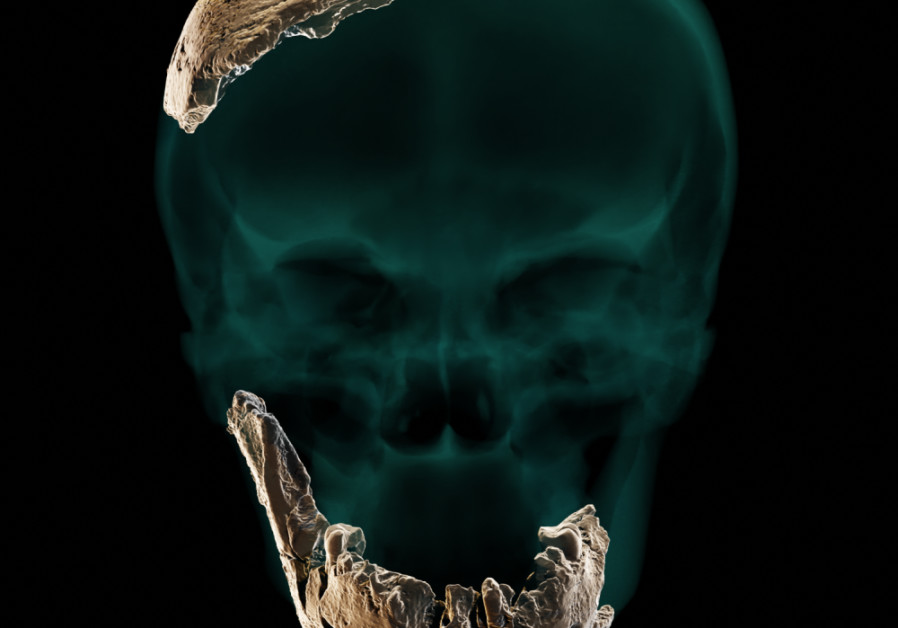
Nesher Ramla Homo, static skull & mandible & parietal orthographic. (Photo credit: Tel Aviv

The first clue came from the skull fragment, an almost complete right parietal bone.

“Although we only had a fragment of the skull, by completing it virtually we saw it was very low and flat, compared to ours which is tall and round,” May said. “This is a very archaic characteristic. In addition, the skull was very thick, thicker than ours and even of Neanderthals skulls”.

Another element that marked the difference between the skull that the scholars were examining and a modern human skull was the pattern left on the skull by the blood vessels outside of the brain.

“The pattern on our skulls is complex with many arterial branches, but in that case, it was very simple, with only four arterial branches, once again, very archaic,” May noted.

Asked if these features also indicate that those ancient humans had smaller brains or were less intelligent than us, the researcher said that this isn’t the case.

“I would not go there,” she remarked. “For example, culturally we know that these ancient humans produced the same tools that Homo Sapiens manufactured. We cannot say that they were less intelligent or had less capabilities.”

What the bones suggest has more to do with their physical appearance than with any other feature, according to May.

The mandible offered further insights in this perspective.
“We noticed the absence of chin,” May said. “Only Homo Sapiens had chins.”

Very soon, the researchers could affirm with certainty that the remains did not belong to a Homo Sapien.

“However, it is easy to say what something isn’t, it is much more difficult to understand what it actually is,” May said. “Now that we knew what those bones were not, we needed to understand what they were.”

The scholars started to compare the three-dimensional model they had created with other fossils found in Israel and in the rest of the world.
“This allowed us to realize that we had a very unique combination of characteristics because we saw that the skull was more archaic than the mandible: while both were not Homo Sapiens, the skull was more similar to the ones of other ancient homos, such as Homo Erectus, while the mandible was more comparable to that of Neanderthals,” May said.

“This is how we understood that we were talking about a different type of human,” she further said.

Further clarity was offered by the fact that the Nesher Ramle Homo – as the scholars named it – appeared similar to other fossils found in Israeli prehistoric sites, such as the Qessem Cave, dating back to a much earlier period, as early as 400,000 years ago.

“Some of these fossils were already known but nobody could agree about which ancient human they belonged to,” May said. “Experts previously called them ‘archaic Homo Sapiens’ because they did not understand what they were. We didn’t know that someone else was living here alongside the Homo Sapiens.”

“This was the first time we could give them a name and say that they were a large population living in the region between 400,000 and 130,000 years ago.”

Thanks to the connection they managed to establish between the fossils, the researchers could reach yet another conclusion.

“We had something very archaic, dating back to much earlier than Neanderthals,” May said. “At this point, we started to think that we could be talking about the ancestor population of the European Neanderthal.”

This theory represents one of the most revolutionary aspects of the Nesher Ramla discovery.

Up until this new study – which was published as the cover story of the prestigious journal Science last month – Neanderthals had been believed to have originated in Europe, and later reached the area of Israel – the most south location they ever inhabited, as far we know today – some 70,000 years ago.

“Now we are saying that they came from Israel, they were descendants of the Nesher Ramla Homo,” May said.

Searching through the fossils previously uncovered in Israel, the group also found what appear to be fossils from a hybrid population from a later period, around 100,000 years ago, presenting characteristics of both Homo Sapiens and Nesher Ramla Homo, proving that the two populations not only coexisted in the region, but also interbred.

For the future, May said that it is going to be crucial to find more fossils from the relevant periods.

“We want to find more fossils, we are working on it all the time, we want to learn more about this population,” she said. “There is a lot of work to do.”


Zawartość publikowanych artykułów i materiałów nie reprezentuje poglądów ani opinii Reunion’68,
ani też webmastera Blogu Reunion’68, chyba ze jest to wyraźnie zaznaczone.
Twoje uwagi, linki, własne artykuły lub wiadomości prześlij na adres:
webmaster@reunion68.com

Israeli Doctors Find Severe COVID-19 Breakthrough Cases Mostly in Older, Sicker Patients

Israeli Doctors Find Severe COVID-19 Breakthrough Cases Mostly in Older, Sicker Patients

Reuters and Algemeiner Staff


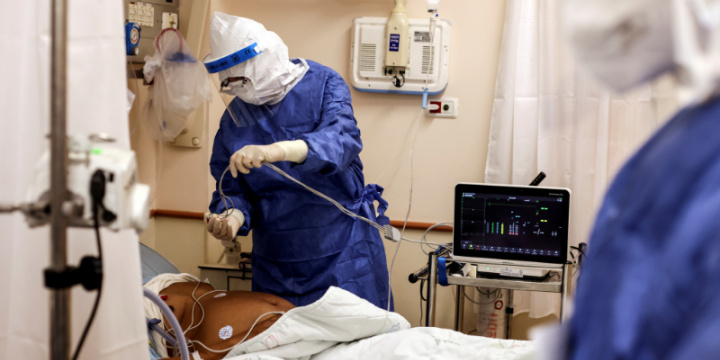
A medical staff member attends a patient suffering from the coronavirus disease (COVID-19), in a ward at Beilinson hospital in Petah Tikva, Israel August 18, 2021. REUTERS/Ammar Awad

In Israel’s COVID-19 wards, doctors are learning which vaccinated patients are most vulnerable to severe illness, amid growing concerns about instances in which the shots provide less protection against the worst forms of the disease.

Around half of the country’s 600 patients presently hospitalized with severe illness have received two doses of the Pfizer Inc shot, a rare occurrence out of 5.4 million fully vaccinated people.

The majority of these patients received two vaccine doses at least five months ago, are over the age of 60 and also have chronic illnesses known to exacerbate a coronavirus infection. They range from diabetes to heart disease and lung ailments, as well as cancers and inflammatory diseases that are treated with immune-system suppressing drugs, according to Reuters interviews with 11 doctors, health specialists and officials.

Such “breakthrough” cases have become central to a global debate over whether highly vaccinated countries should give booster doses of COVID-19 vaccines, and to which people.

Israel began offering booster doses to people age 60 and up in July, and has since expanded that eligibility.

The United States, citing data out of Israel and other findings, said on Wednesday it would make booster doses available to all Americans beginning in September.

Other countries, including France and Germany, have so far limited their booster plans to the elderly and people with weak immune systems.

“The vaccinated patients are older, unhealthy, often they were bedridden before infection, immobile and already requiring nursing care,” said Noa Eliakim-Raz, head of the coronavirus ward at Rabin Medical Centre in Petach Tikva.

In contrast, “the unvaccinated COVID-19 patients we see are young, healthy, working people and their condition deteriorates rapidly,” she said. “Suddenly they’re being put on oxygen or on a respirator.”

Israel’s Health Ministry raised new alarm this week with a report showing the effectiveness against severe disease of the Pfizer vaccine, developed with Germany’s BioNTech, appeared to have dropped from more than 90% to 55% in people age 65 and up who received their second jab in January. Disease experts say it is not clear how representative the figures are, but agree it is concerning given evidence that overall vaccine protection against infection is waning.

They cannot say whether that is due to the amount of time that has passed since inoculation, the ability of the highly contagious Delta variant to evade protection, the age and underlying health of the people vaccinated, or a combination of all of these factors.

Health officials in the UK and United States, two other nations with high vaccination rates and a spike in Delta infections, have reported similar trends. In the UK, about 35% of the people hospitalized with a Delta case in recent weeks had received two doses of a COVID-19 vaccine. Nearly three-quarters of US breakthrough infections that led to hospitalization or death were among people age 65 or older, according to federal data.

US officials said their booster plan is based on concern that over time, the vaccines will provide less protection against severe disease, including among younger adults.

“We are watching other countries carefully and (are) concerned that we too will see what Israel is seeing, which is worsening infections over time” among vaccinated people, US Centers for Disease Control and Prevention Director Rochelle Walensky said at a press conference on Wednesday. The World Health Organization has repeatedly urged wealthy nations to refrain from providing boosters while much of the world has yet to access their first COVID vaccine doses.

IMMUNE RESPONSE

The Delta variant, first identified in India, has become the dominant version of the SARS-CoV-2 virus globally, accelerating a pandemic that has killed more than 4.4 million people.

In Israel, daily new cases have increased from the single digits in June to around 8,000 since the arrival of Delta. Approximately half of the cases — the majority of them mild to moderate — are in vaccinated people.

Those vaccinated first in Israel were at high-risk, including people age 60 and up. The immune response of some may have weakened by the time Delta hit Israel. But for others with underlying health conditions, the vaccine may have not kicked in at all.

“For some of them the vaccine did not trigger an immune response, they had no antibodies, because of the illness itself or because they are treated with medication that suppresses the immune system,” said Dror Mevorach, who heads the coronavirus ward at Hadassah hospital in Jerusalem. He cited examples such as chronic lymphocytic leukemia and lymphoma.

Among 3 million vaccinated Israelis covered by Clalit, the country’s largest healthcare provider, 600 have suffered severe breakthrough cases since June. Around 75% of them were above the age of 70 and were at least 5 months after their second dose, according to Ran Balicer, Clalit’s chief innovation officer. Nearly all of them have chronic illnesses.

“We are hardly seeing young vaccinated people in severe condition,” said Balicer.

In the UK, doctors described similar characteristics among vaccinated patients who fall severely ill.

“In those people who come in, because of their age, because of their co-morbidities, they might be people that you would expect that the vaccine is not quite so efficacious as other age groups,” said Tom Wingfield, a clinical lecturer at the Liverpool School of Tropical Medicine.

A new surge in US coronavirus cases and deaths has been fueled by Delta, particularly in states where vaccination rates remain low. Among vaccinated patients who become infected, there is evidence of older people being hit harder.

In Texas, 92% of the vaccine breakthrough cases that resulted in death were in people over the age of 60 and 75% had a known underlying condition that put them at high risk from COVID-19, according to a public health department spokesperson.

Initial data in Israel suggests the booster shots administered in the last few weeks are reducing the risk of infection in older people compared with those who have received only two doses..

Even without boosters, Israeli doctors say that vaccinated patients tend to recover more quickly.

“The vaccinated patients I’ve treated usually left the ICU in about three days. The unvaccinated patients took a week or two until they stabilized,” said Yael Haviv-Yadid, head of the critical care ward at Sheba Medical Centre near Tel Aviv.

Even if the vaccine did not stop them getting ill, it may have mitigated their illness, said Alex Rozov, head of the coronavirus ward at Barzilai Medical Centre in Ashkelon.

“Our cautious impression is that the vaccinated patients suffer an easier course of illness — the treatment is more effective among those who have antibodies.”


Zawartość publikowanych artykułów i materiałów nie reprezentuje poglądów ani opinii Reunion’68,
ani też webmastera Blogu Reunion’68, chyba ze jest to wyraźnie zaznaczone.
Twoje uwagi, linki, własne artykuły lub wiadomości prześlij na adres:
webmaster@reunion68.com


עדן בן זקן – ברחובות של תל אביב

עדן בן זקן – ברחובות של תל אביב

עדן בן זקן – הערוץ הרשמי


Zawartość publikowanych artykułów i materiałów nie reprezentuje poglądów ani opinii Reunion’68,
ani też webmastera Blogu Reunion’68, chyba ze jest to wyraźnie zaznaczone.
Twoje uwagi, linki, własne artykuły lub wiadomości prześlij na adres:
webmaster@reunion68.com