Archives

Is Israel Ready to Respond to Rockets From Lebanon?

Is Israel Ready to Respond to Rockets From Lebanon?

Doron Matza


A supporter of Lebanon’s Hezbollah gestures as he holds a Hezbollah flag in Marjayoun, Lebanon May 7, 2018. REUTERS / Aziz Taher / File Photo

The recent rocket fire from Lebanon into Israeli territory connects with Hamas’ overall strategy of expanding the scope of the confrontation between itself and Israel that sharpened during the war in Gaza in May of this year. It is by no means clear that Israel is equipped to prevent this from becoming a regular event.

The two rockets recently launched from Lebanon into Israeli territory were not the first of their kind. They were preceded by a similar incident during the Gaza war. Both incidents apparently involved Palestinian elements affiliated with Hamas who acted with the tacit consent of Lebanon’s real ruler, Hezbollah.

Events that were once perceived as exceptions sometimes become the rule. What may have begun as a kind of identification of Palestinian elements in Lebanon with Hamas may become a permanent course of action that will characterize these elements, and stifle the quiet reality maintained in the northern sector between Israel and Lebanon since the 2006 Second Lebanon War.

A scenario in which Hamas-affiliated elements in Lebanon occasionally fire rockets toward northern Israel has a good chance of materializing. It would be in line with the organization’s strategic trend, as expressed both before and during the Gaza war, of shattering the local context of the conflict with Israel and connecting it to the general situation in the Middle East. It comports with Hamas’ primary short-term goal, which is to disrupt the trend toward Israeli-Arab normalization.

To that end, Hamas has an interest in both heating up the West Bank and Israel’s Arab community and expanding the military conflict to Lebanon.

The firings from Lebanon toward Israel not only serve Hamas’ effort to expand the framework of the overall confrontation with Israel but also fit in with its need to manage and rehabilitate the Gaza Strip while confronting Israel.

In the months that have followed the May war, Hamas has been relatively cautious in its dealings with Israel, sending incendiary and explosive balloons toward Israeli territory while avoiding rocket fire that could reignite full-blown hostilities. Activating the Lebanon front could provide Hamas with a tactical-operational tool against Israel that moves the potential scene of clashes from Gaza to south Lebanon. This could give the Gaza Strip a degree of confidence about the likely response of Israel, which has revealed some embarrassment about the shootings in the north.

These developments are taking place against the backdrop of the sociopolitical disintegration of Lebanon (which has never really functioned properly). This state of affairs not only allows Hamas-sympathizing elements in Lebanon to use its their territory for firing on Israel, but also weakens the Lebanese army’s ability to enforce its authority over rebellious Palestinian elements.

It is still unclear what Hezbollah’s role was in the two recent rocket firings: whether it gave prior approval, or whether the events took place under its nose. Regardless, Hezbollah will find it difficult to prevent similar events from taking place. As a result, repeated patterns of fire from Lebanon by Palestinian elements who are affiliated with Hamas, could pose a significant challenge to Israel.

The Israeli response has been characterized by artillery fire into Lebanese territory with almost no defined purpose, along with public statements by the political and military echelons that Israel will not accept this development. But statements and deeds aside, the new reality is that shooting incidents could turn the north into a scene of renewed clashes against the background of the disintegration of Lebanon. Israel would then have to deal with the parallel questions of how to prevent shootings and respond to them when they do occur. Will the address for the response be Lebanon — a country in a state of collapse, with a weak military that has little ability to prevent such events — or Hezbollah, which would expose Israel to the possibility of exchanging blows with the organization? This is a complex dilemma.

It is not at all clear that Israel currently has the tools or ability to prevent individual drizzles from becoming scattered showers.


Dr. Doron Matza, a Research Associate at the BESA Center, has held senior positions in the Israeli intelligence system.

A version of this article was originally published by Makor Rishon and The BESA Center.


Zawartość publikowanych artykułów i materiałów nie reprezentuje poglądów ani opinii Reunion’68,
ani też webmastera Blogu Reunion’68, chyba ze jest to wyraźnie zaznaczone.
Twoje uwagi, linki, własne artykuły lub wiadomości prześlij na adres:
webmaster@reunion68.com



What Jews in NY need to know about Kathy Hochul, who will replace Cuomo

What Jews in NY need to know about Kathy Hochul, who will replace Cuomo

STEWART AIN/JTA


Kathy Hochul, who will succeed Andrew Cuomo as governor of New York, is no stranger to the New York Jewish community.
.
Kathy Hochul’s official congressional photo / (photo credit: Wikimedia Commons)

Kathy Hochul, who will succeed Andrew Cuomo as governor of New York, is no stranger to the New York Jewish community.

Cuomo resigned Tuesday, a week after a state investigation concluded that he sexually harassed 11 women. He had faced intense pressure to step aside, including from President Joe Biden, or face impeachment.

Cuomo enjoyed a warm working relationship Jews across the denominational spectrum. As Cuomo’s surrogate, Hochul has made it a point to keep up with the issues and concerns of Jews, local leaders say, visiting Jewish day schools, meeting regularly with Jewish community officials and touring Orthodox neighborhoods with local community leaders.

“We have brought hundreds and hundreds of students and activists to Albany [to meet her], and most recently – last March — she spoke at our virtual mission to Albany,” said Maury Litwack, the former director of state political affairs at the Orthodox Union. “And for years she has been speaking and addressing our leadership missions to Albany.”

Earlier this year, Hochul visited Jewish day schools in Brooklyn and Queens, Litwak recalled.

“The Jewish community and Kathy Hochul have a longstanding relationship,” he said. “She likes to see things and go places and learn about people and their issues, and the Jewish community is definitely a stop for Kathy.”
A native of Buffalo, Hochul, who will turn 63 this month, was Cuomo’s running mate in 2014 and reelected in 2018. In New York, the governor and lieutenant governor are elected separately.

Hochul (pronounced hoe-kool) was among the first politicians to call out a recent spate of antisemitism in the state, in May 2019. When the number of antisemitic incidents nationwide began to spike that year, she convened a meeting in the city with Jewish leaders to address the situation and wrote on Facebook that “Anti-Semitism has no place in New York. ”

Among those at the meeting were David Pollock, associate executive director of the Jewish Community Relations Council of New York. The meeting demonstrated that “she is clearly sensitive to the issue and supportive of the community’s concerns,” he told The Jewish Week.

Rabbi Joseph Potasnik, executive vice president of the New York Board of Rabbis, also attended and said the meeting was just one of several times Hochul has reached out to the Jewish community.

“I have attended a number of meetings she conducted and I find it very important that she is an ardent listener,” he said. “That is a great quality. She wants to hear the concerns of Jewish leadership.”

Hochul has also visited the Yeshiva of Flatbush, a Modern Orthodox day school in Brooklyn. Its executive director, Jeffrey Rothman, said she has been a champion of state aid to private schools for the purpose of hiring qualified instructors to teach science, technology and math courses.

Devorah Halberstam, co-founder and director of External Affairs at the Jewish Children’s Museum in Crown Heights, Brooklyn, said she has “known Kathy for a very long time,” seeing her at meetings about antisemitism and when Hochul visited the museum.

A visit three years ago was followed a week later by her appearance at the annual event marking the anniversary of the 1991 Crown Heights riots, in which Black residents of the neighborhood, angered after a car in the motorcade of Lubavitcher Rebbe Menachem Mendel Schneerson accidentally struck and killed a Black child, attacked Hasidic Jews they encountered. A Hasidic student, Yankel Rosenbaum, was stabbed to death.

“I have found her to be very personable, in touch with what is going on and very aware of the different communities,” Halberstam said.

In the fall of 2019, members of the Crown Heights Jewish Community Council took her on a walking tour of their largely Hasidic neighborhood, including the Chabad Lubavitch movement’s headquarters on Eastern Parkway.

“She felt very comfortable being in our Hasidic community,” recalled Jacob Goldstein, a retired chair of Community Board 9, who accompanied her on the tour.

Married and the mother of two, Hochul holds a bachelor’s degree from Syracuse University and a law degree from Catholic University. She was an aide to Sen. Daniel Patrick Moynihan, and served as a member of the Hamburg Town Board and as clerk of Erie County.

As a Democrat, she won a special election in 2011 to fill the seat of Rep. Christopher Lee. Lee resigned after a photo of him shirtless was emailed to a woman he met on Craigslist and was published online.While in Congress, Hochul fought to protect the Affordable Care Act, reproductive rights and LGBTQ rights.

The district, representing Buffalo and Niagara Falls, was considered the most Republican in the state. Hochul lost when she ran again in 2012.
Hochul was essentially the governor’s representative when he couldn’t make it to an event, observed Ezra Friedlander, CEO of the Friedlander Group, a public affairs and public policy consulting group.

“She didn’t have an independent role but was an extension of the governor and the administration,” he said. “In the Cuomo administration she was not regarded as the go-to person when you wanted something done legislatively. … Although she was lieutenant governor, she wasn’t an insider and cannot be held accountable for the governor’s tsuris.”

But at the same time, she has used her position to travel throughout the state, visiting each of its 62 counties and attending various civic functions and getting to know community leaders.

“She knows what she’s doing,” Friedlander said. “For many years she has been waiting for this moment to be her own person. She is ambitious and wants to be governor. She has relationships she has built upon. It will be interesting to see if she can parlay that into her own term. … I think she will make a strong push to get elected in her own right. She will not go quietly into the night.”

After New York State Attorney General Letitia James released the results of her office’s investigation into Cuomo last week, multiple Democrats, including President Joe Biden, called on Cuomo to step down. The New York Assembly’s Judiciary Committee said it would hold hearings this month to decide if it will recommend that legislators move forward with impeachment.


Zawartość publikowanych artykułów i materiałów nie reprezentuje poglądów ani opinii Reunion’68,
ani też webmastera Blogu Reunion’68, chyba ze jest to wyraźnie zaznaczone.
Twoje uwagi, linki, własne artykuły lub wiadomości prześlij na adres:
webmaster@reunion68.com


News From Israel- August 10, 2021

News From Israel- August 10, 2021

ILTV Israel News


#Iran continues to play hardball, as #Israeli and #American officials discuss alternatives to the #JCPOA nuclear deal.

#Hamas, the internationally recognized #Palestinian terror group may not be #radical enough. #Isis-like organizations appear to gain a foothold in the Hamas-run #Gaza strip.

Amidst a series of heatwaves burning their way through the region, the #UN release a damning #report on the scale of global #climatechange and Israel hopes to be a “beacon” in the efforts to turn back the clock.


Zawartość publikowanych artykułów i materiałów nie reprezentuje poglądów ani opinii Reunion’68,
ani też webmastera Blogu Reunion’68, chyba ze jest to wyraźnie zaznaczone.
Twoje uwagi, linki, własne artykuły lub wiadomości prześlij na adres:
webmaster@reunion68.com


Hezbollah is testing Israel and so far it’s succeeding – analysis

Hezbollah is testing Israel and so far it’s succeeding – analysis

YAAKOV KATZ


Israel’s response to the Hezbollah rockets could put the Lebanon border in the same situation as the Gaza border

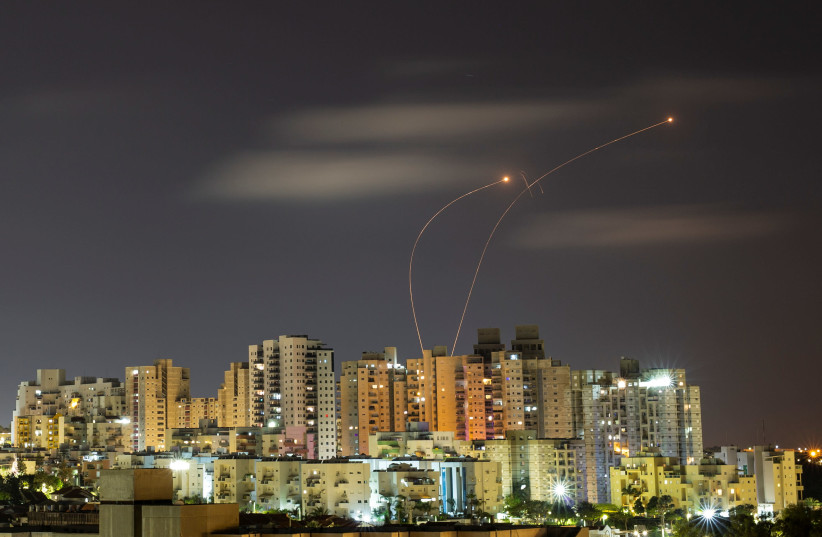
Streaks of light are seen from Ashkelon as the Iron Dome anti-missile system intercepts rockets launched from the Gaza Strip on May 20, 2021. / (photo credit: AMIR COHEN/REUTERS)

On Monday, Prime Minister Naftali Bennett spoke at the Knesset. He was met by a volley of yelling, heckling and name calling.

“Let’s talk about the results [of the last government],” he said. “In Gaza, you showed restraint in face of rocket attacks while we attack for every incendiary balloon. You left Hezbollah with ten times more rockets that can reach any place in Israel and because of that the defense budget needs to be big.”

Bennett was not wrong. Benjamin Netanyahu returned to the premiership in 2009, three years after the Second Lebanon War. At the time, Hezbollah had an estimated 30 or 40 thousand rockets. Nowadays, they are believed to have over 150,000.

Was it Netanyahu’s fault? That is questionable, but there is no doubt that under his tenure Israel made a conscious decision not to launch a preemptive strike to stop the Iranian proxy’s military buildup. Israel allowed the armament to go on even though it knew that the rockets were intended to be used one day against it.

For the most part, the decision was in line with Israeli military doctrine. Israel has not launched preemptive action to stop a conventional military buildup; that has been reserved for two instances when Iraq (1981) and Syria (2007) were pursuing nuclear weapons. Nuclear, yes. Regular rockets, no.

What Bennett will learn though is that it is easy to talk but harder to act. This is despite the fact that one of the senior members of his coalition and security cabinet, Justice Minister Gideon Sa’ar, is a longtime proponent of preemptive action against Hezbollah.

In 2018, Sa’ar warned that Israel had a narrow window to attack Hezbollah to prevent it from obtaining precision-guided munitions.

This is all important to keep in mind following Hezbollah’s rocket attack against Israel on Friday. The barrage of about 20 rockets came just two days after three rockets were launched toward Kiryat Shmona. The difference was that the rockets on Wednesday were said to have been fired by a rogue Palestinian group. On Friday, Hezbollah openly took responsibility.

Israel’s response until now has been mild. After Wednesday’s attack, the Air Force bombed open areas in southern Lebanon from where the rockets had been fired. After Friday’s barrage, Israel responded with artillery fire in the direction of the source of the fire. By Saturday night, that seemed to be it.

This is dangerous and complicated. IDF Spokesperson Brig.-Gen. Ran Kochav went so far as to explain that the fact Hezbollah fired its 20 rockets into open fields meant that the Lebanese terrorist group was deterred and scared of a larger conflict with Israel. If that wasn’t the case, he told reporters in a briefing on Friday, it would have attacked population centers.

Is this true? We don’t know. What we do know, is that it is a dangerous way to think since it sets up Israel to allow its northern border to turn into the way things are along the border with Gaza. There, for years, Israel restrained itself after rocket attacks. If it responded, it hit sand dunes or makeshift Hamas observation posts. Nothing too serious.

This normalized rocket fire into sovereign Israel. As long as no one was hurt or killed and as long as the rocket fire was sporadic, Israel could restrain itself. Did it make sense? Maybe. Did it also erode Israel’s deterrence? Definitely.

That is happening along the northern border as well. Kochav’s comment could be interpreted as normalizing rocket fire now from Lebanon. No one was killed and no one was hurt so that must mean that Hezbollah is deterred.
Not necessarily. What comments like Kochav’s potentially do when coupled with a mild military response, is create for Hezbollah a feeling that it – like Hamas – can normalize rocket attacks against Israel’s North.

This would be disastrous for Israel but difficult to stop. Too strong a response could lead to a larger escalation – something Israel does not want – while too weak a response could lead Hezbollah to learn a bad lesson, something Israel also does not want.

That right balance of how to respond and is going to be hard to find. Based on Friday’s events, the government needs to do so fast.


Zawartość publikowanych artykułów i materiałów nie reprezentuje poglądów ani opinii Reunion’68,
ani też webmastera Blogu Reunion’68, chyba ze jest to wyraźnie zaznaczone.
Twoje uwagi, linki, własne artykuły lub wiadomości prześlij na adres:
webmaster@reunion68.com


News From Israel- August 08, 2021

News From Israel- August 08, 2021

ILTV Israel News


Tensions in the north between Israel and Lebanese terror group, Hezbollah, get heavier

New covid regulations enter into force

A Galilee ice creamery shows how you’re supposed to advocate for peace


Zawartość publikowanych artykułów i materiałów nie reprezentuje poglądów ani opinii Reunion’68,
ani też webmastera Blogu Reunion’68, chyba ze jest to wyraźnie zaznaczone.
Twoje uwagi, linki, własne artykuły lub wiadomości prześlij na adres:
webmaster@reunion68.com