
Archives

Archaeologists find part of Jerusalem’s wall destroyed ahead of 9th of Av

Archaeologists find part of Jerusalem’s wall destroyed ahead of 9th of Av

ROSSELLA TERCATIN


The section of the wall that was exposed. (photo credit: KOBI HARATI/CITY OF DAVID)
A section of Jerusalem’s city wall built some 2,700 years ago and mostly destroyed by the Babylonian army in 586 BCE was uncovered by archaeologists in the City of David National Park, the Antiquities Authority (IAA) announced Wednesday.
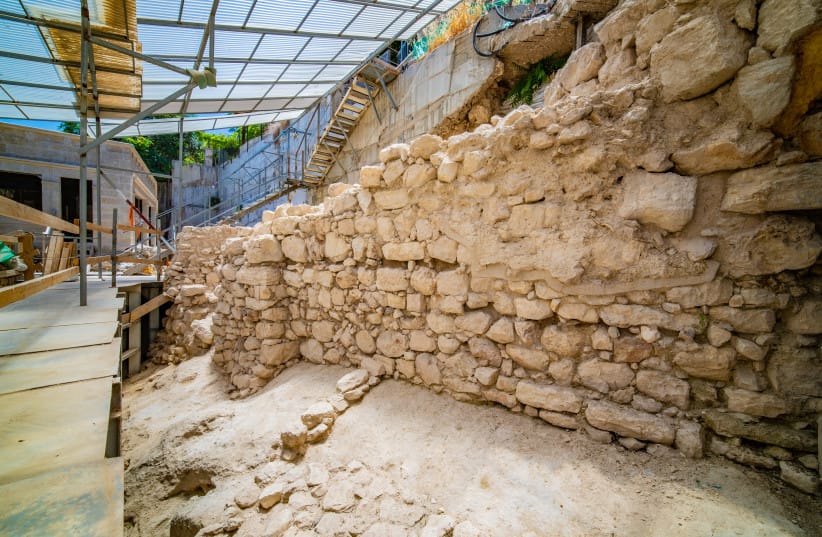
The massive structure – some 5 m. wide – was built on the steep eastern slope leading to the city, just a few dozen meters away from the Temple Mount.

Probably the steepness of the area preserved the structure from destruction during the Babylonian conquest – a vivid account of which is offered in the Bible – since the invading army likely accessed the city from an easier path.

“By the ninth day [of the fourth month] the famine had become acute in the city; there was no food left for the common people. Then [the wall of] the city was breached…. On the seventh day of the fifth month – that was the 19th year of King Nebuchadnezzar of Babylon – Nebuzaradan, the chief of the guards, an officer of the king of Babylon, came to Jerusalem. He burned the House of the Lord, the king’s palace, and all the houses of Jerusalem; he burned down the house of every notable person,” reads the last chapter of the Book of Kings II.
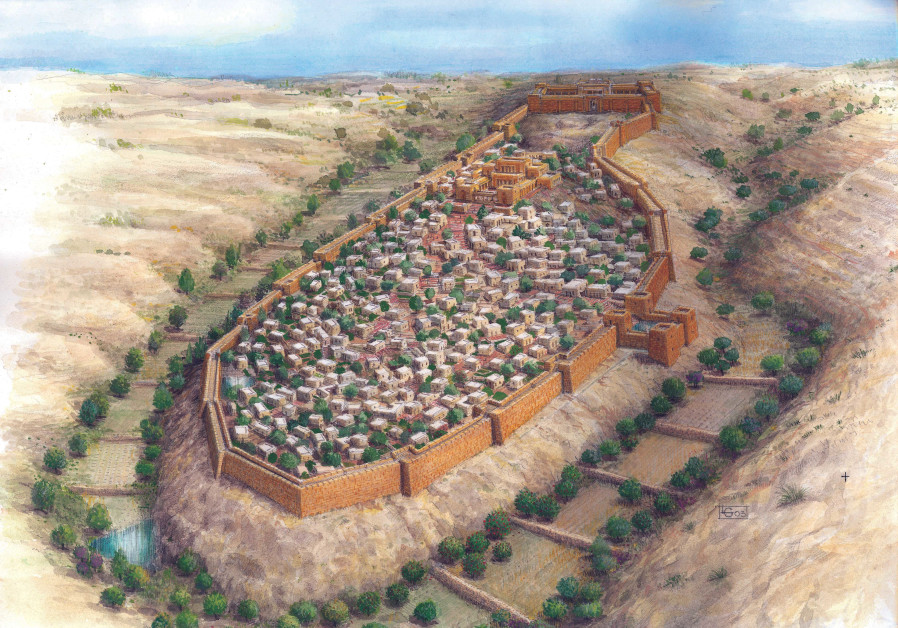
The walls of the city of Jerusalem in the days of the First Temple. (Credit: SHALOM KVELLER – COURTESY CITY OF DAVID ARCHIVE

For the archaeologist, uncovering the remains was very emotional, as related by Dr. Filip Vukosavovic of the Ancient Jerusalem Research Center, a codirector of the excavation with Dr. Joe Uziel and Ortal Chalaf on behalf of the IAA.

“When we exposed the first part of the wall, an area about 1 m. per 1 m. large, I immediately understood what we had found,” he said. “I almost cried.”

Indeed, the remains not only present an incredible testimony about centuries of life in Jerusalem and their tragic end but they also solved a decades-long archaeological mystery. During excavations in the area led by British archaeologist Kathleen Kenyon in the 1960s and by archaeologist Yigal Shiloh in the 1970s, remains of a massive wall were unearthed in two different spots of the slope. However, since the two structures did not appear to be connected, most scholars did not believe that they were part of a city wall, whose presence was described in the Bible but still needed to be proven by archaeological evidence.

“Now we can say with certainty that the city wall did exist, at least on the eastern slope,” Vukosavovic said. Since the eastern slope represented the most difficult approach to access Jerusalem, it is safe to assume that also the rest of the city was surrounded by a wall, he added.
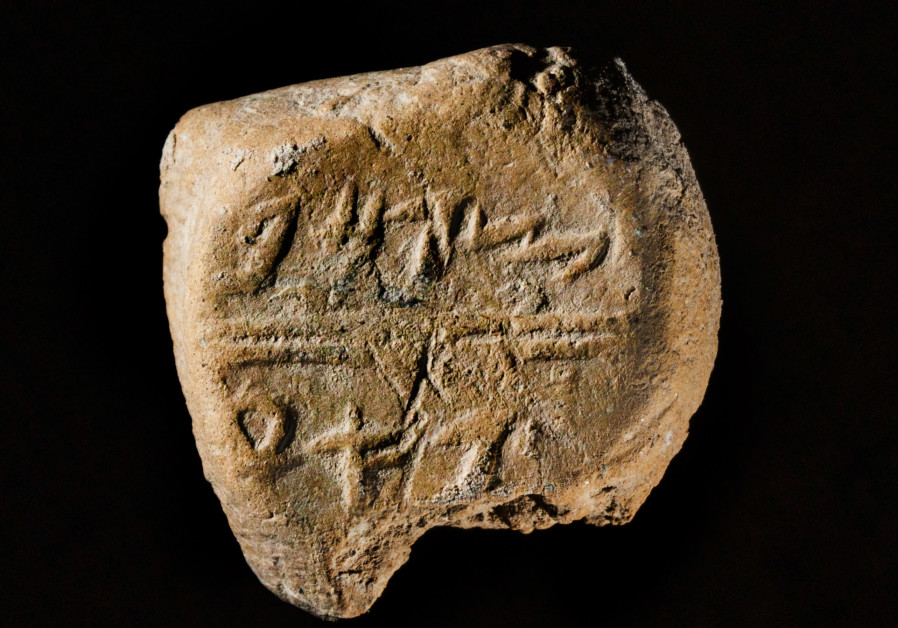
A stamp seal which bears the name “Tsafan” in ancient Hebrew script. (Credit: KOBY HARATI/CITY OF DAVID)

“The city wall protected Jerusalem from a number of attacks during the reign of the kings of Judah, until the arrival of the Babylonians who managed to break through it and conquer the city,” said Vukosavovic, Uziel and Chalaf.

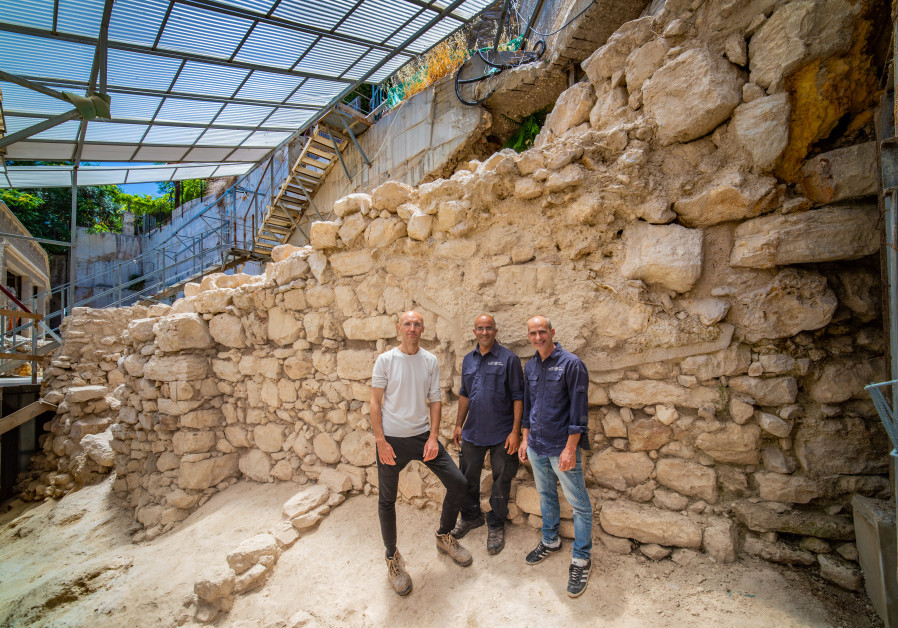
Excavation directors: Dr. Joe Uziel, Ortal Kalaf, and Dr. Filip Vukosavovic are standing by the exposed section of the wall. (Credit: KOBY HARATI/CITY OF DAVID)

While the newly uncovered section still has to be dated independently (“We are working on getting some radiocarbon dating,” Vukosavovic noted), the other two sections were built around the eighth century BCE, in a period also known as the First Temple period.

Behind the remains of the wall, the ruins of some houses are still visible.
“In one, we found ashes that we believe date back to the Babylonian invasion,” said Vukosavovic.
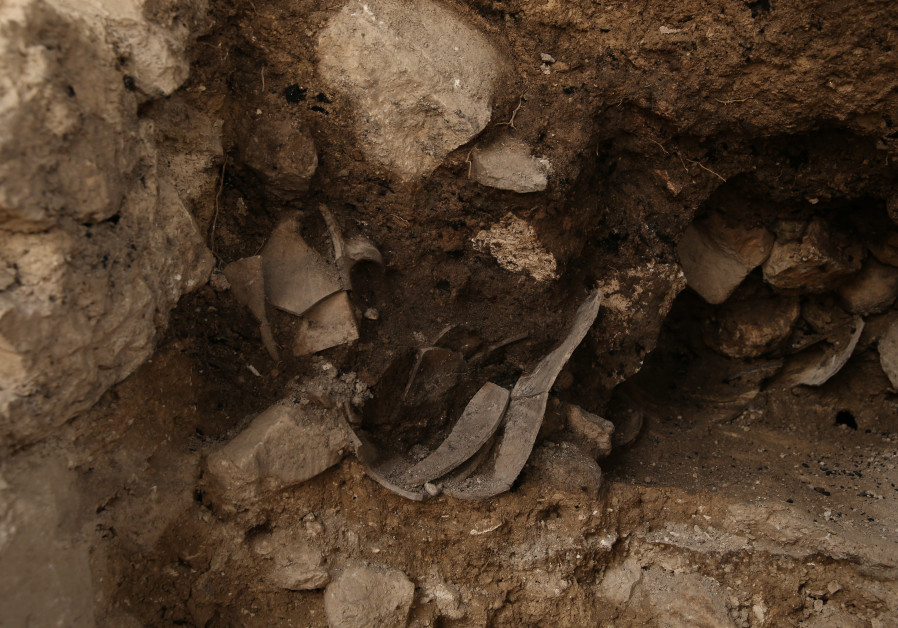
Remains of destruction discovered near the wall from previous excavations. (Credit: ELIYAHU YANAI/CITY OF DAVID ARCHIVES)

In addition, the archaeologists uncovered multiple artifacts that offer a glimpse into the daily life of Jerusalem when the wall was still standing, and after its fall in 586 BCE: fragments of pots, pans and other vessels, seal impressions, some of them carrying inscriptions – for example, “lamelech” (to the king), which was usually featured on jars used for tax collection. A small Babylonian seal stamp made in stone was also found.

“Maybe it was dropped by one of the soldiers, or maybe it belonged to a Jerusalemite who liked Babylonian-style objects, or maybe it dates back to a later period and was owned by those who lived in the city after its destruction,” Vukosavovic remarked.

WHILE THE wall on the eastern slope remained standing – to the point that centuries later it would be used as a foundation for new buildings – Jerusalem was burned down, the Temple destroyed, and the Jews sent into exile.

Similarly, this happened again some 500 years later – when the city was again thriving – this time at the hands of the Romans. The second destruction took place on the ninth day of Av, on the same date as the first. This year that day falls on this coming Sunday.

To this day, Jews all over the world fast and mourn the loss of Jerusalem, commemorating these days of war and destruction millennia ago, as witnessed by the archaeologists’ new finds of ancient white stones.


Zawartość publikowanych artykułów i materiałów nie reprezentuje poglądów ani opinii Reunion’68,
ani też webmastera Blogu Reunion’68, chyba ze jest to wyraźnie zaznaczone.
Twoje uwagi, linki, własne artykuły lub wiadomości prześlij na adres:
webmaster@reunion68.com

2,000-year-old basilica unearthed in Ashkelon


2,000-year-old basilica unearthed in Ashkelon

ROSSELLA TERCATIN


“The basilica was first discovered in the 1920s by British archaeologist John Garstang who then covered it once again,” said Dr. Rachel Bar Nathan, IAA director of excavation.

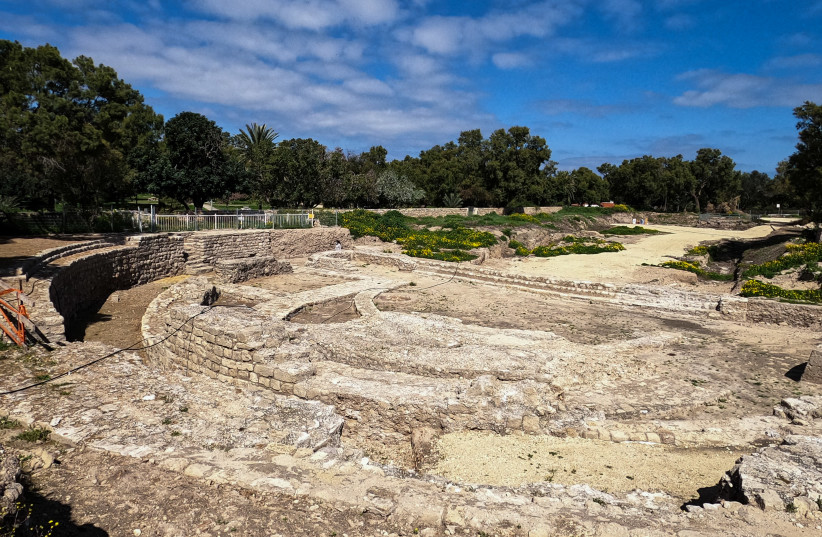
The Basilica and the Odeon Complex in the Tel Ashkelon National Park
(photo credit: YANIV COHEN/NATURE AND PARKS AUTHORITY)

The remains of a magnificent Roman basilica, the largest in Israel, have been uncovered in Ashkelon in an excavation conducted by the Antiquities Authority (IAA) within a development project of the Tel Ashkelon National Park and will soon be accessible to the public, the Israel Nature and Parks Authority (INPA) announced on Monday.

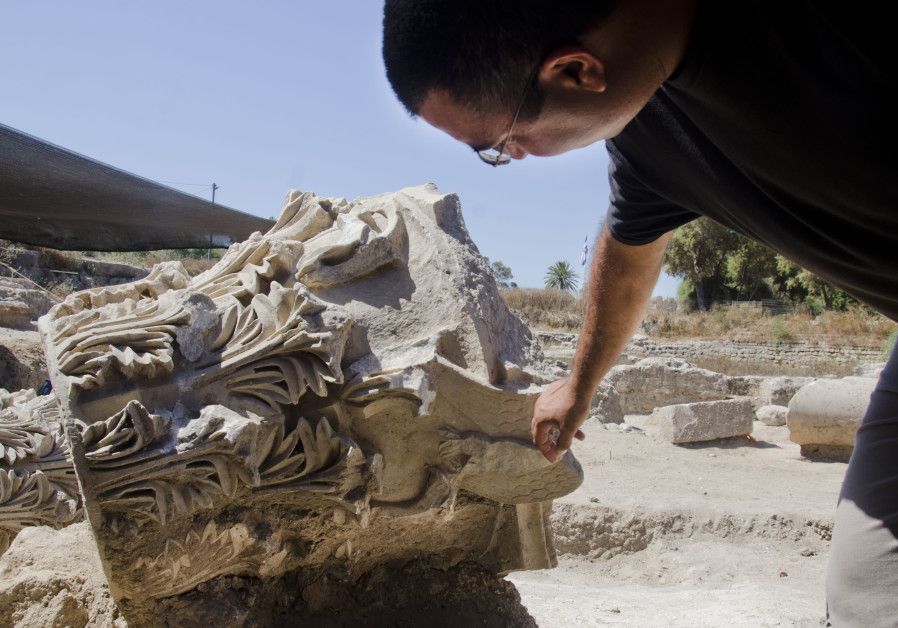
Located just a few meters from the seashore, the structure, a public building, was divided into three sections: a main hall and two side parts. According to the archaeologists, the main hall was surrounded by massive marble columns as high as 13 m. and ornate with elaborated capitals, featuring plant motifs and in some instances an eagle – a Roman symbol. Their remains offer an insight into the splendor of the original building.

“The basilica was first discovered in the 1920s by British archaeologist John Garstang who led an expedition on behalf of the Palestinian Exploration Fund and then covered the structure once again,” said Dr. Rachel Bar Nathan, IAA director of excavation together with Saar Ganor and Federico Kobrin.

Archaeologist Saar Ganor with a capital in Tel Ashkelon National Park. (Credit: YOLI SHWARTZ ISRAEL ANTIQUITIES AUTHORITY)

The area would not be excavated again for almost a century, until a few years ago the works started one more time, in the years 2008-2012 and then in 2016-2018, when the INPA decided to develop the area and reconstruct part of the colonnade.

Among other things, a small odeon (theatre) was uncovered during the works.

“Garstang had already calculated the dimensions of the building, and seeing the remains of the marble columns, made with materials imported from Asia Minor, he had suggested that the basilica dated back to the time of King Herod the Great, since historian Josephus described how the king built a colonnaded hall and other structures in the city,” Bar Nathan said.

Appointed by the Romans as king of Judea in the second half of the 1st century BCE, Herod was known for the extensive construction and restoration works that were carried out around the land on his behalf, including the complete rebuilding of the Temple of Jerusalem.

“Our project started in 2016,” Bar Nathan said. “When we excavated the basilica we realized that while the original structure did date back to the time of Herod, as Garstang thought, the more grandiose elements, the marbles, the columns, were built later, around the 2nd-3rd century CE, the time of emperor Septimius Severus style.”

The archaeologists found some Herodian coins at the site.

Several massive marble sculptures from Severus’s era were also found, some of them portraying pagan gods, including Isis – an Egyptian deity depicted as Tyche, the city’s goddess of fortune – and Nike, the goddess of victory.

When Herod ruled over Judea, Ashkelon was a free city and a renowned trade port. A Jewish population lived there but did not represent the majority. Later, Ashkelon became a Roman city.

In Roman times, the basilica was not a religious building, but rather a public building in the center of the city used for commerce, court cases and other civic functions. In the following centuries, Christian churches would be inspired by this architectural structure.

An earthquake destroyed Ashkelon and the basilica in 363 CE. Its remains would be reused in the Abbasid and Fatimid periods – 8th-12th centuries CE – to build industrial installations in the area.

An operation to preserve and restore the complex, including the basilica and the theater, is currently being carried out by the IAA as part of a joint project by the INPA, the Ashkelon Municipality and the Leon Levy Foundation to develop the area and make it accessible to the public.
The organizations are also working on a new itinerary for visitors, touching all the main attractions in Tel Ashkelon, including an arched Canaanite gate.

“The Tel Ashkelon National Park combines a fascinating antiquities site with unique natural resources characteristic of the dunes in the coastal plain,” Shaul Goldstein, CEO of the INPA, said in a press release. “It was the first national park to be declared in Israel in the 1960s and since then, it has been constantly evolving and renewing for the benefit of visitors from all over the country.”


Zawartość publikowanych artykułów i materiałów nie reprezentuje poglądów ani opinii Reunion’68,
ani też webmastera Blogu Reunion’68, chyba ze jest to wyraźnie zaznaczone.
Twoje uwagi, linki, własne artykuły lub wiadomości prześlij na adres:
webmaster@reunion68.com


JEWISH PIONEERS RETURNING TO ALL “QUARTERS” OF JERUSALEM’S OLD CITY

JEWISH PIONEERS RETURNING TO ALL “QUARTERS” OF JERUSALEM’S OLD CITY

David Mark


While today is the traditional day for mourning over the First and Second Temples in Jerusalem and many other calamities, it is becoming clear that what happened in 1967 was only the beginning of the return to Jerusalem.
.

.
In the fifty plus years since Jerusalem’s liberation, young Jewish pioneers have returned to live across all of Jerusalem’s Old City. These pioneers are not “colonists” as the world wants to claim, but returnees.

Before the Arab pogroms of the 1920s and 1930s there was a Jewish majority in Jerusalem. Jews in fact lived across the entire Old City in what is now considered the Muslim and Christian Quarters

So how is it that today’s pioneers are so successful in reversing the Jewish exile from the Old City?

Faith.

Organizations like Ateret Cohanim, Ir David, Heritage House, and others are leading the way as a driving force in helping to connect, return, and develop Jewish neighborhoods throughout the Old City and Holy Basin.

Through education, purchases, and community activities, old Jewish neighborhoods where Jews were driven out are now resettled. Historical landmarks like Beit Wittenberg where Mark Twain stayed and the Old Yemenite Shul in Kfar Shiloach (today called Silwan) have been returned and restored.

So have we won? Have we liberated to the point where we no long have to cry and fast on Tisha B’Av. Not yet, but we are well on our way.


Zawartość publikowanych artykułów i materiałów nie reprezentuje poglądów ani opinii Reunion’68,
ani też webmastera Blogu Reunion’68, chyba ze jest to wyraźnie zaznaczone.
Twoje uwagi, linki, własne artykuły lub wiadomości prześlij na adres:
webmaster@reunion68.com


Palestinian Conflict Won’t Change Arab-Israel Normalization

Palestinian Conflict Won’t Change Arab-Israel Normalization

Ahmed Quraishi


Bahraini Foreign Minister Abdullatif bin Rashid Al Zayani, Israeli Prime Minister Benjamin Netanyahu and United Arab Emirates Foreign Minister Sheikh Abdullah bin Zayed Al Nahyan display their copies of signed agreements while US President Donald Trump looks on, at the signing ceremony of the Abraham Accords, at the White House in Washington, DC, Sept. 15, 2020. Photo: Reuters / Tom Brenner.

A future Gaza war will not derail Arab-Muslim normalization with Israel. The theory that Palestinian-Israeli peace dictates Israel’s wider acceptance in the Arab and Muslim region no longer holds true. The Palestinian conflict remains significant, but does not preclude Israel’s integration into the Arab-Muslim expanse around it.

The direst prediction of them all — the death of the Abraham Accords after the latest Gaza war — never came close.

On the contrary, a stream of actions involving major Muslim nations, stretching from Kazakhstan to Egypt, and from Sudan to Morocco, immediately after the recent escalation, indicate subtle shifts in the dynamics of the Arab-Israeli conflict. The biggest one could be the decoupling of the Palestinian-Israel peace process and Israel’s wider regional relations.

The United Arab Emirates has just received the first Israeli foreign minister in Abu Dhabi. Eight Muslim nations and Israel were part of the US-led Sea Breeze military drills in the Black Sea recently. The Muslim nation of Kazakhstan, a member state of the Organization of Islamic Cooperation (OIC), dedicated a memorial to Jews just days after the recent Gaza war. And that war was still raging when Sudan reaped the fruits of its normalization with Israel (among other positive policies), through international debt-relief commitments in Paris on May 17.

A week later, President Ilham Aliev celebrated “the strong ties” between Azerbaijan and Israel, and proudly declared that Baku has “full access to sophisticated Israeli weaponry.” Egypt sent the first invitation in 13 years to an Israeli foreign minister to visit Cairo.

In March, OIC membership applicant Kosovo became the first Muslim nation to move its embassy to Jerusalem. When Gaza erupted two months later, Kosovo did not reconsider. Nor did the OIC or any member state take significant punitive action against Israel. [The multilateral organization did slap Kosovo on the wrist for that move, though].

There is also Bangladesh — days after the Gaza ceasefire — removing the Israel exclusion from its passport and telling the Palestinian ambassador: “We are a sovereign country; we will decide what to do.” Although the country has no diplomatic ties with Israel, the timing of the gesture is important.

Normalization is here to stay, and Israel is no longer the enemy in many strategic circles across the wider Middle East. Predictions of the Abraham Accords’ demise were premature. Hamas and Iran, and a long list of right-wing parties, leftist nationalists, and populist leaders (like President Erdogan in Turkey and Prime Minister Imran Khan in Pakistan) find few buyers in the region for their anti-normalization pitch.

Perceptions about Israel changed between 2011 and 2020 in regional national security circles. Israel’s reputation in technology, its precision strikes in Syria, the role of its weaponry in the Nagorno-Karabakh war, and its alleged covert actions on Iran’s nuclear program have had the combined effect of forcing some policy planners in the region to see a robust Israeli role in collaborative regional security.

In interviews with two security officials in two countries neighboring Iran in January and May last year, they said that they indirectly rely on Israel to counter Iran’s influence, which they believe they cannot do alone. Officials in the region will not say this openly, but journalists have heard variations of this view from government, military, and intelligence officials in background briefings within the past five years.

But a word of caution: Israel should not stretch its luck.

While the dynamics have changed, a repeat of the Gaza conflict, renewed unrest in Jerusalem, and fresh images of Palestinian women and children scuffling with strong-looking, impressively attired Israeli soldiers will strain the luck of Israel’s many good friends in the region, empower hard-liners, and could slow new ties.

But if Israel shows its new friends that it can deftly handle the conflict with the Palestinians, then it can expect help from its new support network in the region to pressure Palestinian leaders to enact necessary reforms, focus on opportunities for young Palestinians, and shun violence. The idea that Arabs should nudge Palestinians toward moderation is another brewing trend in moderate Arab countries that has the potential to change the Arab approach toward the Palestinian issue, depending again on how Israel plays its cards.


Ahmed Quraishi a journalist who covers national security issues in the MENA region. Twitter @_AhmedQuraishi


Zawartość publikowanych artykułów i materiałów nie reprezentuje poglądów ani opinii Reunion’68,
ani też webmastera Blogu Reunion’68, chyba ze jest to wyraźnie zaznaczone.
Twoje uwagi, linki, własne artykuły lub wiadomości prześlij na adres:
webmaster@reunion68.com

Israeli Model Set to Star in New Music Video From Latin Singer Maluma Alongside Scott Disick

Israeli Model Set to Star in New Music Video From Latin Singer Maluma Alongside Scott Disick

Shiryn Ghermezian


Eden Fines on the cover of the May 2020 issue of Harper’s Bazaar Vietnam. Photo: ITM Models.

Israeli model Eden Fines will be featured in a new music video from Latin pop singer Maluma, it was announced Monday during the Israeli television show “Good Evening with Guy Pines.”

The Yemenite-Turkish model flew to Miami in June to film scenes for the music video, in she will play part of a love triangle with Maluma and his friend, “Keeping Up With the Kardashians” star Scott Disick.

Fines, who is studying naturopathy, has been featured on the covers of Harper’s Bazaar VietnamGlamour Bulgaria and Cosmopolitan Mexico. She previously starred in Israeli singer Moshe Peretz’s music video for “Caramela,” and was on the Israeli reality show “It Girls.”

This is not the first time that Maluma has included an Israeli model in one of his music videos. In 2019, Rishon Lezion native Neta Alchimister starred in the music video for his song “HP.”


Zawartość publikowanych artykułów i materiałów nie reprezentuje poglądów ani opinii Reunion’68,
ani też webmastera Blogu Reunion’68, chyba ze jest to wyraźnie zaznaczone.
Twoje uwagi, linki, własne artykuły lub wiadomości prześlij na adres:
webmaster@reunion68.com