Archives

Tom Friedman’s Latest Stratagem Is Having US Taxpayers Subsidize Syria’s Assad

Tom Friedman’s Latest Stratagem Is Having US Taxpayers Subsidize Syria’s Assad

Ira Stoll


New York Times columnist Thomas Friedman. Photo: Charles Haynes via Wikimedia Commons.

New York Times columnist Thomas L. Friedman floats an unconventional idea in his latest article: having the US pay the Syrian dictator, Bashar al-Assad, to kick Iran out of Syria.

Here’s how Friedman frames it: “I have an idea: One way to defuse the tension between the US and Israel would be for Biden to attempt a radical new diplomatic initiative — a leveraged buyout of the Iranian presence in Syria.”

The Times columnist writes that “Biden and the gulf Arab states could go to the Russians and Assad with this offer: Kick out the Iranian forces from Syria and we will triple whatever financial aid Iran was giving Syria, and we’ll tacitly agree that Assad (though a war criminal) can stay in power for the near term.”

Friedman acknowledges that the idea would be “cynical,” but contends, “Israel’s military would back this deal, because breaking the Syrian land bridge that Iran uses to keep Hezbollah supplied with rockets would be a game-changer.”

Friedman’s column doesn’t give a dollar amount, but a May 2021 report from the Atlantic Council said, “Experts place the Islamic Republic’s annual support for Assad’s war at $15 billion per year.” Triple that would be $45 billion a year, or more than 11 times annual US aid to Israel. That would indeed be a “game changer,” though perhaps not exactly in the way Friedman means it.

Just how bad an idea is it to drop $45 billion a year on Bashar Assad’s Syria? Let us count the ways.

First, Syria has a history of breaking its promises. The US government says the Syrian regime has used chemical weapons such as sarin and chlorine 50 times since Damascus joined the Chemical Weapons Convention in 2013. There’s no reason to believe Syria would keep any promises it makes to kick Iran out.

Second, it contradicts the stated Biden policy of emphasizing human rights. As Elliott Abrams recently wrote in a different context, “Recall what Secretary of State Blinken said when he announced this year’s State Department Country Reports on Human Rights Practices: ‘President Biden has committed to putting human rights back at the center of American foreign policy, and that’s a commitment that I and the entire Department of State take very seriously.  We will bring to bear all the tools of our diplomacy to defend human rights and hold accountable perpetrators of abuse.’”

Syria is a major human rights abuser. According to the State Department:

Significant human rights issues included: unlawful or arbitrary killings by the regime; forced disappearances by the regime; torture, including torture involving sexual violence; harsh and life-threatening prison conditions, including denial of medical care; prolonged arbitrary detention; political prisoners and detainees; serious problems with the independence of the judiciary; arbitrary or unlawful interference with privacy; serious abuses in internal conflict, including aerial and ground attacks impacting civilians and civilian infrastructure including schools, markets, and hospitals; serious restrictions on free expression, including restrictions on the press and access to the internet, censorship, and site blocking; substantial suppression of the rights of peaceful assembly and freedom of association; undue restrictions on freedom of movement; inability of citizens to change their government peacefully through free and fair elections, including severe restrictions on political participation; high-level and widespread corruption; lack of investigation of and accountability for violence against women; coerced abortion; unlawful recruitment and use of child soldiers by the regime and other armed actors; trafficking in persons; violence and severe discrimination targeting lesbian, gay, bisexual, transgender, and intersex persons; existence and use of laws criminalizing consensual same-sex sexual conduct between adults; and severe restrictions on workers’ rights.

American policy should punish or change this sort of behavior, not reward it.

Third, it’s legally difficult. Syria is designated under American law as a state sponsor of terrorism. Section 620A of the Foreign Assistance Act of 1961 as amended forbids the US government from providing foreign aid “to any country if the Secretary of State determines that the government of that country has repeatedly provided support for acts of international terrorism.” There’s a provision for the president to waive that restriction if “national security interests” justify it, but it’s not at all clear that in this case such a waiver would be legally justified.

Fourth, tripling Iranian aid to Syria might create a bidding war. What’s to stop China from coming along and offering Syria four times what Iran was paying to achieve whatever its local goals are? It just sets up an auction.

Fifth, Syria would get rewarded yet another time for fulfilling obligations it or its proxies are already bound to under various previous agreements, such as the Taif Accords and United Nations Security Council Resolution 1559.

Sixth, the key issue is less the Iranian forces in Syria than in Lebanon. They can be resupplied by other, non-Syrian means, or manufacture their own missiles. The recent Gaza example shows that an Iranian-backed terrorist force can rain rockets down on Israel without a land bridge. Remember, Gaza is “blockaded.” If not even Israel and Egypt can prevent Gaza terrorists from building missiles and rockets, why would Friedman expect that Syria can or would prevent terrorists in neighboring Lebanon from building rockets?

Seventh, the Friedman-Bribe-Syria plan extends the logic of rewarding terrorist bad behavior from the Iran nuclear deal to Syria, again in exchange for minimal promises. Would Syria make peace with Israel? Cede its claim to the Golan Heights or to Shebaa Farms? Become a democracy? Cease harboring terrorists not only from Hezbollah but also from other terrorist groups such as the PKK, Al Qaeda, and ISIS? Stop using chemical weapons on its own population? Release US hostages such as Austin Tice? Or does Assad claim the $45 billion a year cash bonanza up front merely by promising to cut off Iranian land bridge, and does the US only then begin negotiating on the “longer, stronger” front, on the model of the Iran nuclear deal, where the US front-loads all its concessions in exchange for imaginary future progress?

Eighth, Friedman’s unsubstantiated claim that “Israel’s military would back this deal” is an odd one. Israel’s military is under civilian democratic control. This is a foreign policy question. What matters is not whether Israel’s military would back the deal but whether the Israeli public would. Nowhere in the new Israeli coalition agreement is it written that the parties are going to support $45 billion in financial aid to the Assad regime.

Finally, short of unleashing his full chemical weapons arsenal in a way that would make the “only children” of Gaza look like small potatoes in terms of collateral damage, it’s not even clear that Assad has the capacity to kick the Iranian forces out of Syria. Maybe with $45 billion of US taxpayer dollars he would. More likely, though, he’d use the ammunition and weapons purchased with those funds not on fighting or deterring Iran but rather on attacking Israel or his own internal political rivals. For the US and Israel, the Friedman-Bribe-Syria plan would be a bad risk.


Ira Stoll was managing editor of The Forward and North American editor of The Jerusalem Post. His media critique, a regular Algemeiner feature, can be found here.


Zawartość publikowanych artykułów i materiałów nie reprezentuje poglądów ani opinii Reunion’68,
ani też webmastera Blogu Reunion’68, chyba ze jest to wyraźnie zaznaczone.
Twoje uwagi, linki, własne artykuły lub wiadomości prześlij na adres:
webmaster@reunion68.com



WJRO condemns Polish parliament for draft bill on Holocaust restitution

WJRO condemns Polish parliament for draft bill on Holocaust restitution

JERUSALEM POST STAFF


The bill passed the Sejm on Thursday with 309 in favor and 120 abstained and must go to the Polish Senate for private approval.

.
The site of the former Nazi German concentration and extermination camp Auschwitz is pictured during the ceremonies marking the 75th anniversary of the liberation of the camp and International Holocaust Victims Remembrance Day, in Brzezinka near Oswiecim, Poland, January 27, 2020. / (photo credit: REUTERS/NORA SAVOSNICK)

The World Jewish Restitution Organization (WRJO) condemned the Polish Parliament for passing a draft bill introducing a statute of limitations on claims for the restitution of property.

This draft bill would severely limit any ability by Polish Jewish Holocaust victims to recover their stolen property. Poland is the only country in the European Union that has not legislated on property restitution, despite repeated calls to do so from the US.

The WJRO is calling for a withdrawal of the proposed bill that would make it nearly impossible to challenge decisions issued by the Communist authorities to expropriate Holocaust era private property, Jewish and non-Jewish owners alike.

“We urgently call upon Prime Minister Morawiecki and the Polish Government to address the issue of private property restitution in a just and timely manner,” said the Chair of Operations for the WJRO Gideon Taylor. “Both Jewish and non-Jewish claimants have waited decades for a measure of justice resulting from the confiscation or nationalization of their property during the Holocaust or by the Communist government.”

“The current proposal, if adopted, would further harm Polish Holocaust survivors who have already suffered so much,” Taylor added. “New, insurmountable legal conditions should not be imposed in 2021 that would make it impossible to recover property or receive just compensation.”

Additionally, the WJRO issued a letter to Polish Prime Minister Mateusz Morawiecki, who pledged that his country would not pay restitution to Holocaust survivors for German crimes committed against them on its territory during World War II.

“I can only say that as long as I am the prime minister, Poland will surely not pay for the German crimes. Not a zloty [PL currency], not a euro, not a dollar,” Morawiecki said on Friday.

The advancement of the bill heightened tensions with Israel on the issue, with Foreign Minister Yair Lapid warning that ties between the two strong allies could be harmed.

“No law will change history,” Lapid said. “The Polish law is immoral and will severely harm relations between the countries. Israel will stand as a bastion protecting the memory of the Holocaust and the dignity of Holocaust survivors and their property.”

“Poland, on whose ground millions of Jews were murdered, knows the right thing to do,” the foreign minister added.

The United States also spoke out against the bill.

“The decision of Poland’s s parliament yesterday was a step in the wrong direction. We urge Poland not to move this legislation forward,” the US State Department spokesman Ned Price said in a tweet on Friday.
Poland-Israel ties have been strained since 2018, after Poland passed a law penalizing those arguing that Poland or the Polish people were in any way responsible for the Holocaust.

Poland was home to one of the world’s biggest Jewish communities until it was almost entirely wiped out by the Nazis during World War II. Jewish former property owners and their descendants have been campaigning for compensation since the fall of communism in 1989.

In 2015, Poland’s Constitutional Tribunal ruled that there must be a deadline set, after which faulty administrative decisions on returning confiscated property can no longer be challenged. In March, a parliamentary committee proposed a bill to implement that ruling, with deadlines ranging from 10-30 years. Critics say that would put a time limit on requests for restitution.

The draft bill passed the Sejm on Thursday with 309 in favor and 120 abstained and must go to the Polish Senate for private approval.

Polish Deputy Foreign Minister Pawel Jablonski said on Friday morning in a tweet that Lapid’s statement is “marked by bad will, and above all, a deep ignorance of the facts. The Israeli Foreign Ministry declined to comment on Jablonski’s tweet.

“Poles, like Jews, were victims of terrible German crimes,” Jablonski tweeted. “The act passed in the Sejm [lower house of parliament] protects the victims of these crimes and their heirs against fraud and abuse. It is the implementation of the judgment of the Constitutional Tribunal of 2015. As a result of wild re-privatization… many people were deprived of their possessions.”

Blocking the law would be an injustice in which Israel should not be a part, Jablonski added.

Lapid said that preserving the memory of the Holocaust and taking care of survivors, which includes property restitution, is an important part of Israel’s identity and the Foreign Ministry’s actions.

“This is a moral and historic responsibility that we proudly carry,” he stated.

Lapid added that he expects countries to act to return Jewish property that was confiscated during the Holocaust.

“The Polish law, which effectively prevents restitution of Jewish property or compensation in exchange for it, is a terrible injustice and shamefully harms the rights of Holocaust survivors and their descendants, which came from Jewish communities that lived in Poland for hundreds of years,” he stated.


Zachary Keyser, Lahav Harkov and Tovah Lazaroff contributed to this report.


Zawartość publikowanych artykułów i materiałów nie reprezentuje poglądów ani opinii Reunion’68,
ani też webmastera Blogu Reunion’68, chyba ze jest to wyraźnie zaznaczone.
Twoje uwagi, linki, własne artykuły lub wiadomości prześlij na adres:
webmaster@reunion68.com

4,000-year-old Syrian monument contains remains of soldiers killed in war

4,000-year-old Syrian monument contains remains of soldiers killed in war

JERUSALEM POST STAFF


The monument, located at the site of Banat-Bazi in Syria, resembles the Ancient Egyptian Stepped Pyramid of Saqqara which was around the same size but made of dirt instead of stone.

saqqara pyramid 298.88
(photo credit: Courtesy)

A 4,000-year-old war memorial dating back to 2,4000 BCE in Syria was built to honor soldiers who died in battle, a new study shows.

The memorial is known as the White Monument due to the white sheen it was given by the materials used to build it. It was first excavated several years ago and has now been the focus of a new study to determine the purpose for which it was built.

The White Monument is 22 meters in height and 100 meters in diameter. The white sheen over it is caused by erosion washing down the sides of the monument, which were constructed using gypsum and marl, both calcium and carbon rich materials.

While texts dating back to the third century BCE have long suggested that burial mounds made up of enemy corpses were a Mesopotamian symbol of victory, no such examples have been discovered to date, and archeologists originally thought that this may be one such monument.

However, further research revealed that the monument, built above layers of carefully buried adult males, may have been a memorial to the community’s dead, rather than a symbol of victory over the enemy.

“These findings not only challenged some of the excavators’ assumptions, but also some traditional underpinnings of Near Eastern archaeology,” said Professor Anne Porter from the University of Toronto.

The monument, located at the site of Banat-Bazi in Syria, resembles the Ancient Egyptian Stepped Pyramid of Saqqara which was around the same size but made of dirt instead of stone.

The dead appear to have been buried in a specific pattern and according to ritual, research suggests. Each of the dead was buried alongside his military gear, jewelry, and sometimes with the skins of a kunga, a donkey-like animal often depicted pulling chariots. Some of the corpses were buried in pairs and some alone. According to Porter, the pairs buried with kunga skins may have been chariot teams.

While at first it was thought to be a simple mass grave, excavations revealed that the bodies had been deliberately and intentionally buried, and this decision pointed to the monument having been erected by the surviving members of the communities that they had died fighting for.


Zawartość publikowanych artykułów i materiałów nie reprezentuje poglądów ani opinii Reunion’68,
ani też webmastera Blogu Reunion’68, chyba ze jest to wyraźnie zaznaczone.
Twoje uwagi, linki, własne artykuły lub wiadomości prześlij na adres:
webmaster@reunion68.com

Humans, neanderthals coexisted in the Negev desert 50,000 years ago

Humans, neanderthals coexisted in the Negev desert 50,000 years ago

IDAN ZONSHINE


The study also found that Boker Tachtit is the earliest known migration point from Africa for early Homo Sapiens (humans) from the Levant region.

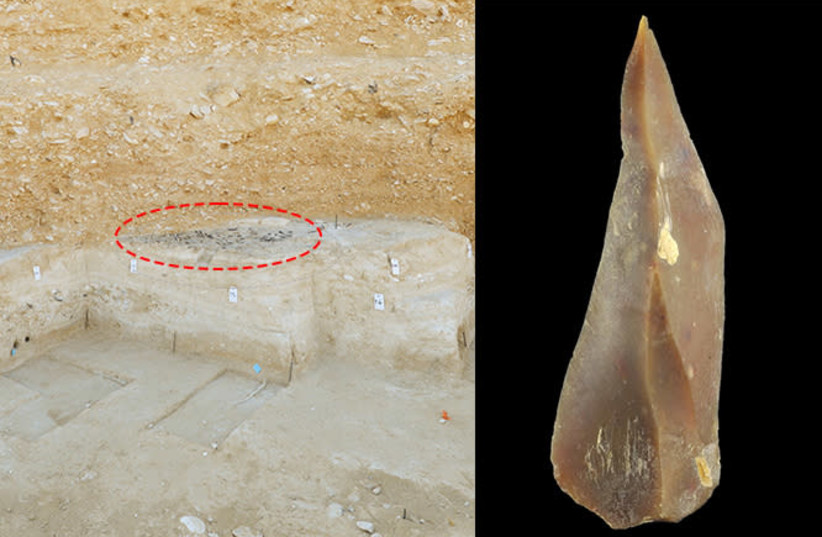
(L-R) View of the Boker Tachtit excavation site. Circled: a group of unearthed flint stone artifacts; Flint point representative of the Upper Paleolithic in Boker Tachtit. /  (photo credit: CLARA AMIT ISRAELI ANTIQUITIES AUTHORITY)

A recent reexamining of artifacts from the Boker Tachtit archaeological excavation site in Israel’s central Negev desert has found that humans likely coexisted with neanderthals around 50,000 years ago.

The study also found that Boker Tachtit is the earliest known migration point from Africa for early Homo Sapiens (humans) in the Levant region.

The study, which was published on Monday in the Proceedings of the National Academy of Sciences scientific journal, was led by researchers from the Weizmann Institute of Science and the Max Planck Society, Prof. Elisabetta Boaretto, together with Dr. Omry Barzilai of the Antiquities Authority (IAA).

“Boker Tachtit is the first site outside of Africa, which modern man penetrated on his way to the rest of the world, hence the importance of the site, as well as the importance of dating it accurately,” Dr. Barzilai, director of excavation at the Boker Tachtit site on behalf of the IAA, said in a statement.

“The age of the site as dated in the study – 50,000 years – indicates that modern man existed in the area of the Negev at the same time as the Neanderthal man, who is known to have lived in it during this period,” he said. “There is no doubt that the two species, who lived and roamed the Negev, were aware of each other’s existence.”

“Our research Boker Tachtit site places an important and unequivocal point of reference on the timeline of human evolution,” he concluded.

According to the “recent African origin” theory, Homo sapiens originated in Africa as early as 270,000 years ago and at different times took either the northern route to Eurasia, passing through the Levant, or several possible southern routes to remote corners of Asia and even Oceania – reaching as far as Australia by land.

DNA research shows that the migration of modern human groups began from Africa to Asia and Europe, and from there to the rest of the world about 60,000 years ago, caused Neanderthals to disappear and assimilate into the modern human population.

During the Middle Paleolithic period (50,000-250,000 years ago), two different species of man lived in the world at the same time: Neanderthal man and modern man.

Neanderthal man lived in Europe and Central Asia, while modern man lived in Africa. The Middle East and Israel in particular were the distribution limits of these species, so they also contain remnants of the two populations at different time periods.

Boker Tachtit, which is located in the Wadi Zin basin in what today is known as the Ein Avdat National Park, is considered a key site for tracing this migration out of Africa.

It is considered a major site in the Levant for documenting an important period in humankind’s prehistory: the transition from a predominantly Neanderthal prehistorical culture to the beginning of modern humans’ reign (Middle to Upper Paleolithic).

This transition was marked by technological innovations such as blade production and the introduction of standardized tools made from bones and antlers.

American archaeologist Anthony Marks, who first excavated and published his analysis of Boker Tachtit in the early 1980s, defined the site as a transitional industry from the Middle to the Upper Paleolithic and, based on a single radiocarbon date, concluded that it dates to 47,000 years ago.
The problem was, however, that additional dates obtained from the site, some reaching as late as 34,000 years ago, made the timing of the transition very problematic.

“If we are to follow this timeline, then the transitional period could have lasted more than 10,000 years, and yet artifacts excavated from northern sites in Israel, Lebanon and even Turkey suggest that the transition occurred much faster,” says Boaretto, who heads D-REAMS – The Dangoor Research Accelerator Mass Spectrometry – Laboratory at the Weizmann Institute, which specializes in advanced archaeological dating methods.
“Marks managed to date only a few specimens from Boker Tachtit, owing to the limitations of radiocarbon dating then, and the range of his proposed dates is not consistent with evidence gathered from other – old and new – excavation sites in the region,” Boaretto says. “Radiocarbon dating, the method that he used in his study, has evolved tremendously since his time,” she said.

To resolve these questions, Boaretto, Barzilai and their multidisciplinary team performed advanced dating methods on specimens obtained from Boker Tachtit during the new excavations that they performed in 2013–2015.
These methods included the latest techniques, such as high-resolution radiocarbon dating of single charcoal pieces found at the site and optically stimulated luminescence-dating of quartz sand grains, performed at the Weizmann Institute and at the Max Planck Institute, respectively.
The researchers also integrated detailed studies of the sediments, using micro-archaeological methods to understand how the site was formed physically, and to contribute necessary data for the construction of its chronological framework.

“We are now able to conclude with greater confidence that the Middle-to-Upper Paleolithic transition was a rather fast-evolving event that began at Boker Tachtit approximately 50-49,000 years ago and ended about 44,000 years ago,” says Boaretto.

This dating allows for a certain overlap between the transition that occurred at Boker Tachtit and that of the Mediterranean woodland region (Lebanon, Turkey) between 49,000 and 46,000 years ago.

“The dating results prove – for the first time in prehistoric research – the hypothesis that there was indeed an overlap in space between the late Mostar culture, identified with Neanderthal man, and the Emirite culture, linked to the emergence of modern man in the Middle East,” Barzilay said.
Still, it shows that Boker Tachtit was the earliest site for this transition in the Levant, and that, based on the materials found, is a testimony to the last dispersal event of modern humans from Africa.

According to the new dating scheme, the early phase at Boker Tachtit also overlaps with the locally previous, Middle Paleolithic culture in the region – that of the Neanderthals. “This goes to show that Neanderthals and Homo sapiens in the Negev coexisted and most likely interacted with one another, resulting in not only genetic interbreeding, as is postulated by the ‘recent African origin’ theory, but also in cultural exchange,” Boaretto and Barzilay conclude.


Zawartość publikowanych artykułów i materiałów nie reprezentuje poglądów ani opinii Reunion’68,
ani też webmastera Blogu Reunion’68, chyba ze jest to wyraźnie zaznaczone.
Twoje uwagi, linki, własne artykuły lub wiadomości prześlij na adres:
webmaster@reunion68.com

New prehistoric human unknown to science discovered in Israel

New prehistoric human unknown to science discovered in Israel

ROSSELLA TERCATIN


Hebrew U and Tel Aviv University researchers found remains of a new type of ‘Homo’ who lived in the region some 130,000 years ago.

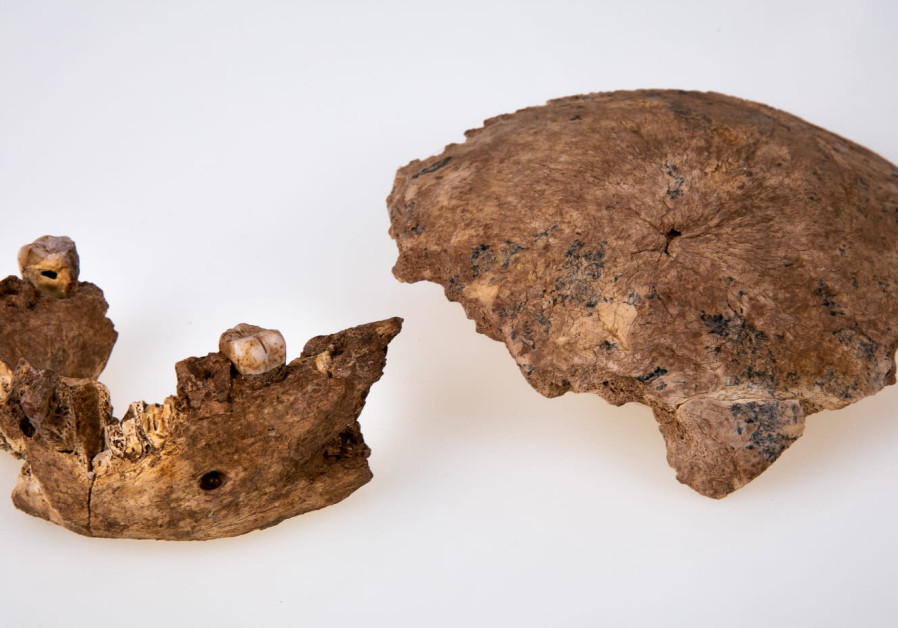
Skull found at the site among other items at Nesher Ramla. / (photo credit: DR. YOSSI ZAIDNER)

A new type of early human previously not known to scientists has been discovered in Israel, Tel Aviv University and Hebrew University researchers announced Thursday as their extraordinary findings appeared in the prestigious academic journal Science.

Researchers believe the new “Homo” species intermarried with Homo sapiens and was an ancestor of the Neanderthals.

Tens of thousands of years ago, the busy central region of what is now a densely populated and traffic-jammed part of Israel, was a landscape that very much resembled the African savanna. It featured rhinos, wild horses and cattle and other large animals that were perfect game for ancient hunter-gatherers.

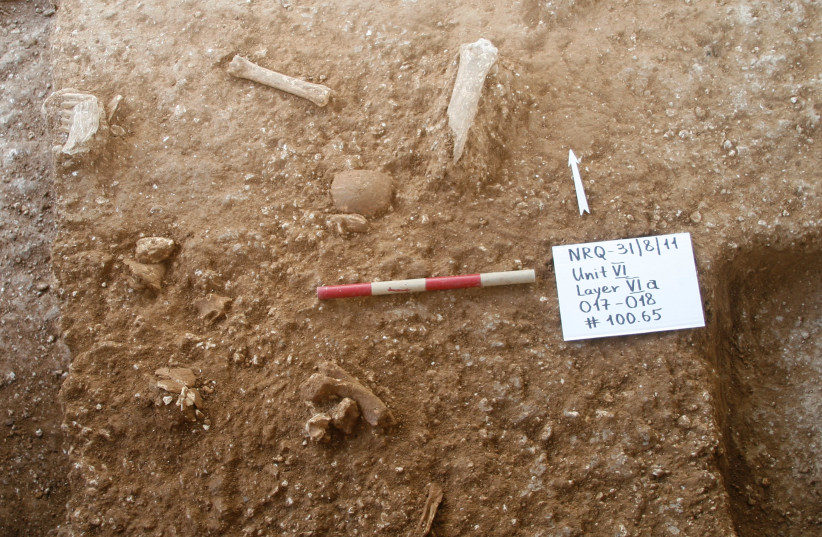
The site of Nesher Ramla, a few kilometers from the modern-day city, was probably close to a water reservoir where early humans could hunt animals. Today, the dig site is filled with many animal bones, stone tools for making fire and butchering, and human bones, including skulls, TAU anthropologist Prof. Israel Hershkovitz said.

.
“We know that modern humans – or Homo sapiens – arrived in this area some 200,000 years ago,” he said. “When we started excavating and examining the different archaeological layers, we found that they dated back between 140,000 and 120,000 years ago, so we expected to find remains of Homo sapiens. We did not realize that another form of human was living alongside them.”

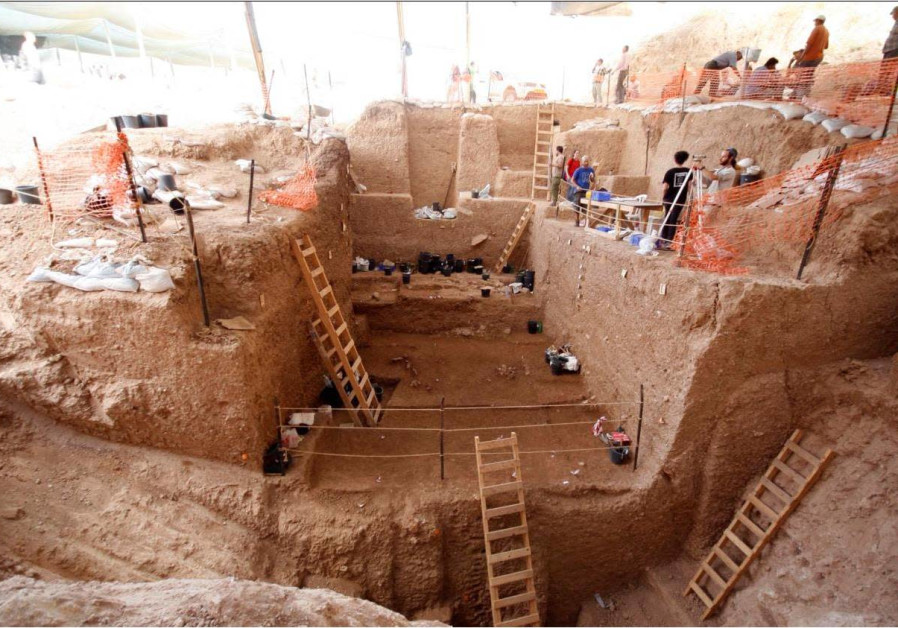
The site was discovered during a salvage excavation led by Hebrew University archaeologist Dr. Yossi Zaidner at the Nesher cement plant. Israeli law demands that a salvage excavation be carried out alongside any new construction project.

Thick archaeological layers uncovered during the dig at Nesher Ramla. (Photo credit: Dr. Yossi Zaidner)

“This is an extraordinary discovery,” said Zaidner. “We never imagined that alongside Homo sapiens, archaic Homo roamed the area so late in human history.”

The researchers believe that the newly discovered human type, which they named after the site, lived in the region hundreds of thousands of years ago and at least until 130,000 years ago.

The Nesher Ramla research team (Left to Right): Israel Hershkovitz, Marion Prevost, Hila May, Rachel Sarig and Yossi Zaidner. (Photo credit: Tel Aviv University)

Hershkovitz said it took a long time to determine that the bones they found indeed belonged to a hitherto unknown species.
“There was no ‘eureka’ moment,” he noted.

But the findings may radically change what researchers have so far believed about how ancient populations evolved and interacted, including how sapiens and Neanderthal, other ancient human types, related to each other.

“We have shown that contrary to what was previously believed, the Neanderthals are not a European story, but very much a story of the Levant,” he said.

Researchers believe the Nesher Ramla was an ancestor of the Neanderthals and other archaic Asian populations.

“Previously, it was thought that Neanderthals arrived in [what is now] Israel around 70,000 to 50,000 years ago from Europe,” Hershkovitz remarked. “However, now we are talking about a population living here some 130,000 years ago.”

Some features of the remains, like the teeth and the jaws, were more similar to Neanderthal species, while the skulls resembled the Homo type. But something did not make sense.

Fossil remains of skull and jaw found at Nesher Ramla. (Photo credit: Tel Aviv University)

When the researchers understood that the bones they had retrieved did not belong to either a Neanderthal or a Homo sapiens, they started to examine the possibility that they belonged to the last survivors of a more archaic population that they thought had become extinct hundreds of thousands of years earlier.

“We started to look for other members of this population, and we discovered that some fossils previously unearthed at other prehistoric sites in Israel, including the Qesem cave, belonged to the same group,” Hershkovitz said.

“We therefore realized that we were dealing with a huge population that lived in the region, and probably also migrated in different directions, including in Asia and in Europe and later became the humans we know as Neanderthal.”

According to Hershkovitz, Nesher Ramla Homo and Homo sapiens not only coexisted peacefully and exchanged technology, but also produced offspring.

“They engaged culturally and biologically,” he said. “In Europe, the story was very different because when modern humans arrived there around 45,000 years ago, they completely eliminated the local Neanderthals. This did not happen here.”

“We think that some later fossils we found in several caves dating back to 100,000 years ago probably belonged to offspring of sapiens and Nesher Ramla,” he added.

For example, in the Qafzeh cave in the Lower Galilee, archaeologists found the remains of several humans presenting the features of both species, some closer to the sapiens, some to the Nesher Ramla.

“It is similar to what happens when we see that certain children look more like their mother and some look more like their father,” Hershkovitz noted.
The scientists were not able to extract any DNA from the fossils.

“Warm weather destroys DNA,” Hershkovitz said. “In Israel, we have not been able to find any preserved DNA from earlier than 15,000 years ago.”

For this reason, the researchers’ conclusions are based on the morphology of the bones found.

“People think in paradigms,” said TAU Dr. Rachel Sarig. “That’s why efforts have been made to ascribe these fossils to known human groups like Homo sapiens, Homo erectus, Homo heidelbergensis or the Neanderthals. But now we say: No. This is a group in itself, with distinct features and characteristics.”

In the past, geneticists had already suggested that an unknown population represented the missing link between sapiens and Neanderthal, as pointed out by another researcher, Dr. Hila May. The Nesher Ramla population could represent the answer.

“As a crossroads between Africa, Europe and Asia, the Land of Israel served as a melting pot where different human populations mixed with one another, to later spread throughout the Old World,” she added. “The discovery from the Nesher Ramla site writes a new and fascinating chapter in the story of humankind.”


Zawartość publikowanych artykułów i materiałów nie reprezentuje poglądów ani opinii Reunion’68,
ani też webmastera Blogu Reunion’68, chyba ze jest to wyraźnie zaznaczone.
Twoje uwagi, linki, własne artykuły lub wiadomości prześlij na adres:
webmaster@reunion68.com