
Archives

Senior PIJ commander killed in IAF airstrike Monday afternoon

Senior PIJ commander killed in IAF airstrike Monday afternoon

ANNA AHRONHEIM


The airstrikes on Hamas targets came as rocket sirens continued to blare throughout the night in Ashkelon and Beersheba, with two separate barrages being aimed at each city.

Third round of IDF strikes against the Hamas ‘Metro’ tunnel system, Monday, May 17, 2021. (Credit: IDF Spokesperson’s Office)

Senior Palestinian Islamic Jihad commander Hassam Abu-Arbid was killed in an Israeli airstrike in the northern Gaza Strip Monday afternoon as rockets fired from the blockaded enclave continued to be fired towards southern Israel communities.

The IDF said that abu-Arbid, was killed in a joint operation with the Shin Bet intelligence services, commanded over the northern Gaza Strip brigade of the terror organization and was behind the launching of rockets and anti-tank guided missiles towards Israel.

IDF Spokesperson Brig.-Gen. Hidai Zilberman told reporters that shortly after the killing of Abu-Arbid, the military targeted a car near the Gazan beach in the northern sector of the Strip with operatives as well as an autonomous maritime vehicle.

“We recognized preparations for a maritime attack,” Zilberman said, adding that the maritime vehicle was totally destroyed and several operatives were killed.

The IDF attack of the home of Hamas head Yayha Sinwar, May 16, 2021. (Credit: IDF Spokesperson”s Unit)

The IAF also hit hundreds of kilometers of Hamas’s “Metro” underground tunnel network for the third time overnight on Monday. Striking 15 kilometers of what it called the “C” line, the attack “was part of a broad operation by the IDF to significantly damage the underground system of terror organizations in Gaza,” it said.

Striking 15 kilometers of what it called the “C” line, the attack “was part of a broad operation by the IDF to significantly damage the underground system of terror organizations in Gaza,” it said.

The attack included 54 fighter jets that dropped some 110 precision munitions on 35 targets in 20 minutes.

IAF jets also hit nine residences they claim belonged to high ranking Hamas commanders that were used as terror infrastructure and to store weapons.
The homes that were hit belonged to the Beit Hanoun battalion commander and of company commanders in Beit Hanoun, the Sabara battalion in Gaza City and the Shati battalion.

The IAF also struck military infrastructure used for command and control in the home of a Hamas operative responsible for military intelligence in Shejaiya.

The IDF also destroyed a tunnel in southern Gaza, the entrance to which was built near a kindergarten.

“This once again proves how Hamas purposely builds its military assets in the heart of civilian populations,” the military said, adding that the “IDF has taken precautions to ensure minimizing damage to civilian population.”
As the rockets continued to be launched, the IAF also destroyed the homes of Gaza Hamas leader Yahya Sinwar and his brother Muhammed, who is in charge of the logistics and manpower of Hamas, which “serve as significant terror infrastructure,” the IDF said in a statement.

The IAF also carried out airstrikes against several other homes, as well as the offices of Hamas Political Bureau’s Planning and Development head Samah Sarag, the residence of the commander of the Hamas Zeitoun Battalion in Gaza City Youssef Abel-Wahab, and the residence of senior Hamas Military Intelligence official Ahmad Abd El Aal.

Dozens of weapon factories and storage sites in Tzabrah tel Aloha, Sheik Amodan and Gaza City were struck as well. The military says that those sites were located in the homes of Hamas naval and airborne operatives, anti-tank squads and offensive cyber units.

According to the Palestinian Health Ministry in Gaza, 181 people have been killed since the fighting began, including 52 children and 31 women. Another 1,200 have been injured.

ZILBERMAN ON SUNDAY deflected criticism of the military’s actions in the Gaza Strip, particularly the bombing of the Al Jala building with media offices on Saturday.

“I want to see what would happen if one rocket was fired on Washington. They are firing salvos toward civilian populations,” Zilberman said when asked about the strike on the building that was home to the offices of the Associated Press and Al Jazeera in Gaza. “We are in the middle of an operation. If Hamas and PIJ think they can hide behind the media, their buildings are not something they can hide behind.”

The IDF said the building held the offices of Hamas’s military intelligence as well as other offices belonging to Palestinian Islamic Jihad. It has refused requests to reveal the evidence upon which it determined that Hamas was using the office building for terrorist activity, although it said that the US was shown the evidence and reportedly accepted it.

Expecting the fighting to continue for several more days, Zilberman warned the Israeli public to continue to seek shelter when rocket sirens are activated.

According to the spokesman, Hamas spent tens of millions of dollars on constructing this strategic asset.

“Every meter of the tunnel cost around $500 [so] one kilometer cost half a million dollars,” he said. “You can imagine what else they could have spent the money on.”

Since the beginning of operation “Guardian of the Walls,” approximately 3,150 rockets have been fired from the Gaza Strip at Israeli territory as of 7:00 a.m. on Monday, of which about 460 failed launches fell in the Gaza Strip.

The Iron Dome Air Defense System has intercepted most of the rockets that would have hit populated areas in Israel, with an intercept rate of approximately 90%.

Zilberman said that the military will continue to strike this system in the coming days, as well as the multi-barreled rocket launchers that are being used by the terror groups to launch salvos towards the Jewish state.

The IDF has hit 40-45 of these launchers, which have between four and nine medium- long-range rockets that can be fired every second.

While the IAF has begun to take out these launchers over the past 36 hours, the Israeli public won’t see its effect for some time, Zilberman said.


The Jerusalem Post Staff contributed to this report.


Zawartość publikowanych artykułów i materiałów nie reprezentuje poglądów ani opinii Reunion’68,
ani też webmastera Blogu Reunion’68, chyba ze jest to wyraźnie zaznaczone.
Twoje uwagi, linki, własne artykuły lub wiadomości prześlij na adres:
webmaster@reunion68.com


Iran’s hand seen in Hamas drone threat against Israel – analysis

Iran’s hand seen in Hamas drone threat against Israel – analysis

SETH J. FRANTZMAN


Why do drone threats matter? Because drones can carry warheads and also move slowly and may maneuver.

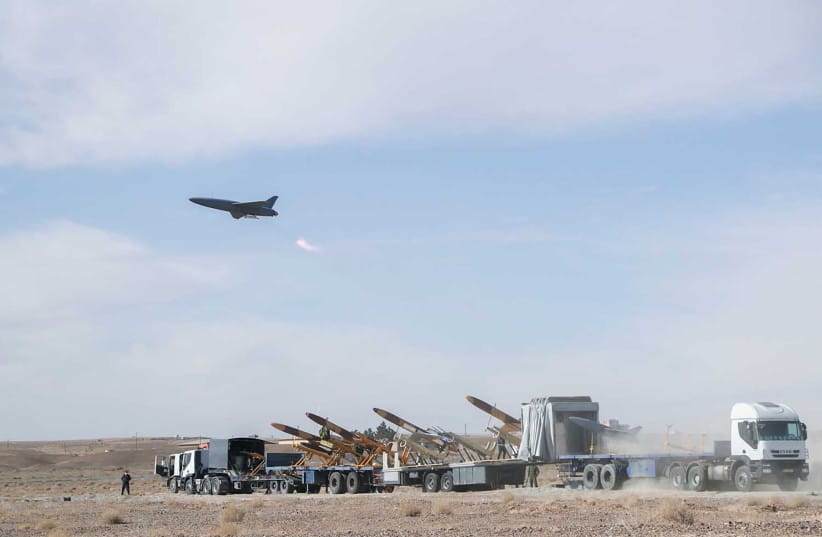
A drone is launched during a large-scale drone combat exercise of Army of the Islamic Republic of Iran, in Semnan, Iran January 4, 2021. Picture taken January 4, 2021 / (photo credit: IRANIAN ARMY/WANA/REUTERS)

Israel has increasingly had to deal with drone threats by Hamas, and said on Thursday that it downed a UAV that crossed from the Gaza Strip into Israeli territory.

The new drone threat has also been showcased by Hamas in a video circulated online that shows the Palestinian terror group with several medium-size drones in Gaza. Hamas says its new drones are called “Shehab.”

Drone Experts such as Nick Waters and others have pointed out the close connection between the Hamas “Shehab” and the Iranian Ababil.

The IDF has released video of the drone flying and being shot down. These drones appear to be based on Iranian Ababil drones, models of which have been exported to the Houthis in Yemen, and which the Houthis built and used against Saudi Arabia. The US has warned for years about the Iranian drone threat, including putting Iran drones on display in Washington.

The IDF said on Wednesday that it “struck a squad of terrorists operating explosive UAV launchers belonging to the Hamas terrorist organization in the Gaza Strip. The squad was struck while they were preparing to launch the UAV into Israeli territory.”

Israel also said on Wednesday that the Iron Dome Aerial Defense System intercepted a Hamas UAV that crossed from Gaza into Israeli territory. Israel’s Defense Ministry has said that the Iron Dome system has new capabilities, developed and made operational over the years, that make it effective against drones.

Why do drone threats matter? Because drones can carry warheads and also move slowly and may maneuver. Most of the Iranian-style drones, which are called “loitering munitions” or “kamikaze” drones, are the kind that can be programmed to fly to a certain destination and then sent on their way.

They are launched from a rail and can be transported on a truck or even a boat and launched that way. They have a propeller at the back, and gyroscope technology used in the drones for guidance links Iran to the drone exports that have gone to Yemen, Iraq, Syria, and even further afield, to be used in places like Sudan, Afghanistan, and Venezuela, according to various reports.

Iran used drones to attack the Abqaiq oil processing facilities in September 2019 that appeared to be a warning to Israel. Iran also used a drone flown from the T-4 base in Syria to attack Israel in 2018. It flew into Israeli airspace and was shot down by a helicopter. Iran also advised Hezbollah to send what Israel called a “killer drone” team to an area near the Golan in 2019. Israel struck that team.

There have been numerous drone incidents on the Lebanese border, and also several on the Syrian border. In addition, Israel’s enemies have tried to shoot down Israeli drones. In March, Israel’s IDF said “during routine IDF UAV activity over Lebanon, anti-aircraft missiles were fired toward the UAV. The aircraft was not hit and continued its mission as planned.”

Last month Israel said that troops downed a drone and located an additional drone “belonging to the Hezbollah terror organization that crossed from Lebanon into Israeli airspace.”

The IDF shot down another drone from Lebanon in January, and shot down a drone that flew from Lebanon in November. Additionally, there were drone infiltrations in July and August.

In addition, Israel said it struck a drone site in September related to Hamas in Gaza. Israel said in September 2019 that “a drone infiltrated into Israeli airspace from the Gaza Strip and dropped an explosive device on a military vehicle.”

All this points to an increasing drone capability by Hamas, and this week’s conflict has seen several references to Hamas’s UAVs.

Israel uses several terms for drones, usually calling the smaller quadcopters rakhfanim, and larger drones malatim, meaning a UAV.

The Hamas drones that resemble the Ababil will likely have a warhead on the front and some sort of guidance system. They have two sets of wings, one toward the rear and a smaller set in the front, looking similar to a flying fish with fins. They are slightly longer than an average person.

Apparently the design is relatively easy to manufacture because the Houthis have become experts at using drones to terrorize Saudi Arabia.

Some of these drones also have increasingly longer ranges. Concern in January pointed to a new drone based in Yemen among the Houthis,which had a 2,000-km. range that could reach Eilat.

Iran has long boasted that it has drones with ranges of thousands of kilometers, and Iran has said it has increased the armaments it can put on the drones. That means Iran has a drone army that combines the kind of smart munition elements that cruise missiles have. The drones can be operationalized in swarms.

Iran has also tried to copy the US Predator and Sentinel as well as other drones, adding munitions to them as has the US Reaper. However, Iran has had mixed success in this.

It also has mixed success supplying the Houthis, Hamas, Hezbollah or Iraq-based militias with a way to fly the drones with a live video feed or have them return to base. This means that Iran’s drones are still quite antiquated, and that its allies like Hamas possess drones that have outdated aspects.

Hamas drones are a threat because they can maneuver and fly low, but they still may be a blend between aspects of the V-1, – old Israeli drones from the 1980s – and cruise missiles. However, it is clear Iran is exporting its technology.

Iran first began using Ababils in the 1980s against Iraq during the Iran-Iraq war. They were built at a HESA factory that is based on a factory that was once built by Textron, which constructed Bell 214 helicopters prior to 1979.

The Islamic Revolutionary Guard Corps today often uses the Ababil drones, and this makes sense because the IRGC’s Quds Force oversees support for Hamas, Hezbollah, and the Houthis.

It is believed that pro-Iran militias in Iraq have now used drones several times against US facilities. This points to a wider drone war being waged by Iran against Israel, Saudi Arabia, the US and others.


Zawartość publikowanych artykułów i materiałów nie reprezentuje poglądów ani opinii Reunion’68,
ani też webmastera Blogu Reunion’68, chyba ze jest to wyraźnie zaznaczone.
Twoje uwagi, linki, własne artykuły lub wiadomości prześlij na adres:
webmaster@reunion68.com


Gantz Asks Government for Two-Week Extension to Home Front State of Emergency

Gantz Asks Government for Two-Week Extension to Home Front State of Emergency

i24 News


Israeli Defense Minister Benny Gantz attends a cabinet meeting of the new government, at the Chagall Hall in the Knesset, the Israeli parliament in Jerusalem, May 24, 2020. Photo: Abir Sultan / Pool via Reuters / File.

Israel’s Defense Minister and Alternate Prime Minister Benny Gantz asked the government on Wednesday to extend the Home Front’s state of emergency another two weeks, which includes all communities within an 80-kilometer radius from the Gaza Strip.

Gantz said that there was “no end date” to the Gaza military operation as Israel likely faces another night of rocket attacks aimed not just at the south but the center of the country where the overwhelming majority of the population resides.

A new wave of rocket attacks could come in retaliation for a major military operation conducted jointly by the IDF and Shin Bet (Israel Security Agency) that killed a number of senior Hamas commanders, many of them thought to be close to Hamas military wing commander Mohammed Deif.

“Israel is not preparing for a ceasefire. There is currently no end date for the operation. Only when we achieve complete quiet can we talk about calm,” Gantz said. “We will not listen to moral preaching from any organization or institution regarding our right and duty to protect the citizens of Israel.”


Zawartość publikowanych artykułów i materiałów nie reprezentuje poglądów ani opinii Reunion’68,
ani też webmastera Blogu Reunion’68, chyba ze jest to wyraźnie zaznaczone.
Twoje uwagi, linki, własne artykuły lub wiadomości prześlij na adres:
webmaster@reunion68.com


News from Israel – May 11, 2021

News from Israel – May 11, 2021

ILTV Israel News


#Palestinian rockets continuing to rain down indiscriminately on Israeli civilian regions. Israel responding with hundreds of #airstrikes of its own.


Zawartość publikowanych artykułów i materiałów nie reprezentuje poglądów ani opinii Reunion’68,
ani też webmastera Blogu Reunion’68, chyba ze jest to wyraźnie zaznaczone.
Twoje uwagi, linki, własne artykuły lub wiadomości prześlij na adres:
webmaster@reunion68.com


IDF strikes over 130 targets in Gaza as 250 rockets pound Israel

IDF strikes over 130 targets in Gaza as 250 rockets pound Israel

ANNA AHRONHEIM, TZVI JOFFRE, IDAN ZONSHINE


A number of roads and train lines in southern Israel were closed due to security concerns.

.

Israel was bombarded by over 200 rockets from the Gaza Strip since Monday as terror groups sent barrages of rockets, injuring at least seven Israeli civilians.

In retaliation for the rocket-fire, the IDF carried out waves of airstrikes against 130 terror targets in Gaza, in an operation called “Guardians of the Wall.”

The targets hit by Israel included the home of a Hamas battalion commander in a multi-story building, the organization’s military intelligence headquarters, munition manufacturing sites, military complexes belonging to Hamas and the Palestinian Islamic Jihad, as well as two terror tunnels that were close to the border fence. The strikes were said to have killed at least 15 Hamas terrorists.

Palestinian WAFA news agency reported that a total of 24 people including children were killed in the strikes and another 103 were injured.
The wave of airstrikes began after the security cabinet authorized “significant airstrikes” in the Gaza Strip.

Palestinian Islamic Jihad releases footage of a ATGM strike on a civilian vehicle

.
IDF Spokesman Brig.-Gen. Hidai Zilberman warned on Tuesday that the military is “prepared for a variety of scenarios” including an escalation and said that the operation would last “several days” and would deal a hard blow to Hamas.

As such, the IDF has deployed additional Iron Dome batteries to the southern Gush Dan region.

“We will continue to act vigorously against Hamas and other terror organizations,” he said, adding that Hamas is responsible for “what is happening and will bear the consequences.”

Referring to the casualties in Gaza, Zilberman said that while Israel “takes precautions” to minimize possible harm to civilians during its military operations, Hamas “deliberately places its military assets in the heart of the civilian population in Gaza.”

The IDF spokesman stressed that while 200 rockets were fired towards Israel, a third of the rockets fell inside Gaza. The Iron Dome, he said, had a 90% success rate in intercepting dozens of rockets fired from the Strip.

Hamas had threatened Israel on Monday that it would launch the rockets due to the ongoing clashes in Jerusalem and shortly after 6 p.m. seven rockets were fired towards the capital.

The IDF warned Hamas that all options, including a ground operation, were on the table after the Monday rocket fire that marred Jerusalem Day with sirens going off in the capital as thousands of people were parading through downtown to celebrate the holiday.

Following the rocket fire, the Israel Air Force carried out several strikes in Gaza, killing at least 8 Hamas militants and targeting rocket launchers and two military positions. Palestinian media reported that 22 people had been killed – including nine children – and another 95 wounded.

Three children were killed in Beit Hanoun but it is unclear if it was due to an Israeli Air Force strike or the failure of a rocket launched from Gaza.

One rocket struck an empty house in a community near Jerusalem. Dozens of rockets were also fired towards Sderot, Ashkelon and neighboring communities as well.

Another rocket hit a house in Nir Am, in the Sha’ar Hanegev Regional Council, shortly after midnight on Monday night. No injuries were reported.
On Tuesday morning, around 6 a.m., a wave of rockets hit two residences in Ashkelon. One rocket hit a family home, moderately injuring the parents and lightly injuring the children. The rocket which hit the second home lightly injured two people. All six were evacuated to Barzilay Medical Center in Ashkelon.

read more


Zawartość publikowanych artykułów i materiałów nie reprezentuje poglądów ani opinii Reunion’68,
ani też webmastera Blogu Reunion’68, chyba ze jest to wyraźnie zaznaczone.
Twoje uwagi, linki, własne artykuły lub wiadomości prześlij na adres:
webmaster@reunion68.com