Archives

News from Israel – May 10, 2021

News from Israel – May 10, 2021

ILTV Israel News


#JerusalemDay​ marked with riots and #clashes​ as opposed to celebrations and parades.
–
The political ‘change bloc’ reportedly closing in on a deal to form the #government​.
–
Wounded #IDF​ veterans are given the support they deserve.


Zawartość publikowanych artykułów i materiałów nie reprezentuje poglądów ani opinii Reunion’68,
ani też webmastera Blogu Reunion’68, chyba ze jest to wyraźnie zaznaczone.
Twoje uwagi, linki, własne artykuły lub wiadomości prześlij na adres:
webmaster@reunion68.com


News from Israel – May 09, 2021

News from Israel – May 09, 2021

ILTV Israel News


Clashes break out in #Jerusalem​ as 80,000 Palestinians arrive to pray at the temple mount.
–
Tensions spilling over from the strip too, as fire balloons from #Gaza​ set fires in Israeli fields.
–
And this #Israeli​ set his sights above and beyond the basic confines of #photography​.


Zawartość publikowanych artykułów i materiałów nie reprezentuje poglądów ani opinii Reunion’68,
ani też webmastera Blogu Reunion’68, chyba ze jest to wyraźnie zaznaczone.
Twoje uwagi, linki, własne artykuły lub wiadomości prześlij na adres:
webmaster@reunion68.com


IDF strikes Gaza after rocket launched at Israel amid Jerusalem unrest

IDF strikes Gaza after rocket launched at Israel amid Jerusalem unrest

TZVI JOFFRE


A number of rioters were injured along the Gaza border as IDF soldiers responded with rubber bullets and tear gas.

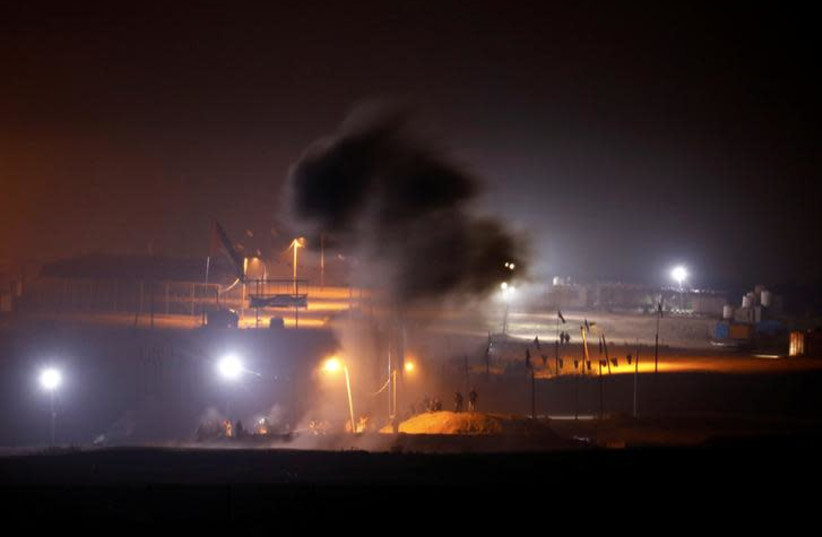
Smoke rises after an explosion as Palestinians take part in a night protest held along the Gaza side of the border with Israel / (photo credit: REUTERS/AMIR COHEN)

The Israeli Air Force struck a Hamas military site in the southern Gaza Strip in response to rocket fire earlier on Saturday night, according to the IDF Spokesperson’s Unit.

A rocket was fired from the Gaza Strip toward Israel on Saturday night, amid riots along the Gaza border fence and in Jerusalem, according to the IDF. A rocket alert was sounded in an open area.

The Coordinator of Government Activities in the Territories (COGAT) decided on Sunday morning to freeze the entry permits of 350 Gazan businessmen into Israel, after the tense night, according to Israeli media.

Earlier on Saturday night, a number of Palestinian rioters were injured during riots along the border of the Gaza Strip, amid unrest in recent days around the Temple Mount and planned evictions in the Sheikh Jarrah neighborhood of east Jerusalem.

According to Palestinian reports, the IDF responded to the rioters, who were referred to as the “night confusion units” by Palestinian media, by launching tear gas and firing rubber bullets. The protestors have used in the past incendiary and explosive balloons to disrupt the lives of Israeli citizens living near the Gaza border.

It remains unclear exactly how many rioters were injured and what condition they were in, but video footage from the scene showed ambulances arriving and at least one person who appeared to be unconscious. Initial reports indicated the injuries included one person injured by rubber bullets and a number of others who were short of breath due to tear gas.

Images and video from the riots showed Palestinians lighting large fires and throwing explosives at the border fence. Regional councils in Israeli communities near the border issued statements to residents, informing them that the explosions were occurring within Gaza and that the IDF had the situation under control.

Amid the unrest, the commander of the IDF’s Gaza Division met with local authorities from communities border the Gaza Strip on Saturday night, according to Israeli media.

The riots come after a number of incendiary balloons were launched from the Gaza Strip in recent days and riots broke out in Jerusalem, amid protests against the planned eviction of Palestinians from homes in the Jerusalem neighborhood of Sheikh Jarrah.

At least 53 Palestinians were injured in riots on Saturday night, as 90,000 worshippers visited al-Aqsa.

An incendiary balloon from the Gaza Strip landed in the yard of a house in Moshav Zimrat on Saturday evening, N12 News reported. The family was at home when the incendiary balloon landed, according to the report.

At least three balloons were spotted in areas surrounding the Gaza Strip on Saturday, with two fires sparked by the balloons.

Additionally on Saturday, Egypt called on the Palestinian terrorist groups in the Gaza Strip to deescalate tensions and on Israel to halt the evictions in the Sheikh Jarrah neighborhood, according to Al-Arabiya.
Abu Ubaida, the spokesman of the Izzadin al-Qassam Brigades, Hamas’s military wing, issued a short statement in support of the rioters in Jerusalem on Saturday night.

“We salute the steadfastness of our people stationed in Jerusalem and al-Aqsa, and we tell them that the Commander of the Al-Qassam Brigades, Muhammad al-Deif, has promised you and will not break his promise,” said Ubaida.

Ubaida was referencing statements made by Deif last week, in which he stated “This is our final warning. If the aggression against our people in the Sheikh Jarrah neighborhood does not stop immediately, we will not stand idly by and the occupation will pay a heavy price.”

On Saturday night, the Palestinian Islamic Jihad terrorist movement issued a statement in support of the Jerusalem rioters as well, warning Israel that “its criminal leaders must understand the message of the resistance leadership well.”

The PIJ called on Palestinians to continue to clash with Israeli forces on Monday, when Israelis mark Jerusalem Day to celebrate the capture of Jerusalem in 1967, so that “the enemy and everyone who supports it knows that the men of Al-Aqsa are the people of defiance and steadfastness.”
Additionally on Saturday, PIJ Secretary-General Ziyad al-Nakhalah warned that what is happening in Jerusalem “cannot be tolerated” and that Israel should expect a response “at any moment.”

The tensions also come as the IDF prepares to launch a massive, month-long exercise called “Chariots of Fire” on Sunday. The exercise is set to be the largest ever carried out by the IDF and will simulate war on multiple fronts, including with Gaza and Hezbollah.

Hezbollah has reportedly raised its alert level in southern Lebanon and Syria in light of the exercise. Sources who spoke with the Lebanese El-Nashra newspaper claimed that the level of alert was the highest since the Second Lebanon War in 2006. Hezbollah officials reportedly fear that the exercise could be used to launch an attack, with the sources saying that the exercise is being viewed as “extremely dangerous.”

“Hezbollah warned against this maneuver because Israel worked during the past wars to take soldiers and personnel from the training fields to the field directly, and this is what is happening now at the southern front of Lebanon and the north of Palestine,” the sources told El-Nashra.


Zawartość publikowanych artykułów i materiałów nie reprezentuje poglądów ani opinii Reunion’68,
ani też webmastera Blogu Reunion’68, chyba ze jest to wyraźnie zaznaczone.
Twoje uwagi, linki, własne artykuły lub wiadomości prześlij na adres:
webmaster@reunion68.com


Jerusalem Tensions High as Thousands Head to Al-Aqsa After Clashes

Jerusalem Tensions High as Thousands Head to Al-Aqsa After Clashes

Reuters and Algemeiner Staff


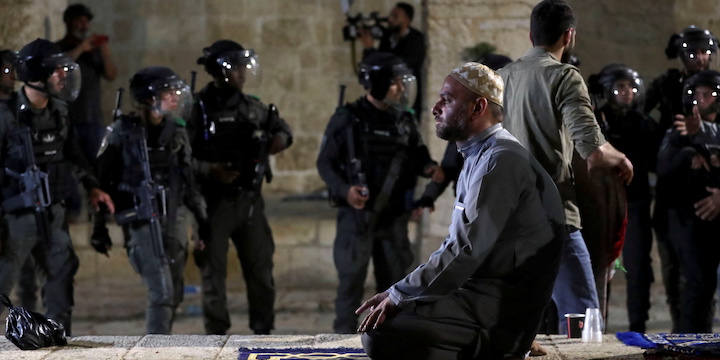
A Palestinian man prays as Israeli police gather during clashes at the compound that houses Al-Aqsa Mosque, known to Muslims as Noble Sanctuary and to Jews as Temple Mount, amid tension over the possible eviction of several Palestinian families from homes on land claimed by Jewish settlers in the Sheikh Jarrah neighbourhood, in Jerusalem’s Old City, May 7, 2021. Photo: REUTERS/Ammar Awad/File Photo

Israel said it was beefing up security forces on Saturday in anticipation of more confrontations with Palestinian protesters, a day after fierce clashes at Jerusalem’s Al-Aqsa Mosque.

Tensions have mounted in the city, the West Bank and Gaza throughout the Muslim holy month of Ramadan, amid growing anger over the potential eviction of Palestinians from Jerusalem homes on land claimed by Jewish settlers.

Thousands of Palestinians were expected to return to Al-Aqsa Mosque after dark fell for the sacred Muslim night of Laylat al-Qadr.

Television footage showed buses of Muslim worshippers from Israeli Arab cities being stopped by police on the main highway to Jerusalem.

Word of the roadblock spread on social media, drawing hundreds of young men from nearby Arab villages and from Jerusalem.

Dozens drove their cars the wrong way down the now-empty Jerusalem-bound lanes, picking up fellow Muslims who had abandoned their own vehicles to start the uphill trek on foot. Some chanted in Arabic: “With our souls and our blood, we will redeem you, Al-Aqsa!”

Police said it was stopping only those planning to take part in riots before the buses were allowed to proceed. Scuffles broke out and footage showed officers firing stun grenades.

On Friday, police fired rubber bullets and stun grenades towards rock-hurling Palestinian youths at the mosque in the walled Old City on the Noble Sanctuary/Temple Mount plaza sacred to both Muslims and Jews.

At least 205 Palestinians and 18 Israeli officers were injured in Friday’s confrontations, which drew international condemnations and calls for calm.

Police Commissioner Yaakov Shabtai said more officers were being deployed in Jerusalem on Saturday.

“The right to protest will be preserved, but riots will be answered firmly and with zero tolerance. I call on everyone to act responsibly and with restraint,” Shabtai said in a statement.

Prime Minister Benjamin Netanyahu said in a statement that law and order would be maintained in Jerusalem as would the right to worship.

Clashes have erupted nightly in eastern Jerusalem’s Sheikh Jarrah – a neighborhood where numerous Palestinian families face eviction in a long-running legal case.

The Israeli military said it was boosting troops in the West Bank and near the Gaza Strip, where Palestinians have sent incendiary balloons over the border, igniting brush fires in Israeli territory. A military spokesman said extra forces there would largely be firefighting ones.

CALL FOR BORDER PROTESTS

Gaza groups issued a call for protests along the border with Israel. “We salute the ppl. of Al-Aqsa, who oppose the arrogance of the Zionists & we call on our ppl. in Palestine to support their brothers by all means,” Moussa Abu Marzouk, a leader of the armed Islamist group Hamas that rules Gaza, said on Twitter.

Tension was expected to remain high over the next few days. Israel’s Supreme Court will hold a hearing on the Sheikh Jarrah evictions on Monday, the same day that Israel marks Jerusalem Day – its annual celebration of its acquisition of eastern Jerusalem during the 1967 Middle East war.

Palestinians want eastern Jerusalem as the capital of a future state. Israel claims the entire city as its eternal, indivisible capital.


Zawartość publikowanych artykułów i materiałów nie reprezentuje poglądów ani opinii Reunion’68,
ani też webmastera Blogu Reunion’68, chyba ze jest to wyraźnie zaznaczone.
Twoje uwagi, linki, własne artykuły lub wiadomości prześlij na adres:
webmaster@reunion68.com


Arab protests against the Balfour Declaration and Jewish immigration, May 1921

Arab protests against the Balfour Declaration and Jewish immigration, May 1921

Dr. Alex Grobman


The British response to the pogroms encouraged the oppressors, rewarded violence, and penalized the victims – just like in Russia. Op-ed.
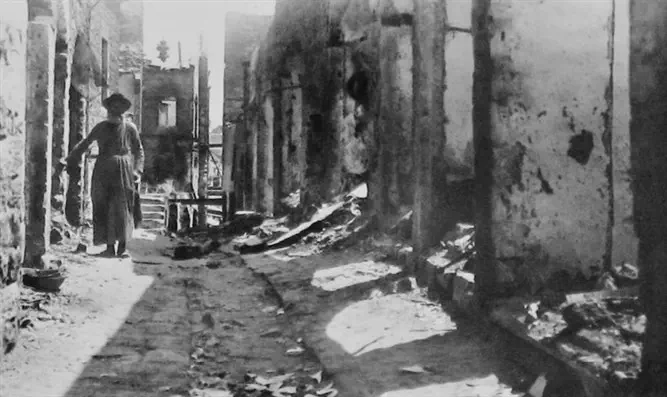
Jews street after pogrom

When Arabs protested the Balfour Declaration in 1921, Sir Herbert Samuel, the Jewish first High Commissioner in Palestine, the name given to the area by the Roman conquerors of Judea, responded that Jews were expected to immigrate to Palestine within certain fixed limits “to help with their resources and efforts to develop the country, to the advantage of all its inhabitants.” [1]

Jewish immigration, Winston Churchill assured them, was being monitored regarding the numbers and character of the people. The country was “greatly under-populated” and undeveloped, which allowed for more people to build a life there. The work already accomplished by the Jews during the last 20 to 30 years could not be “brutally and rudely overturned by fanatical attacks of the Arab population” launched against Jews in Jaffa, Rehovot, Petach Tikva and other Jewish areas in May 1921. [2]

Despite its initial pro-Zionist orientation, the British government gradually “whittled down” the Balfour Declaration, reflecting the hostility towards Zionism of many in the government. By 1921, immigration had practically ceased, the “bulk” of the British officers in Palestine were not sympathetic to Zionism, and the Zionists were not receiving the concessions needed to establish a national Jewish homeland.

Public hostility in Britain, Colonel Richard Meinertzhagen, General Allenby’s Chief Political Officer and later involved in the creation of the British Mandate, thought, was a result of the failure to understand the purpose of Zionism, fear of its potential financial cost and a general antisemitic British temperament that quickly translated into anti-Zionism.[3]

To pressure the British to end Jewish immigration, anti-Zionist riots broke out in Mandatory Palestine in 1920-1921, killing several Jews. In April 1920, during a religious festival (al-Nabi Musa) in Jerusalem, many Arabs, led by Al-Hajj Amin al-Husayni, the Mufti of Jerusalem, attacked Jews in the Old City.

On May 1, 1921, there was a riot in Jaffa, after which the Arabs attacked Jews in Petah Tikvah and Hadera, pillaging and destroying a significant amount of property. The disturbances, which shocked the Jews and the British, lasted several days and demonstrated the Arabs’ fierce opposition to continued Jewish immigration into the country, [4] and their insistence on remaining part of Syria. [5]

In view of the intensity of the attacks during which 88 people were killed and 238 injured, Sir Herbert Samuel [6] brought in the army to quell the disturbances. Many were arrested and heavy fines were levied against Arab villages involved in the riots. However, he also sought to ease Arab hostility and insisted that the Zionists demonstrate no ill-will toward the Arabs.

This had to be done through economic development and by making conciliatory declarations that would assuage Arab fears of Jewish immigration and Jewish political dominance. “Unless there [was] very careful steering, it [was] upon the Arab rock that the Zionist ship may be wrecked,” Samuel concluded. [7].

Another response to the riot was a meeting at the Colonial Office in London on November 29, 1921, arranged between Dr. Chaim Weizmann and members of the Arab Delegation from Palestine. This meeting, and others, ended in failure as the two groups were unable to reconcile their differences about the proposed Mandate and the future structure of Palestine. [8]

Jews saw Samuel’s capitulation to violence as appeasement and proof that their criticism of the British administration in Palestine and their disillusionment with the British were justified. Samuel further alienated the Jews of Palestine on June 3, 1921, in his first major address after the riots. Samuel tried to assure the Muslim and Christian inhabitants that he would implement whatever measures required to prove that their rights were “really safe.”

The British Government, he said, which is the “trustee under the Mandate for the happiness of the people of Palestine, would never impose on them a policy which that people had reason to think was contrary to their religious, their political, and their economic interests.” [9]

Chaim Weizmann had no illusions about Samuel. “He is meek and mild and timid. Still he is, with all that, the best we can have in the circumstances.” [10]

The Jewish press reflected the community’s anger toward the British, and their profound concern that these riots were like the ones they had experienced in Russia.

Berl Katznelson, a leading figure of the Zionist labor movement, declared, “The pogrom against Israel in Eretz Israel is still continuing.” Ben-Gurion concurred: “We who experienced the pogroms knew quite well that without the wish of the authorities and their open or clandestine backing, actively or passively, the task of the pogrom cannot succeed.” [11]

When the riots occurred in 1921, Samuel held the Jews responsible and brought them to trial. The British claimed this was a clash between communist and anti-communist Jewish demonstrators on May Day, which the Jews dismissed as absurd.

The British also sought to obscure the fact that the Arabs had been the sole aggressors. Arab policemen involved in the riots were not punished, while Jews attempting to defend themselves were arrested when they harmed their assailants. Stolen property was not returned, and those who killed Jews were not tried. Jewish immigration was halted, and those caught trying to enter the country were sent back to their ports of origin. This was another example of where the British encouraged the oppressors, rewarded violence, and penalized the victims. [12]

British reaction reminded Jews of the Russian government’s response to pogroms. First, the British took their time in responding to the al-Nabi Musa riots and behaved with a combination of apathy and “criminal neglect.” Then they arrested Ze’ev Jabotinsky, the Zionist activist, and his men who were attempting to organize their own self-defense in Jerusalem. Jabotinsky had established the Jewish Legion under British auspices during World War I. At the end of the riots, the British tried to reduce tensions by prohibiting the Jews from holding a public funeral for the victims.

Most of the rioters were not tried, whereas when Jews were apprehended with weapons, they were given substantial sentences. Eventually, the convictions were rescinded, but in the context of a general amnesty for the rioters and the Jews. This prompted Berl Katznelson to refer to the Jewish victims by the ancient Hebrew idiom harugei malkhut (those slain by the [non-Jeiwsh] government), a term used for the Ten Martyrs who were tortured and executed by the Romans. [13]

Dr. Grobman is the resident scholar at the John C. Danforth Society and a member of the Council of Scholars for Scholars for Peace in the Middle East (SPME.)


Sources

[1] Extracts From Speech Delivered By H.E. The High Commissioner For Palestine on 3 June 1921,” [UK National Archives] T.N.A. CO 733/7: 255-256.

[2] Extract From Speech On The Middle East By Mr. W. Churchill On June 14, 1921 [UK National Archives] T.N.A. CO 73 3/7: 256- 258.

[3] Richard Colonel Meinertzhagen, Middle East Diary 1917-1956, (New York: Thomas Yoseloff, 1959), 101.

[4] An Interim Report on the Civil Administration of Palestine During the Period 1st July 1920-30th June 1921, op. cit.; Anita Shapira, Land and Power: The Zionist Resort to Force 1881-1948 (New York: Oxford University Press, 1992), 110.

[5] Basheer M. Nafi, Arabism, Islamism and the Palestine Question.1908-1941: A Political History, (Reading, England: Ithaca Press, 1998), 71.

[6] Bernard Wasserstein, Herbert Samuel: A Political Life, (Oxford, England: Clarendon Press, 1992), 230-245.

[7] Shapira, Land and Power, op. cit., 110-111; An Interim Report on the Civil Administration of Palestine During the Period 1st July 1920-30th June 1921, op. cit.; Neil Caplan, Futile Diplomacy: Early Arab-Zionist Negotiation Attempts, 1913-1931, vol. one, (London: Frank Cass, 1983), 48-49.

[8] Ibid., 50-51.

[9] Wasserstein, Herbert Samuel: A Political Life op. cit., 256-260.

[10] Wasserstein argues that it was Samuel’s ability to convince the Conservative British Government to remain in Palestine, adhere to the basic policies of the Balfour Declaration and support Samuel’s plan to foster Zionist growth conditioned by “conciliation of Arab opposition,” that enabled the Jews to establish a “a viable semi-autonomous economy, an underground army, and the embryonic institutions of a national state.” Had Samuel not pursued this policy, the British might have been willing to abandon the Zionist experiment.

[11] Ibid., 260-262.

[12] Shapira, Land and Power, op. cit., 112

[13] Ibid., 113.


Zawartość publikowanych artykułów i materiałów nie reprezentuje poglądów ani opinii Reunion’68,
ani też webmastera Blogu Reunion’68, chyba ze jest to wyraźnie zaznaczone.
Twoje uwagi, linki, własne artykuły lub wiadomości prześlij na adres:
webmaster@reunion68.com