Archives

The Tragedy of Benjamin Netanyahu

The Tragedy of Benjamin Netanyahu

Benjamin Kerstein


Israeli Prime Minister Benjamin Netanyahu looks on as he arrives to a hearing in his corruption trial at Jerusalem’s District Court February 8, 2021. Photo: Reuben Castro/Pool via REUTERS

The ancient Greeks who invented the tragedy based it, in many ways, on an idea first articulated by the philosopher Heraclitus: ethos anthropo daimon — character is fate. What makes a man successful, they understood, is quite often what eventually destroys him. History has tended to bear this out, and at the moment, no public figure seems to embody it better than Benjamin Netanyahu.

As Israel’s longest serving prime minister, Netanyahu has been in many ways an extraordinary success. Among his achievements are normalization agreements with a series of Arab and Muslim states, a still-booming economy, a COVID-19 vaccination campaign that leads the world, spectacular covert operations against Iran, and a security policy that has, with one exception, avoided major conflict. Yet Netanyahu is now facing imminent defeat. With a deadlocked election result that leaves him unable to form a governing coalition, he appears to be, at long last, on his way out.

The most remarkable thing about this has been little commented upon: with all of Netanyahu’s accomplishments, why is it happening at all? Logically, Netanyahu should have won the elections running away. The fact that he hasn’t, and indeed stands on the edge of political oblivion, is almost incomprehensible.

The answer to this question, in classic Greek fashion, is that Netanyahu has been defeated by his own talents. It is not an exaggeration to say that Netanyahu is, if nothing else, a political genius. As he himself has reportedly said: everyone else plays checkers, while he plays chess. With a preternatural understanding of Israel’s convoluted political system, Netanyahu is a dancer, constantly maneuvering between friends and enemies, allies and rivals, shifting when necessary and holding fast at others, all in the service of his desire to remain, somehow, in power; and there are very few things he will not do, and few principles he will not abandon, to achieve victory.

The laundry list of these maneuvers is long, and goes back to the beginning of Netanyahu’s political career: his failure to condemn incitement against the late Yitzhak Rabin; his deliberate torpedoing of a unity government with obviously false claims of a cabinet conspiracy against him by then-ministers Tzipi Livni and Yair Lapid; his infamous claim that “the Arabs are flowing to the polls”; his assertion that Lapid and Benny Gantz were collaborating with terror supporters; his recent betrayal of a rotation agreement with Gantz, and so on — it is a dark, but effective, legacy.

Netanyahu’s unscrupulous brilliance has worked for a long time, but the bill appears to have come due — and it is precisely that brilliance that has proved to be his Achilles’ Heel. With his endless machinations over a decade in power, Netanyahu has survived; but he has also alienated almost everyone, including his natural allies. Indeed, the “anti-Netanyahu bloc” that formed in the last elections included many right-wingers who in other circumstances would almost automatically join a Netanyahu-led government, such as Gideon Sa’ar, Naftali Bennett, and Avigdor Lieberman. Even Gantz and Lapid, who are firmly in the center, are not that far from Netanyahu on most policy questions, and could easily be included in a unity coalition were it not for their intense antipathy toward the prime minister himself.

One could view all of this as simple opportunism or shallow personal animosity on the part of Netanyahu’s enemies, and there is some truth in that. But it is not the primary cause. Opportunism can be finessed and personal animosity put aside in the world of politics. What cannot be finessed and put aside is total lack of faith. Put simply, Netanyahu’s political enemies don’t believe a word he says, don’t believe he will live up to his promises, and see no reason whatsoever to ally themselves with someone who will betray them at the first possible opportunity.

And they have good reason for thinking this, because Netanyahu has indeed lied to and betrayed almost everybody in Israeli politics. It is possible that he has done so because he feels has to, that he is the only one who can successfully lead Israel, and thus principles must be compromised and disreputable things done in the name of a greater good. That this greater good has also been very good for Netanyahu, however, has not been lost on his victims.

Netanyahu has been an extremely good prime minister on his own terms. He may even be a great man. At the very least, as was once said of Napoleon, he is as great as a man can be without virtue. But Netanyahu is also a tragically flawed human being. In Sophocles’ masterpiece Oedipus Rex, it is Oedipus’ noble, selfless desire to save his subjects from a plague that proves to be his undoing. In Aeschylus’ Oresteia, it is Orestes’ filial loyalty to his murdered father that condemns him to be pursued by the Furies. It is possible that, like them, Netanyahu’s character will be his fate. It will be his own extraordinary gifts, and the sometimes terrible measures he has taken to serve them, that will prove to be his downfall.


Benjamin Kerstein is a columnist and the Israel Correspondent for the Algemeiner. His website can be viewed here and his books purchased at Amazon.com. Following him on Twitter @benj_kerstein.


Zawartość publikowanych artykułów i materiałów nie reprezentuje poglądów ani opinii Reunion’68,
ani też webmastera Blogu Reunion’68, chyba ze jest to wyraźnie zaznaczone.
Twoje uwagi, linki, własne artykuły lub wiadomości prześlij na adres:
webmaster@reunion68.com


News Israel – Apr. 29, 2021

News Israel – Apr. 29, 2021

ILTV Israel News


Defense minister Gantz becomes justice minister as well, as prime minister Netanyahu gives in to demands from legal authorities.
–
Israel and Lebanon resume diplomatic talks with respect to our shared maritime borders
–
hundreds of personal case files dumped in full on the side of the road in central Israel


Zawartość publikowanych artykułów i materiałów nie reprezentuje poglądów ani opinii Reunion’68,
ani też webmastera Blogu Reunion’68, chyba ze jest to wyraźnie zaznaczone.
Twoje uwagi, linki, własne artykuły lub wiadomości prześlij na adres:
webmaster@reunion68.com


Facing outcry, Kerry denies he told Iran’s Zarif about Israeli strikes in Syria

Facing outcry, Kerry denies he told Iran’s Zarif about Israeli strikes in Syria

TOI STAFF


Former US secretary of state cites Israeli minister’s 2018 speech mentioning raids, and State Department notes generally that such operations were public knowledge

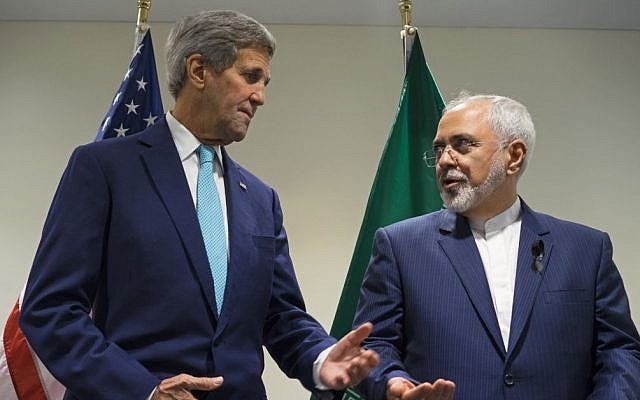
In this photo from Sept. 26, 2015, US Secretary of State John Kerry (left) meets with Iranian Foreign Minister Mohammad Javad Zarif at United Nations headquarters. (AP Photo/Craig Ruttle, File)

Former US secretary of state John Kerry on Monday denied Iranian Foreign Minister Mohammad Javad Zarif’s claim that the top US diplomat told him Israel had carried out 200 strikes on Iranian targets in Syria.

“I can tell you that this story and these allegations are unequivocally false. This never happened — either when I was Secretary of State or since,” Kerry tweeted.

The tweet cited a 2018 article by the Reuters news agency in which then-intelligence minister Israel Katz said that Israel had carried out over 200 airstrikes against Iranian targets in Syria over the previous two years.

Kerry’s denial came amid pressure from some parts of the Republican party after The New York Times published a report on a leaked interview Zarif gave last year.

Finance Minister Israel Katz at Tel Aviv’s Ichilov Medical Center on December 20, 2020 (Miriam Alster/Flash90)

Zarif said that he was often kept in the dark about security matters, and that “to his astonishment,” Kerry told him that Israel had attacked Iranian interests in Syria at least 200 times.

In the recording, Zarif told the interviewer that he hadn’t been told about key issues.

“Kerry has to tell me that Israel has attacked you 200 times in Syria?” said Zarif.

“You did not know?” the interviewer asked twice, according to direct quotes published by the Times for the first time on Monday evening, to which Zarif responded “no, no” on both occasions.

Zarif did not clarify when the purported conversation with Kerry took place. Kerry served as a chief negotiator for the 2015 nuclear deal between Iran and world powers and dealt closely with Zarif over the years.

Israel acknowledges having launched hundreds of strikes in Syria since the start of the civil war there in 2011, aimer to counter Iranian moves to establish a permanent military presence in the country and to transport advanced, game-changing weapons to terrorist groups in the region, principally Hezbollah.

Still, Israel’s official policy is to neither officially confirm nor deny specific operations in Syria, save for those in retaliation for an attack from the country.

US State Department spokesman Ned Price speaks at the State Department in Washington, March 31, 2021. (AP Photo/Carolyn Kaster, Pool)

State Department spokesman Ned Price on Monday noted the widespread reporting on Israel’s strikes and implied that even if Kerry had made the comments, the existence of the strikes was public knowledge.

“I would just make the broad point that if you go back and look at press reporting from the time, this certainly was not secret,” Price said. “And governments that were involved were speaking to this publicly, on the record.”

Some Republican officials attacked Kerry in the wake of the Times report, accusing him of leaking Israeli military secrets. Kerry, who now serves as US President Joe Biden’s special envoy on the climate crisis, was already under fire from the GOP over those policies.

“People are talking about treason — and I don’t throw that word around a lot,” said Alaska’s Sen. Dan Sullivan. “John Kerry does all kinds of things that I can’t stand. But this is the one that broke the camel’s back.”

Nikki Haley, who served as US ambassador to the UN under the Trump administration and is widely thought to be considering a 2024 presidential run, called the reported conversation between Kerry and Zarif “disgusting.”

However, others in the party urged a more cautious approach to Zarif’s comments.

Sen. Lindsey Graham, Republican-South Carolina, speaks during a Senate Judiciary Committee hearing on Capitol Hill in Washington, November 10,2020. (Susan Walsh/AP)

“I don’t know if we should trust that tape or not. If it’s true, it’s very damaging,” said Sen. Lindsey Graham. “I like John Kerry, but that would not be helpful and it would be very problematic if it were true. But let’s wait and see how authentic this is.”

Ahead of Kerry’s public response , Sen. Mitt Romney also said that the matter should be examined in light of the fact it was based only on the Iranian envoy’s comments, Politico reported.

“It’s very troubling, and there needs to be full transparency to understand exactly what was done, by whom, for what purpose, and an accounting of what occurred,” said Romney, a member of the Senate Foreign Relations Committee. “We have one recording by an Iranian official, but this is something that has to be evaluated and looked into.”

The most recent time a high-level US official was accused of divulging Israeli military secrets was 2017, when then-president Donald Trump told Russia of intelligence that reportedly came specifically from a spy embedded in the Islamic State terrorist group on behalf of Israel. The spy was also reportedly a major asset in gaining information on the actions of Iran in Syria — through its Revolutionary Guard Corps and Lebanese proxy Hezbollah. The leak reportedly placed the person’s life at risk and Israeli intelligence officials were said to have been outraged by Trump’s actions.

Zarif made the comments about Kerry in an hours-long taped conversation that took place last March as part of an oral history project. A copy was leaked to the UK-based Persian language news channel Iran International, which is viewed as hostile to Iran and is owned by Saudi Arabians.

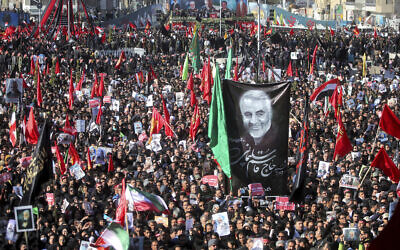
Mourners attend a funeral ceremony for Iranian Gen. Qassem Soleimani and his comrades, who were killed in Iraq in a US drone strike, in the city of Kerman, Iran, January 7, 2020.
(Erfan Kouchari/Tasnim News Agency via AP)

In the interview, Zarif also criticized the power of Qassem Soleimani, saying the assassinated head of the Islamic Revolutionary Guard Corps had been setting Tehran’s policy.

Zarif said that Soleimani had worked with Russia to sabotage the nuclear deal and acted in Syria’s long-running war in a way that damaged Tehran’s interests, as well as undermining him on a number of occasions, the Times reported.

“In the Islamic Republic the military field rules,” Zarif said. “I have sacrificed diplomacy for the military field rather than the field servicing diplomacy.”

The extracts also suggested Soleimani refused to listen to a request by Zarif’s Foreign Ministry that Tehran show less overt support for Syrian leader Bashar Assad, including not using state airline Iran Air to transport military equipment and personnel to Syria and not deploying ground forces to the war-torn country.

Zarif also criticized Soleimani for allowing Russian planes to fly over Iran on their way to bomb Syria.

According to the Times, Zarif could be heard on a number of occasions in the interview emphasizing that his words were not for publication.

Zarif also claimed that Soleimani traveled to Moscow to “demolish our achievement” and try to stop Russia’s support for the nuclear deal struck with world powers.


Zawartość publikowanych artykułów i materiałów nie reprezentuje poglądów ani opinii Reunion’68,
ani też webmastera Blogu Reunion’68, chyba ze jest to wyraźnie zaznaczone.
Twoje uwagi, linki, własne artykuły lub wiadomości prześlij na adres:
webmaster@reunion68.com


TV7 Israel News 26.4

TV7 Israel News 26.4

TV7 Israel News


1) Tensions escalated on Israel’s southern front with the Hamas-controlled Gaza Strip, over the weekend; when Palestinian Islamists launched at-least 45 rockets and mortar-shells toward Israel’s southern communities.

2) The Islamic Revolutionary Guards Quds Force Deputy Commander for Economic Affairs, former Iranian Oil Minister Rostam Ghasemi reveals that the Iranian-backed Houthi militia was the one which targeted Israeli vessels in recent months on Tehran’s behalf.

3) The Iranian-backed Houthi militia in Yemen announced that it “carried out (yet another) attack on the King Khalid Air Base in Saudi Arabia.


Zawartość publikowanych artykułów i materiałów nie reprezentuje poglądów ani opinii Reunion’68,
ani też webmastera Blogu Reunion’68, chyba ze jest to wyraźnie zaznaczone.
Twoje uwagi, linki, własne artykuły lub wiadomości prześlij na adres:
webmaster@reunion68.com


Coin from 2nd Temple Mount era found during Tower of David conservation

Coin from 2nd Temple Mount era found during Tower of David conservation

TOBIAS SIEGAL


Tyrian shekels are often mentioned in historical accounts from the Second Temple Period, but a very few have actually been found.

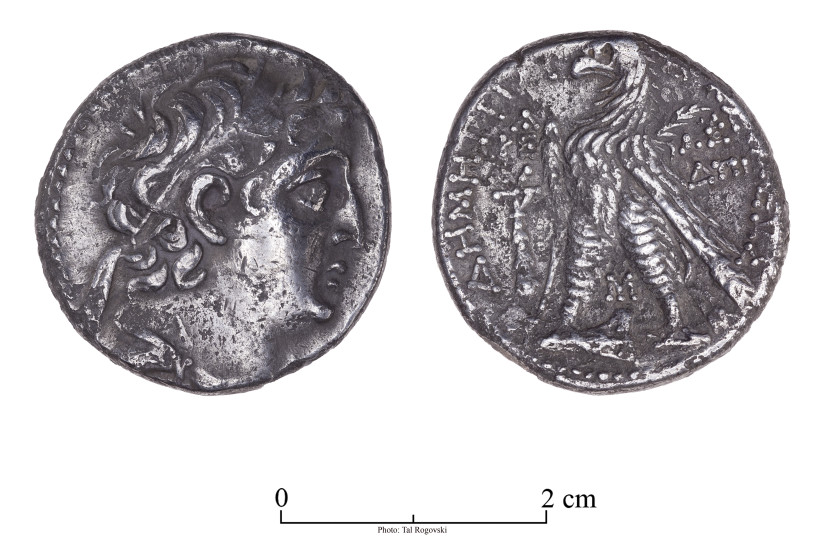
The Tyre coin recently discovered at the Tower of David Museum. / (photo credit: TAL ROGOVSKY)

In the midst of one of the most comprehensive conservation projects currently taking place in Israel, archeologists in Jerusalem’s Old City discovered a Tyre coin, believed to have been used to pay the Temple tax by pilgrims making their way to the Temple for Passover, Shavuot or Sukkot.

The ancient coin was found inside a box of artifacts originally excavated in the 1980s, when the last conservation project took place at the site.

The box was somehow lost and only discovered recently as part of a well-needed conservation project currently taking place at the Tower of David Museum.

The box included the rare silver coin, called a “Tyre shekel,” which was used during the Second Temple Period and produced in the ancient city of Tyre, where Tyrian shekels were minted from 125 BCE until the outbreak of the Great Revolt in 66 CE.

Tyrian shekels are often mentioned in historical accounts from the Second Temple Period, but very few have actually been found.
The Tower of David complex, where the exciting finding was made, includes the ancient palace of Herod, where many theologians and historians believe that the trial of Jesus took place. The tallest tower in the complex is called the Phasael Tower, which was the first to be identified as the “Tower of David” in the 5th century CE.

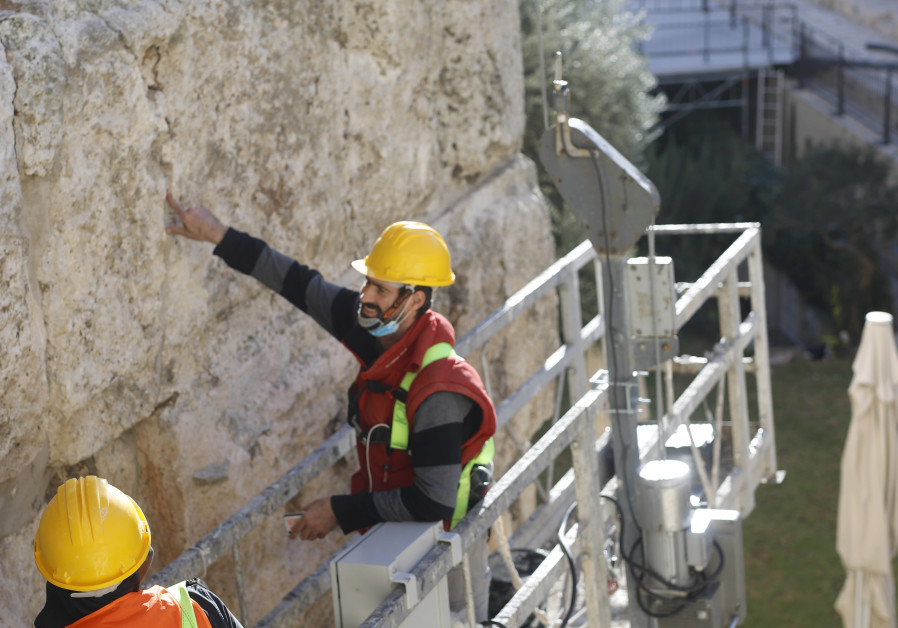
conservation work taking place at the Phasael tower. A wide crack running from top to bottom is threatning the tower’s entire structural integrity. (Credit: Tower of David Museum)

It is that tower that is currently undergoing major conservation. A large crack running from top to bottom is threatening the tower’s entire structural integrity, which has led the conservation team leading the project to expedite its efforts to restore the 2,000-year-old damaged stones.

“The Tower of David is one of the most important structures in Israel, both in terms of its history and location,” said Yotam Carmel, conservation manager at Ken HaTor, the company put in charge of the project. “The last conservation project at the Tower of David was carried out in the 1980s. Since then the citadel has been in desperate need of conservation.”

Eilat Lieber, director and chief curator of the Tower of David Museum, noted the importance of the conservation project for future generations.
“At this holiday time, we are grateful for this unique opportunity to physically preserve the walls and towers of this ancient site that stood during the time of the Second Temple thousands of years ago, helping to preserve and conserve the site so that it continues to be a beacon in Jerusalem for future generations to come,” Lieber said.

The Tower of David Museum, located in the ancient citadel at the Jaffa Gate entrance to the Old City, will remain open for the general public throughout the year, in accordance with Health Ministry guidelines.

The coin that was recently discovered will be displayed next year in a new and permanent exhibit at the museum.


Zawartość publikowanych artykułów i materiałów nie reprezentuje poglądów ani opinii Reunion’68,
ani też webmastera Blogu Reunion’68, chyba ze jest to wyraźnie zaznaczone.
Twoje uwagi, linki, własne artykuły lub wiadomości prześlij na adres:
webmaster@reunion68.com