Archives

News From Israel- Apr. 21, 2021

News From Israel- Apr. 21, 2021

ILTV Israel News


#Iran​ claims to have found the culprit in the #Natanz​ nuclear plant explosion earlier this month.
–
Israel works towards some common-sense reforms following a tragic and ultimately avoidable death.
–
The first heatwave of 2021 is here… and you might want to avoid cooling off along the coasts.


Zawartość publikowanych artykułów i materiałów nie reprezentuje poglądów ani opinii Reunion’68,
ani też webmastera Blogu Reunion’68, chyba ze jest to wyraźnie zaznaczone.
Twoje uwagi, linki, własne artykuły lub wiadomości prześlij na adres:
webmaster@reunion68.com


Archaeology: Israel’s national pastime – analysis

Archaeology: Israel’s national pastime – analysis

HERB KEINON


Embers still burn from the country’s once great passion for excavations.

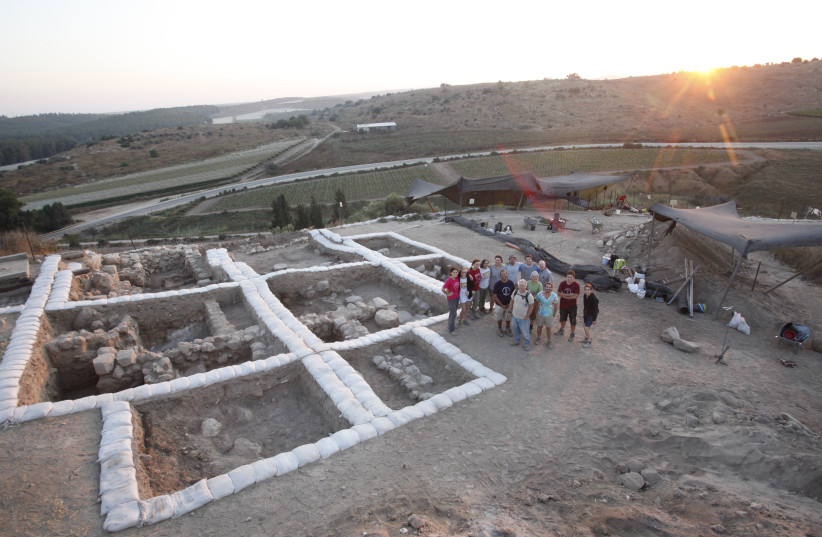
A team of archaeologists, led by Prof. Yosef Garfinkel of the Hebrew University of Jerusalem’s Institute of Archaeology and Prof. Michael Hasel at Southern Adventist University in Tennessee, revealed extensive ruins of a Canaanite temple dating / (photo credit: Courtesy)

“Archaeology in Israel is a popular movement,” Amos Elon wrote in his 1971 book The Israelis: Founders and Sons. “It is almost a national sport. Not a passive spectator sport but the thrilling, active pastime of many thousands of people, as perhaps fishing in the Canadian Lake Country or hunting in the French Massif Central.”

Those words, published a half-century ago, reverberated this week as dramatic archaeological finds hit the front pages of the newspapers, and squeezed into prime-time television and radio news shows.

While it has been a long time since one could honestly say they felt that same fervor for archaeology among the masses as Elon described, the fact that the media did devote so much attention to these findings on Tuesday – in a week dominated by political news – indicates that the embers still burn from the country’s once great passion for excavations.

On Tuesday, the Antiquities Authority (IAA) announced a trove of finds from a wide-scale archaeological operation ongoing since 2017 in hidden caves in the Judean Desert, in cooperation with the Civil Administration’s Archaeological Department.

Among the finds were an ancient woven basket, believed to be some 10,500 years old, and the 6,000-year-old skeleton of a child. Those were the “universal” finds. Of more particular Jewish interest were the discovery of fragments of ancient scrolls of the biblical books of Zechariah and Nahum, as well as coins dating to the Bar-Kochba revolt in 132 CE.

And these findings come just a week after another archaeological story was highlighted in the media: an 11-year-old boy hiking with his family in the Negev discovered a figurine, believed to be a fertility amulet, dating to the First Temple period.

The findings announced on Tuesday from the Judean Desert were not just stumbled upon this week. The findings were announced on Tuesday, but the artifacts themselves were discovered over a year ago.

Why is that important? Because the IAA seem to have made a decision to announce the findings together – both those of a universal character and those particularly Jewish.

And why is that significant? Because Israeli archaeologists have often been accused of focusing on finds that would validate Jewish claims to the Land of Israel, at the expense of highlighting discoveries – such as the 10,500-year-old basket and 6,000-year-old skeleton – that do not have an “Israeli angle.”

“For the disquieted Israeli, the moral comforts of archaeology are considerable,” Elon wrote 50 years ago. “In the political culture of Israel, the symbolic role of archaeology is immediately evident. Israeli archaeologists, professionals and amateurs are not merely digging for knowledge and objects, but for the reassurance of roots, which they find in the ancient Israelite remains scattered throughout the country.”

It is only natural that a people, accused far and wide of being interlopers in a land not its own, would find comfort in artifacts testifying to its presence in that land going back more than three millennia.

From Masada to the City of David to Tel Shilo, whenever Israeli archeologists make a startling discovery shedding light on biblical or Jewish history, they are accused of searching for and finding only Jewish artifacts in an attempt to whitewash the history of other peoples that historically roamed and resided in this land.

But finding Jewish artifacts – or even focusing on the discovery of Jewish archaeological sites – does not deny the presence of other civilizations here. What those finds are able to do, however, is to refute the arguments of those who deny that Jews were among all those people who did roam and reside here, including in Jerusalem.

It was, for instance, Yasser Arafat who told US president Bill Clinton at Camp David in 2000 that there was no Temple on the Temple Mount, but that it was rather in Nablus. And in 2016, the United Nations Educational, Scientific and Cultural Organization (UNESCO) passed a resolution that referred to the Temple Mount exclusively by its Arabic name – Haram al-Sharif – thereby erasing any Jewish link to the site or to Jerusalem.

By unveiling both Jewish and general archaeological discoveries on the same day, the IAA made a statement: we are interested and focused on both Jewish and general discoveries.

But as significant as the discovery of the woven basket and that ancient mummified skeleton were, for most Israeli Jews the particular Jewish findings likely resonated more loudly.

The bones of early man can be found in the plains of Tanzania; ancient woven baskets can be located in the pyramids of Peru. But only in Israel will you find a Greek translation of Zechariah, with the word “God” written in ancient Hebrew, and only in Israel will you find coins minted to commemorate the last great stab at Jewish independence.

And what was one of the biblical fragments discovered and painstakingly reconstructed? A verse from Zechariah (8:16-17) eerily relevant as Israel gears up for Tuesday’s election:

“These are the things you are to do: Speak the truth to one another, render true and perfect justice in your gates. And do not contrive evil against one another, and do not love perjury, because all those are things that I hate – declares the Lord.”

Giving voice to the feelings of many who were excited and even moved by the findings, Ofer Sion, head of the Antiquities Surveys Departments, said in a Channel 13 interview that “within hand’s reach” is a fragment “that a Jew, one of your forefathers, one of your great-grandparents, read from.”

Calling this the “apex,” he said that after 1,900 years of “horrible exile,” artifacts such as those found in the Judean Desert are “the closest we can come to our forefathers.”


Zawartość publikowanych artykułów i materiałów nie reprezentuje poglądów ani opinii Reunion’68,
ani też webmastera Blogu Reunion’68, chyba ze jest to wyraźnie zaznaczone.
Twoje uwagi, linki, własne artykuły lub wiadomości prześlij na adres:
webmaster@reunion68.com


Armani Removes From Sale Blazer Resembling Holocaust Concentration Camp Uniform

Armani Removes From Sale Blazer Resembling Holocaust Concentration Camp Uniform

JNS.org


The fashion company Georgio Armani pulled an item from sale that resembled prison uniforms worn in concentration camps, April 2021. Photo: Twitter.

The Italian high-end fashion house Giorgio Armani recently removed from sale a blazer that resembled a Holocaust concentration camp uniform following a request by the pro-Israel organization StandWithUs.

Roz Rothstein, CEO and co-founder of StandWithUs, first shared a photo of the “offensive” black-and-white vertically striped jacket on April 4 on Twitter, after being displayed outside an Armani store in Beverly Hills, Calif.

A photograph of the blazer, part of the fashion label’s spring-summer 2021 Men’s Collection, was also shared on Armani’s official Instagram page.

Rothstein called on Armani to apologize and remove the item for purchase.


Roz Rothstein @RozRothstein

A better view of the new offensive Armani jacket displayed in Beverly Hills. Armani: apologize and remove it!

Image

10:30 PM · Apr 4, 2021


StandWithUs said on Facebook about the “distasteful” item: “This is an awful look for anyone who cares about Holocaust memory or for anyone with their own personal memory of Nazi concentration-camp uniforms that prisoners were forced to wear. Georgio Armani should rethink and withdraw this insensitive ‘style.’ ”

The organization announced on Tuesday that Armani had responded to its request by pulling the item. The photo of the jacket on Armani’s Instagram page was also deleted.


Zawartość publikowanych artykułów i materiałów nie reprezentuje poglądów ani opinii Reunion’68,
ani też webmastera Blogu Reunion’68, chyba ze jest to wyraźnie zaznaczone.
Twoje uwagi, linki, własne artykuły lub wiadomości prześlij na adres:
webmaster@reunion68.com


The Warsaw Ghetto Revolt was initially dubbed ‘fake news’ by some US Jews

The Warsaw Ghetto Revolt was initially dubbed ‘fake news’ by some US Jews

MATT LEBOVIC


New book ‘The Jewish Heroes of Warsaw’ traces the immediate aftermath of Holocaust’s most famous revolt, including the ‘gendering’ of resistance and politicization of its narrative
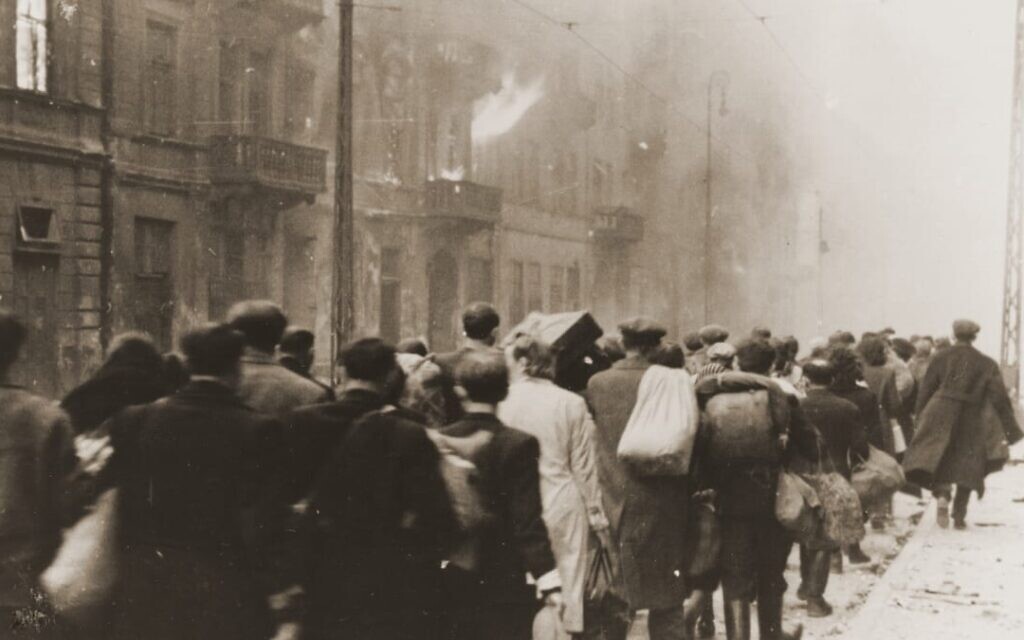
Jews marched out of the ghetto during Warsaw Ghetto Revolt in April and May, 1943 (public domain)

When American political cartoonist Arthur Szyk decided to commemorate the one-year anniversary of the Warsaw Ghetto Revolt, he crafted a montage dedicated to “the heroic battle of our brothers in the war against the Nazi barbarians,” as the caption read.

The image showed a cross-section of Warsaw Jews fighting against a Nazi war machine intent on burning the ghetto to the ground. Most of the ghetto’s 400,000 Jews had already been deported to the death camp Treblinka in 1942, and about 800 people — most of them young adults — participated in armed resistance the following year.

Although Szyk knew that women were involved in the revolt, no woman appeared in his widely circulated image. There were boys with side-curls and men in workers’ caps, as well as resisters with symbols nodding to socialism, Zionism, and Polish nationalism — just no women.

“The memory of the revolt and memory of resistance does end up being very gendered,” said historian Avinoam Patt, whose book — “The Jewish Heroes of Warsaw: The Afterlife of the Revolt” — will be published on May 4.

Among ways in which the revolt was “edited” for American audiences, said Patt, was a “specific type of heroic image that privileged masculine fighters as leaders of the resistance while presenting women as symbols of martyrdom and sacrifice,” he told The Times of Israel in an interview.

In his book, Patt explores the revolt’s immediate afterlife, when Jewish communities began to “process” what took place and shape narratives that still endure. For example, Patt demonstrates how the revolt was memorialized in Israel to enforce Zionist ideology, while American Jews generally framed the revolt as part of Allied war efforts.

“The book looks at the interplay of history and memory,” said Patt, director of the Center for Judaic Studies at the University of Connecticut.
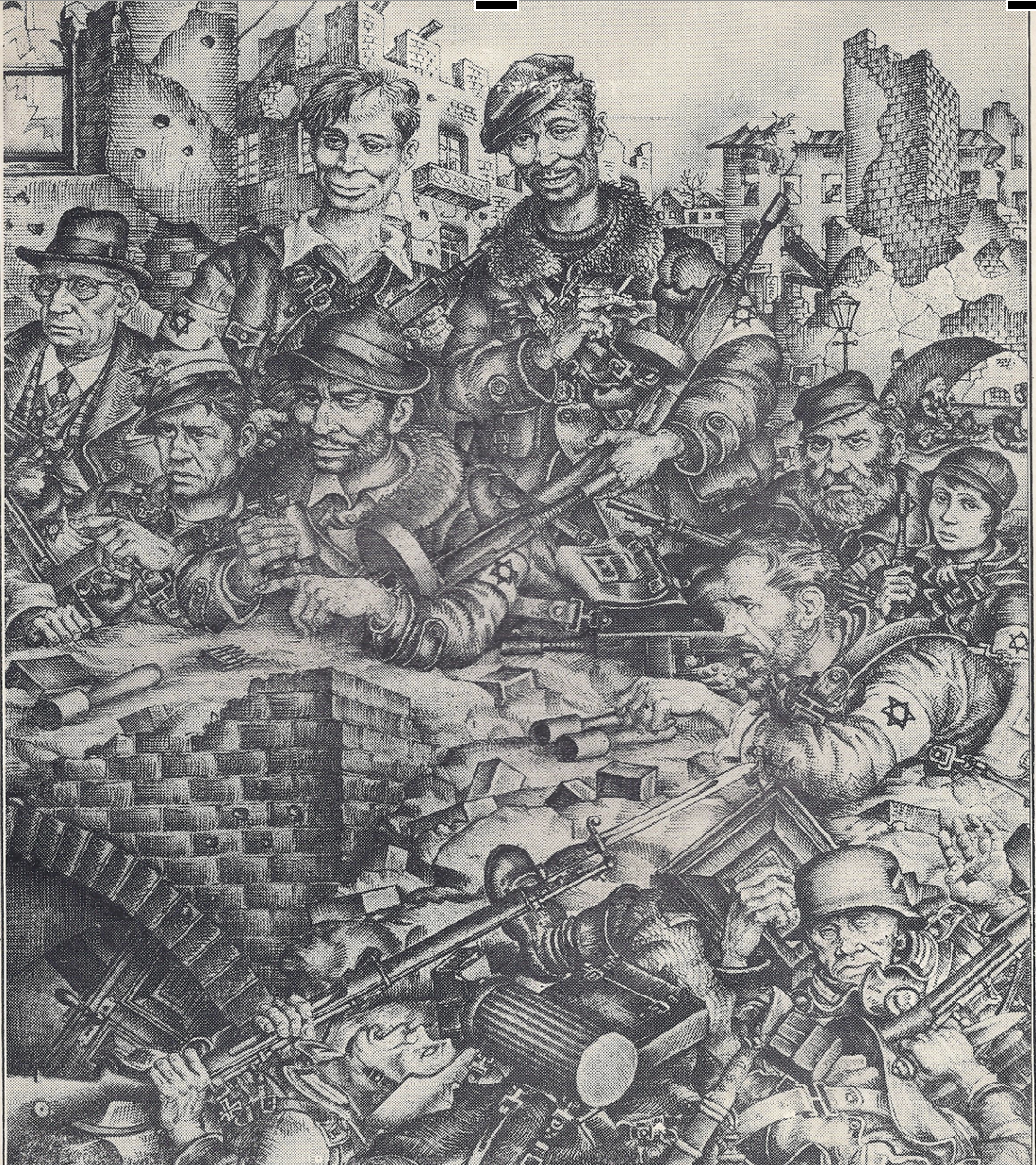
Arthur Szyk’s commemorative montage of the Warsaw Ghetto Revolt (public domain)

When the Warsaw Ghetto Revolt broke out on April 19, 1943, Jews around the world were sitting down for the Passover seder. By this point in the war, it was widely known that millions of Jews were being murdered across Europe. However, in the United States, American Jewish leaders had been unable to catalyze large-scale rescue actions.

News of the revolt hit just as people were shifting from “active rescue efforts” to “memorial mode,” said Patt, and not everyone in the US believed a revolt had taken place.

Historian Avinoam Patt (courtesy)

For example, New York’s influential “Der Tog” would not confirm an uprising took place until May 12. In an editorial, the Yiddish newspaper said the revolt was likely a German “pretext” to conduct a massacre, and that unarmed Jews were not able to hold off an army that devoured Poland in four weeks.

Apart from the stance of “Der Tog,” however, the American Jewish press generally picked up the story. For example, “The Forward” printed a front-page story about the revolt on April 23, just four days after the outbreak of fighting.

In both the US and Israel, media outlets erroneously reported that “Polish commandos” had infiltrated the ghetto to help lead fighting. In fact, no such commandos participated, and the ghetto’s Jewish Fighting Organization managed to obtain only a few weapons from Polish resistance leaders.

‘A revolution in Jewish history’

As Jews slowly learned the identities of Warsaw Ghetto Revolt fighters, fictionalized accounts began to appear. In the Yiddish play, “The Battle of the Warsaw Ghetto,” the heroes were fictionalized to meet the needs of a dramatic NBC radio production, for example.

“In the American context, the identities of the heroes seemed less important,” said Patt. “For Zionist leaders in the Yishuv, the names matter greatly, as they did for Bundists in New York and elsewhere,” he said.

For American Jews, the revolt was most important as a symbol of Jews’ contribution to the Allied war effort, said Patt. The fictionalization of the revolt endured for decades, including the seminal 1961 book, “Mila 18,” by Leon Uris.
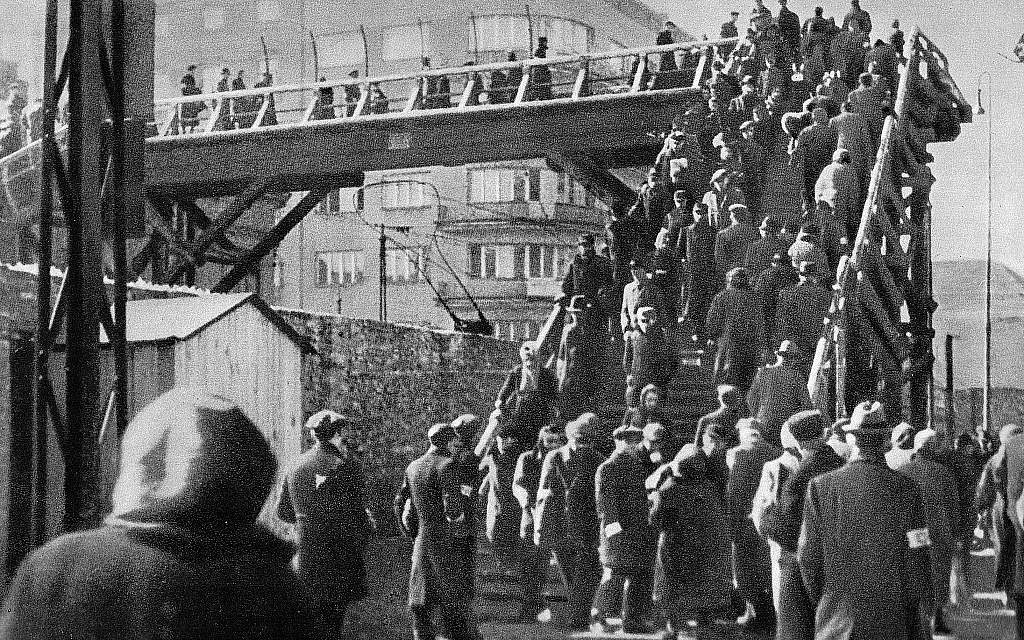
Warsaw Ghetto footbridge connecting cut-off parts of the ghetto from Aryan Warsaw under Nazi occupation (public domain)

“The revolt was interpreted differently by different groups of Jews,” said Patt. “Current social and political agendas shape how history is recorded,” he said.

During the months following the revolt, a public relations battle was waged behind the scenes. Specifically, Zionist leaders were alarmed that Bundist leaders were claiming credit for what took place in Warsaw.

In May 1944, several Zionist leaders hiding in Aryan Warsaw compiled accounts of the revolt from all fighting sectors of the ghetto. The document trove was sent to London, and the name Mordechai Anielewicz — the revolt’s 24-year old leader — entered into Zionist and Jewish history.

Zivia Lubetkin (public domain)

When Zionist leaders compiled their 120-pages of testimony, they made sure to elevate the movement’s role in unifying resistance movements across the ghettos. The narrative that only Jews can protect themselves contrasted — for example — with the Bundists’ emphasis on Jewish-Polish cooperation.

In Israel, the revolt came to be seen as “a revolution in Jewish history.” The uprising’s first day became an “anchor” for Yom HaShoah and the creation of Yad Vashem, as well as the resistance-oriented nature of Israeli Holocaust memory in general.

One of the “Jewish heroes of Warsaw” featured in Patt’s book is Zivia Lubetkin, whose eight-hour speech about the revolt sent shockwaves through pre-state Israel in June 1946. Along with other former resisters, Lubetkin founded the Ghetto Fighters’ Kibbutz in 1949 to commemorate that chapter of Jewish history.

Still, Patt notes, while certain names of Jewish heroes would be recorded by history, others would fade from collective memory, along with the experiences of the Jewish masses who constituted the bulk of the population in the ghetto.

Baking matzah in the Warsaw Ghetto, Nazi-occupied Poland (Courtesy: Yad Vashem Photo Archives 24DO6)

“The symbolic spirit that animated the fighters would be more important than the identities of the actual fighters themselves, just as political interpretations that reinforced the existing worldviews of Jews in Israel and America would matter more than the complexities of wartime behavior that led to the revolt,” said Patt.

“Historians would seek to record the names of heroes in the ghetto; memory only demanded that the Jewish people remember that those heroes had fought for Jewish honor and dignity,” added the historian.


Zawartość publikowanych artykułów i materiałów nie reprezentuje poglądów ani opinii Reunion’68,
ani też webmastera Blogu Reunion’68, chyba ze jest to wyraźnie zaznaczone.
Twoje uwagi, linki, własne artykuły lub wiadomości prześlij na adres:
webmaster@reunion68.com


TV7 Israel News 19.04

TV7 Israel News 19.04

TV7 Israel News


1) Gazan Islamists launched a rocket toward Israel’s southern communities over the weekend – drawing an Israeli retaliatory response.

2) The Foreign Ministers of Cyprus, Greek, Israel and the United Arab Emirates conclude a multilateral meeting – aimed at further deepening regional cooperation on multiple areas of joint interest.

3) U.S. President Joe Biden voices satisfaction that despite the latest developments the Islamic Republic of Iran remains engaged to try and revive the 2015 nuclear agreement.


Zawartość publikowanych artykułów i materiałów nie reprezentuje poglądów ani opinii Reunion’68,
ani też webmastera Blogu Reunion’68, chyba ze jest to wyraźnie zaznaczone.
Twoje uwagi, linki, własne artykuły lub wiadomości prześlij na adres:
webmaster@reunion68.com