Archives

Mine-free River Jordan shrine ends 50 year wait for Epiphany

Mine-free River Jordan shrine ends 50 year wait for Epiphany

REUTERS


Israeli de-mining efforts began in 2018 and included support from the Halo Trust, a Scottish-based mine clearance group.

Worshippers attend a mass at the Franciscan Church that was reopened after landmines were removed at the Qasr el-Yahud site, near Jericho, in the Israeli-occupied West Bank, January 10, 2021. / (photo credit: AMMAR AWAD/REUTERS)

A shrine near the traditional site of Jesus’ baptism on the River Jordan hosted an Epiphany procession for the first time in more than 50 years on Sunday after it was declared free of landmines.

The historic event, coordinated by the Unit for Coordination of Government Activities in the Territories (COGAT), the Israel Nature and Parks Authority, the IDF and Israel Police, began with Father Francesco Patton, the custodian of the Holy Land for the Roman Catholic Church, leading Franciscan friars towards a shrine in what was once a war zone between Israel and Jordan.

Although the two countries have been at peace since 1994, seven churches laid abandoned for more than 50 years in the area of de-mining operations. The area lies about a kilometer from the Qasr al-Yahud baptism site in the West Bank, which is a major draw for Christian pilgrims.

“Today, we are back to pray,” Father Ibrahim Faltas, one of the clergymen at the ceremony, said. Attendance at the procession, which commemorates the baptism of Jesus by John the Baptist, was capped at 50 due to COVID-19 restrictions.

Israeli de-mining efforts began in 2018 and included support from the Halo Trust, a Scottish-based mine clearance group, an Israeli official said.
As of 2021, “the danger has been completely removed,” a branch of Israel’s Defense Ministry said.

After visiting the shrine, the friars passed fading signs reading “DANGER – MINES!” in English, Arabic and Hebrew as they went down to the river to pray.

“We will continue working during the COVID-19 pandemic to coordinate the traditional baptism ceremonies for the other Christian denominations and to preserve the freedom of worship and of religion for all believers,” added Lt.-Col. Amos Twito, the head of Jericho District Coordination and Liaison Office (DCL), said, “I will take this opportunity to wish all Christians a happy holiday and a good year.”


Jerusalem Post Staff contributed to this report.


Zawartość publikowanych artykułów i materiałów nie reprezentuje poglądów ani opinii Reunion’68,
ani też webmastera Blogu Reunion’68, chyba ze jest to wyraźnie zaznaczone.
Twoje uwagi, linki, własne artykuły lub wiadomości prześlij na adres:
webmaster@reunion68.com


World’s first food processor, from 350,000 years ago, found near Haifa

World’s first food processor, from 350,000 years ago, found near Haifa

BROWN JANUARY


The food processor is the oldest abrasion tool ever found.
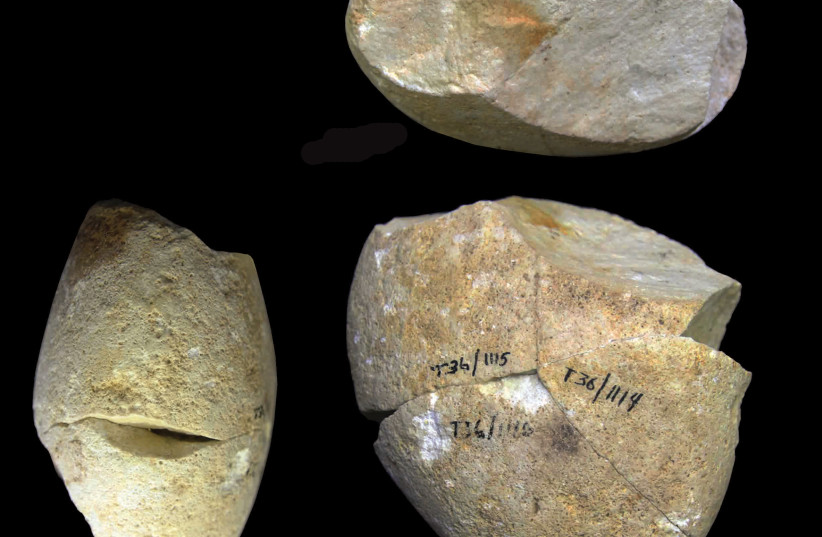
The oldest abrasion tool ever found, it is about 350,000 years old and was discovered in Tabun Cave on Mount Carmel. / (photo credit: COURTESY DR. IRIS GROMAN-YAROSLAVSKI)

Researchers have identified the oldest abrasion tool ever found, which is about 350,000 years old and was discovered in Tabun Cave on Mount Carmel in northern Israel, near Haifa, and which researchers think was used for processing food.

A new study published in the prestigious Journal of Human Evolution by Dr. Ron Shimelmitz, Dr. Iris Groman-Yaroslavski, Prof. Mina Weinstein-Evron, and Prof. Danny Rosenberg of the Zinman Institute of Archaeology at the University of Haifa identifies the oldest tool used for abrading various materials from around 350,000 years ago, before the appearance of Homo sapiens.

The tool, a rounded dolomite pebble bearing microscopic signs of abrasion, was found in Tabun Cave on Mount Carmel, one of the key prehistoric sites in Israel and around the world. The finding predates by around 150,000 years all other tools found to date bearing signs of abrasion.

“Although we were not able to associate this item with certainty to food processing, it is highly probable that it was used for this purpose. Whatever the case, for those of us who are involved in the archaeology of food and of food-processing methods in different periods – from prehistory to modern times – this little pebble from Tabun is of enormous importance. It allows us to explore the earliest origins of the act of abrasion and to see how cognitive and motor capabilities that developed over the course of human evolution ultimately led to phenomena that continue to be important in modern human culture. These processes had their beginnings in abrasion and in the development of food processing techniques, and extended to such realms as the transition to permanent settlements, agriculture, storage, and the rise in social and economic complexity,” said Rosenberg, who is head of the Laboratory for the Study of Stone Tools and Ancient Food Processing Technologies.

The researchers concluded in the paper that, “The unusual finding from Tabun Cave shows that hominins processed various materials by means of abrasion as early as 350,000 years ago. In other words, at a very early stage, they added a crucial technology to their toolkit showing that they were both willing and able to process materials in various ways in order to maximize their exploitation of the resources they found around them.”

Tabun Cave, which forms part of the UNESCO Sites of Human Evolution at Mount Carmel, the Nahal Me’arot / Wadi el-Mughara Caves, is unique due to the series of approximately 100 superimposed archaeological layers that have been exposed in it, testifying to the activities of hominins over the past 500,000 years.

For 90 years, the site has been an important focus for the study of human evolution. The groundbreaking finding was uncovered as part of a new project led by Shimelmitz, together with Weinstein-Evron and partners from Israel and abroad. The project is causing scientists to reexamine findings from previous excavations at the site as part of the project supported by the Israel Science Foundation, the Gerda Henkel Foundation and the Dan David Foundation.

WHILE ANALYZING findings discovered in the excavations undertaken at the cave in the 1960s by Prof. Arthur Jelinek of the University of Arizona that have not previously been researched or published, Shimelmitz noticed that one of the stones showed clear signs of abrasion. These signs were similar to those found on much later stone tools, but had not been seen before on tools dating back this far.

A careful analysis of the item in the laboratories of the Zinman Institute of Archaeology provided a systemic profile of the signs of use-wear on the surface of the stone. The research, undertaken together with Rosenberg, and Groman-Yaroslavski, head of the Laboratory for Use-Wear Analysis, focused on a microscopic examination of the pebble.

In order to understand and interpret the patterns seen under the microscope, the researchers undertook a series of controlled abrasion experiments using natural dolomite pebbles collected on Mount Carmel that have similar characteristics to the pebble found in Tabun Cave. During the experiment, various materials were abraded over different periods of time using the pebbles, which were immediately subjected to microscopic examination to identify the abrasion patterns created in the experiments.

“Although the results did not show a full correlation between the patterns of abrasion seen on the unique pebble and those we documented in our experiments, we found a high level of similarity to the abrasion marks found following the abrasion of animal skins. Accordingly, we concluded that the ancient stone-tool was used for the abrading of soft materials, although we still do not know exactly which,” Groman-Yaroslavski explained.

“Although this tool is ostensibly ‘simple,’ its appearance at such an early date and the fact that it is unparalleled in findings from this early stage of human evolution mean that it is of global importance,” the researchers said, explaining that the early appearance of abrasion technology underscores the depth and complexity of the chain of technological innovations associated with human evolution, such as when and where hominins began to abrade food and other materials.

“In essence, the evolution of technology manifested in the stone tools is a direct reflection of the patterns of change in the ability of ancient hominins to shape their environment,” Shimelmitz explained, noting that the period of time 400,000 – 200,000 years ago saw some of the most important technological innovations and significant changes in human behavior. “For example, the use of fire becomes part of the daily routine, as well as the use of base camps from which the hominins went out for various activities.

Thus, the abrasion technology does not appear in isolation, but as part of a network of broader changes that, to an extent anticipates the more complex behavior with which we are familiar from later hominins such as Neanderthals and Homo sapiens.”

The next evidence of the use of abrading comes only after some 150,000 years, leading researchers to speculate whether this ability was lost for nearly 200,000 years and then found again. This will be one of the questions archaeologists will focus on when they continue their research on this stone.


Zawartość publikowanych artykułów i materiałów nie reprezentuje poglądów ani opinii Reunion’68,
ani też webmastera Blogu Reunion’68, chyba ze jest to wyraźnie zaznaczone.
Twoje uwagi, linki, własne artykuły lub wiadomości prześlij na adres:
webmaster@reunion68.com


TV7 Israel News 03.02.21

Israel-UAE-Bahrain to present united-stance to US; Iran rejects any compromise-TV7

TV7 Israel News


1) The Islamic Republic of Iran maintains an uncompromising position, vowing to reject any Western demand to amend the 2015 nuclear agreement – while in tandem – the Ayatollah regime is aspiring to utilize the European Union to draw the United States back into the deal.

2) The Biden Administration reiterates its intention to resume financial aid to the Palestinians.

3) Israeli Prime Minister Benjamin Netanyahu is scheduled to visit the United Arab Amirates and the Kingdom of Bahrain, next week.


Zawartość publikowanych artykułów i materiałów nie reprezentuje poglądów ani opinii Reunion’68,
ani też webmastera Blogu Reunion’68, chyba ze jest to wyraźnie zaznaczone.
Twoje uwagi, linki, własne artykuły lub wiadomości prześlij na adres:
webmaster@reunion68.com


Ancient Greek inscription found by chance in the Negev

Ancient Greek inscription found by chance in the Negev

HANNAH BROWN


The stone was found by a “Project 500” worker from the Parks and Nature Authority while cleaning and preparing nature paths in the Nitzana National Park.

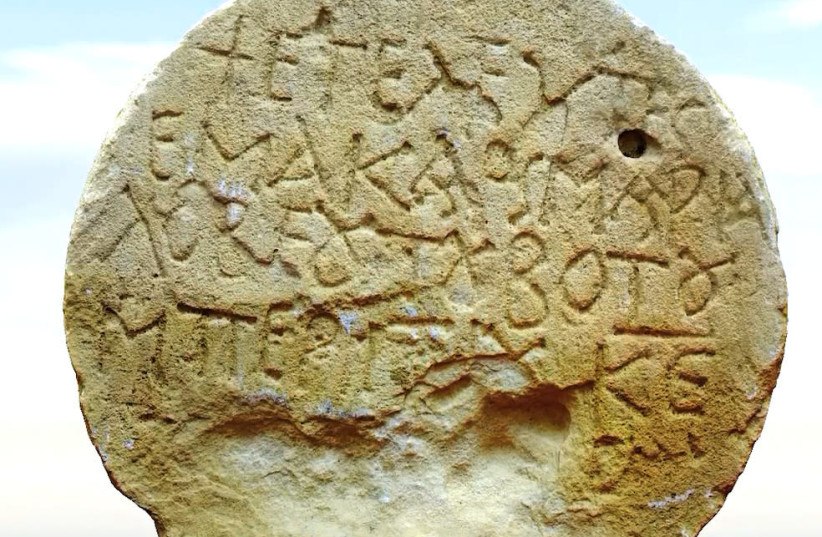
The stone bearing a Greek inscription found by chance in the Negev. / (photo credit: EMIL ALADJEM/ISRAEL ANTIQUITIES AUTHORITY)

A stone bearing an inscription in Greek from the end of the Byzantine period was discovered last weekend in the Nitzana National Park in the Negev. The flat, round stone, c. 25 cm. in diameter, was used as a tombstone in one of the cemeteries surrounding the ancient settlement.

The stone was found by a “Project 500” worker from the Israel Nature and Parks Authority while cleaning and preparing nature paths in the Nitzana National Park.

The stone was left at the head of the path, where it caught the eye of David Palmach, the director of the Nitzana Educational Eco-Village, who realized that it bore an inscription. Palmach photographed and collected it, to prevent its being looted. He also contacted the INPA and the Antiquities Authority, and the inscription is being transferred to the National Treasuries Department.

The inscription was deciphered by Dr. Leah Di Segni of the Hebrew University of Jerusalem and it refers to “Blessed Maria, who lived an immaculate life” and died on February 9. The stone dates from the late sixth-early seventh centuries CE.

According to Dr. Tali Erickson-Gini of the Antiquities Authority, “Nitzana is renowned as a key site in research into the transition between the Byzantine and the early Islamic periods. During the fifth and sixth centuries CE, Nitzana acted as a center for the villages and settlements in the vicinity. Among other things, it had a military fortress as well as churches, a monastery and a road station that served Christian pilgrims traveling to Santa Katarina, which believers regarded as the site of Mount Sinai.”

According to Erickson-Gini, Nitzana was founded in as early as the third century BCE as a Nabataean road station on a major trade route, and the place was inhabited intermittently for about 1,300 years, until it was abandoned in the 10th century CE and its name was forgotten.

Archaeological excavations at the site in the 1930s unearthed a papyrus archive, and the name “Nessana” was rediscovered. The burial-stone find, naming the deceased as Maria, joins other stones commemorating Christians buried in the churches and cemeteries around Nitzana that have been unearthed in excavations by the Ben-Gurion University of the Negev, among others.

Antiquities Authority Southern District archaeologist Pablo Betzer said, “Unlike other ancient towns in the Negev, very little is known about the burial grounds around Nitzana. The find of any inscription such as this may improve our definition of the cemeteries’ boundaries, thus helping to reconstruct the boundaries of the settlement itself, which have not yet been ascertained.”


Zawartość publikowanych artykułów i materiałów nie reprezentuje poglądów ani opinii Reunion’68,
ani też webmastera Blogu Reunion’68, chyba ze jest to wyraźnie zaznaczone.
Twoje uwagi, linki, własne artykuły lub wiadomości prześlij na adres:
webmaster@reunion68.com


Israeli Actress Shira Haas and Netflix Mini-Series ‘Unorthodox’ Nominated for Critics Choice Awards

Israeli Actress Shira Haas and Netflix Mini-Series ‘Unorthodox’ Nominated for Critics Choice Awards

Shiryn Ghermezian


Israeli actress Shira Haas in 2018. Photo: Wikimedia Commons.

Netflix mini-series “Unorthodox” and its Israeli star Shira Haas both garnered nominations for the Critics Choice Awards, it was announced on Monday.

In the category of Best Limited Series, the show, about an ultra-Orthodox woman named Esty who breaks away from Brooklyn’s Hasidic Jewish community, is up against “I May Destroy You,” “Mrs. America,” “Normal People,” “The Plot Against America,” “The Queens Gambit,” “Small Axe,” and “The Undoing.”

Haas was nominated for Best Actress in a Limited Series or Movie Made for Television alongside Cate Blanchett (“Mrs. America”), Michaela Coel (“I May Destroy You”), Daisy Edgar-Jones (“Normal People”), Anya Taylor-Joy (“The Queen’s Gambit)” and Tessa Thompson (“Sylvie’s Love”).

The 25-year-old shared the news in an Instagram post and said, “WOW! Thank you @criticschoice for this great honor.”

Haas also received an Emmy nomination last year for her role in “Unorthodox.”

Last week, she talked about her “very challenging but also very empowering” head-shaving scene in the Netflix show at the InFocus: Israeli Cinema virtual film festival, in which she appeared via Zoom on a panel discussion with Israeli filmmakers. Haas, who also stars in the Israeli television series “Shtisel” and Israel’s Oscar submission “Asia,” recalled, “It was on the first shooting day. I had such long hair then. One heck of a welcome.”

“It’s such an important scene and a very symbolic one,” she added. “It’s a story about a woman who’s finding her voice, and in that scene, she’s literally finding it. It was [filmed] live and there were a lot of people and cameras. I was really nervous about singing in front of everyone and messing up. I felt a lot of responsibility to do it right.”

The 26th annual Critics Choice Awards ceremony will be held on Sunday, March 7, 2021, at the Barker Hangar in Santa Monica, Calif. It was air that same day on The CW.


Zawartość publikowanych artykułów i materiałów nie reprezentuje poglądów ani opinii Reunion’68,
ani też webmastera Blogu Reunion’68, chyba ze jest to wyraźnie zaznaczone.
Twoje uwagi, linki, własne artykuły lub wiadomości prześlij na adres:
webmaster@reunion68.com