
Archives

Ancient marketplace in Tiberias may have been one of Islam’s first mosques

Ancient marketplace in Tiberias may have been one of Islam’s first mosques

SARAH BEN-NUN


The excavations estimate that what was unearthed underneath the structure — the outer layer of a mosque — might actually date back to 635 CE, constructed by a friend of the Prophet Muhammad.
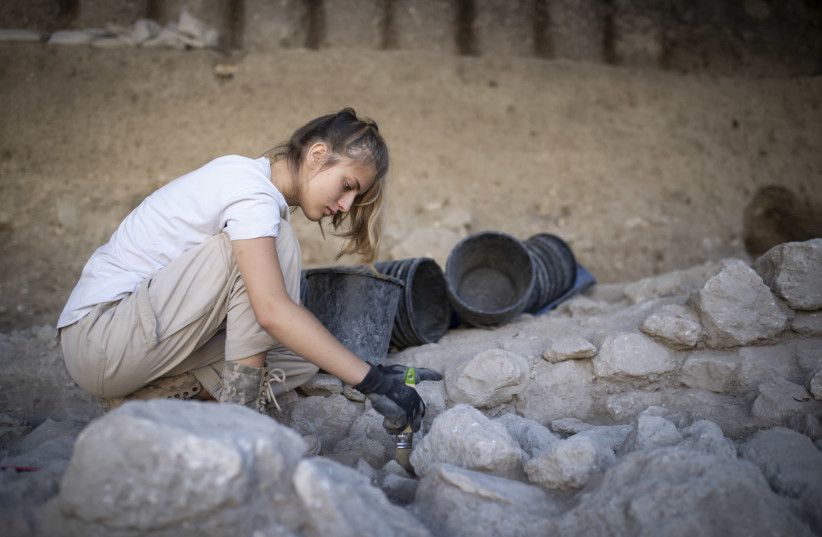
Valeria Fenik works at a digging site in the Givati Parking Lot excavation grounds, at the City of David National Park, on July 22, 2019. The most recent digging site currently under work is attributed to the Muslim, Byzantine, and early Roman periods.  / (photo credit: HADAS PARUSH/FLASH90)

The outer layer of a mosque discovered in excavation in Tiberias, has been dated to the seventh century CE, according to a presentation last week of archaeological findings from the site. The dating of the layer may deem the mosque one of the first known mosques to have been built after the beginning of Islam.

Dr. Katia Cytryn-Silverman, who led the 11-year-long excavations at the site on the outskirts of Tiberias, is a senior lecturer at the Hebrew University of Jerusalem and presented the findings last week during an academic conference with Hebrew University and the Ben-Zvi Institute. The conference was organized in commemoration of Tiberias’s 2,000th anniversary, according to Haaretz.

Cytryn-Silverman, who specializes in Islamic archaeology, said that the early Islamic period layer could make the structure one of the first known mosques.

The excavations estimate that what was unearthed underneath the structure — the outer layer of a mosque — might actually date back to 635 CE, and potentially constructed by a friend of the Prophet Muhammad — Shurahbil ibn Hasana — when the Levant was conquered by his forces in the seventh century, noted Arab News.

Cytryn-Silverman said that they cannot be sure that ibn Hasana built the structure. “But,” she added, “we do have historic sources that say he established a mosque in Tiberias when he conquered it in 635,” Arab News reported.

Cytryn-Silverman explained that after the Arab conquest, Tiberias became a center of economic and political growth for the Arab world, Haaretz reported.

Arab News noted further that historians do know where a lot of the earliest mosques are, but cannot access them since contemporary mosques have been constructed over the original site.

For example, Haaretz noted, one of the oldest mosques in the world is in Fustat, Egypt. Fustat was Egypt’s first Muslim capital, established in the seventh century. The mosque, Mosque of Amr, was the first to be built in Egypt.

Jewish presence in Fustat is dated to the late seventh century, as they joined the various other groups in the developing city. Maimonides moved there in 1166, where he gained the title Ra’is al-Umma or al-Millah (Head of the Nation or of the Faith) for writing his Guide for the Perplexed, and was an acclaimed physician.


Zawartość publikowanych artykułów i materiałów nie reprezentuje poglądów ani opinii Reunion’68,
ani też webmastera Blogu Reunion’68, chyba ze jest to wyraźnie zaznaczone.
Twoje uwagi, linki, własne artykuły lub wiadomości prześlij na adres:
webmaster@reunion68.com



Nick Cannon’s Daytime Talk Show to Debut This Year Following Postponement Over Antisemitic Comments

Nick Cannon’s Daytime Talk Show to Debut This Year Following Postponement Over Antisemitic Comments

Shiryn Ghermezian


Nick Cannon during his interview on “Cannon Class” with Photo: Screenshot.

Nick Cannon’s daytime talk show will premiere later this year after initially being pushed off due to antisemitic comments he made in 2020, it was announced on Thursday.

Liongate’s Debmar-Mercury and Fox Television Stations said in a press release that a nationally syndicated daytime talk show hosted by the media personality will begin airing this fall.

The show was originally set to premiere in September 2020 but was postponed after he promoted antisemitic conspiracy theories on his podcast “Cannon’s Class” last summer, and slammed critics of Nation of Islam leader Louis Farrakhan, who has referred to Jews as “termites.” He initially refused to apologize for his remarks, but days later took to social media to voice regret for his “hurtful and divisive words.” At the time he also demanded an apology from ViacomCBS, the media giant that ended its partnership with Cannon because of his antisemitic statements.

Ira Bernstein and Mort Marcus, co-presidents of Debmar-Mercury, said about the new talk show, “We, along with our many other strong broadcast partners, are excited to be able to bring Nick’s unique, light-hearted and entertaining style to the daytime audience starting this fall.”

Cannon added, “It’s been a longtime dream of mine to host my own daytime talk show and that I’m able to do this in New York City, bringing daytime television back to the place that has fostered generations of talent, is very special to me. With this show, we’ll be uniting all aspects of entertainment in a unique way in the very place where a lot of what we know today as our culture started. I couldn’t ask for better partners than Debmar-Mercury and FOX and thank them for supporting me in this endeavor.”

Cannon, who hosts FOX‘s celebrity competition series “The Masked Singer,” will executive produce the New York-based show alongside his longtime manager, Michael Goldman and showrunners Katy Murphy Davis and Matt Strauss. Davis (“The Oprah Winfrey Show,” “Red Table Talk”) and Strauss (“The View,” “The Dr. Oz Show,” “Katie”) are both Daytime Emmy Award-winning producers.

Cannon will continue to host “The Masked Singer,” which will release two more installments this year. He hosted eight seasons of NBC’s talent competition series, “America’s Got Talent,” and is the host and producer of the nationally syndicated radio show “Nick Cannon Radio.” Cannon is also the creator, host, and executive producer of MTV‘s sketch comedy show “Wild ‘N Out,” which recently aired its 15th season.


Zawartość publikowanych artykułów i materiałów nie reprezentuje poglądów ani opinii Reunion’68,
ani też webmastera Blogu Reunion’68, chyba ze jest to wyraźnie zaznaczone.
Twoje uwagi, linki, własne artykuły lub wiadomości prześlij na adres:
webmaster@reunion68.com

ISRAEL First Impressions (one day in Tel Aviv)

ISRAEL First Impressions (one day in Tel Aviv)

Kara and Nate


Zawartość publikowanych artykułów i materiałów nie reprezentuje poglądów ani opinii Reunion’68,
ani też webmastera Blogu Reunion’68, chyba ze jest to wyraźnie zaznaczone.
Twoje uwagi, linki, własne artykuły lub wiadomości prześlij na adres:
webmaster@reunion68.com



Prehistoric Ashdodites used chopping tools to eat bone marrow – study

Prehistoric Ashdodites used chopping tools to eat bone marrow – studyPrehistoric Ashdodites used chopping tools to eat bone marrow – study

ROSSELLA TERCATIN


Hundreds of thousands of years ago, the ancient humans living in the area of modern Ashdod used a specific type of stone tools to break animal bones and extract the bone marrow.

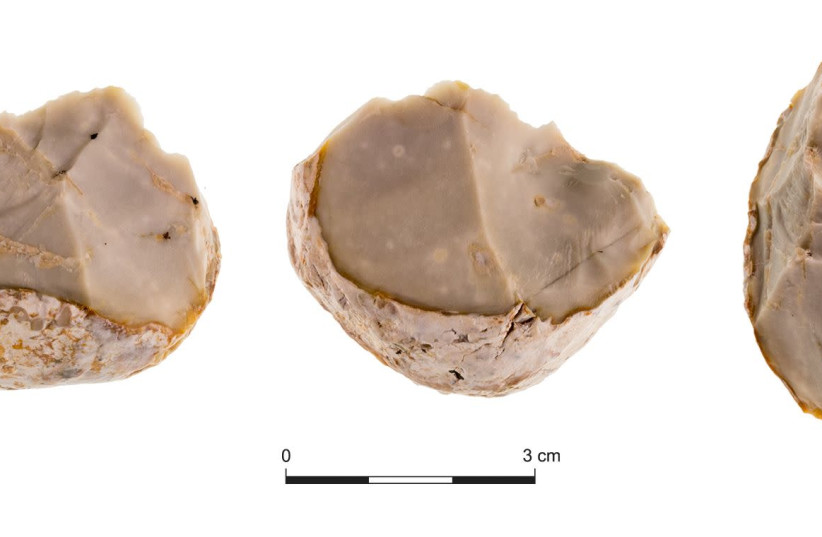
A chopping tool from prehistoric site Revadim. / (photo credit: RAN BARKAI)

Hundreds of thousands of years ago, the ancient humans living in the area of modern Ashdod used a specific type of stone tools to break animal bones and extract the bone marrow, a new study has found. And, most likely, they were not the only ones.

Known as “chopping tools,” flint pebbles with one flaked, sharp and massive edge are among the earliest artifacts ever produced. They appeared as early as 2.5 million years ago.

“The chopping tool was invented in Africa about 2.6 million years ago, and then migrated with humans wherever they went over the next two million years,” Prof. Ran Barkai of the Sonia and Marco Nadler Institute of Archaeology at Tel Aviv University explained in a press release. “Large quantities of these tools have been found at almost every prehistoric site throughout the Old World – in Africa, Europe, the Middle East and even China – evidence for their great importance. However, until now, they had never been subjected to methodical lab testing to find out what they were actually used for.”

Barkai conducted the study with his TAU colleague Dr. Aviad Agam, together with Dr. Flavia Venditti from the University of Tübingen and in collaboration with the Laboratory of Technological and Functional Analyses of Prehistoric Artifacts from Sapienza, University of Rome, which also sent researchers.

“For years we have been studying stone tools from prehistoric sites in Israel, in order to understand their functions,” Barkai added. “One important source of tools is Revadim, an open-air site (as opposed to a cave) dating back to 500,000-300,000 years before our time, and rich with remarkably well-preserved findings.”

Located east of Ashdod, Revadim offered highly favorable conditions to ancient humans and was settled over and over again over the millennia.
Researchers have unearthed many artifacts at the site, as well as bones of many types of game, such as elephants, cattle, deer, gazelles and others.

For this study, whose findings were published in the journal PLOS ONE on Wednesday, the team examined 53 samples of chopping tools, including the use-wear traces and the organic residues they carried.

The scholars also manufactured replicas of the tools using flint collected in the area and employed them to break bones of middle-size animals.
According to the scientists, the chopping tools represented a multipurpose toolkit, which can be compared to toolkits of modern tradesmen.

Extracting bone marrow requires breaking the bone with a high degree of precision in order to avoid damaging the marrow, a staple in the prehistoric humans’ diet in light of its nutritiousness, they pointed out.
“The chopping tool, which we examined in this study, was evidently outstandingly popular, because it was easy to make, and highly effective for this purpose,” Barkai explained.

“This is apparently the reason for its enormous distribution over such a long period of time,” he concluded. “The present study has expanded our knowledge of the toolkit of early humans – one more step toward understanding their way of life, tracking their migrations, and unraveling the secrets of human evolution.”


Zawartość publikowanych artykułów i materiałów nie reprezentuje poglądów ani opinii Reunion’68,
ani też webmastera Blogu Reunion’68, chyba ze jest to wyraźnie zaznaczone.
Twoje uwagi, linki, własne artykuły lub wiadomości prześlij na adres:
webmaster@reunion68.com

Overview: Holocaust Martyrs’ and Heroes’ Remembrance Day 2021

Overview: Holocaust Martyrs’ and Heroes’ Remembrance Day 2021

Yad Vashem


Until the Very Last Jew: Eighty Years Since the Onset of Mass Annihilation

Holocaust Martyrs' and Heroes' Remembrance Day

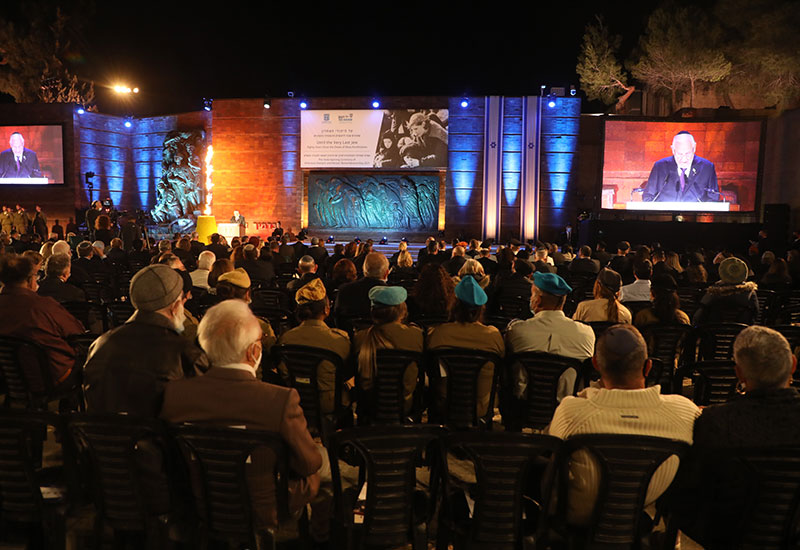
Holocaust Martyrs’ and Heroes’ Remembrance Day (Yom Hashoah in Hebrew) is a national day of commemoration in Israel, on which the six million Jews murdered in the Holocaust are memorialized. It is a solemn day, beginning at sunset on the 27th of the month of Nisan and ending the following evening, according to the traditional Jewish custom of marking a day. Places of entertainment are closed and memorial ceremonies are held throughout the country. The central ceremonies, in the evening and the following morning, are held at Yad Vashem and are broadcast live. Marking the start of the day-in the presence of the President of the State of Israel and the Prime Minister, dignitaries, survivors, children of survivors and their families, gather together with the general public to take part in the memorial ceremony at Yad Vashem in which six torches, representing the six million murdered Jews, are lit. The following morning, the ceremony at Yad Vashem begins with the sounding of a siren for two minutes throughout the entire country. For the duration of the sounding, work is halted, people walking in the streets stop, cars pull off to the side of the road and everybody stands at silent attention in reverence to the victims of the Holocaust. Afterward, the focus of the ceremony at Yad Vashem is the laying of wreaths at the foot of the six torches, by dignitaries and the representatives of survivor groups and institutions. Other sites of remembrance in Israel, such as the Ghetto Fighters’ Kibbutz and Kibbutz Yad Mordechai, also host memorial ceremonies, as do schools, military bases, municipalities and places of work. Throughout the day, both the television and radio broadcast programs about the Holocaust. In recent years, other countries and Jewish communities have adopted Yom Hashoah, the 27th of Nisan, to mark their own day of memorial for the victims of the Holocaust.

Holocaust Martyrs’ and Heroes’ Remembrance Day 2021 will be on Thursday, April 8th. The State Opening Ceremony will be held at Yad Vashem on Wensday, April 7th at 20:00.


Zawartość publikowanych artykułów i materiałów nie reprezentuje poglądów ani opinii Reunion’68,
ani też webmastera Blogu Reunion’68, chyba ze jest to wyraźnie zaznaczone.
Twoje uwagi, linki, własne artykuły lub wiadomości prześlij na adres:
webmaster@reunion68.com