Archives

How immigrants paved the way for Israel’s LGBTQ+ acceptance

How immigrants paved the way for Israel’s LGBTQ+ acceptance

ZVI JOFFRE


For 45 years, olim have led the way in Israel’s LGBTQ+ community via the Agudah
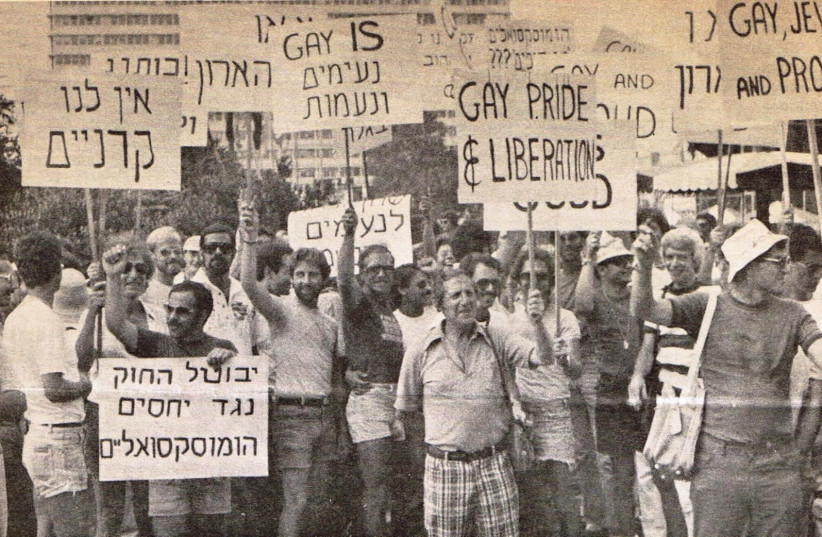
FIRST UNMASKED gay protest in Tel Aviv, 1979. / (photo credit: THE AGUDAH – THE ASSOCIATION FOR LGBTQ EQUALITY IN ISRAEL)

On November 14, 1975, more than 10 years before homosexuality became legal in the State of Israel, a small ad appeared in the personal ad section of The Jerusalem Post reading, “If you are interested in chaniging (sic) the legal status of Homosexuals, in Israel, contact: S.I.R. (Society for Individual Rights).”
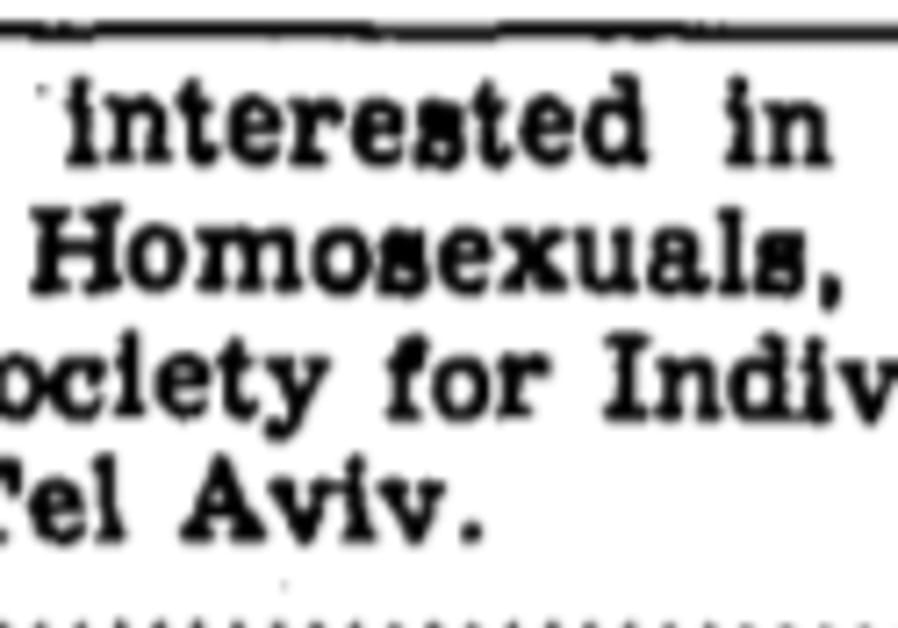
THE FIRST advertisement by the Agudah in ‘The Jerusalem Post’ on November 14, 1975. (Photo credit: Jerusalem Post Archives)

The ad marked the first publication of what is now known as The Agudah – The Association for LGBTQ Equality in Israel. The association was founded during a meeting of gay men and one woman, including new immigrants and Holocaust survivors, in 1975 in Tel Aviv.

Jonathan Danilowitz, an oleh from South Africa who served as chairman of the Agudah from 1985 to 1986, had his first encounter with the association in 1975 with that ad in the Post.

“I didn’t think, or I wasn’t willing to admit to myself, that I was gay, but the wording of the ad was okay for me because it said if you want to ‘help’ homosexuals, so for me it was like helping ‘them’ and not myself,” said Danilowitz.

“Everybody was in the closet,” explained Danilowitz. “Everybody was afraid of being gay or rather didn’t want to be known as gay. The Agudah’s original name did not have the word ‘homosexual’ or ‘gay’ or anything similar to that in it because most of us would not have become members of an organization that had a frightening name.”

UNTIL 1988 homosexuality was illegal in Israel. While the law was never enforced due to a decision by the attorney-general, gay men and women were occasionally harassed by police and few were willing to be publicly out of the closet.

While there were some native Israelis among the first LGBTQ+ activists in Israel, most of the more active and public activists and leaders who formed the Agudah and other initiatives were new immigrants who, in a pre-Internet era didn’t have to worry about being outed to their families or communities back in the Diaspora.

“The key players in establishing the Agudah were newcomers from North America and Western Europe where things started to move forward while Israel was left behind in many ways,” explained Dan Yanovich, a volunteer coordinating the archive project. Yanovich stressed that the establishment of the Agudah came six years after the Stonewall Riots in New York largely launched the Pride movement in the US and two years after the American Psychiatric Association removed homosexuality from a manual on mental disorders.

“This is Israel, the land of the Bible. Whereas in all countries homosexuality was looked down upon, it was particularly looked down up here by the religious authorities,” said Danilowitz. “Israelis were petrified of being gay. Nice Jewish boys were not gay. It didn’t work that way. So, they stayed in the closet.”

Yanovich explained that even the activists in the community were mostly in the closet. The protocol of the first meeting of the Agudah listed only the first names of the members. In 1976, a number of homosexual Israelis were interviewed on a show called The Third Hour, but only Avi Angel, an immigrant from the US who served then as the executive-director of the Agudah, agreed to be interviewed with his real name and without his voice being distorted.

At first the Agudah was mostly a social organization, dealing little with activism. It held lectures and workshops on LGBTQ+ topics and organized parties and social events for the gay community.

In the 1970s, Danilowitz worked for El Al. While traveling, he visited Congregation Beit Simchat Torah, a gay synagogue in New York.
“I wasn’t religious by that time,” said Danilowitz. “I had been brought up in an Orthodox family but I’d dropped it all. So, I went one night. It was a frightening experience for me to go, but I found it was a great experience to meet normal gay people.”

While in the US, Danilowitz heard about an international conference of gay Jewish organizations which was held in cities around the world but not in Israel, so he persuaded the organizations to hold the 1979 conference in Israel.

“We had endless trouble. Whenever anybody discovered that we were having a conference, they immediately pulled out of the contracts that we’d signed for places to stay and facilities,” said Danilowitz. They finally managed to pull it off by pretending to be travel agents holding a conference.
“It enraged the people who attended here and it enraged us, the Israelis, how badly we were being treated and that we could do nothing about it,” added Danilowitz. “That perhaps was the start of people understanding that we had to do something about the laws and the way we were being treated here.”

During the conference, the first unmasked gay protest was held in what is now known as Rabin Square and was covered by Channel 1 news. While it took time for the community to begin taking further action, the conversation on the need for change had received the boost it needed.

WHILE ACTIVISM was boosted by the conference in 1979, it declined in the 1980s due to the AIDS crisis, as the community tried to separate itself from being associated with the disease, explained Yanovich. Much of the community went underground. The Agudah went several years without a chairperson.

Amid the AIDS crisis, Danny Kent, an immigrant from the US, helped lead the fight against AIDS and education efforts in Israel. After working with the Israel AIDS Task Force upon arriving in Israel, Kent helped organize a version of The Names Project in Israel in the early 1990s.

The Names Project was first carried out in the US in the mid-1980s to commemorate those lost to AIDS with a patchwork of quilts made by their friends and family. Kent brought the idea to Israel and organized the creation of quilt panels by the friends and families of Israelis who died due to AIDS. The quilt panels were displayed in Tel Aviv, Haifa, Nazareth, Nazareth Illit and Jerusalem in the project’s first tour in 1990 and were later displayed in locations across the world.

Activism began to reawaken in the late 1980s with the establishment of Klaf, a feminist lesbian organization, and Otzma, a political activism group for the LGBTQ+ community.

Even more dramatic change began with a legal battle against El Al involving Danilowitz that started in 1989 and continued until 1994. Before the Danilowitz case, media representation of LGBTQ+ people largely focused on AIDS, sexual assault and marginal figures. Danilowitz’s case and the press’s attention on it provided one of the first instances of a “normative” white homosexual citizen in the media spotlight on the topic of homosexuality.

Danilowitz began the battle after El Al refused to treat him and his partner, with whom he was in a common law relationship, like other common law couples employed at the company.

The dispute between Danilowitz and El Al went back and forth until the refusal was “so obviously discriminatory and unfair” that Danilowitz and his partner decided to see what could be done about the matter in a legal sense, leading to a suit against El Al in the Tel Aviv Labor Court.

The lawyer representing Danilowitz told him that there was “no way” that the district labor court would agree with their side and that the national court would also not agree with them if they appealed, but that maybe by the time the case reached the Supreme Court they “might have a chance.”
In the end, the district court agreed that El Al’s refusal was discriminatory. After the company filed an appeal to the national court, it agreed as well. El Al then appealed to the Supreme Court to overturn the decision, but lost again, leading to the matter becoming a Supreme Court precedent. In any similar cases in the future, judges would need to take the Supreme Court’s decision into account.

“We were very surprised. Thrilled, but surprised,” said Danilowitz.
The decision affected not just gay couples, but other minorities and discriminated groups, including women, explained Danilowitz. Others followed suit, went to court on similar issues and succeeded as well.
ANOTHER MILESTONE occurred in 1998 when Dana International, an Israeli transgender signer, won the Eurovision Song Contest, raising public interest about transgender and LGBTQ+ people. The first pride parade was held in Tel Aviv in June of that year, with an unprecedented crowd of 3,000 people. While the number may seem small compared to the 250,000 who attended Tel Aviv pride in 2019, it was well above what was expected at the time, explained Yanovich.
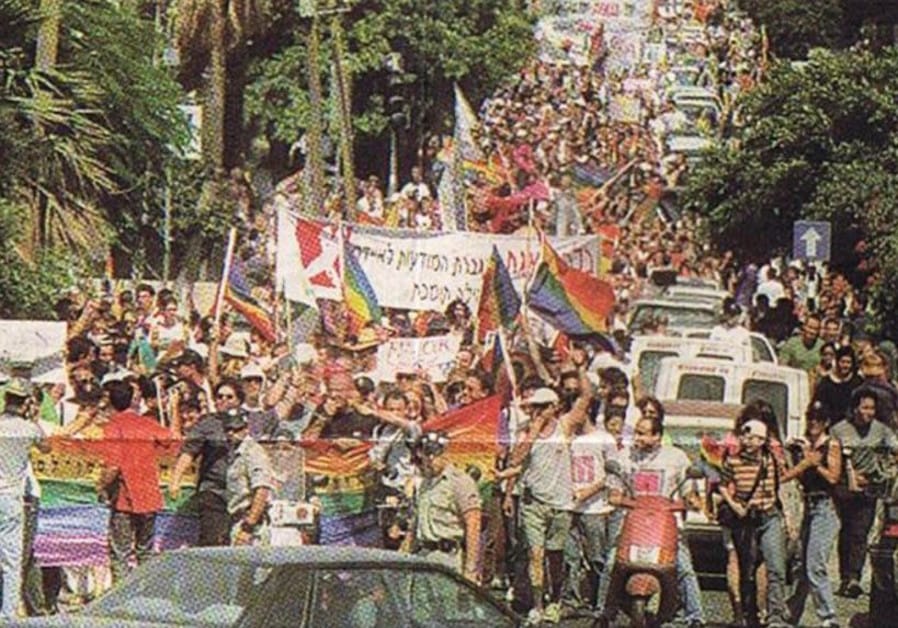
IMAGE FROM Israeli newspaper covering the first Pride Parade in Tel Aviv, 1998. (Photo credit: The Agudah – The Association for LGBTQ Equality in Israel)

In 1989, Danilowitz founded Tehila, a support group for parents of LGBTQ+ children. The group started with one small group in Tel Aviv but now has branches across Israel.

In the 45 years since that small meeting in a Tel Aviv apartment, the status of LGBTQ+ people here has radically changed. Pride parades are held in dozens of cities around Israel every year and there are many LGBTQ+ Israeli celebrities and Knesset members.

“In 1971, The Jerusalem Post would not have interviewed me on a subject like this,” said Danilowitz, adding that there is now “endless” and mostly positive media attention on the LGBTQ+ community.

Workplace discrimination laws have also advanced, thanks, at least in part, to the lawsuit carried out by Danilowitz. Gay couples and couples who can’t get married in the state can get married abroad and have their marriages recognized in Israel. Gay couples can also adopt and have children through surrogacy abroad and have their parenthood recognized. Cities have begun recognizing gay marriages for municipal rights – including Tel Aviv, Ramat Gan, Modi’in-Maccabim-Reut and Rishon Lezion.

“Life is completely different,” stressed Danilowitz.

DESPITE THE advances made in the past four decades, the Agudah and gay community still have a long way to go, activists stressed, citing issues concerning marriage, adoption, surrogacy, divorce and more. Yanovich stressed that while the trends provide grounds for optimism, the situation wasn’t always as good as it is now and can improve even further.

“It depends on people to make the change. It doesn’t just happen,” said Yanovich, pointing to the importance of activism in the major changes that have occurred so far.

To mark the 45-year anniversary of the Agudah’s establishment, the association has launched a project to establish an archive of LGBTQ+ history in Israel, as many of the community’s founders grow older and many documents and artifacts remain inaccessible by the general public.

The project is split into two phases. In the first phase, the association aims to collect, organize and publish an accessible archive of press documents, academic papers, interviews and documents from LGBTQ+ organizations, among other content. In the second phase, the association hopes to establish a “virtual museum” of articles on a variety of subjects and create an interface that will allow visitors to easily access the information gathered in the archive.

The Agudah has also begun recruiting dozens of Jewish LGBTQ+ “ambassadors” from 30 countries to help promote LGBTQ+ rights and create safe spaces for LGBTQ+ people, as part of the activities to mark 45 years since the association’s establishment.

Ambassadors in Brazil, Australia, the US, the UK, France, Germany and other countries will support LGBTQ+ communities in their Jewish communities and serve as a bridge between their communities and the LGBTQ+ communities in Israel.

The ambassadors project will also help LGBTQ+ immigrants integrate in Israel.

“This is an exciting closure for the LGBTQ+ community in Israel with Diaspora Jewry, from which many people who founded the pride struggle in Israel came,” said Agudah chairwoman Hila Farr. “This is a struggle for equality across continents, countries and sectors. The ambassadors will help build a bridge and a direct interface between the community in Israel with LGBTQ+ people around the world so that everyone can be who they are everywhere.”


Zawartość publikowanych artykułów i materiałów nie reprezentuje poglądów ani opinii Reunion’68,
ani też webmastera Blogu Reunion’68, chyba ze jest to wyraźnie zaznaczone.
Twoje uwagi, linki, własne artykuły lub wiadomości prześlij na adres:
webmaster@reunion68.com



‘I Still Owe Israel My Entire Existence:’ Jewish Olympian AJ Edelman on Representing Country, Arab Teammates, Giving Back

‘I Still Owe Israel My Entire Existence:’ Jewish Olympian AJ Edelman on Representing Country, Arab Teammates, Giving Back

Shiryn Ghermezian


Amir Fawarsy (in purple) and a volunteer help Ward Fawarsy with a bobsled at the Olympic Sliding Center in Pyeongchang, South Korea. Photo: Provided.

The Israeli bobsled team led by Jewish Olympian A.J. Edelman and his Israeli Arab teammates are vying for a chance to compete in the 2022 Winter Olympics, a lofty ambition for a sun-drenched country that has never medaled in those games.

But for Edelman and his fellow athletes, the quest is about much more than a prize podium: it’s a chance to represent the nation they share together, and to give back to the next generation of Israeli hopefuls.

“The Olympics are not the goal,” Edelman, 29, told The Algemeiner on Wednesday from South Korea, where the team is training at the Olympic Sliding Center in Pyeongchang. “We have no relevance other than the fact that we wear the Israeli flag…and so because of that, it’s an honor unparalleled that you can never repay.”

Edelman’s squad is one of Israel’s two bobsled teams hoping for a spot in next year’s Olympic Games, which will take place in Beijing, China. The athlete, who is originally from Boston but made aliyah in 2016, retired from competitive sporting after racing in the 2018 Olympic contest in skeleton, which features a smaller sled. A former ice hockey goalie and speed skater, he was Israel’s first ever Olympic athlete in that sport, but retired from athletics after experiencing what he called a “disturbing” episode related to a helmet disqualification at the 2018 Games, and receiving emotional abuse from other athletes.

Turning to business, Edelman was accepted into the Yale School of Management, hoping to pursue an MBA. But he was soon back on the ice, this time as a bobsledder — because, as he put it, “I still owe Israel my entire existence and identity.”

He had his first exposure to bobsledding in 2014 as a breakman, responsible for stopping the sled, and was a bobsled driver in 2019. Edelman recruited his Druze teammates Moran Nijem and cousins Amir Fawarsy and Ward Fawarsy, who all play for Israel’s national rugby team. As bobsledders, they must run alongside the four-person carriage, pushing it to achieve maximum speed. When it builds momentum down a narrow, iced track, the riders jump in — Edelman the driver in front, followed by the brakeman in back.

As a diverse team representing the same flag, they have become an example of Arabs and Jews working closely to make their country and communities proud.

“One thing that I’ve always been very, very insistent on is that no one gets in my sled if the Games are the goal,” he said. “The number one thing that I ask any person who has expressed any interest in getting in a sled is ‘Would you do this for any other country and what’s your motivation?’ And anyone who says, ‘if presented the opportunity, I would sled for [any country other than Israel],’ then they’re not for this team. It’s not the right mindset. Israel has to be the first and only choice.”

AJ Edelman and Amir Fawarsy on the slide in South Korea. Photo: Provided.

Nijem and the Fawarsy cousins told The Algemeiner Thursday that they want to establish a school for potential Druze athletes of all sports, and hope their run in the Olympics will make it possible.

“Sport builds character, can be a career, can make you travel the world, and that’s more important than making money,” said Amir, 24. “We want people to do sports especially in our village and community, where things are now heading to a bad place. A lot of problems are happening in our community, and to me sports was always the solution. It kept us out of the problems. We need sports in our community.”

Edelman said his teammates’ vision resonated with his own. “My entire 2018 Olympic run was essentially that for Israel and Jews abroad,” he said. “They believe and I believe firmly that when they made the Games, it will provide them an opportunity to establish that kind of institution; to get that change done in their community. That for me has always been my driving force representing Israel.”

“The reason I’m back is because I think if not for me, then who else?” he said about his return to representing Israel in the sport. “If you believe that you’re the only person who is able to do what you want to do, to be a force for good, then you’re obligated to do so. It’s certainly an Israeli concept that if you have the power to overcome and do something positive, then you have to absolutely do that. For them, they’re doing it for their community and being a driving force for good. I’m just trying to do the same, to give back.”

The team met only recently, but said they already trust each other immensely — crucial in a high-speed sport with little room for error, and which can result in severe brain injury. “We really trust AJ. We believe in him and he also believes in us,” said Amir. “We believe we can make it and we’ll do our best every single day and train hard.”

Nijem and the Fawarsys knew nothing about bobsledding prior to meeting Edelman, and deferred their education to fly out of Israel during the coronavirus pandemic and train with Edelman in South Korea. Though races last a matter of minutes, Amir told The Algemeiner that the full-day of training is extremely “challenging,” leaving them completely “exhausted” even after a short run on the slide.

The Druze athletes haven’t seen snow in some 13 years, and adapting to the weather of 22-degrees below freezing in South Korea has been a challenge.

“Being an athlete, you always think about the country you’re representing,” Amir said. “You are not thinking about yourself. Every action you do, you have to think that you are here representing your country.”

Edelman has already spent about $70,000 of his own money to support his bobsled team — including paying for a coach, equipment and food costs — after an investor has failed to pay a promised $5 million. The team is crowdfunding money from supporters on GoFundMe, and Edelman is even trying to auction off his own Olympic ring on Ebay for additional funds. He said the team is practically living off of barley and eggs: “not the best diet for an athlete,” he admitted.

David Greaves, the president and co-founder of Bobsleigh Skeleton Israel, which is affiliated with the National Olympic Committee of Israel, said about Edelman, “He is an incredibly driven, exceptional person. If I was to bet on his success, I would have to bet in favor of him…it’s going to be a pretty exciting ride.”

Edelman explained, “I believe that everyone has a few reasons for being put here [on Earth] and my tavkid [duty] for now is helping Israel as much as I can through sport. We have an obligation not to walk away from Israel after getting to a supposed goal. I think a lot of Olympic athletes do that and it’s such a shame, because it’s a misuse of the honor and privilege that the country gave you.”

The team will find out if they qualifies for next year’s Olympic Winter Games in January 2022, based on a number of races beginning in October.


Zawartość publikowanych artykułów i materiałów nie reprezentuje poglądów ani opinii Reunion’68,
ani też webmastera Blogu Reunion’68, chyba ze jest to wyraźnie zaznaczone.
Twoje uwagi, linki, własne artykuły lub wiadomości prześlij na adres:
webmaster@reunion68.com
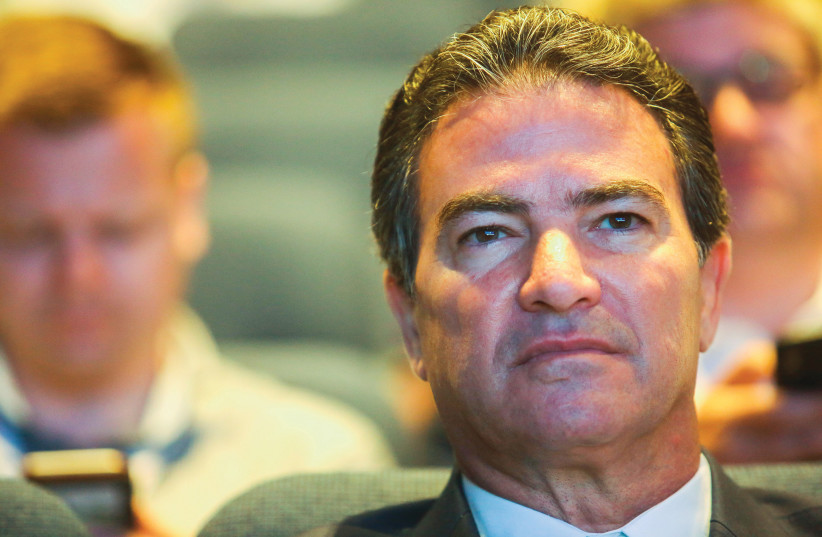

As Trump exits, the full Mossad story on normalization into focus

As Trump exits, the full Mossad story on normalization into focus

YONAH JEREMY BOB


Key moments with Saudi Arabia, United Arab Emirates in 2017 and 2019 led to last year’s deals

MOSSAD DIRECTOR Yossi Cohen. / (photo credit: FLASH90)

As the administration of president Donald Trump exits stage left, it’s time to take stock of the four normalization deals that Israel has already signed.

Contrary to conventional wisdom, although the July-to-December 2020 wave of deals provided the historic photos, the turning point moments were back in 2017 and 2019, The Jerusalem Post has learned. Also, though, it has not yet signed an agreement itself, the key party was always Saudi Arabia.

Much of the de-emphasis of these points has to do with Mossad chief Yossi Cohen – whose acts were mostly shrouded in mystery until a major speech in July 2019 – who was leading the Israeli push by Prime Minister Benjamin Netanyahu.

There have been multiple narratives about who really got the ball rolling between Israel, the US and the UAE, and about when was the critical turning point.

Of course, part of the complex answer is that each country in the Israel, UAE, US triad played its part.

Also, each of the countries that came afterward made its own contributions which helped form the order of who would be “in” during the Trump era and who would play “wait and see.”

But there is a crucial piece of the story that has not been emphasized.

But to properly understand what happened in 2020, Israeli intelligence sources would say that it is imperative to understand the behind-the-scenes role of Cohen and the Saudis and what happened in September-November 2017, and in July 2019.

TRADITIONALLY, CLANDESTINE developments with countries with which Israel has no diplomatic relations fall under the realm of the Mossad.

In that respect, the Post has learned that Cohen especially distinguished himself from his start in January 2016 by not only marking goals, but establishing a unit to focus on the normalization goal.

Reports of Cohen’s travels to Saudi Arabia, UAE, Bahrain, Sudan, Morocco and other countries without diplomatic relations with Israel started coming in the middle of his term, but he was on the travel circuit even earlier.
There were precursors like former National Security Council chief Yaakov Amidror and former Foreign Ministry director-general Dore Gold. There were also other Israeli intelligence figures, who are conventionally less involved with foreign countries, who got involved in the game in important ways in recent years.

One interesting departure from Mossad dominance of the normalization trend related to Sudan and Morocco.

Cohen was virtually the sole key figure paving the early path which led to normalization with the UAE, and which brought the Saudis to actively support the trend, even as they themselves have not formally crossed the line.

He was also the early middleman for Sudan and Morocco.
But at an undefined point leading up to normalization with those countries, National Security Council chief Meir Ben Shabbat, represented by “R.” or “Maoz,” a Shin Bet agent on “loan” to the NSC, took a critical role in finishing those deals.

Ben Shabbat, Maoz and, according to reporter Barak Ravid, a British-Israeli lawyer named Nick Kaufman, who had connections with the Sudanese because of his expertise in dealing with some of their International Criminal Court issues, helped smooth over a range of rough patches along the way.
Cohen would not deny that Ben Shabbat and Maoz made contributions to those normalization pushes and helped save them at various points when the US and Sudan hit temporary walls.

However, the Post has learned that even once Ben Shabbat and R. were working the Sudan and Morocco angles, Cohen’s view would be that he was still the “project manager” for the normalizations, and that he merely “subcontracted” out aspects of implementation.

In Cohen’s narrative, his direct involvement in planning the meeting between Netanyahu and chairman of the Sovereignty Council of Sudan Lt.-Gen. Abdel Fattah Abdelrahman al-Burhan in Uganda in February 2020, as well as being physically present there, shows that he had gotten most of the key work done before subcontracting out later implementation measures.

Further, even as Ben Shabbat, Maoz and their team helped put out fires down the stretch, Cohen still had his hands at least partially on the wheel with additional meetings, one of which with the deputy chairman of the Sudanese Sovereign Council, Gen. Mohamed Hamdan Dagalo, was widely reported in August 2020.

Reports throughout the second half of 2020 noted Cohen hopping around the Gulf and elsewhere.

IN SOME ways, sources would say, this would lead to a new perspective on the July-December 2020 normalization wave.

Conventional wisdom is that no wave was coming until July 2020, and that there might have been no wave if UAE Ambassador to the US Yousef Al Otaiba, Israeli Ambassador to the US Ron Dermer, senior adviser to the US president Jared Kushner, his aide Avi Berkowitz, Ambassador to Israel David Friedman and a variety of other players had not suddenly scrambled to a magic formula, which then paved the way for the other three normalization deals.
While recognizing each contribution to the Abraham Accords, Cohen’s narrative would be entirely different.

His version of events would look back to his major July 2019 speech at the Interdisciplinary Center Herzliya conference.

In that speech, he said, “The Mossad has identified at this time a rare opportunity, perhaps the first in the history of the Middle East, to reach a regional understanding that would lead to an inclusive regional peace agreement,” he said.

He added: “This creates a window of opportunity that is perhaps one-time only.”

While his speech made headlines, nothing immediately came of it. In fact, nothing came of it for another 13 months, and most viewed it as just giving out talking points which Netanyahu and a variety of other ministers were periodically issuing.

A point Cohen made in the speech saying the Mossad had set the stage for “a renewal of ties with Oman and the establishment of Foreign Ministry representation” was even met with a public rejection by Oman.
Yet, sources would indicate that in Cohen’s view, this speech was actually the key point.

He was not pontificating with generic hopeful aspirations or guessing, the way some other ministers might have been who were hearing things secondhand.

Cohen was delivering a hard-nosed assessment of the future which he knew firsthand to be on the way.

He could not predict the exact timing, but he knew that he had helped convince the Saudis as well as the UAE that normalization was the way forward, and that they would find the right moment.

The reason he could make that speech in July 2019, the Post has learned, is that ironically, even as they have not yet officially crossed the normalization line themselves, the Saudis were the key, and were committed.
In that sense, Israeli intelligence sources have indicated that a real turning point was the reported visit of Saudi Crown Prince Mohammed bin Salman to Tel Aviv in September 2017.

BY NOVEMBER 2017, this had led to a historic interview by then-IDF chief Gadi Eisenkot with a Saudi media outlet in which he proclaimed that Israel was now sharing classified intelligence on Iran with Riyadh.
In this light, insiders like Cohen could see the building of momentum for the events of 2020, even if they were far from inevitable, long before the general public caught on.

Then why didn’t Cohen make the July 2019 speech back in 2017?
Sources indicated that the plan was to get the other countries on board so it would build like a wave.

Saudi support in late 2017 laid the groundwork for the Mossad to have greater success in building that wave over the next 18 months, including visits by Netanyahu and other Israeli ministers to various countries.
The current Mossad chief might even say that the months when normalization happened were when it had to happen. This was because it was all part of a general vision of achieving certain common goals within the Trump administration’s framework for the Middle East.

No one knew who would win the US election in November 2020, but everyone knew that US President Joe Biden (then the Democratic challenger) had a strong shot.

From this perspective, the normalization wave had to start no later than around September, and July was about the latest it could start if time would be left for a series of countries to each make a splash by joining.
But the Palestinians needed to be given a chance first to accept the Trump administration’s peace plan, which kept getting delayed by Israeli elections, until it was finally unveiled in January 2020.

From then until July 2020, with a boost of cooperative activity between Israel and the UAE in March relating to the coronavirus, the question was timing.

Also, from that perspective, as crucial as the Kushner-Friedman-Berkowitz group, Otaiba and Ben Shabbat, “Maoz” and his team were, the big leaps forward were already made by the Mossad with the Saudis by 2017 and were getting revved up by the time of Cohen’s July 2019 speech.

Undeniably, the US, UAE and Ben Shabbat’s team helped put out major fires and used out-of-the-box thinking to create new opportunities.

The Mossad would be happy to share credit with the full cast. Certainly, the Trump administration’s approach of making deals between Israel and its neighbors at all costs created opportunities that would not have otherwise existed.

In addition, not every prediction Cohen made has come true.
After naming Oman in 2019, he was on record again in fall 2020 that Oman would sign a normalization agreement with Israel, and that still has not yet panned out.

Still, some of the key US actors saving, salvaging and signing the Abraham Accords in 2020 were not even in office in 2016, and in 2017 were still learning the lay of the land – this while the Mossad was already paving the road.

But, by and large, if many of Cohen’s seemingly audacious 2019 predictions about normalization have come true, it could be because, as a director and producer, he was already holding much of the script.


Zawartość publikowanych artykułów i materiałów nie reprezentuje poglądów ani opinii Reunion’68,
ani też webmastera Blogu Reunion’68, chyba ze jest to wyraźnie zaznaczone.
Twoje uwagi, linki, własne artykuły lub wiadomości prześlij na adres:
webmaster@reunion68.com


Gazans fire rockets at Israel

Gazans fire rockets at Israel;

TV7 Israel News


1) Palestinian Islamists launch two rockets from the Gaza Strip toward Israel’s southern communities– drawing Israeli retaliatory bombardments against Hamas installations.

2) Palestinian President Mahmoud Abbas issues a decree to hold parliamentary and Presidential elections for the Palestinian Authority, the first in fifteen years.

3) Israel commends the United States for its role in bringing peace to the region – while in tandem – confronting the Islamic Republic’s malign activities in general and its pursuit of nuclear weapons in particular.


Zawartość publikowanych artykułów i materiałów nie reprezentuje poglądów ani opinii Reunion’68,
ani też webmastera Blogu Reunion’68, chyba ze jest to wyraźnie zaznaczone.
Twoje uwagi, linki, własne artykuły lub wiadomości prześlij na adres:
webmaster@reunion68.com


Weizmann scientists date Santorini eruption with modern olive branch

Weizmann scientists date Santorini eruption with modern olive branch

HANNAH BROWN


The annual growth of the olive tree is not a simple story.

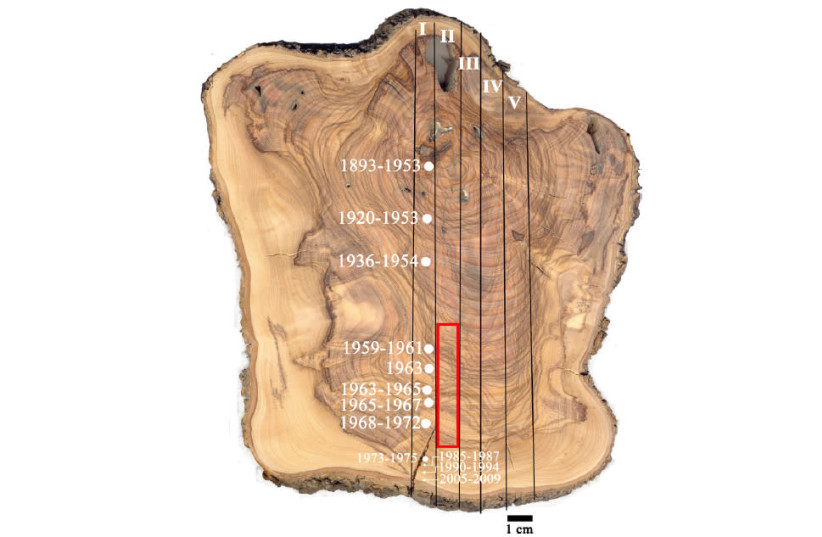
A cross section of a model olive-tree branch used to help date the Santorini volcanic eruption.  /  (photo credit: Courtesy)

When the volcano on the Mediterranean island of Santorini erupted over three thousand years ago – give or take a few hundred — it spewed lava, rocks and ash over a huge region. The ash from that eruption is so prevalent in the archaeological record of the region that it is used to date the strata above and below. But few agree on the chronological date of the eruption itself. That is why a single olive branch discovered in the ashes on Santorini has become the center of a recent controversy between archaeologists and chronologists.

Whereas some archaeologists place that date in the second part of the 16th century BCE, a study using radiocarbon dating and an analysis of the olive branch’s growth rings placed this volcanic eruption around 1630-1620 BCE, nearly a 100 years’ difference. Researchers in the lab of Prof. Elisabetta Boaretto, of the Weizmann Institute of Science in Rehovot’s Scientific Archaeology Department, have now shown how different methods could produce dates that agree, after all.

The Weizmann scientists focused on the fact that the annual growth of the olive tree is not a simple story. Although a cross section of olive wood does show somewhat concentric rings, the light and dark circles visible to the naked eye do not represent single years of growth. The darker rings may be a sort of staining, rather than signs of annual cycles. To get around this, the archaeological team studying the Santorini branch made use of micro computer tomography (microCT), finding slight variations in density that logically seemed to represent yearly growth. But Weizmann’s Prof. Boaretto, Dr. Yael Ehrlich and Dr. Lior Regev decided to go back to basics and ask: Do the variations noted in the microCT studies truly represent yearly growth rings, and, if so, would the last ring (and thus, its date) in the Santorini branch reveal the true date of the eruption?
Their answer was a resounding: sort of.

The team took a modern branch from an olive tree that was about 70 years old and dated its wood using several independent methods to study and date the growth of the rings. They applied microCT and high-resolution radiocarbon dating on various segments of a cross section. The researchers were looking to identify the “bomb peak” – a doubling of radiocarbon concentration in the atmosphere that occurred in the 1960s due to the atmospheric nuclear weapons testing of those years. With the Dangoor research accelerator in her lab, Boaretto and her team conducted100 radiocarbon determinations in segments of 20 mg of wood along the growth radius of the branch. With these high-resolution measurements, the Weizmann researchers mapped the inclusion in the wood of the nuclear-testing radiocarbon to the level of single month in Israel, and they compared it with the global radiocarbon distribution from that period. On the same material, the team measured two other isotopes of carbon (12C and 13C), and these revealed seasonal changes in growth.

The highlight of the experiment, says Boaretto, was that their method was so precise, they could even identify parts of the year when the trees add their new mass – that is, olive trees do undergo seasonal growth through the spring and into the summer, a process that tends to contribute to the forming of rings that are deposited annually. Moreover, they found that the boundaries between years can generally be observed with microCT. Even when the wood was charred (which is how wood material is usually found in archaeology), the dividing lines could be made out.

In a second highlight of the group’s high-resolution method, however, they found that in the outermost layers, just beneath the bark, the growth that comprised something like the last 30 years in their samples had run together a bit in a single band. That could call ring-counting methods into question, as the ring boundaries telling them exactly how many years it had grown in that period were missing. On top of that, they found that olive trees, as they get older, can stop adding wood to some or parts of their branches even as they continue to add new growth elsewhere. The boundaries between the still-active and the dead parts are invisible to the eye, but the radiocarbon method revealed a difference of 40 years in the apparent age between two different samples, both taken around the circumference of the branch. In other words, a sample taken from the outermost area of a cross-section of a branch, which might be thought to represent the age of the tree at the time of sampling, could actually appear to be 40 or more years younger than the tree’s true age. This insight suggested to Boaretto and her team a new interpretation for the absolute date given for the “last” ring in the Santorini branch.

The Weizmann team suggested that, while the original microCT study of the Santorini branch may have been counting real growth rings, there is a distinct possibility that the radiocarbon date obtained from the branch does not represent the date of the eruption, but rather an older date. The area the sample was taken from may have stopped growing decades before the eruption. Modeling different possible scenarios, such as non-ring-forming growth and supposing a premature end to growth in the branch, the team showed that the resulting new date ranges overlap with that of the archaeological evidence.

Determining the date of the eruption is important to archaeological research: Whether it occurred before or after 1570 BCE would have seruiys implications for other studies. This date is indeed related to the beginning of the so-called “New Kingdom” of Egypt – the period of extensive colonization and large pyramid building – and another significant signpost in the archaeological record. The original archaeological dating of the Santorini olive branch had put the eruption within the New Kingdom era; this chronological connection, or lack of connection, has significance for dating other findings in the Mediterranean region from this period.

“This is not the last word on the Santorini dating,” says Boaretto. “But it has highlighted, among other things, how we can use modern artifacts to check our dating methods, and why we need to continually return to the most basic questions. After setting the biological clock of an olive tree with radiocarbon, it is possible to better interpret a study in which the data comes from counting ancient olive tree rings.”

Boaretto’s research is supported by the head of the Helen and Martin Kimmel Center for Archaeological Science; the Dangoor Research Accelerator Mass Spectrometry Laboratory; the Instituto Serrapilheira; and Dana and Yossie Hollander. Boaretto is the incumbent of the Dangoor Chair of Archaeological Sciences.


Zawartość publikowanych artykułów i materiałów nie reprezentuje poglądów ani opinii Reunion’68,
ani też webmastera Blogu Reunion’68, chyba ze jest to wyraźnie zaznaczone.
Twoje uwagi, linki, własne artykuły lub wiadomości prześlij na adres:
webmaster@reunion68.com