Archives

Could Pfizer save Israel and Netanyahu at the same time?

Could Pfizer save Israel and Netanyahu at the same time?

MAAYAN JAFFE-HOFFMAN
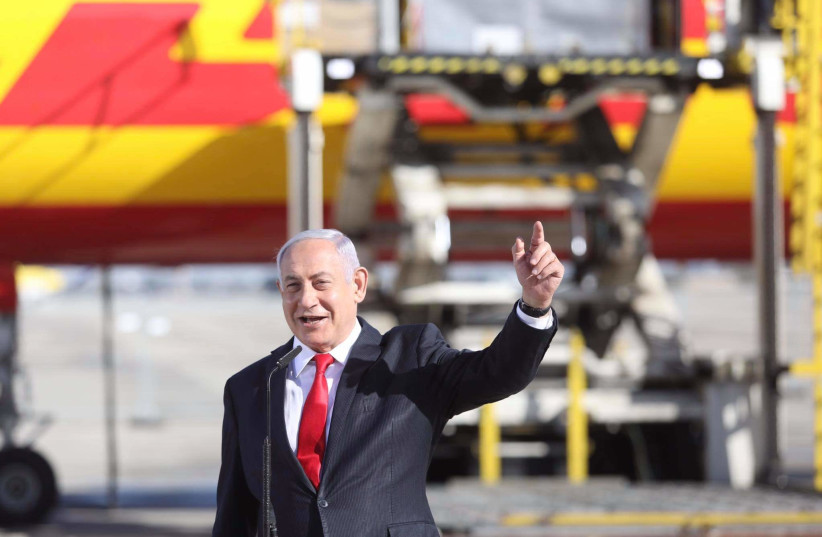

Prime Minister Benjamin Netanyahu welcomed the arrival of the first batch of Pfizer coronavirus vaccines in Israel /  (photo credit: MARC ISRAEL SELLEM)

If coronavirus had been expected to kill Prime Minister Benjamin Netanyahu’s chances of winning the next election, according to polls, the coronavirus vaccination could be his “green passport” to victory.

The fight that went on for months between Likud and Blue and White was over whether elections should be held in March or in June, with Alternate Prime Minister Benny Gantz wanting the former and Netanyahu the latter, because the prime minister feared going to an election during a pandemic.

Gantz won the battle and elections were set for March 23. But little did he know that Netanyahu would pick up the pace, make Israel the fastest country in the world to get vaccinated, and change the election from one held in the shadow of a pandemic to one executed during a possible post-virus victory.

“The agreement that I have made with Pfizer will enable us to vaccinate all citizens of Israel over the age of 16 by the end of March and perhaps even earlier,” Netanyahu said Thursday during a public address that was broadcast on all major TV outlets.

The irony of the timing cannot be ignored: Pfizer was likely making a strategic business decision, but it is saving Israel and could end up inadvertently rescuing Netanyahu as well.

If the majority of Israelis have been jabbed by mid-March and have green passports in hand when they go to vote, Israelis will “get back to life,” as per the name of the vaccination campaign.

Israelis have short-term memories – you have to, if you want to live in a country where one day there is a bus bombing and the next day you have to go to work. Our ability to forgive, forget and look forward is part of our signature national resilience.

And, so too, it can be expected that after a few visits to the movie theater, sporting events and restaurant-made meals in lieu of Netflix, as well as running solo and delivery, Israelis will cast off the last year as if it were a nightmare for the dream of better times.

PICTURES OF special “coronavirus polling stations” presented by the Central Elections Committee will be just that – mocked up photographs of the coronavirus election that could have been.

Perhaps masks and social distancing will still be required, but if around five million Israelis have been vaccinated or recovered from corona – achieving herd immunity – then few, if any, special booths will be needed on the day citizens of the country cast their ballots.

Fears harbored by Israel’s oldest voters that going to the polls could put their lives at risk will dissipate, allowing for at least average voter turnout.

If the last election is any indication – when Israel assumed voter turnout would be lowest during a third election in a-year-and-a-half but 71.5% of Israelis voted – the country could then see record numbers also.

Greater voter turnout tends to help larger parties, because niche parties have a smaller but set pool of voters.

Finally, many believed that following the ousting of US President Donald Trump, Netanyahu would no longer be needed, and he could even become a liability for US-Israel relations.

The US capitol riots further ignited fears that Israel, due to Netanyahu’s close ties with the president, could be brought down alongside Trump’s social media accounts.

But once again, Netanyahu proved otherwise, negotiating millions of vaccines by presenting Israel as a model country for vaccination to the world – a light unto the nations.

“In recent weeks, I have held 17 conversations with my friend, Pfizer chairman and CEO Albert Bourla,” Netanyahu said Thursday night. “The last conversation was held in the past 24 hours. This evening I am excited to inform you about a tremendous breakthrough that will pull us out of the coronavirus and get us back to life. We will be the first country in the world to emerge from the coronavirus.”

He went on to explain that as part of the agreement with Pfizer, “Israel will be a global model state for the rapid vaccination of an entire country” and provide the company with “statistical data that will help develop strategies for defeating the coronavirus.”
Later, it was reported that the data will also be shared with the World Health Organization.

NETANYAHU’S THEATRICAL performance conjured up images of his presentation from the Defense Ministry in Tel Aviv in 2018, where he informed the public that Israeli spies had nabbed the Iranian nuclear archive.

He likes to brag that Israel can do what no other country can accomplish under his leadership; that Israel is better than the world. According to Netanyahu, Israeli cows give more milk than other cows, just as Israel’s health system can vaccinate more people in less time.

The Prime Minister’s Office said Friday that several European leaders, including the chancellor of Austria, the prime minister of Denmark and the president of Cyprus, have called in recent days to congratulate Netanyahu on the successful vaccination campaign taking place in Israel and to be updated on its details.

The note mentioned that Cypriot President Nicos Anastasiades, discussed possible “cooperation between the two countries” on the subject of vaccination. Media outlets later reported that he had also asked Netanyahu to share vaccines with his country.

And there are surely more countries lining up for Israel’s help.
Now, Netanyahu can claim he does not need Trump – that he is in a league of his own.

Far from March being a low-point for Netanyahu in which a country suffering through a pandemic would have overthrown him in frustration, in 70 days, the timing could be pitch-perfect. A country that should be among the first to rid itself of coronavirus could turn around and vote for him in gratitude.


Zawartość publikowanych artykułów i materiałów nie reprezentuje poglądów ani opinii Reunion’68,
ani też webmastera Blogu Reunion’68, chyba ze jest to wyraźnie zaznaczone.
Twoje uwagi, linki, własne artykuły lub wiadomości prześlij na adres:
webmaster@reunion68.com



Israeli Model Yael Shelbia Hopes to ‘Extend Peace in the Middle East’ After Her UAE Magazine Cover Shoot

Israeli Model Yael Shelbia Hopes to ‘Extend Peace in the Middle East’ After Her UAE Magazine Cover Shoot

Shiryn Ghermezian


Israeli model Yael Shelbia. Photo: Courtesy of ITM Models/Yossi Michaeli.

Tel Aviv-based model Yael Shelbia says she has high hopes for the future of the Middle East, after becoming the first Israeli to appear on the cover of a magazine published in the United Arab Emirates.

“As a Jewish religious, IDF soldier and a model, I’m so very honored to be the first one to participate in such a historical cover,” Shelbia, 19, told The Algemeiner on Wednesday. “I hope that in the near future, we will be privileged to extend the peace in the Middle East.”

Shelbia, who started modeling when she was 14, will appear on the cover of the Dubai-based fashion and lifestyle magazine L’Official Arabia in its February issue. She flew to New York City for the cover photoshoot for a single day during a snowstorm, Kayla Lask, from Shelbia’s Israel-based modeling agency ITM Models, told The Algemeiner.

In addition to being featured on the cover, Shelbia will have an 8-page spread in the magazine and will wear looks by Israeli designers. The magazine’s February issue will be dedicated solely to Israeli fashion, The Algemeiner previously reported.

Shelbia currently lives in Tel Aviv, where she is also serving in the IDF. The Shabbat-observant model is originally from the northern Israeli city of Nahariya and has four brothers and sister. She has already been featured on a number of magazine covers in Israel and was recently voted as 2020’s most beautiful woman in the world in a ranking published by TC Candler.

In 2018, she was featured in an advertisement for Kim Kardashian’s makeup collection KKW Beauty.


Zawartość publikowanych artykułów i materiałów nie reprezentuje poglądów ani opinii Reunion’68,
ani też webmastera Blogu Reunion’68, chyba ze jest to wyraźnie zaznaczone.
Twoje uwagi, linki, własne artykuły lub wiadomości prześlij na adres:
webmaster@reunion68.com


Israel warns of nuclear arms race; Iran attempts to blackmail South Korea

Israel warns of nuclear arms race; Iran attempts to blackmail South Korea

TV7 Israel News


1) Israel and Sudan formalize their normalization of relations as part of the Abraham Accords.

2) Gulf Arab States end a prolonged diplomatic-rift with Qatar for the purpose of confronting the Islamic Republic of Iran.

3) Seoul deploys its anti-Piracy unit to the Gulf after the Islamic Revolutionary Guards seizes a South Korean-flagged vessel and its crew.


Zawartość publikowanych artykułów i materiałów nie reprezentuje poglądów ani opinii Reunion’68,
ani też webmastera Blogu Reunion’68, chyba ze jest to wyraźnie zaznaczone.
Twoje uwagi, linki, własne artykuły lub wiadomości prześlij na adres:
webmaster@reunion68.com


Follow the money: Hunting terrorists and their state sponsors – opinion

Follow the money: Hunting terrorists and their state sponsors – opinion

AVI JORISCH


Israel has learned that one of the most effective ways to curb illicit actors is to hit them where it hurts: their pocketbook.

Money for terror. /  (photo credit: POLICE SPOKESPERSON’S UNIT)

As I looked out the balcony of my Jerusalem apartment, I heard a loud thud. Almost immediately I saw ambulances driving at breakneck speed, and fear spread through my limbs. It was sometime in the late 1990s, and Hamas suicide bombings were taking place almost daily.

Then I waited. My girlfriend came home looking dazed and shaken. She’d been in Mahaneh Yehuda, where the bomb went off. She described men and women putting on their “death jackets” – paramedics and shop owners who had experienced this type of horror many times before and were trying to save as many people as possible and pick up the pieces of the dead. She sobbed uncontrollably in my arms for what seemed like an eternity.

I hadn’t thought of that traumatic day for a long time until I read Harpoon: Inside the Covert War Against Terrorism’s Money Masters (Hachette Books, 2017) by Nitsana Darshan-Leitner and Samuel Katz. As they described the many bombings, military operations and targeted assassinations from the Second Intifada, those memories haunted me. I finally understood why to this day I so rarely take public transportation anywhere in the world and why I avoid crowded places.

Years after the Mahaneh Yehuda bombing, I worked at the US Treasury and Defense departments tracking illicit money. Harpoon describes many of the operations we worked on to try and choke off the financial superhighways terrorists, money-launderers and criminals use to raise and move their dirty money. As I read, those memories came back to me as well. Non-fiction books don’t generally read like novels but I couldn’t put this one down.
Israel has fought many wars, and the battle against money-laundering and terrorism finance is perhaps one of its most significant challenges. Darshan-Leitner and Katz provide the first-ever account – previously classified – of how Israel brought together its government services, including intelligence units, police and diplomats, to create a task force to combat blood money.

In the early ‘90s, Israel nabbed Muhammad al-Hamid Khalil Salah, a Palestinian living in Chicago. After arriving at Ben-Gurion Airport, a nervous Salah went to the East Jerusalem YMCA. The Shin Bet (Israel Security Agency) was suspicious, and an entry team positioned itself outside his hotel room, picked the lock and burst in. A police bomb unit was summoned to open his suitcases in case they were rigged with explosives. What the law enforcement officials found stunned them into silence: a huge amount of American dollars.

Israel’s security apparatus later discovered that Salah was much more than a bag man, delivering bundles of cash like a common courier; he was, in fact, a key node in the finance unit of Hamas’s trans-national terrorist finance organization. This case forced Israel to start tracking Palestinian charities that were ostensibly collecting nickels and dimes for orphans and widows, but were actually raising huge amounts to fund bullets, bombs and suicide bombers. The light had finally gone off for Israel’s security apparatus: Money could be a powerful tool to disrupt terrorists.

As a result of that realization, in 2001, former Mossad head Meir Dagan formed a task force, code-named Harpoon, to follow money movements around the world. Harpoon describes some of the conventional and unconventional tactics the task force employed to disrupt the flow of money.

AS THE BOOK’S authors describe, since Harpoon’s founding, an army of accountants, forensic specialists, bankers and policymakers has worked to detect and curb the formal and informal methods terrorist groups like Hamas and Hezbollah employ to abuse the international financial sector.

In spy thriller-like fashion, Harpoon covers Israel’s 2010 assassination of Mahmoud Al-Mabhouh, a senior Hamas military wing commander and top financier. Al-Mabhouh spent a chunk of his career commanding the highly secretive squad whose sole mission was to kidnap and murder Israeli soldiers, and he was eventually selected by Iran and Hezbollah to channel massive sums into the Palestinian Islamic factory of death.

“He was part accountant, part purchasing agent, part arbitrator, part facilitator and part banker,” recalled a former member of Harpoon. “Money went into one of his hands, and death came out the other.”

A year before he met his destiny, Israel inserted a Trojan horse on his laptop and monitored all of his movements. He traveled to Dubai, ostensibly a neutral city, since the United Arab Emirates has made it clear to Middle Eastern adversaries that they may not use its territory for waging war.

That, however, reportedly didn’t stop an Israeli hit squad from assassinating al-Mabhouh in his hotel room, leaving the room locked from the inside – something no expert has been able to explain.

In the Second Lebanon War in 2006, Dagan argued in favor of bombing banks in Lebanon that, based on Harpoon’s work, were known to be handling funds for terrorists. Dagan believed that targeting the Lebanese economy would cripple the Party of God, stop Hezbollah from firing rockets into Israel, and send a message to the populace that their economic fate depended on reining in Hezbollah.

During the war, Israel bombed Beit al-Mal, Hezbollah’s treasury office, and banks that served as key pipelines for Hezbollah operations. These included Al Baraka Bank, Fransabank and Middle East Africa Bank – some of which I named and shamed in 2003 – as Hezbollah’s TV station advertised its accounts at these bank accounts and encouraged viewers to wire funds to it. Close to $100 million in hard currency was reportedly incinerated in the Israeli bombings, and Israel also hit bank information centers (and their backup facilities), erasing valuable data.

Harpoon also describes working with Dagan and others in the task force to develop a new battlefield to pursue those engaged in terrorism – “lawfare.”

Darshan-Leitner, the founder of Shurat HaDin, an Israeli NGO that uses the legal system to fight terrorists, has filed thousands of cases in US courts against individuals, corporations and banks that have aided and abetted terrorism. This groundbreaking means of going after illicit actors has exerted financial pain on terrorists and their state sponsors, depriving them of valuable access to the international financial sector.

Terrorism is a plague that is waged by those looking to demoralize and bring down democratic regimes. Groups like Hamas, Hezbollah and al-Qaeda, and state sponsors like Iran, Sudan, Syria and North Korea, threaten the international order and all of civilized society. Darshan-Leitner’s work at Shurat HaDin and the work of Harpoon have played a critical role in going after terrorism and its sponsors. Responsible international policymakers can use Harpoon as a blueprint to creatively and successfully pursue terrorism finance. Israel has learned that one of the most effective ways to curb illicit actors is to hit them where it hurts: their pocketbook.


The writer is the author of Thou Shalt Innovate: How Israeli Ingenuity Repairs the World (Gefen Publishing) and a senior fellow at the American Foreign Policy Council.


Zawartość publikowanych artykułów i materiałów nie reprezentuje poglądów ani opinii Reunion’68,
ani też webmastera Blogu Reunion’68, chyba ze jest to wyraźnie zaznaczone.
Twoje uwagi, linki, własne artykuły lub wiadomości prześlij na adres:
webmaster@reunion68.com


Gymnast Lihie Raz Wins First Israeli Medal in European Gymnastics Championship, Securing Olympics Spot

Gymnast Lihie Raz Wins First Israeli Medal in European Gymnastics Championship, Securing Olympics Spot

Shiryn Ghermezian


Israeli Gymnast Lihi Raz. Photo: Screenshot.

Artistic gymnast Lihie Raz on Sunday became the first Israeli to take home a medal at the Women’s European Artistic Gymnastics Championships, held this year in Mersin, Turkey, The Jerusalem Post reported.

The US-born 17-year-old won the bronze medal on the floor, scoring 12.750, securing her spot in the Israeli delegation that will compete in the 2021 Tokyo Olympic Games.

The silver went to Turkish gymnast Goksu Uctas Sanli, who scored 13.050, and the gold was taken by Romanian gymnast Larisa Iordache, who earned a score of 13.450.

Israel was also successful at the Rhythmic Gymnastics European Championships in Kiev, Ukraine last month. Israeli gymnast Linoy Ashram won the gold medal in the individual rhythmic category and the Israeli team won the group rhythmic gymnastics gold medal.

Watch Raz’s routine in the video below:


Zawartość publikowanych artykułów i materiałów nie reprezentuje poglądów ani opinii Reunion’68,
ani też webmastera Blogu Reunion’68, chyba ze jest to wyraźnie zaznaczone.
Twoje uwagi, linki, własne artykuły lub wiadomości prześlij na adres:
webmaster@reunion68.com