Archives

The Great Promise – The Spielberg Jewish Film Archive

The Great Promise

Hebrew University of Jerusalem Hebrew University of Jerusalem


Zawartość publikowanych artykułów i materiałów nie reprezentuje poglądów ani opinii Reunion’68,
ani też webmastera Blogu Reunion’68, chyba ze jest to wyraźnie zaznaczone.
Twoje uwagi, linki, własne artykuły lub wiadomości prześlij na adres:
webmaster@reunion68.com


You can kill Covid with a flick of a switch, study shows

You can kill Covid with a flick of a switch, study shows

SRAEL21c Staff


Ultraviolet LED lights kill coronavirus quickly, efficiently and cheaply — but don’t go stringing purple lights all over your home.

Israeli researchers discover that coronavirus can be quickly and easily killed using UV LED lights. Photo by Nor Gal via Shutterstock.com

As the world continues to race toward a vaccine for Covid-19, new Israeli research shows that the humble light bulb could become a major player in the fight against the pandemic.

Researchers have discovered that coronavirus can be killed quickly, efficiently and cheaply using ultraviolet light-emitting diodes, or UV LED lights.

In a study recently published in the Journal of Photochemistry and Photobiology B: Biology researchers found the optimal wavelength for killing the coronavirus is 267 nanometers.

They also discovered that a wavelength of 286 nanometers is almost as efficient, requiring less than half a minute to destroy more than 99.9 percent of the coronaviruses – good news considering that 286 nm LED bulbs are much cheaper and more readily available, and could be installed in air conditioning and water systems.

Prof. Hadas Mamane. Photo courtesy of Tel Aviv University

Tel Aviv University’s Prof. Hadas Mamane, who led the study, believes that the technology will soon be available for use.

“The entire world is currently looking for effective solutions to disinfect the coronavirus,” she says. “The problem is that in order to disinfect a bus, train, sports hall or plane by chemical spraying, you need physical manpower, and in order for the spraying to be effective, you have to give the chemical time to act on the surface.

“The disinfection systems based on LED bulbs, however, can be installed in the ventilation system and air conditioner, for example, and sterilize the air sucked in and then emitted into the room.”

Mamane explains that it is quite simple to kill the coronavirus using LED bulbs that radiate ultraviolet light.

recomended by: Leon Rozenbaum

“But no less important, we killed the viruses using cheaper and more readily available LED bulbs, which consume little energy and do not contain mercury like regular bulbs. Our research has commercial and societal implications, given the possibility of using such LED bulbs in all areas of our lives, safely and quickly.”

Ultraviolet radiation is a common method for killing viruses and bacteria. Ultraviolet disinfecting bulbs can be found, for example, in home water purifiers.

Earlier this year, scientists determined that applying ultraviolet light on the inside of ventilation systems in indoor spaces can quickly and efficiently deactivate both airborne and surface-deposited Covid-19.

Despite the exciting discovery, this is not the time to string purple lights all over your home.

“Of course, as always when it comes to ultraviolet radiation, it is important to make it clear to people that it is dangerous to try to use this method to disinfect surfaces inside homes,” Mamane warns.

“You need to know how to design these systems and how to work with them so that you are not directly exposed to the light.”


Zawartość publikowanych artykułów i materiałów nie reprezentuje poglądów ani opinii Reunion’68,
ani też webmastera Blogu Reunion’68, chyba ze jest to wyraźnie zaznaczone.
Twoje uwagi, linki, własne artykuły lub wiadomości prześlij na adres:
webmaster@reunion68.com


News From Israel- Jan 05, 2021

News From Israel- Jan 05, 2021

ILTV Israel News


New information regarding the motive for killing Esther Horgan in a #terror attack last month, now coming to light.
–
Meanwhile… Israel calling on the international community to band together against #Iran’s latest threats.
–
The Israel Antiquities Authority reporting a historic discovery with global implications.


Zawartość publikowanych artykułów i materiałów nie reprezentuje poglądów ani opinii Reunion’68,
ani też webmastera Blogu Reunion’68, chyba ze jest to wyraźnie zaznaczone.
Twoje uwagi, linki, własne artykuły lub wiadomości prześlij na adres:
webmaster@reunion68.com


More False Claims: Israel and Palestinian Diabetes Rates

More False Claims: Israel and Palestinian Diabetes Rates

Adam Levick


View of the United Nations Relief and Works Agency (UNRWA) building in Rafah in the southern Gaza Strip. Photo: Abed Rahim Khatib / Flash90

Blogger Elder of Ziyon posted recently about a webinar held by The Lajee Center, an NGO centered in the Aida UNRWA camp, that featured Health for Palestine Director Dr. Bram Wispelwey arguing that Israel was responsible for high levels of diabetes among Palestinian “refugees.”

However, of greater concern, is the fact that several months ago, the London Review of Books (LRB) published a blog post by Dr. Wispelwey (“Underlying Conditions,” April 18) where he made the same accusation.

Here are the relevant passages:

At nearly 18 per cent officially, and probably higher, the prevalence of diabetes among Palestinian refugees in the West Bank is one of the highest in the world. The official rate in Gaza is 16 per cent. Among adult citizens of Israel, it’s 7.2 per cent…

Decades of living in overcrowded refugee camps and a rapid transition to cheap and readily available high calorie foods, in part a result of the neoliberal economic changes that came with the Oslo Accords, have led to an explosive increase in obesity and diabetes among Palestinians. As in other parts of the world, the prevalence of the disease is linked to land dispossession, structural violence, colonial domination and oppression. [emphasis added]

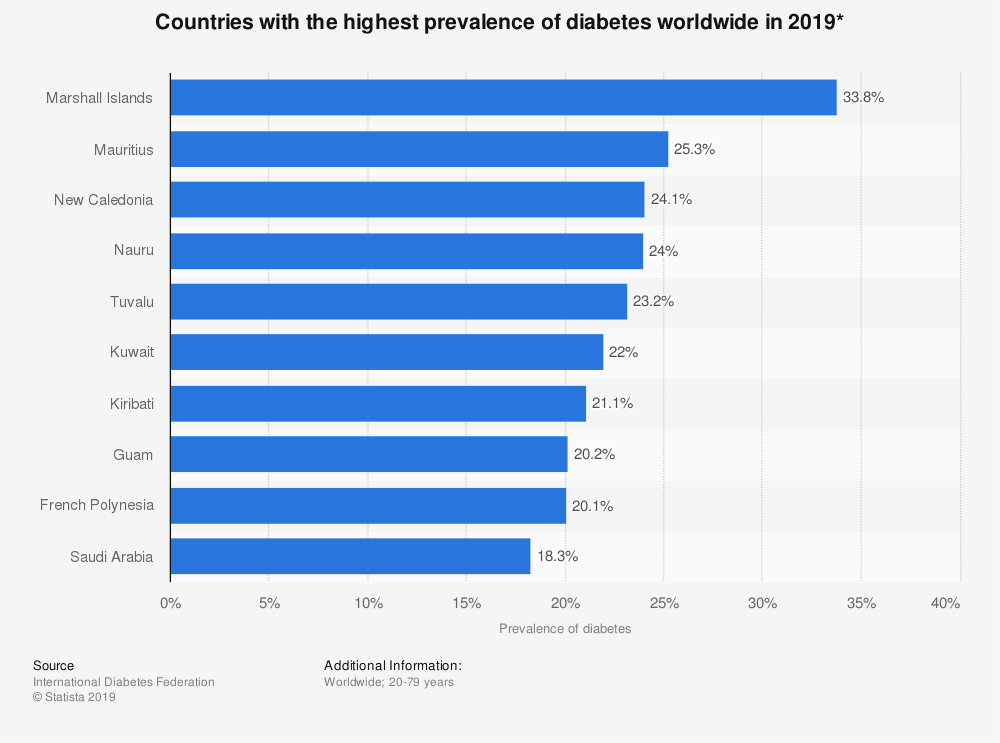
First, Elder put the charge in context by citing a report from the World Diabetes Foundation showing that the Palestinian diabetes rate, nearly 18%, is similar to other Middle Eastern countries. Additionally, this graph shows that wealthy oil-producing Gulf countries with high levels of expenditures on public health, such as Saudi Arabia and Kuwait, are among those states with higher levels of diabetes than Palestinians.

If the LRB contributor was to make a serious argument about the cause of high levels of diabetes among Palestinians, he would have at least had to acknowledge that other, far wealthier states in the region similarly have a high prevalence of the disease.

But this would have required real research, and forced him to consider that cultural or sociological factors, and individual lifestyle choices regarding diet and exercise within the MENA region may explain such high Palestinian morbidity rates.

But, as the passages above show, no serious research was conducted.

For instance, Wispelwey claims that living in “overcrowded refugee camps” and “neoliberal economic changes that came with the Oslo Accords” led to “readily available high calorie foods,” which resulted in increased diabetes rates. Yet, he doesn’t offer any empirical evidence to demonstrate a correlation between these phenomena, nor any data showing lower levels of diabetes before the Oslo Accords.

Even more clumsily, the LRB contributor posits that the prevalence of diabetes is linked to “land dispossession, structural violence, colonial domination and oppression” — yet he offers no evidence to connect the two. And, even if we were to accept the writer’s accusation about Israeli “colonialism” and “structural violence,” data in the chart above shows the states with the highest levels of the disease have no such political dynamics present.

At the end of the day, all we have is an evidence-free, politically-motivated assertion suggesting Israeli responsibility for high Palestinian diabetes rates — sophomoric anti-Israel agitprop dutifully published by editors at an influential British literary magazine.


Adam Levick serves co-editor of CAMERA UK, an affiliate of the Committee for Accuracy in Middle East Reporting in America (CAMERA), where this article first appeared.


Zawartość publikowanych artykułów i materiałów nie reprezentuje poglądów ani opinii Reunion’68,
ani też webmastera Blogu Reunion’68, chyba ze jest to wyraźnie zaznaczone.
Twoje uwagi, linki, własne artykuły lub wiadomości prześlij na adres:
webmaster@reunion68.com


IVC: 2020 was a record year for Israeli tech

IVC: 2020 was a record year for Israeli tech

ZEV STUB


Money / (photo credit: INGIMAGE / ASAP)

Despite the global crisis, Israeli tech companies raised a record $9.9 billion in 578 deals, according to the 2020 Israeli Tech Review published by IVC and Meitar Law Offices.

Those numbers represent an increase of 27% in volume and a 14% increase in the number of deals compared to 2019. The numbers were bolstered by seven large deals worth more than $200 million each, compared to three such large deals in 2019.

The findings parallel those published in a competing report by PwC Israel earlier in the week.

“While in 2020, primarily due to the COVID-19 pandemic, we saw a significant decline in the M&A activity of Israeli companies, we simultaneously experienced an increase in financing rounds by Israeli and foreign investors, in the number of deals as well as the capital invested,” said the report’s authors. “Specifically, financing among growth companies showed a significant increase, as did the total number of rounds. The above demonstrates the maturity and development of the Israeli high-tech industry, manifested, among other things, in the increased number of companies that have crossed the billion-dollar valuation (unicorns).”

“Besides, in 2020, we saw a significant increase in financing by Israeli tech companies on the capital market, partly due to low-interest rates and the general hesitation in the markets in light of COVID-19. SPAC deals also experienced significant growth in 2020, as in the US, it was a record-breaking year in the number of SPAC offerings and the overall amounts raised in these offerings.”

“According to the pipeline we observe, this trend will continue in 2021, and many of the large companies that have matured in recent years will examine the option of public capital markets for continued growth and development. We believe that it will lead to an increase in M&As in these companies, where traded shares will be used as currency,” the report said.
There were 371 VC-backed deals worth $8.7 billion during the year, compared to $6.52 billion in 320 deals in 2019. Investments in early rounds declined in the first two quarters due to the COVID-19 crisis. However, the numbers picked up in the third and fourth quarters.

Some 121 publicly-traded hi-tech companies raised $6.6 billion during the year, compared to $2 billion by 68 companies in 2019. The most significant trend observed among investors was the focus on existing portfolio companies and increased follow-on investments, the report said.

Mature growth companies raised record amounts in 2020, continuing the trend observed over the past two years. Total investments in growth companies were $8.33 billion. Early-stage companies raised $1.6 billion in 2020.
There was a significant decrease in mergers and acquisitions, as 93 companies netted $7.8 billion, after 143 M&As raised $14.24 billion in 2019. As in 2019, US-based corporations accounted for 90% of all M&As.

There were 18 IPOs by Israeli tech companies on local and foreign capital markets in 2020, with a total offering of $1.6 billion. Israeli public companies’ activity on the capital markets was $6.55 billion (including IPOs, follow-ons and RDs, PIPEs, equity, and debt) in 121 deals compared to $1.95 billion raised in 68 deals in 2019.

“2020, which was and continues to be impacted by COVID-19, is ending on a strong note and with hopes for continued activity in financing and offering and renewed increase in M&As,” the report concluded.


Zawartość publikowanych artykułów i materiałów nie reprezentuje poglądów ani opinii Reunion’68,
ani też webmastera Blogu Reunion’68, chyba ze jest to wyraźnie zaznaczone.
Twoje uwagi, linki, własne artykuły lub wiadomości prześlij na adres:
webmaster@reunion68.com