
Archives

Beitar Jerusalem, the unlikely symbol of Israeli-Arab unity

Beitar Jerusalem, the unlikely symbol of Israeli-Arab unity

JPOST EDITORIAL


Perhaps now, Beitar can shed its racist image and become a sporting model of Jewish-Muslim teamsmanship.

BEITAR JERUSALEM looks like a whole new team – both on and off the pitch – after a number of personnel changes, from the club’s owner to executives to players, and improved results are bound to follow. / (photo credit: DANNY MARON)

We welcome the news that Sheikh Hamad Bin Khalifa Al Nahyan, a member of the United Arab Emirates’ royal family, has purchased a 50 percent stake in the Beitar Jerusalem soccer club, and congratulate him with the Arabic term, “Mabruk!”

“A historic and exciting day for Beitar Jerusalem,” the capital’s Premier League team tweeted to its followers, noting that the deal had been signed by the Israeli co-owner, Moshe Hogeg, and Sheikh Hamad on Monday – three months after Israel and the UAE established diplomatic ties as part of the US-led Abraham Accords.

Perhaps now, Beitar – which is infamous for its refusal to sign an Arab player and the anti-Arab chants of some of its hardcore fans, known as “La Familia” – can shed its racist image and become a sporting model of Jewish-Muslim teamsmanship.

Beitar’s announcement quoted Sheikh Hamad as saying: “I am thrilled to be a partner in such a glorious club that I have heard so much about and in such a great city, the capital of Israel and one of the holiest cities in the world.”

Pledging to invest NIS 300 million in the team over the next decade, he said this represented “the fruits of peace and brotherhood between the nations” and would “bring people together through sport.”

Saying he would strive to put together the best team possible, he concluded with the fans’ famous chant, “Yalla, Beitar!”

Hogeg said, “On the eve of Hanukkah, Beitar’s menorah is lit in a new and exciting light. Together, we all march the club to new days of coexistence, achievements and brotherhood for the sake of our club, community and Israeli sports.”

Beitar has sought to change its ugly image in recent years and received an award from President Reuven Rivlin in 2017 for its efforts to tackle racism and reduce the number of racist chants at its games. Hogeg, a cryptocurrency entrepreneur, said after buying the team in 2018 that he planned to put it on a “new path.”

The sheikh’s son, Mohammed bin Hamad bin Khalifa, will in effect control the club from the UAE and become a member of its new board of directors. The funds invested by his father will be used, inter alia, to buy some star players.

Foreign ownership of football clubs in England has proved to be enormously successful. A staggering 15 clubs in the English Premier League are owned or part-owned by overseas investors.

Since the West London club, Chelsea, was bought by Russian-Israeli billionaire Roman Abramovich in 2003, it has won 16 major trophies – the UEFA Champions League, the UEFA Europa League twice, the Premier League five times, the FA Cup five times and the League Cup three times.

We can only hope that Beitar, which has been struggling financially and on the field in recent years, can return to its glory days and flourish after being injected with much-needed funding from the UAE. Beitar has won the Israeli Premier League six times, as well as seven Israeli Cups and two Israeli Supercups – in 1976 and 1986.

The club was founded in 1936 by Shmuel Kirschstein and David Horn, who chaired the so-called Beitar branch in Jerusalem, and several players were also members of the banned Irgun and Lehi groups associated with the Revisionist Zionism movement trying to oust the British Mandate.

The club has traditionally worn yellow and black and plays its home matches at Teddy Stadium (named after legendary Jerusalem mayor, Teddy Kollek).

Some fans have protested against the UAE purchase. Others, however, welcomed the move and the promised funding as providing a new start.

We understand that some fans may be upset by a quintessentially Israeli team being sold to a foreign investor, but it is time to put an end to unbridled hatred that shames not only the club but the whole of Israel.
Just as FIFA has effectively conducted a “#Say No To Racism” campaign and Chelsea has successfully promoted its “#Say No To Antisemitism” campaign, so too should the new Beitar launch a new campaign against hatred.

From now on, “Yalla, Beitar!” should be a chant associated with sportsmanship and coexistence – and the team should become a proud mascot of the Abraham Accords.


Zawartość publikowanych artykułów i materiałów nie reprezentuje poglądów ani opinii Reunion’68,
ani też webmastera Blogu Reunion’68, chyba ze jest to wyraźnie zaznaczone.
Twoje uwagi, linki, własne artykuły lub wiadomości prześlij na adres:
webmaster@reunion68.com
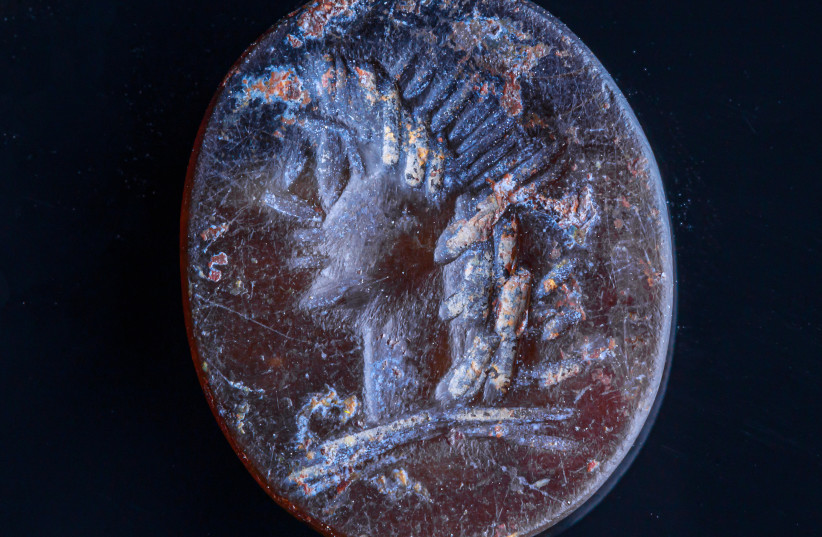


2,000-year-old gem seal depicting Greek god Apollo found under City of David

2,000-year-old gem seal depicting Greek god Apollo found under City of David

HANNAH BROWN


Although Apollo is an Olympian deity of the Greek and Roman cultures, it is highly probable that the person wearing the ring with Apollo’s portrait was a Jew.

Seal with the image of Apollo. / (photo credit: ELIYAHU YANAI/CITY OF DAVID)

Researchers discovered a gem seal featuring a portrait of Apollo in the drainage channel of the City of David late last month. It was found in archaeological soil that was removed from the foundations of the Western Wall during work on the Archaeological Sifting Project in Tzurim Valley National Park.

The excavations were carried out under the auspices of the City of David and the Israel Nature and Parks Authority.
The gem features an engraved portrait of the god Apollo. According to researchers, this surprising and rare find is only the third secured gem sealing (intaglio) from the Second Temple period to have been discovered in Jerusalem.

The gem is cut from dark brown jasper and has remnants of light yellow, brown and white layers. In antiquity, jasper was considered a precious stone. The gem sealing was embedded in a ring, and it dates from the first century CE (Second Temple period).

The oval-shaped gem is 13 mm. long, 11 mm. wide and 3 mm. thick. Because it is an intaglio – having a design carved into the upper side of the stone – its main function was a seal to be stamped on soft material, usually beeswax, for use as a personal sign ature on contracts, letters, wills, goods and bundles of money.

The intaglio features an engraving of Apollo’s head in profile to the left, with long hair flowing over a wide, pillar-like neck, large nose, thick lips and small, prominent chin. The hair is styled in a series of parallel lines directed to the apex and surrounded by a braid above the forehead. One line of hair marks a strand that covers the ear; long curls flow over part of the neck, reaching the left shoulder. Thin diagonal lines at the base of the head mark the upper end of the garment and the body.

Although Apollo is an Olympian deity of the Greek and Roman cultures, it is highly probable that the person wearing the ring with Apollo’s portrait was a Jew, according to the researchers, archaeologist Eli Shukron, Prof. Shua Amorai-Stark and senior archaeologist Malka Hershkovitz.

SHUKRON, who conducted the excavation in which the gem was found, said in a press release: “It is rare to find seal remains bearing the image of the god Apollo at sites identified with the Jewish population. To this day, two such gems [seals] have been found at Masada, another in Jerusalem inside an ossuary [burial box] in a Jewish tomb on Mount Scopus and the current gem that was discovered in close proximity to the Temple Mount.

“When we found the gem, we asked ourselves: ‘What is Apollo doing in Jerusalem? And why would a Jew wear a ring with the portrait of a foreign god?’ The answer to this, in our opinion, lies in the fact that the owner of the ring did so not as a ritual act that expresses religious belief, but as a means of making use of the impact that Apollo’s figure represents: light, purity, health and success.”

Amorai-Stark, a researcher of engraved gems, added: “At the end of the Second Temple period, the sun god Apollo was one of the most popular and revered deities in Eastern Mediterranean regions. Apollo was a god of manifold functions, meanings and epithets. Among Apollo’s spheres of responsibility, it is likely that association with sun and light – as well as with logic, reason, prophecy and healing – that fascinated some Jews, given that the element of light versus darkness was prominently present in the Jewish worldview in those days.”

“The fact that the craftsman of this gem left the yellow-golden and light brown layers on the god’s hair probably indicates a desire to emphasize the aspect of light in the god’s persona, as well as in the aura that surrounded his head,” he said. “The choice of a dark stone with yellow coloring of hair suggests that the creator or owner of this intaglio sought to emphasize the dichotomous aspect of light and darkness and/or their connectedness.”

The Archaeological Sifting Project at Tzurim Valley National Park, sponsored by the City of David and the Nature and National Parks Authority, is a large-scale archaeological project that offers the public an opportunity to experience and appreciate archaeological activity without the need for advanced training or specialized knowledge.

The sifting has been supervised closely by archaeologists. It allows participants to become “archaeologists for a day” as they process archaeological material unearthed in City of David excavations, where they often find ancient treasures. The findings discovered thus far in the project include an imprint of King Hezekiah, coins from different periods, arrowheads and jewelry.

Due to the current nationwide closure of tourist sites, the site is closed. But it will be reopened to the public as soon as conditions permit.


Zawartość publikowanych artykułów i materiałów nie reprezentuje poglądów ani opinii Reunion’68,
ani też webmastera Blogu Reunion’68, chyba ze jest to wyraźnie zaznaczone.
Twoje uwagi, linki, własne artykuły lub wiadomości prześlij na adres:
webmaster@reunion68.com

Israeli Athlete Makes History After Winning Two Medals in Europe

Israeli Athlete Makes History After Winning Two Medals in Europe

JNS.org


Israeli gymnast Artem Dolgopyat at the European Championships on Dec. 13, 2020. Photo: YouTube/Screenshot.

Israeli gymnast Artem Dolgopyat made history on Sunday, after winning the gold medal for the floor exercise at the European Championships, in addition to a bronze medal for vault with a score of 14.766.

Prime Minister Benjamin Netanyahu congratulated Dolgopyat on Twitter, saying “all citizens of Israel are proud of you.”

Israeli gymnast Alexander Myakinin later won the bronze medal on the high bar event, getting a score of 14.200.

The win puts the two athletes on a promising path for the Tokyo 2021 Olympic Games, adding to various other fields that Israel has made strides in, including judo and baseball.


Zawartość publikowanych artykułów i materiałów nie reprezentuje poglądów ani opinii Reunion’68,
ani też webmastera Blogu Reunion’68, chyba ze jest to wyraźnie zaznaczone.
Twoje uwagi, linki, własne artykuły lub wiadomości prześlij na adres:
webmaster@reunion68.com


Islamic-era candle molds found near Tiberias

Islamic-era candle molds found near Tiberias

HANNAH BROWN


Findings could add to historians’ understanding of those who lived near the Sea of Galilee in the early Islamic period.

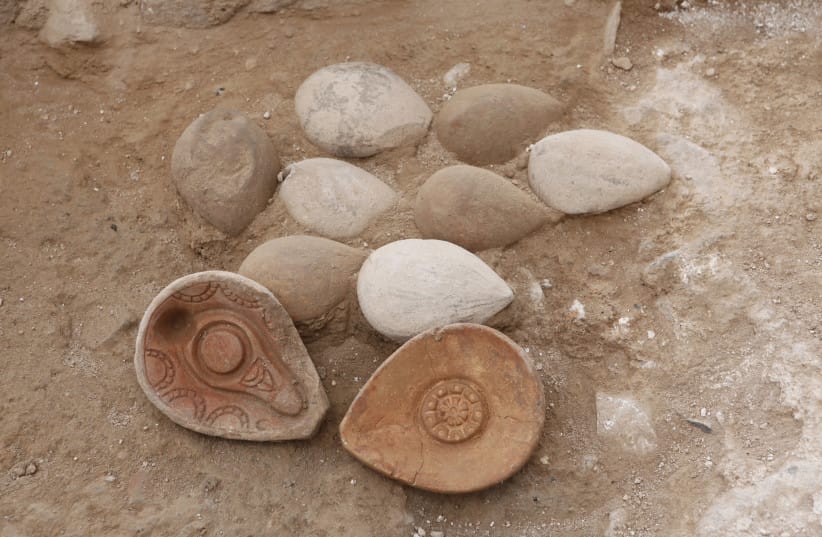
The Islamic-era candle mold found in Tiberias. / (photo credit: TAL ROGOVSKY)

A trove of artifacts, including well-preserved molds for candles dating from over one thousand years ago, were found in Tiberias, the Hebrew University of Jerusalem and the Israel Museum announced on Monday.

The find was rare in terms of both size and quality and could add to historians’ understanding of those who lived near the Sea of Galilee in the early Islamic period between the 7th and 11th centuries CE, researchers said.

The artifacts, which include 10 candle molds that survived intact and are decorated with geometric and floral designs, could confirm that a candle-making industry existed there.

The excavation was directed by Dr. Oren Gutfeld, alongside Michal Haber and Tal Rogovenski, all from The Hebrew University’s Institute of Archaeology, with the assistance of the Israel Antiquities Authority. Following preservation work in the Israel Museum’s laboratory, the candles and holders will be exhibited for the very first time over the Hanukkah holiday.

The items unearthed include building remains, but the majority of findings were home utensils and light manufacturing apparatuses dated to that period, including clay tools used in oil candle production. Just 500 meters south of this excavation, another Hebrew University team (also led by Dr. Gutfeld) discovered the largest hidden trove of steel tools from the Islamic period found anywhere, which is on display today in the Israel Museum.

In addition to the 10 fully preserved candleholders, fashioned from clay, the site also held numerous oil candles, including some unused ones, suggesting the site had served as a production facility.
Remarkably, one candleholder was etched with the word “Allah” and another had a five-pointed star etching – not unlike a Star of David (although no connection is known to the traditional Jewish Hanukkiah or menorah).

An extensive earthquake occurred in the region in the 11th century, causing considerable damage and casualties and evidence of the destruction it caused can be seen at this site.

“We excavated the landslide area and this provided remarkable evidence of an earthquake that struck the area in the year 1033 and destroyed the city of Tiberias,” said Gutfeld. Based on the nature of the site and the way in which the ruins were laid out upon their discovery, the research team believes that the area’s residents fled in the wake of the earthquake and the region remained largely unpopulated for many years.

Liza Luria, curator of the Islamic Art and Archaeology Exhibit at the Israel Museum, explained, “The exhibit of these clay utensils enables visitors to follow the course of their creation, understand how they were fashioned and designed, then hardened to achieve their final form. Such discoveries offer an exceptional glimpse of the traditional forms of industry used by the local residents in ancient times, which continue to be relevant and inspire design even today.”


Zawartość publikowanych artykułów i materiałów nie reprezentuje poglądów ani opinii Reunion’68,
ani też webmastera Blogu Reunion’68, chyba ze jest to wyraźnie zaznaczone.
Twoje uwagi, linki, własne artykuły lub wiadomości prześlij na adres:
webmaster@reunion68.com


News From Israel- Dec 20, 2020

News From Israel- Dec 20, 2020

ILTV Israel News


srael officially sets off on its campaign to vaccinate the nation
–
New virus restrictions imposed on travel as a new, more infectious strain of the virus is discovered
–
Breaking borders with a new song of peace– artists from across the region join together for an incredible ensemble


Zawartość publikowanych artykułów i materiałów nie reprezentuje poglądów ani opinii Reunion’68,
ani też webmastera Blogu Reunion’68, chyba ze jest to wyraźnie zaznaczone.
Twoje uwagi, linki, własne artykuły lub wiadomości prześlij na adres:
webmaster@reunion68.com