Archives

Memories and Expectations of Antony Blinken

Memories and Expectations of Antony Blinken

Martin Peretz


The New Republic staff with a young Antony Blinken. TOP: Left, Chuck Lane; Third from Left, Leon Wieseltier; Fourth from Left, Rick Hertzberg; Fourth from Right, Antony Blinken; Second from Right, Laura Obolensky. BOTTOM: Left, Dorothy Wickenden; Second from left, Mort Kondracke; Third from Left, Marty Peretz; Third from Right, Charles Krauthammer; Second from Right, Mike Kinsley; Right, Ann Hulbert. Photo: courtesy of Martin Peretz.

An extended metaphor from Meir Blinkin, the immigrant Yiddish writer, born in 1879 in Pereyeslav, the Ukraine, dead at 37 in New York where mourning throngs ushered him towards his last address:

Chava was suddenly overwhelmed with the feeling that life was really beautiful, full of promise; life never betrayed those who hoped and believed…

But…

When Chava finally fell asleep she dreamed she had come into possession of a marvelous violin and that all unexpectedly the main string, the one which produces the tenderest, most     heartfelt tones, had snapped.

This was the tale of a curt marriage. But this also was Blinkin’s life — or the lives of his neighbors on the lower east side of New York. The next generation was someone whom I’d met when I was doing “good works” for the Jerusalem Foundation, actually as chairman. He called himself M.H. Blinken (with him came a new spelling of the name) when, as now, two initials as a first name translated into “wealthy man” or “important man.” I recall meeting him in Palm Beach — though I’m not certain — and collecting a hefty five-figure gift for that philanthropy and then having to listen to him criticize Teddy Kollek, an old line Zionist and mayor of Jerusalem, “the city of gold” — or perhaps more aptly “the city of God” — but of a relatively dovish persuasion. Dovish but tough, if you get what I mean, which I don’t quite.

Tony, as I call him (but I haven’t seen him for a handful of years), comes from an intriguing family… at least the part of it I know. That is, I don’t know his father’s side of the family —Donald’s — but I do know his mother’s, Judith. And his sister’s, Leah. This was really a case of the paterfamilias, a family whose character and color somehow descended and was etched by the father, in this case Samuel, who cut the cloth of a large part of the Paris Jewish community, more of the North Africans than the Eastern European and the old-line French, the descendants of the consistoire of Napoleon, the sanhedrin.

I recall visiting the Pisars when Leah was applying to Harvard and happening in on a conversation about Sam asking prime minister Mitterand to write a letter of recommendation for his daughter. I stuck my head into the confab, arguing that Mitterand’s words would not help — how well did he know the young lady? — and might only raise questions like: why does she need the PM to write for her anyway? But Pisar had survived Dachau and Maidanek: his words did carry weight. Even perhaps with his daughter.

I met Antony Blinken when he was at Harvard but got to know him reasonably well only when he came on board The New Republic. One fact I learned quickly was that he was very smart, even brilliant, and if he believed in something and you didn’t, he could argue you down with alacrity and depth. We spoke then only a tiny bit about Israel and the Arabs, Israel and the Palestinians. But once in a lunchtime discussion around the question — at least as I recall it — he mustered the facts of history which in my view settled the argument.

Of course, Blinken worked for both vice president Biden and president Obama. I trust Biden almost as a righteous gentile Zionist… not that he grasps everything that he should; nor do I. So, yes, even Zionists can be wrong, very wrong. Settling the land, especially all of the land that is left, will destroy even the practical possibilities of peace, even the possibilities of calm. But, from my point of view at least, Obama is hostile in principle to even those of us who believe in a two-state solution but recognize that the blame for its failure to materialize has, for 40 years and more, rested squarely with the Palestinian leadership. This is too concrete a view for Obama’s elevated, and incorrect, conception of liberalism as unifying all oppositions, with himself as the unifier. Israel must, somewhere, be to blame, and he and John Kerry found that “somewhere” in the fig leaf of the West Bank settlements.

I am, obviously, not encouraged that John Kerry is part of the Biden Administration — but I am encouraged that his purview is nowhere near the immediate interests of the Jewish state, except that the universe is the concern of every state, of everyone. Under Biden and Blinken, I do not hope for the axiomatic position of Trump and Kushner, a position I believe is probably the fastest way to peace in the long run. Anyway, the new administration is very different from the old and certainly more reflective. So, I do hope, actually expect from it savvy, responsibility, practicality when it comes to the question of Israel and the Palestinians, of Israel and the other Arabs (like the Saudis) — and I believe, especially under the guidance of Blinken, that’s what we will see and experience.

But I don’t hope or expect a 100% performance. And I have grave misgivings about the other issue of importance to Israel — Iran. Here the Biden administration confronts a choice: continue on some level the Trump policies of isolating the regime, or ease back into an approximation of the nuclear deal of 2015, Obama’s foreign policy “legacy,” by loosening sanctions. Already some signs point to Biden leaning the second way. There is talk that Rob Malley, Obama’s point-person for the Middle East, will reemerge in a Biden administration, and Malley is a supporter of rapprochement with the regime and quite frankly an antagonist — if not an enemy — of Israel. Dan Shapiro is certainly not an enemy but he believes that a lot of pressure on Israel is good for Israel — and his name is also being floated.

This means that Antony Blinken may face a choice of his own: stay with and support the Obama logic, or push for a more pragmatic and assertive approach to Iran that falls short of Trump’s hard line — be a “team” player, or use his capital with the incoming President to urge a tougher stance. If he chooses the former approach, Blinken will be doing no favors to Israel, the Iranian people, or the Middle East as a whole. And also no favor to the United States.


Zawartość publikowanych artykułów i materiałów nie reprezentuje poglądów ani opinii Reunion’68,
ani też webmastera Blogu Reunion’68, chyba ze jest to wyraźnie zaznaczone.
Twoje uwagi, linki, własne artykuły lub wiadomości prześlij na adres:
webmaster@reunion68.com


News from Israel – Dec. 10, 2020

News from Israel – Dec. 10, 2020

ILTV Israel News


Make sure you are staying home for Hanukkah this year. Because if you don’t, you could be hit with a hefty fine.
–
How do you keep students honest while remote learning? One Israeli start up has the artificial intelligence answer.


Zawartość publikowanych artykułów i materiałów nie reprezentuje poglądów ani opinii Reunion’68,
ani też webmastera Blogu Reunion’68, chyba ze jest to wyraźnie zaznaczone.
Twoje uwagi, linki, własne artykuły lub wiadomości prześlij na adres:
webmaster@reunion68.com


Altar to Greek god found in wall of Byzantine church raises questions

Altar to Greek god found in wall of Byzantine church raises questions

HANNAH BROWN


This excavation is now focusing on figuring out how this pagan altar came to be part of the church wall and what the inscription on it means.

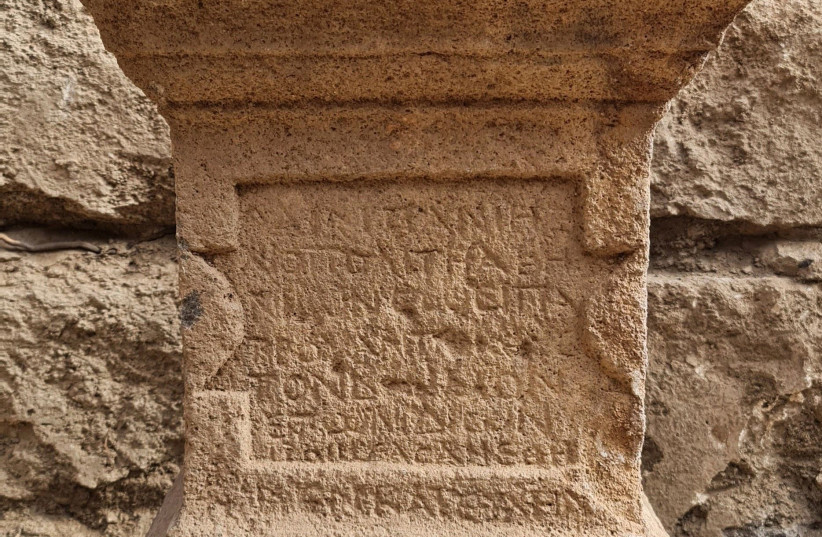
The altar to the Greek god Pan is seen at a Byzantine church in Banyas. / (photo credit: OFER SHINAR)

An Israeli team of researchers excavating a Byzantine church in the Banyas Nature Reserve in Northern Israel believed to be from about 400 CE recently discovered a Roman-era temple to the Greek god, Pan, beneath the church, and made another find that sheds further light on the way that the lives of the later Christians were intertwined with those who worshiped the earlier faiths: a 2nd- or 3rd-century CE altar with a Greek inscription found in the walls of the church.

The church, which is one of the oldest ever found, was important to early Christians, according to Prof. Adi Erlich of the Zinman Institute of Archaeology, University of Haifa, who is leading the excavation of the site with Prof. Ron Lavi. “This site would have had tremendous significance for Christians of the Byzantine era, who believed that this is where Jesus told Peter, ‘I give you the keys to the kingdom of Heaven,’” said Erlich.

This excavation, which is supported and was initiated by the Nature and Parks Authority, is now focusing on figuring out how this pagan altar came to be part of the church wall and what the inscription means. The inscription is being studied by Dr. Avner Ecker of Bar-Ilan University. The inscription, which is in Greek, reads, “Atheneon son of Sosipatros of Antioch is dedicating the altar to the god Pan Heliopolitanus. He built the altar using his own personal money in fulfillment of a vow he made.” Two main things are interesting about this inscription – the combination of Pan with Heliopolitanus, a name normally associated with Zeus, and the origin of the donator from faraway Antioch, some 400 km to the north, located on what is now the on the Turkey-Syria border. “It seems that this cult place was visited by pilgrims coming from afar,” said Erlich.

The Banyas excavation is in a unique location that features a cave, cliff and springs, alongside a terrace formed from the partial collapse of the cliff. The temple was built not long before the beginning of the Christian era.

The discovery of this altar and its inscription raises as many questions for the team researching the site as it answers. The altar was found lying horizontally and it was not until the stone had been thoroughly cleaned that the inscription became visible. Erlich noted that the stone is basalt, and not the local limestone, which is generally found in the area but said that the basalt tends to preserve inscriptions even better than limestone. Why this worshiper chose basalt is one of the many questions the team is investigating in this site that has yielded so many fascinating finds.


Zawartość publikowanych artykułów i materiałów nie reprezentuje poglądów ani opinii Reunion’68,
ani też webmastera Blogu Reunion’68, chyba ze jest to wyraźnie zaznaczone.
Twoje uwagi, linki, własne artykuły lub wiadomości prześlij na adres:
webmaster@reunion68.com


Iran source of MidEast conflicts

Iran source of MidEast conflicts

TV7 Israel News


1) U.S. Secretary of State Mike Pompeo reiterated the Trump Administration’s position – which stipulated that the Israel-Palestinian conflict is not “the true cause of conflict in the Middle East.”

2) Foreign Ministers of European Union member states discussed a common position regarding Turkey’s defiant activities in the Eastern Mediterranean.

3) A Senior Armenian military official voices his love and respect for the state of Israel and its peoples.


Zawartość publikowanych artykułów i materiałów nie reprezentuje poglądów ani opinii Reunion’68,
ani też webmastera Blogu Reunion’68, chyba ze jest to wyraźnie zaznaczone.
Twoje uwagi, linki, własne artykuły lub wiadomości prześlij na adres:
webmaster@reunion68.com


3000-year-old temple-era gold bead found by 9-year-old Jerusalem boy

3000-year-old temple-era gold bead found by 9-year-old Jerusalem boy

IDAN ZONSHINE


The bead was so well preserved, that when the boy brought the bead to the supervising archaeologist, he initially wrote it off as likely being an unidentified modern object.

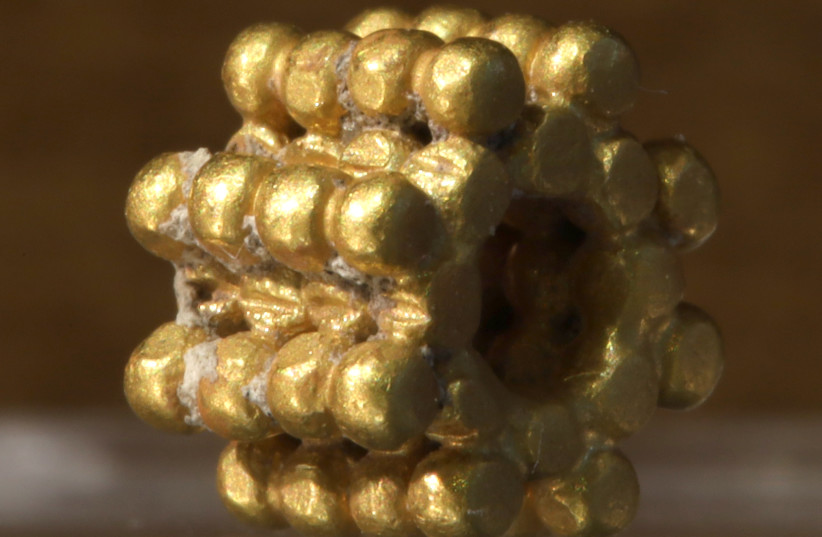
First Temple-era gold granule bead
(photo credit: TEMPLE MOUNT SIFTING PROJECT)

The first ever First Temple-era gold granule bead was discovered during wet sifting of earth from the Temple Mount by a nine-year-old boy, the Temple Mount Sifting Project (TMSP) announced earlier this week.

While sifting through the dirt with his family in August, Jerusalem resident Binyamin Milt uncovered a perfectly preserved small, flower-shaped cylinder, created by four layers of tiny gold balls, unaware that the artifact he was holding was likely forged around 3,000 years ago.

The bead was so well preserved in fact, that when the boy brought the bead to the supervising archaeologist, he initially wrote it off as likely being an unidentified modern object, not even writing down the boy’s contact information before hurrying back to continue sifting.

It was only while sorting through the summer’s artifacts in Dr. Gabriel Barkay’s backyard that he realized the bead was strikingly similar to several similar items he had found when he excavated burial systems from the First Temple period in Katef Hinom.

While those beads were made of silver, they were identical to the gold bead in both shape and manufacturing method (called granulation). Similar beads have been found in several other sites across Israel, dated to various periods, with the overwhelming majority dating to the Iron Age (12th to 6th centuries BCE).

Once the bead’s significance had become clear, TMSP researchers called all the families who participated in the sifting on that specific day, until they made contact with Binyamin.

Pieces of gold jewelry are rarely found among archaeological artifacts from the First Temple period, since gold at that time was not refined and generally contained a significant percentage of silver.

Granulation is a technique which demands of the goldsmith a considerable amount of expertise and experience, due to the many components and complex manufacturing stages.

The granules are shaped using tiny metal pieces which are melted on a bed of charcoal or charcoal powder, which absorbs air, preventing oxidation. Once the metal melts, surface tension of the liquid produces ball-shaped drops. An alternative method involves dripping the liquid metal from a height into a bowl and constantly stirring the drops.

At this stage it is not yet clear what purpose the bead served, though initial projections by TMSP members say it could have been part of an ornament worn by an important personage who visited the Temple, or by a priest. More info on the piece will be published once all the artifacts from the summer are processed.

TMSP was founded in response to illegal renovations which were carried out in 1999 by the northern branch of the Islamic Movement, disposing of over 9,000 tons of dirt, mixed with invaluable archaeological artifacts, dumping it all into the Kidron Valley.

Archaeologists Dr. Gabriel Barkay and Zachi Dvira retrieved the rubble and began sifting through it in 2004, with the goal of understanding the archaeology and history of the Temple Mount, while preserving history.
Over the years, it has grown into an internationally significant project, bringing in over 200,000 volunteers who have helped the researchers find thousands of priceless artifacts.


Zawartość publikowanych artykułów i materiałów nie reprezentuje poglądów ani opinii Reunion’68,
ani też webmastera Blogu Reunion’68, chyba ze jest to wyraźnie zaznaczone.
Twoje uwagi, linki, własne artykuły lub wiadomości prześlij na adres:
webmaster@reunion68.com