Flare-up: demonstrating at the European Parliament, in Brussels, April 2013. (Reuters / Francois Lenoir)
Since Roman times, virtually every type of government that holds competitive elections has experienced some form of populism — some attempt by ambitious politicians to mobilize the masses in opposition to an establishment they depict as corrupt or self-serving. From Tiberius Gracchus and the populares of the Roman Senate, to the champions of the popolo in Machiavelli’s sixteenth-century Florence, to the Jacobins in Paris in the late eighteenth century, to the Jacksonian Democrats who stormed nineteenth-century Washington — all based their attempts at mass mobilization on appeals to the simplicity and goodness of ordinary people. By the mid-twentieth century, populism had become a common feature of democracy.
But then, during an extended period of spectacular economic growth stretching roughly from the aftermath of World War II to the late 1970s, the political establishments of most Western democracies managed to banish their populist rivals to the innocuous fringes of political discourse. On the right, populists occasionally made incursions at the local or regional level but inevitably failed to gain traction in national elections. On the left, the countercultural protest movements of the 1960s and 1970s challenged the status quo but didn’t secure institutional representation until their radicalism had subsided.
As the political scientists Seymour Martin Lipset and Stein Rokkan famously observed, during the postwar years, the party structures of North America and western Europe were “frozen” to an unprecedented degree. Between 1960 and 1990, the parties represented in the parliaments of Amsterdam, Copenhagen, Ottawa, Paris, Rome, Stockholm, Vienna, and Washington barely changed. For a few decades, Western political establishments held such a firm grip on power that most observers stopped noticing just how remarkable that stability was compared to the historical norm.
Yet beginning in the 1990s, a new crop of populists began a steady rise. Over the past two decades, populist movements in Europe and the United States have uprooted traditional party structures and forced ideas long regarded as extremist or unsavory onto the political agenda. The influence of populists has been especially striking in the past few months. In May, Euroskeptical and far-right parties demonstrated unprecedented strength in elections to the European Parliament, even topping the polls in France and the United Kingdom. Meanwhile, in the United States, the Tea Party has sparked a civil war within the Republican Party: the most recent casualty was the House majority leader, Eric Cantor, an influential party power broker who was defeated in a primary election in June by a previously obscure archconservative challenger. The movement is now poised to make major advances in November’s midterm elections and will likely be able to hold Congress hostage with its obstructionist tactics for the foreseeable future.
Members of the Western political establishments have explained away this populist wave by pointing to recent events: the financial crisis of 2008 and the Great Recession that followed, they say, account for the growing impatience with the status quo. But that interpretation underestimates the significance of these electoral shifts. Far from reflecting a temporary crisis, the rise of populism stems from a set of long-term challenges that have diminished the ability of democratic governments to satisfy their citizens. These problems, including a long-term stagnation in living standards and deep crises of national identity, will not go away anytime soon — not even if the economies of the Western democracies experience an unforeseen boom in the coming years. The fact is that the past two decades have represented not a populist moment but rather a populist turn — one that will exert significant influence on policy and public opinion for decades to come.
To avoid the serious damage that populists could inflict on democracy, political establishments on both sides of the Atlantic must find a way to channel populist passions for good. To do so, they need to give voice to the justified grievances that fuel populism while convincing voters that the simple solutions offered up by the populists are bound to fail.
NO MERE BLIP
Perhaps the most visible sign of populism’s rebirth is the rise of the Tea Party in the United States. The movement first exploded onto the American political scene in 2009. It was initially driven by alarm over Barack Obama’s decisive victory in the presidential election of 2008 and by an intense hostility to the health-care reform Obama advocated. But the movement has since broadened its mission into a frontal assault on “big government.” Its targets now include not only Democrats but also any Republican whom Tea Party purists consider too moderate. Thanks to its success in radicalizing the Republican mainstream, the Tea Party has now gained so much influence in the House of Representatives that it can exert an effective veto over the entire legislative machinery of the United States.
Populists are well on their way toward holding similar power on the other side of the Atlantic. In countries across Europe, populists of all stripes have transformed domestic politics in recent decades and now threaten the very existence of the EU. In Austria during the 1990s, Jörg Haider, an ultraconservative nationalist, won millions of sympathizers with denunciations of immigrants and thinly veiled nostalgia for the Third Reich. During the following decade, in the Netherlands, Pim Fortuyn gained a loyal following by warning that Muslim immigrants were undermining liberal Dutch traditions.
More recently, in Italy, the Five Star Movement, a party founded just a few years ago by Beppe Grillo, a former comedian, attracted the third-largest share of the vote in national elections last year with a platform grounded in Grillo’s demand that “the political caste go fuck itself.” In the United Kingdom, the UK Independence Party won the largest share of British votes in May’s elections for the European Parliament by fusing a radical rejection of the EU with inflammatory rhetoric about immigrants from eastern Europe. It was the first time in over a century that a British party other than Labour or the Conservatives triumphed in a national election.
Members of the European establishment have reassured themselves with the belief that these populist successes will start to fizzle once the economic effects of the Great Recession and the euro crisis subside. But although political scientists have tried to prove the hypothesis that recessions or spikes in the unemployment rate have a direct influence on the strength of populist parties, most such studies have come up inconclusive. In some countries and during some time periods, moments of acute economic crisis have coincided with a strong showing by populist movements. But just as often, populists have stagnated or even lost support during recessions. As the Dutch political scientist Cas Mudde has pointed out, right-wing populists in Europe did as well in national elections between 2005 and 2008, before the euro crisis began, as they did in the years of acute economic turmoil, from 2009 to 2013. Traumatic as it was, the Great Recession did not bring about an obvious inflection point: the growth in the political strength of populist parties began during the relatively prosperous 1990s and has continued at a fast but steady pace since then.
IDENTITY CRISIS
If short-term fluctuations in economic factors cannot explain the rise of populism, its underlying causes must operate on a longer time scale. And indeed, there do seem to be two fundamental developments that match the timeline of the populist rise and help explain the particular shape populist politics have taken in recent decades: a decline in living standards from one generation to the next and the perceived threat to national identity posed by immigration and the growth of supranational organizations.
The liberal democracies of the West have always been subject to the ups and downs of markets. But for all the extreme booms and recessions they have experienced, one crucial economic fact has remained remarkably constant: except for during brief moments of extreme crisis, the average citizen of a Western democracy has, since the start of the Industrial Revolution, enjoyed a higher standard of living than his or her parents. The typical citizen could expect to have more money, to live longer, and to spend a greater portion of his or her life at leisure. According to an extensive body of research pioneered by the economists Thomas Piketty and Emmanuel Saez, that is no longer the case. In most developed democracies, the median income has remained stagnant over the past 25 years: in the United States, the Census Bureau reported a lower median household income in 2012 than in 1989.
As political scientists such as Jacob Hacker and sociologists such as Ulrich Beck have shown, this loss of income has been compounded by a concurrent loss of security. Average citizens don’t just make less money today than they did a generation ago; they are also a lot less certain about their future incomes and their degree of protection against new forms of financial and social risk. It is little wonder, then, that so many citizens not only suffer from a strong sense of economic decline but also are growing increasingly convinced that the political establishment has failed them.
During this period of economic decline, citizens of affluent democracies have also had to deal with new challenges to their national identities. In the wake of the ethnic cleansings and mass deportations of the first half of the twentieth century, most European countries became highly homogeneous. Even when decolonization and the economic boom of the 1950s and 1960s began to attract massive numbers of immigrants to Europe, the influx did not pose a real threat to national identity, since most European governments told their citizens that the recent arrivals were merely temporary visitors who would willingly return home once they had taken advantage of short-term economic opportunities.
But that promise began to ring hollow when, in the decades that followed, millions of immigrants gained the right to remain in their adoptive countries and started to demand that they be accepted as full members of the nation. Many Europeans found that prospect unacceptable: even as official definitions of membership in a European nation became more inclusive, some continued to insist that only those who shared the history and ethnicity of the majority population counted as true Germans, or Italians, or Swedes. Populists have been adept at exploiting these rising tensions, promising to protect the interests of “true” members of the nation from minorities with whom political elites are supposedly in cahoots.
Newcomers to the United States and their families have had an easier time gaining acceptance as “true” Americans, since the country has long defined itself as a nation of immigrants. But American populists, too, have been able to capitalize on a sense of a crisis in national identity. The influx of millions of illegal immigrants has allowed Tea Partiers to claim that the country has lost control of its borders. In some quarters, this has stoked larger fears about rapid changes in the country’s cultural and demographic mix: while most Americans of European descent are willing to accept that U.S. citizens come from all kinds of ethnic and cultural backgrounds, some are less willing to countenance the potential end of white dominance over U.S. politics and popular culture. They don’t see themselves in figures such as Obama or Supreme Court Justice Sonia Sotomayor, and the ascent of people of color to some of the country’s highest political offices only heightens some white Americans’ perception that Washington has become distant and alien.
SILENT MAJORITIES
A skeptic might counter that the populist parties currently on the rise don’t share enough common goals to be considered part of a unitary movement. But the rising populist parties on both sides of the Atlantic and within Europe are linked not by a set of specific policy proposals but rather by a shared set of core concerns, expressed in a language of outrage against the status quo and the political elites who maintain it.
Populists give voice to such resentment with a repertoire of strikingly similar slogans and tropes. An election manifesto published recently by the UK Independence Party promises to “stand up for local people and local communities against the politicians of the old parties.” Marine Le Pen, the leader of France’s National Front, complains that “the French, in effect, are no longer consulted on the big questions facing them, from immigration to sovereignty, precisely because the globalized elites who govern us no longer want to hear us talk.” Meanwhile, in the United States, the 2008 Republican vice-presidential candidate and conservative commentator Sarah Palin has said that “the best of America is in these small towns . . . and in these wonderful little pockets of what I call the real America,” implicitly contrasting “pro-America areas of this great nation” with other parts of the country that are presumably less patriotic. The local color varies, but the overarching themes remain the same.
Indeed, the rhetoric of antiestablishment populism has so suffused Western political discourse in recent years that its most common expressions have become clichés. Although the specifics vary, the populists all argue that current policies favor a minority at the cost of the majority. They all claim that elites, through formal mechanisms or social pressure, censor certain kinds of political speech. The reason for this censorship, they all insinuate, is that the political establishment wants to stop the majority from finding out what the minority is really like and to what extent that minority is being favored by current policies. Now, at long last, the populists proclaim, somebody willing to stand up for the people has arrived on the political scene and will fight for the silent majority by enacting policies that favor them.
ENEMIES OF THE PEOPLE
Despite the similarities among all populists, the word “populist” is a neutral description: not every populist movement has to be bad for democracy. Whether a particular movement poses a threat depends on how it plugs concrete values into the broad populist framework. Populists claim that they serve the neglected interests of the silent majority by standing up against a corrupt establishment that collaborates with some undeserving minority. But how, exactly, would populists serve those interests? And might they not be tempted to repress or mistreat the minority they so eagerly attack?
Those concerns are especially relevant when considering right-wing populists, who believe that minority groups are coddled and overprivileged, diverting much-needed resources from the silent, suffering majority: claims that, most of the time, are simply untrue. In both North America and Europe, for example, supposedly privileged ethnic minorities lag behind the majority in terms of income, life expectancy, and a host of other social indicators, in good part because, as sociological studies have consistently shown, they face serious discrimination in education, the workplace, and the housing market. Given this mismatch between rhetoric and reality, if populists win greater power, they are likely to compound existing injustices and inequalities by giving more to the discontented majority and by taking from minorities that already have less, in both material and social terms, than they deserve.
Most right-wing populists fall into one of four basic categories. Perhaps the most common of these is the national chauvinists, who claim that political elites are insufficiently proud of their country, apologize too readily for the nation’s past sins, and too enthusiastically celebrate religious or ethnic minorities.
In Europe, national chauvinism has fueled a number of populist parties, such as Austria’s Freedom Party, Hungary’s Jobbik, and Greece’s Golden Dawn. Even in Germany, where fierce nationalism has long been scorned owing to the country’s Nazi past, Thilo Sarrazin, a former Bundesbank board member turned populist polemicist, has won a devoted following by invoking national-chauvinist themes. In 2010, Sarrazin published a runaway bestseller in which he argued that Turkish immigrants to Germany were simply less intelligent than ethnic Germans, in part due to inbreeding. “Whole clans have a long tradition of incest, and correspondingly many disabilities,” Sarrazin wrote. “But that topic is greeted with deathly silence. Otherwise, some people might have the idea that genetic factors explain why parts of the Turkish population flunk out of German schools.”
A slightly different strand of right-wing thinking, best termed “populist traditionalism,” emphasizes the preservation of conventional lifestyles that most citizens supposedly favor. Although many traditionalists also display nationalist or xenophobic tendencies, the main out-groups they fear are internal to the nation itself: intellectuals, aesthetes, homosexuals, and anyone else too elitist to partake in the homespun, innocent pursuits of ordinary folks. Recently, populist traditionalism has enjoyed a surprising resurgence in western Europe, embraced by political parties such as the Finns Party — which promotes a specifically Christian “Finnish identity” — as well as by those grass-roots groups that have brought millions of people out onto the streets of France to protest same-sex marriage.
Traditionalism of this kind is, of course, familiar in the United States, where it has long represented the political core of the religious right — and, to a certain extent, has come to guide the Tea Party movement. But the Tea Party is best understood as an example of a third strain of populism: the antistatist variety. Most populists lament that the state has been led astray by a snooty establishment in bed with immigrants, minorities, atheists, and intellectuals. But they also believe that government has an important role to play in providing for the well-being of its country’s citizens. Antistatist populists, on the other hand, see the state itself as the greatest threat to their liberty and their lifestyle, and they wish to be as free as possible from its corrupting influence. As the Republican senator Rand Paul, invoking Ronald Reagan, said in a response to Obama’s 2013 State of the Union address that was sponsored by Tea Party groups, “government is not the answer to the problem; government is the problem.”
In Europe, antistatism takes the form of Euroskepticism, the belief that the ever-growing power of Brussels-based “Eurocrats” threatens the freedoms of ordinary people in EU member states. As Nigel Farage, the leader of the UK Independence Party, told the president of the European Council during a speech at the European Parliament: “I have no doubt in your intention to be the quiet assassin of European democracy and of the European nation-states.” Le Pen has railed against the EU as a “European Soviet Union” and has vowed to prevent it “from grabbing everything with its paws and from extending its tentacles.”
A fourth and final set of right-wing populists has ingeniously distanced itself from nationalism, traditionalism, and antistatism by casting its members as defenders of liberal values. In the United States, alarmist propaganda about “creeping sharia” — a stealth campaign allegedly seeking to impose Islamic law in the United States — usually comes from conservatives positioning themselves as defenders of Christian values. By contrast, the kind of Islamophobia that has gained traction in many parts of Europe dresses up similar prejudices as a defense of liberalism. This strain of populism warns that Muslim immigrants and political elites who “appease” them threaten other citizens’ freedom to live as they choose. As Fortuyn, the openly gay Dutch politician who was an early spokesperson for liberal Islamophobia, said, “I consider [Islam] a backward culture. I have traveled much in the world. And wherever Islam rules, it’s just terrible. . . . Then, look at the Netherlands. In what country could an electoral leader of such a large movement as mine be openly homosexual?”
Inspired by this line of attack, liberal Islamophobes have cropped up throughout France, Germany, the Scandinavian countries — and even Quebec — in the past decade. Insincere though these Islamophobes’ invocations of liberalism might be, their ability to cloak their prejudice in the respectable — even noble — language of tolerance makes this group the most dangerous of today’s populist movements.
WELFARE FAREWELL
Unlike the New Left, whose countercultural critiques shaped the populism of the 1960s and 1970s, the left-wing populists currently enjoying a revival in Western democracies concentrate on economic issues. Unlike many of their counterparts on the right, whose platforms are based on inflated or invented threats, they tend to focus on very real problems: government and corporate corruption, growing economic inequality, declining social mobility, and the stagnation of living standards. The most visible embodiment of such thinking has been the Occupy Wall Street movement, which rallied around the “99 percent” of people struggling under the thumb of the superrich one percent. A similar form of economic populism animates protest parties in Europe, including Greece’s Syriza and Italy’s Five Star Movement, both of which have ferociously defended the traditional welfare state and rejected the austerity measures imposed by Athens and Rome — often at the behest of Brussels or Berlin — in the wake of the euro crisis.
These economic populists are right to point out that contemporary democracies are far from flawless. Left to its own devices, capitalist democracy has a tendency to put more power in the hands of the already powerful and more wealth in the hands of the already wealthy. To counterbalance this gradual erosion of economic and political justice, democracies need occasional eruptions of popular anger. In that sense, left-wing populism can be an important corrective to the self-serving temptations to which any elite is likely to succumb over time.
Although the problems that alarm them are genuine, however, left-wing populists, like the right-leaning cohort, cross into fantasy when it comes to solutions — mostly because they underestimate just how deep the roots of the contemporary economic malaise run. They blame entrenched elites for widespread poverty and advance the myth that the fight for economic justice can be won simply by standing up to the big banks (in the United States), or to Berlin (in Europe), or to the World Trade Organization (in both places). If only national governments were allowed to get on with the straightforward business of redistributing wealth and expanding welfare programs, they suggest, the economic lots of ordinary citizens would quickly improve.
But the reality is that many of the problems left-wing populists point out have arisen out of large-scale forces, such as technological innovation, demographic changes, and economic globalization. The rise of digital technologies and increasingly well-educated work forces in Africa, Asia, and Latin America, for example, has reduced global demand for North American and western European labor. Similarly, public pension systems are under pressure not solely because politicians lack the will to finance them properly but also because Western societies are rapidly aging: in 1960, Italy’s population had a median age of 31.2; by 2020, it is projected to be 46.2.
Economic populists falsely believe that taking entrenched interests down a peg would be enough to return to the golden days of the recent past. But saving the generous welfare states of North America and western Europe will require a new approach, not a dogged defense of the unsustainable status quo. In denying this messy reality, left-wing populists are just as misguided as their right-wing counterparts.
PASSION WITHOUT PANDER
Over the course of their long history, democracies have been opposed by large swaths of their own citizenries, nostalgic for monarchy, feudalism, or even authoritarian rule. Democratic countries have been deeply divided along ethnic, religious, and linguistic lines. They have torn themselves apart over land reform, found themselves dominated by populists and demagogues, and descended into civil war. And yet when most Westerners hear the word “democracy” today, what they picture is a political atmosphere that is respectful, predictable, and a little staid — a system in which a small number of long-standing political parties alternate in government on a semiregular basis, resulting in reasonably moderate changes to public policy.
Most people are, of course, painfully aware that the politics of today’s democracies no longer look much like this; they are more fractured, chaotic, and unpredictable than they were as little as three decades ago. But the period of time during which most Western democracies were essentially stable was extremely short. Indeed, some democracies, such as Italy, have always been dysfunctional. In others, such as the United States, even calm periods were punctuated by moments of lunacy, such as the witch-hunts of the McCarthy era or President Richard Nixon’s blatant disregard for the rules of the democratic game.
For those who wish to usher in a new period of relative democratic stability, the challenge will be to harness the passion of the populists to the cause of reinvigorating governance, but without helping them kindle the flames of an antidemocratic revolt. In the realm of economic policy, this means addressing the generational decline in living standards that has provided populists with such fertile ground. The leaders of affluent democracies must commit themselves to two goals that are often assumed to conflict: wealth redistribution and economic modernization. Only decisive political action, including a more serious attempt to tax wealth, can ensure that future economic growth will benefit the lower and middle classes as well as the rich. But first, governments have to create the conditions for growth. Especially in southern and western Europe, politicians will have to take deeply unpopular steps, including raising the retirement age and loosening labor regulations. This combination of reform and redistribution will not be easy to pull off. But a new generation of ambitious politicians, including Italy’s prime minister, Matteo Renzi, is beginning to win support for painful economic reforms by giving voice to populist frustrations and rallying voters around the goal of redistribution.
An even harder task for establishment politicians will be acknowledging and responding to the widespread sense of a crisis in national identity without pandering to xenophobic populism or dismantling much-needed international institutions. The best strategy is to appeal to nationalist sentiments but reject any suggestion that minorities are less than full members of the nation. That shouldn’t prove too hard in the United States, which has a relatively strong tradition of nonethnic nationalism. But mainstream parties in Europe will have a tougher time, since ethnic conceptions of nationhood are more deeply ingrained there than in the United States. Indeed, European politicians might find it impossible to accommodate such sentiments without giving up on the liberal vision of a multiethnic society — a cure for populism that would be worse than the disease.

Article recommended by Lusia Vogel
By contrast, Europe’s establishment parties could take some easy steps to allay populist fears about the EU. A promising start would be to renounce their long-standing commitment to an “ever-closer union,” an aspiration that makes it all too easy for populists to claim that EU bureaucrats will not rest until they have dismantled Europe’s nation-states. By promising a specific endpoint to the process of integration, European leaders could inoculate themselves against the charge that they are weak on sovereignty while protecting the main achievements of the EU, such as the free movement of goods and people.
Whether these suggestions would suffice to halt the populist advance is, of course, far from certain. The extraordinary stability of postwar democracy rested on exceptional economic and demographic trends that have now run their course. Restoring that kind of stability will be an uphill battle. Even if establishment politicians do everything right over the coming decades, the threat posed by populism is here to stay for the foreseeable future.
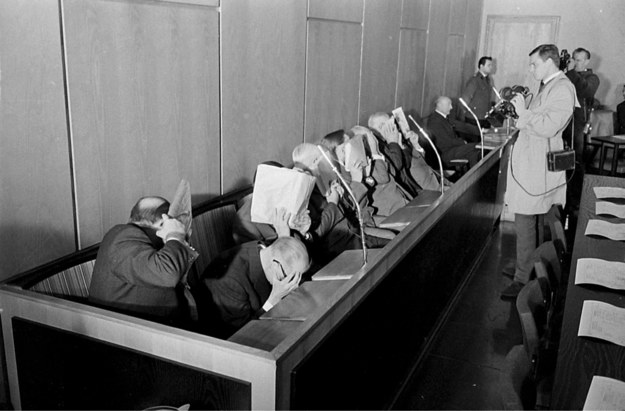
 Oprawcy z obozu zagłady w Treblince przed sądem