 China Warns of ‘Red Lines’ After Israeli Lawmakers Visit Taiwan Amid Deepening Ties
Ailin Vilches Arguello
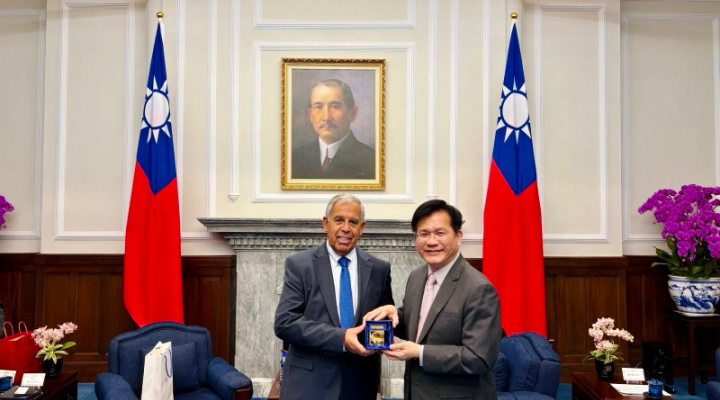 Taiwanese President Lai Ching-te meets with Israeli Knesset members Mickey Levy and fellow lawmakers during a diplomatic visit focused on strengthening cooperation in technology and national resilience amid rising regional tensions. Photo: Screenshot
A diplomatic row has escalated between China and Israel after an Israeli parliamentary delegation visited Taiwan on Tuesday, reflecting deepening ties between Jerusalem and Taipei at a time of mounting geopolitical tensions across the Indo-Pacific and the Middle East.
The delegation of Israeli lawmakers — including Knesset members Mickey Levy, Boaz Toporovsky, Ron Katz, and Yonatan Mishraki — met with Taiwanese President Lai Ching-te and senior officials during a diplomatic visit aimed at expanding cooperation, as both countries work to broaden and deepen bilateral ties across multiple sectors.
During a press conference, Lai praised Israel’s strong support for Taiwan’s international participation, adding that closer engagement and expanded cooperation are essential to strengthening diplomatic relations, reinforcing shared democratic values, and bolstering global and regional stability.
“Taiwan and Israel are geographically far apart, yet we share such universal values as freedom and democracy. We also face complicated circumstances in our respective regions,” the Taiwanese leader said.
“As we witness the continued expansion of authoritarianism, we keenly understand that only by constantly enhancing our self-defense capabilities and societal resilience can we ensure peace and protect peoples’ daily lives and democratic institutions,” Lai continued.
.
As both countries seek to expand cooperation in technology and national resilience, Taiwan’s Foreign Minister Lin Chia-lung expressed hope to lead a delegation to Israel once conditions in the Middle East stabilize, aiming to deepen ties through what he described as “comprehensive diplomacy.”
Further straining already tense relations, China’s Embassy in Israel on Wednesday denounced the visit as a “provocative” move that “severely undermines the political foundation of China-Israel relations,” accusing the lawmakers of breaching the one-China principle.
“There is only one China in the world, and Taiwan is an inseparable part of China’s territory,” an embassy spokesperson said in a statement, arguing that the People’s Republic of China is the only legitimate government of China and that the one-China principle is a basic rule of international relations.
China regards Taiwan, a self-governed democratic island, as a separatist province that must eventually be reunified with the mainland, by force if necessary. Under pressure from Beijing, most countries maintain no formal diplomatic relations with Taiwan. Israel recognizes Beijing but not Taipei, even as Taiwan has increasingly sought closer defense ties with Jerusalem.
The Chinese Embassy accused Israeli lawmakers of repeatedly violating Israel’s one-China policy and of “cooperating with separatist forces” that support Taiwan independence, describing their actions as “despicable in nature.”
“China will never allow anyone, in any form, to separate Taiwan from China, nor will it allow any external forces to obstruct China’s complete reunification,” the embassy said, warning that officials should “not fantasize that they can cross red lines on the Taiwan question without paying a price.”
“We call on the relevant Knesset members to immediately stop their wrong words and actions,” it added, stressing that China’s determination to defend its sovereignty and territorial integrity should not be underestimated.
In recent years, Taiwanese cooperation with Israel has expanded across multiple fields, including academic exchange, agriculture, and health, with more than 36 agreements and memorandums of understanding signed.
In October, Lai said that Israel is a model for Taiwan to learn from in strengthening its defenses, citing the Biblical story of David versus Goliath on the need to stand up to authoritarianism.
“The Taiwanese people often look to the example of the Jewish people when facing challenges to our international standing and threats to our sovereignty from China. The people of Taiwan have never become discouraged,” he said. “Israel’s determination and capacity to defend its territory provides a valuable model for Taiwan. I have always believed that Taiwan needs to channel the spirit of David against Goliath in standing up to authoritarian coercion.”
He made the remarks during a dinner of the American Israel Public Affairs Committee (AIPAC) in Taiwan.
Lai in October also announced a new multi-layered air defense system called “T-Dome” to defend itself against a possible future attack by China. It is partly modeled on Israel’s air defense system.
Lai told the AIPAC dinner that T-Dome had been inspired by Israel’s Iron Dome missile defense system, as well as US President Donald Trump’s “Golden Dome” missile defense shield plan.
“I believe that trilateral Taiwan-US-Israel cooperation can help achieve regional peace, stability, and prosperity,” he said.
Meanwhile, as regional tensions rise and great-power competition shapes the Middle East, diplomatic and security relations between Beijing and Jerusalem have become increasingly strained.
China, a key diplomatic and economic backer of Iran, has moved to deepen ties with the Islamist regime in recent years, signing a 25-year cooperation agreement, holding joint naval drills, and continuing to purchase Iranian oil despite US sanctions.
With nearly 90 percent of Iran’s crude and condensate exports flowing to Beijing, China stands as the largest importer of Iranian oil.
On Thursday, China ordered companies to ignore US sanctions on Iranian oil by invoking a 2021 Commerce Ministry “blocking statute” that bars compliance with foreign sanctions it deems illegitimate, in a move that further escalates tensions with Washington.
In response, US Treasury Secretary Scott Bessent accused Beijing of effectively financing Iran’s military activities through continued oil purchases, arguing that Chinese demand is sustaining Tehran’s economy.
The tensions between China and Israel expands beyond Iran.
In September, Israeli Prime Minister Benjamin Netanyahu accused Beijing, along with Qatar, of funding a “media blockade” against the Jewish state.
According to a report released by the Institute for National Security Studies (INSS), an Israeli think tank, China has increasingly used state media and covert campaigns to spread anti-Israel and antisemitic narratives in the United States.
The report examined how China’s state media portrays Israel and the United States as solely responsible for the war in Gaza, depicting them as destabilizing actors while spreading anti-Israel and antisemitic messages.
“It is evident that China and its proxies play a significant role in the current wave of antisemitism and anti-Israel sentiment in the United States,” Ofir Dayan, a research associate in the Israel-China Policy Center at INSS, wrote in the report.
In February, the Jewish People Policy Institute (JPPI) published a new report showing how China has embraced overt antisemitic messaging in its domestic propaganda in recent years. The study tied the move to both geopolitical rivalry with the United States and efforts to curry favor with Arab and Muslim countries hostile to Israel.
Zawartość publikowanych artykułów i materiałów nie reprezentuje poglądów ani opinii Reunion’68,
ani też webmastera Blogu Reunion’68, chyba ze jest to wyraźnie zaznaczone.
Twoje uwagi, linki, własne artykuły lub wiadomości prześlij na adres:
webmaster@reunion68.com