Archives

News from Israel- May 06, 2021

News from Israel- May 06, 2021

ILTV Israel News


The manhunt for the Tapuach junction shooter comes to a terribly bitter close
–
president Rivlin officially tasks opposition leader Yair Lapid with trying to form the next government
–
destination – the international space station. ILTV explores the 44 Israeli experiments chosen to head into the void.


Zawartość publikowanych artykułów i materiałów nie reprezentuje poglądów ani opinii Reunion’68,
ani też webmastera Blogu Reunion’68, chyba ze jest to wyraźnie zaznaczone.
Twoje uwagi, linki, własne artykuły lub wiadomości prześlij na adres:
webmaster@reunion68.com


‘It’s Like the Jewish Sopranos’: Cast and Crew of ‘Shtisel’ Talk Storylines, Tease Possible Season 4

‘It’s Like the Jewish Sopranos’: Cast and Crew of ‘Shtisel’ Talk Storylines, Tease Possible Season 4

Shiryn Ghermezian


(From top left, clockwise) Hana Laslo, Brigit Grant, Dov Glickman, Alon Zingman, Reef Neeman, Zohar Strauss and Dikla Barkai discuss “Shtisel.” Photo: Screenshot.

The cast and crew of the hit Israeli series “Shtisel” talked about their characters, the future of the show and its worldwide popularity in a virtual discussion hosted by the Israeli Film and Television Festival and Jewish News.

Actors Reef Neeman, Hana Laslo, Zohar Strauss and Dov Glickman, together with director Alon Zingman and producer Dikla Barkai talked with Jewish News’ Brigit Grant about the series and at times referenced a fourth season, leaving fans hopeful for more to come after the March 25 Neflix premiere of “Shtisel” season 3.

Barkai spoke about joining “Shtisel” after reading the first season script and said she was drawn immediately to it. “Finding this kind of project is like finding love. It’s above explanation of when and why I loved the script. I just felt it so strong and I knew I wanted to do it,” she said.

The producer admitted she wasn’t sure “Shtisel” would continue past its first season. She explained, “we felt after the first season, the magic has happened. I thought it’s like this rare moment in life, you have this silly thought that it would never happen again. So between the first season and the second season I had a lot of doubt and maybe a little fear.”

On how and when the show would possibly end, she said, “maybe ‘Shtisel’ is not a series with an end. It’s like life. It can go on and on and on.” Glickman agreed that it can go on for years to come – calling it “like the Jewish Sopranos,” a reference to HBO’s long-running series that spanned  86 episodes over six seasons.

Neeman, a newcomer to “Shtisel” who made her debut in season 3, auditioned for the role of Shira Levi via Zoom and talked about her character’s struggle with love on the show. Strauss also discussed his character’s development throughout the series — from not appearing in most of the first season to having a major role in season three. He later showed a picture of a fan who bought the fake beard he wears while in character as Lippe Weiss.

The cast and crew additionally talked their favorite “Shtisel” scenes, bringing in family members as extras and being recognized around the world. Glickman shared that Lebanese Muslim fans even approached him in Paris once after recognizing him from the series.

Glickman admitted that he cried watching certain scenes in past seasons, while Zingman said he got teary eyed while reading the show’s script, editing various scenes and filming the third season’s final scene, which he described as “so beautiful, emotional and touching.”

Talking about the difficulty of shooting during the COVID-19 pandemic, Zingman said the show was forced to postpone filming until July 2020. The summer heat in Israel added an extra layer of difficulty for the cast, who had to wear traditional ultra-Orthodox garments on camera and face masks off camera while on set. Some members of the show also contracted the coronavirus during the process. Zingman said, “It was really tough. It was really challenging.”

The discussion concluded with Barkai revealing that a traveling exhibition may be in the works to showcase the art featured in “Shtisel.”


Zawartość publikowanych artykułów i materiałów nie reprezentuje poglądów ani opinii Reunion’68,
ani też webmastera Blogu Reunion’68, chyba ze jest to wyraźnie zaznaczone.
Twoje uwagi, linki, własne artykuły lub wiadomości prześlij na adres:
webmaster@reunion68.com


TV7 Israel News 04.05

Jerusalem-Beirut resume talks on maritime dispute; Israel sends aid to India – TV7 Israel News 04.05

TV7 Israel News


1) Israeli Defense Minister Benny Gantz vows to bring the terrorists from yesterday’s attack to justice.

2) Israel and Lebanon have resumed U.S.-mediated talks, this morning – aimed at resolving a long-withstanding maritime-border’ demarcation-dispute in the Mediterranean Sea.

3) The Islamic Revolutionary Guards, by means of local Iraqi proxies, is evidently exploiting Washington’s determination to have the 2015 nuclear deal revived.


Zawartość publikowanych artykułów i materiałów nie reprezentuje poglądów ani opinii Reunion’68,
ani też webmastera Blogu Reunion’68, chyba ze jest to wyraźnie zaznaczone.
Twoje uwagi, linki, własne artykuły lub wiadomości prześlij na adres:
webmaster@reunion68.com


Dead Sea Scrolls: Mysterious scribe wrote eight diverse scrolls, scholars find

Dead Sea Scrolls: Mysterious scribe wrote eight diverse scrolls, scholars find

ROSSELLA TERCATIN


“The main purpose of my work has been using artificial intelligence, an extraction algorithm and statistical analyses to test 51 manuscripts which share a particular handwriting style.”
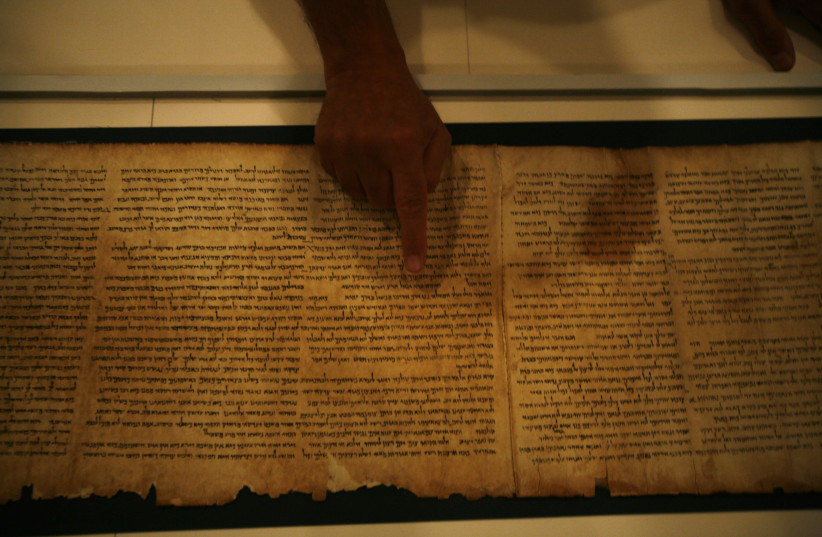
Adolfo Roitman, curator of the Dead Sea Scrolls, points at the original Isaiah Scroll, one of the Dead Sea Scrolls, inside a secured climate-controlled room in the Shrine of the Book at the Israel Museum in Jerusalem September 26, 2011. / (photo credit: BAZ RATNER/REUTERS)

Some 2,000 years ago, an individual scribe wrote at least eight of the Dead Sea Scroll manuscripts, making him the most prolific scribe ever identified, a group of scholars have found out.

The Dead Sea Scrolls are a corpus of some 25,000 fragments unearthed in caves on the shores of the Dead Sea in the 1940s and 1950s. The artifacts include some of the most ancient manuscripts of the Bible and other religious texts that were not accepted in the canon and nonreligious writings.

In the past few years, an artificial intelligence-based paleographic project carried out by scholars at the University of Groningen in the Netherlands and supported by the European Research Council has been focusing on understanding more about the identity of the scribes who copied the scrolls.

“We are pioneering Qumran research at the level of the individual scribe,” paleographer Gemma Hayes told The Jerusalem Post, after presenting the preliminary results of her research at an academic conference at Groningen last month.
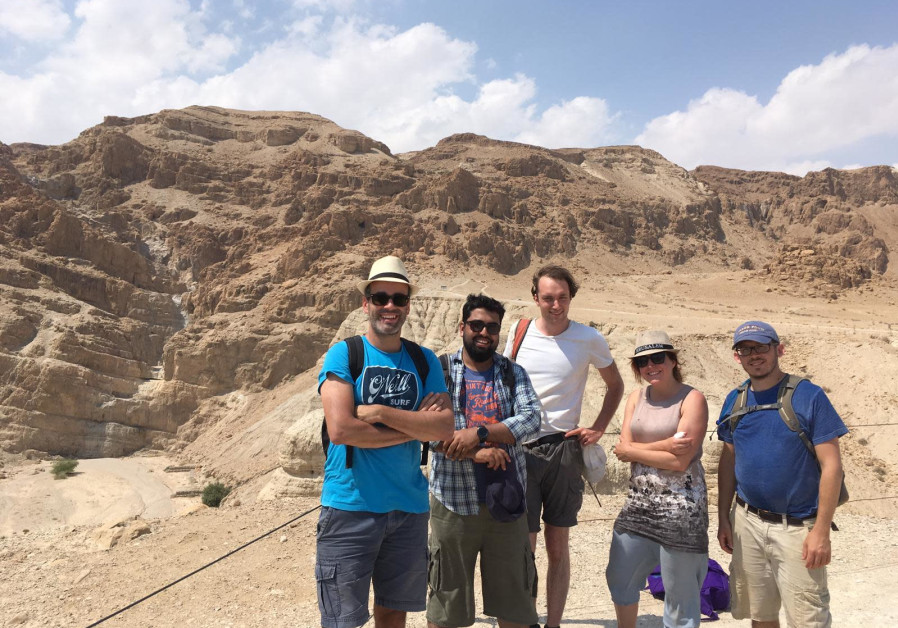
“The Hands that Wrote the Bible,” project team visiting Qumran. (Photo credit: Courtesy Gemma Hayes)

“The main purpose of my work has been using artificial intelligence, an extraction algorithm and statistical analyses to test 51 manuscripts which share a particular handwriting style,” she added.

The style is known as round semi-formal.

“It’s a very beautiful handwriting which dates back to the late 1st century BCE,” Hayes said.

The manuscripts analyzed by the researchers had already been grouped together in the past. Celebrated paleographer Ada Yardeni, who passed away in 2018, suggested that some 90 Dead Sea Scrolls fragments featuring this specific style were the work of one individual.

“She had a method, she identified the specific way a certain letter – a lamed – was written, and she argued that based on this letter you could group all these manuscripts together,” Hayes explained.

The researchers have not been able to test all of the manuscripts Yardeni clustered together because some of them did not present enough material for the technology to examine them.

“We need a certain amount of characters,” Hayes pointed out.
The results on the 51 artifacts that were tested were very significant: the system recognized that eight of the manuscripts considered were written by the same person, making him the most prolific scribe ever identified, in addition to proving his ability to work in two languages.

“One of the really exciting aspects of our findings is that these manuscripts are very diverse,” the researcher explained. “We found seven Hebrew manuscripts and one Aramaic manuscript, so-called sectarian manuscripts associated with the community in Qumran and non-sectarian manuscripts, as well as some para-biblical texts, including the one known as the testament of Naftali and some writing about Rachel and Joseph.”

Among the scrolls written by this individual author is also the iconic Miqsat Ma’ase ha-Torah (MMT) scroll, considered by scholars a foundational document of the Jewish sect which many scholars believed lived in Qumran.
The fact that the same person wrote texts of different natures might help shed new light on the identity of this community and their relationship with the rest of the Jewish people.

Scholars from “The Hands that Wrote the Bible” led by Prof. Mladen Popovic, the head of the Qumran Institute of the University of Groningen, trained their algorithm to recognize elements such as background and foreground, and measure the movement of the writing and calligraphy.

The system therefore allowed them to establish whether manuscripts which looked very similar were actually written by the same person or just in the same style.

“The fact that many wrote in a similar way can potentially tell us something about the training they received,” Hayes pointed out.

Besides the eight manuscripts identified as copied by the same scribe, all the rest were penned by the different people, with one possible exception: two fragments which could have been written by just one person. They are also very diverse and include some biblical manuscripts as well.

Hayes’ research is ongoing. Among others, she is studying the texts’ spelling characteristics.

“I’m looking into putting flesh and bones into this scribe,” she concluded.


Zawartość publikowanych artykułów i materiałów nie reprezentuje poglądów ani opinii Reunion’68,
ani też webmastera Blogu Reunion’68, chyba ze jest to wyraźnie zaznaczone.
Twoje uwagi, linki, własne artykuły lub wiadomości prześlij na adres:
webmaster@reunion68.com


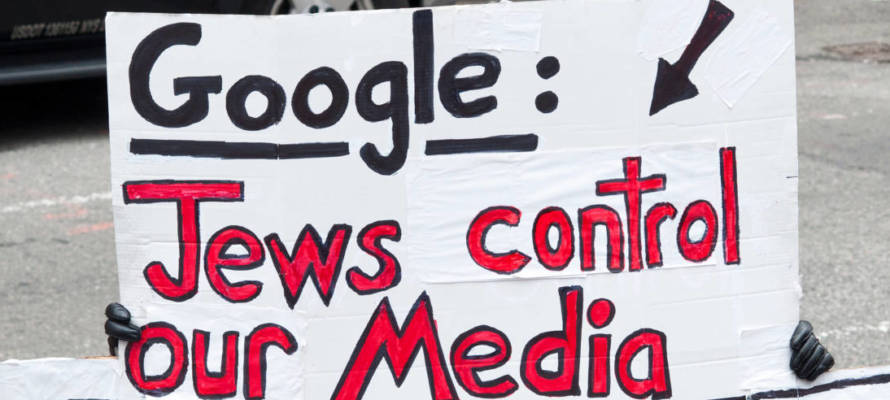
Watchdog identifies Wikipedia, with Google’s help, as the most active spreader of anti-Semitism on the planet.

Watchdog identifies Wikipedia, with Google’s help, as the most active spreader of anti-Semitism on the planet.

Yakir Benzion


Search engines, especially Google, send tens of millions of people around the world to the Wikipedia website every day, where they are fed a diet of blatant anti-Semitism, a prominent British activist and watchdog reported Sunday.

David Collier has studied the popular website for years. He says the bias and false information about Israel and the Jews is getting worse, with millions of people using Wikipedia’s biased information to help spread anti-Semitism.

“I do not believe that most people fully understand the damage that Wikipedia is doing nor the fact that action must be taken to challenge it,” said Collier, noting that despite its claim of openness, key pages about Jews and Israel are closely guarded by specific anti-Semitic editors who block people from correcting their lies.

Collier says it is critical that people understand that Google, the world’s leading search engine, “literally treats [Wikipedia] as the best source in the world,” but that means that tens of millions of people are getting distorted information from Wikipedia where the “facts and arguments have been airbrushed out.”

“It isn’t just about Jews or Israel and it is not enough to sit idly by. Wikipedia is damaging truth and promoting an anti-Western, anti-Semitic, anti-Israel narrative,” Collier said. “This cannot be stated often or hard enough; When it comes to spreading disinformation – Wikipedia is the biggest fake news distributor on the planet.”

“Wikipedia today is a central conduit in the spread of anti-Semitism. The lies, propaganda and distortion are visible on every relevant page,” Collier found.

In his report, Collier gives glaring examples of blatant anti-Jewish bias where Wikipedia pages with Jewish or Israeli themes are full of criticism, while sections on Palestinian or Islamic themes lack any censure or contain meager negative content.

Collier calls this “a subtle, but brutally effective strategy in psychological warfare.”

“The bias is on every page. Sometimes obvious, but more often than not, it only becomes apparent when you compare the way different groups are treated,” Collier explains.

Collier says there are literally hundreds of examples of blatant and inexplicable anti-Semitism and bias, but as a Brit he noted there is a Wikipedia page called the “Israel lobby in the United Kingdom” that is “a page about (allegedly) well-funded Jews, who try to ‘influence politicians and foreign policy.

But when it comes to the Palestinians, there is no corresponding page for a “Palestinian lobby in the United Kingdom,” he discovered.

“Yet if we look at the endless activity of groups [in England] like the Palestine Solidarity Campaign, Friends of Al Aqsa, the Palestine Return Centre and the Islamic Human Rights Commission, we can see exactly what they are doing as well. These groups all lobby,” Collier says.

However, instead of being called lobbyists, the largest British pro-Palestinian group is described on Wikipedia as ‘raising awareness’, ‘educating’ and ‘promoting a greater understanding,’ while Jewish groups are all described using conspiratorial tones.

They are all about influencing, lobbying and billionaire funding, he maintains.

“This is clear evidence of Wikipedia’s anti-Semitism problem,” Collier continues. “Language, history, truth – all of it is under attack from one of the most popular websites in the world, and along with anti-Semitism, it has a distinct anti-Western feel. There is a page for ‘Criticism of the U.S. Government’, but there does not seem to be one for Iran, Russia, China or Pakistan.”

“In fact, the only other country that appears to have a government criticism page is ‘Israel’ – and its page is *five times larger* than its U.S. counterpart. The ‘criticism of Israel’ page is highly toxic and even promotes the anti-Semitic Nazi analogy,” Collier says.

His bottom line: “This website promotes anti-Semitism. It is not enough that we ignore Wikipedia, we should be actively fighting against it.”


Zawartość publikowanych artykułów i materiałów nie reprezentuje poglądów ani opinii Reunion’68,
ani też webmastera Blogu Reunion’68, chyba ze jest to wyraźnie zaznaczone.
Twoje uwagi, linki, własne artykuły lub wiadomości prześlij na adres:
webmaster@reunion68.com