 Dead Sea Scrolls: Mysterious scribe wrote eight diverse scrolls, scholars find
ROSSELLA TERCATIN
“The main purpose of my work has been using artificial intelligence, an extraction algorithm and statistical analyses to test 51 manuscripts which share a particular handwriting style.”
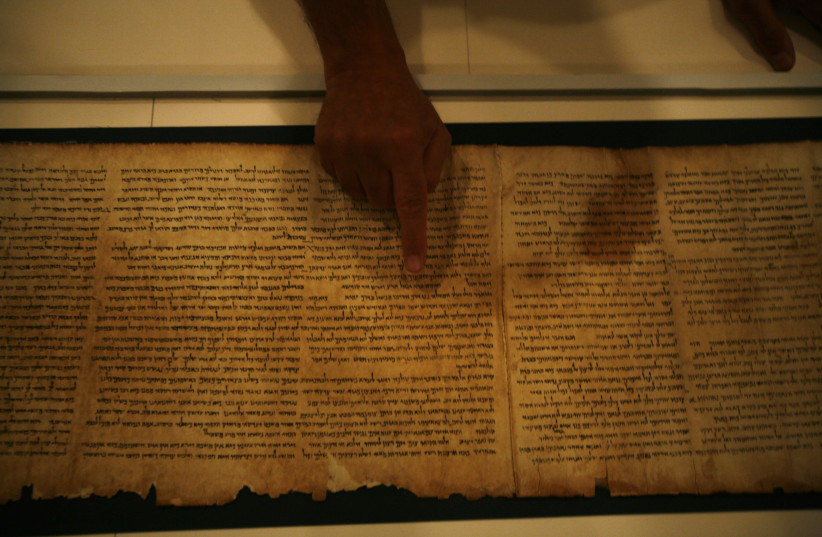
Some 2,000 years ago, an individual scribe wrote at least eight of the Dead Sea Scroll manuscripts, making him the most prolific scribe ever identified, a group of scholars have found out.
The Dead Sea Scrolls are a corpus of some 25,000 fragments unearthed in caves on the shores of the Dead Sea in the 1940s and 1950s. The artifacts include some of the most ancient manuscripts of the Bible and other religious texts that were not accepted in the canon and nonreligious writings.
In the past few years, an artificial intelligence-based paleographic project carried out by scholars at the University of Groningen in the Netherlands and supported by the European Research Council has been focusing on understanding more about the identity of the scribes who copied the scrolls.
“We are pioneering Qumran research at the level of the individual scribe,” paleographer Gemma Hayes told The Jerusalem Post, after presenting the preliminary results of her research at an academic conference at Groningen last month.
“The main purpose of my work has been using artificial intelligence, an extraction algorithm and statistical analyses to test 51 manuscripts which share a particular handwriting style,” she added.
The style is known as round semi-formal.
“It’s a very beautiful handwriting which dates back to the late 1st century BCE,” Hayes said.
The manuscripts analyzed by the researchers had already been grouped together in the past. Celebrated paleographer Ada Yardeni, who passed away in 2018, suggested that some 90 Dead Sea Scrolls fragments featuring this specific style were the work of one individual.
“She had a method, she identified the specific way a certain letter – a lamed – was written, and she argued that based on this letter you could group all these manuscripts together,” Hayes explained.
The researchers have not been able to test all of the manuscripts Yardeni clustered together because some of them did not present enough material for the technology to examine them.
“We need a certain amount of characters,” Hayes pointed out.
The results on the 51 artifacts that were tested were very significant: the system recognized that eight of the manuscripts considered were written by the same person, making him the most prolific scribe ever identified, in addition to proving his ability to work in two languages.
“One of the really exciting aspects of our findings is that these manuscripts are very diverse,” the researcher explained. “We found seven Hebrew manuscripts and one Aramaic manuscript, so-called sectarian manuscripts associated with the community in Qumran and non-sectarian manuscripts, as well as some para-biblical texts, including the one known as the testament of Naftali and some writing about Rachel and Joseph.”
Among the scrolls written by this individual author is also the iconic Miqsat Ma’ase ha-Torah (MMT) scroll, considered by scholars a foundational document of the Jewish sect which many scholars believed lived in Qumran.
The fact that the same person wrote texts of different natures might help shed new light on the identity of this community and their relationship with the rest of the Jewish people.
Scholars from “The Hands that Wrote the Bible” led by Prof. Mladen Popovic, the head of the Qumran Institute of the University of Groningen, trained their algorithm to recognize elements such as background and foreground, and measure the movement of the writing and calligraphy.
The system therefore allowed them to establish whether manuscripts which looked very similar were actually written by the same person or just in the same style.
“The fact that many wrote in a similar way can potentially tell us something about the training they received,” Hayes pointed out.
Besides the eight manuscripts identified as copied by the same scribe, all the rest were penned by the different people, with one possible exception: two fragments which could have been written by just one person. They are also very diverse and include some biblical manuscripts as well.
Hayes’ research is ongoing. Among others, she is studying the texts’ spelling characteristics.
“I’m looking into putting flesh and bones into this scribe,” she concluded.
Zawartość publikowanych artykułów i materiałów nie reprezentuje poglądów ani opinii Reunion’68,
ani też webmastera Blogu Reunion’68, chyba ze jest to wyraźnie zaznaczone.
Twoje uwagi, linki, własne artykuły lub wiadomości prześlij na adres:
webmaster@reunion68.com