Archive | 2026/06/03

Radość z nienawiści do Żydów

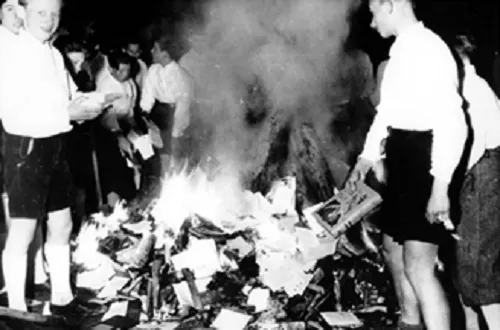
Zdjęcie z 1938 roku – młodzi sympatycy nazizmu palą książki żydowskich autorów. (World History Archive.)

Radość z nienawiści do Żydów

Todd Pittinsky


Dlaczego antysemici zawsze świetnie się bawią – i jak Żydzi wzbogacają to doświadczenie

Antysemityzm ma szczególny historyczny rys: ludzie uczestniczący w nim często sprawiają wrażenie, jakby naprawdę świetnie się bawili. Tłumy są rozradowane. Retoryka jest teatralna. Są pieśni, żarty, hasła, wewnętrzne aluzje i ten nieomylny klimat ludzi, którzy dobrze się bawią. Nawet najohydniejsze wybuchy nienawiści często przychodzą w oprawie przypominającej święto. Od średniowiecznych widowisk religijnych po nazistowskie wiece i kampusy uniwersyteckie po 7 października – antysemityzm wielokrotnie oferował swoim zwolennikom coś znacznie bardziej psychologicznie satysfakcjonującego niż zwykła nienawiść. Antysemita może opisywać siebie jako człowieka rozgniewanego. W rzeczywistości często doskonale się bawi.

Większość form nienawiści jest emocjonalnie wyczerpująca. Antysemityzm historycznie oferował znacznie lepsze „doświadczenie użytkownika”. Łączy w sobie kilka przyjemności naraz: poczucie odkrycia „prawdy”, przynależność, moralną pewność, a nawet rozrywkę. Na przestrzeni tysiącleci bardzo różne społeczeństwa na nowo odkrywały tę samą odurzającą mieszankę.

Pierwszą przyjemnością jest poczucie objawienia. Niewiele doświadczeń daje większą satysfakcję niż wrażenie, że chaos świata nagle staje się zrozumiały. Kryzysy finansowe, wojny, imigracja, zmiany kulturowe, manipulacje medialne – współczesne życie przynosi skutki, których większość z nas naprawdę nie rozumie i nad którymi, jak się wydaje, nikt nie sprawuje pełnej kontroli. Antysemityzm zamienia strukturalną złożoność w narrację i opowieść. Ktoś za tym stoi: Żydzi.

Antysemityzm zawsze sprzedawał się nie tyle jako uprzedzenie, ile jako wgląd w rzeczywistość. Antysemita nie czuje się zagubiony ani bezsilny. Czuje się oświecony. „Połączył kropki”. Od Marcina Lutra przekonanego, że wreszcie zdemaskował żydowskie oszustwo, przez dziewiętnastowiecznych spiskowców tropiących ukryte wpływy finansowe, po współczesnych internetowych „śledczych” wyjaśniających pożary lasów za pomocą diagramów i zrzutów ekranu dotyczących Izraela i Izraelczyków – emocjonalny schemat jest ten sam. Przyjemność płynąca z poczucia odkrycia prawdy zostaje pomylona z myśleniem.

Żydowskie oburzenie jest częścią systemu nagród. Jest częścią zabawy.

Drugą przyjemnością jest przynależność. Antysemityzm zawsze świetnie budował wspólnotę. Średniowieczne oskarżenia o mord rytualny nie wywoływały jedynie strachu, lecz także procesje, rytuały i wspólne oburzenie. Tożsamość zbiorowa często kształtuje się wokół wspólnego wroga. Późniejsze ruchy nacjonalistyczne odkryły, że antysemityzm jest wyjątkowo skutecznym sposobem przemieniania obcych sobie ludzi w towarzyszy, obywateli związanych wspólną sprawą. Ruchy antysemickie doskonale rozumiały znaczenie widowiska: pieśni, sztandary, marsze, żarty, zakodowany język i wewnętrzne odniesienia były ciepłymi przyjemnościami uczestnictwa.

Kultury spajają się wokół wspólnych postaci – bohaterów, zdrajców, męczenników, outsiderów. Żyd stał się jedną z najbardziej trwałych i uniwersalnych takich figur, służąc jako wspólny punkt odniesienia. To, że Żydzi zajmują tak nieproporcjonalnie ważne miejsce w zachodniej myśli i kulturze – w książkach, sztukach teatralnych, teologii, teorii politycznej i sztuce – samo w sobie stanowi wskazówkę. Naród stanowiący niewielki ułamek ludzkości przyciągnął niezwykle dużą uwagę symboliczną. Część tego zainteresowania wynika z rzeczywistych osiągnięć, ale znaczna część jest skutkiem obsesji. Żyd stał się wspólną figurą kulturową: symbolem, złoczyńcą, kozłem ofiarnym, zagadką. Postacią, wokół której łatwo mogły gromadzić się zbiorowe emocje, ponieważ tak wielu ludzi znało już tę rolę. Ludzie jednoczyli się nie tylko przeciwko Żydom, ale także poprzez wspólne opowieści o nich.

Ideologia antysemicka ma znaczenie, ale w dużej mierze pełni funkcję przykrywki. Ważniejsze jest ciepło panujące w pomieszczeniu.

Trzecią przyjemnością jest wymiar moralny. Antysemityzm pozwala swoim zwolennikom doświadczać nienawiści jako cnoty. Antysemita nie postrzega siebie jako prześladowcy. Odczuwa swoje działania jako przejaw odwagi. Demaskuje ukrytą władzę. Broni społeczeństwa. Okrucieństwo staje się służbą publiczną. Takie ujęcie – nienawiść do Żydów jako coś słusznego i sprawiedliwego – okazało się nieskończenie elastyczne. Średniowieczna przemoc wobec Żydów była przedstawiana jako „obrona chrześcijaństwa”. W średniowiecznym świecie islamu podporządkowanie Żydów w ramach praw dhimmi przedstawiano jako sprawiedliwy porządek społeczny i akt miłosierdzia. Radzieckie czystki opisywano jako przejaw „antykosmopolitycznej cnoty”. Nazistowska propaganda przedstawiała prześladowania jako higienę narodową. W dużej części współczesnego świata antysemityzm podróżuje pod sztandarem antysyjonizmu i oporu, przepakowując eliminacyjne nastawienie wobec Żydów jako teologię wyzwolenia. Słownictwo się zmienia – antykolonializm, antyglobalizm, antyelitaryzm – lecz emocjonalna konstrukcja pozostaje ta sama. Antysemita może czuć się dobrze. Jest demaskatorem. Głosicielem prawdy. Patriotą. Bojownikiem o wolność.

Zadziwiające jest, jak trwała pozostaje ta sama struktura narracyjna. Oskarżenia o mord rytualny, które wstrząsały średniowieczną Europą – zamordowane niewinne ofiary, potworni sprawcy i sprawiedliwa wspólnota, która ich ujawnia – okazały się niezwykle trwałe i łatwe do przenoszenia w nowe realia. Wystarczy ubrać oskarżenie w język raportów o prawach człowieka zamiast teologii, a struktura niemal się nie zmienia.

Te przyjemności – objawienie, przynależność i moralna pewność – nie są jedynie odczuwane. Są odgrywane. Antysemityzm zawsze rozumiał znaczenie widowiska. Podczas krucjatowych masakr nad Renem tłumy formowały się w religijnych procesjach pełnych hymnów, sztandarów i ekstatycznych zbiorowych emocji. Późniejsze stulecia dopracowały tę formę poprzez palenie kukieł Judasza, parady, kostiumy i wiwatujące tłumy. Antysemityzm przetrwał nie tylko jako doktryna, lecz także jako zbiorowa rozrywka. Ludzie w niego wierzyli, owszem, ale co ważniejsze – żyli nim.

Nazistowskie Niemcy rozumiały to z przerażającą precyzją. Niektóre z najbardziej niepokojących materiałów filmowych z tamtego okresu są tak wstrząsające właśnie dlatego, że ludzie wydają się na nich radośni. Tłumy uśmiechały się podczas bojkotów żydowskich sklepów, a później podczas publicznych aktów upokarzania i poniżania. Palenie książek przypominało uniwersyteckie festiwale. Pochody z pochodniami stawały się hałaśliwymi świętami publicznymi. Wspólne grabieże, gromadzenie się i obserwowanie płomieni zamieniały nienawiść w publiczny teatr, w którym zwykli ludzie mogli brać udział.

Dzisiejsza kultura cyfrowa skomercjalizowała te przyjemności. Platformy internetowe są projektowane tak, by maksymalizować zaangażowanie poprzez maksymalizowanie emocjonalnej nagrody. Antysemityzm wyjątkowo dobrze pasuje do takich systemów. Platformy wzmacniają dreszcz płynący z „zakazanej wiedzy”, wewnętrznego języka, memów i zbiorowego oburzenia, czyniąc je natychmiast dostępnymi i nieskończenie powtarzalnymi. Cyfrowy lincz – skoordynowany masowy atak na pojedynczy żydowski cel – jest tłumem przeniesionym do internetu. Podobnie jak wcześniejsze tłumy, także te są często radosne i publiczne. W przeciwieństwie jednak do dawnych form uczestnictwo nie wymaga już wychodzenia na ulicę ani większego wysiłku fizycznego. Tłum nie musi się już gromadzić – wystarczy, że się zaloguje.

Zalewanie profili żydowskich dziennikarzy żartami o Holokauście i memami o „piecach”; malowanie swastyk na synagogach, menorach czy żydowskich centrach społecznych – często celowo w okresie świąt; nagrywanie antysemickich obelg kierowanych do osób wyraźnie identyfikowanych jako Żydzi i publikowanie tych nagrań dla rozrywki; przerabianie klasycznych antysemickich stereotypów na wiralowe „ironiczne” treści lub remiksy wideo – nic z tego nie stanowi spójnej odpowiedzi na rzekomo wszechmocną międzynarodową kabałę kontrolującą światową gospodarkę, politykę, media, migrację i satelity. Są to rytuały upokorzenia. Nie chodzi o opór. Chodzi o przyjemność.

Objawienie, przynależność i moralne uzasadnienie wyjaśniają znaczną część atrakcyjności i trwałości antysemityzmu. Są to przyjemności, które potrafią podszywać się pod wnikliwość, solidarność i sprawiedliwość. Każda z nich ma własną historię przykrywającą rzeczywistość. Razem usuwają zwykłe społeczne hamulce powstrzymujące okrucieństwo. Gdy nienawiść zaczyna wydawać się sprawiedliwa i wspólnotowa, samo cierpienie Żydów staje się źródłem przyjemności. Sadyzm – przyjemność czerpana z żydowskiego bólu, strachu i upokorzenia dla nich samych – nie potrzebuje już żadnego przebrania. Samo cierpienie ofiar staje się nagrodą.

Jedną z najtrudniejszych prawd, z jakimi muszą mierzyć się Żydzi w kontekście antysemityzmu, jest to, że ich oburzenie stanowi część systemu nagród. Jest częścią zabawy.

Antysemityzm rzadko zadowala się samym wyrażaniem siebie. Poszukuje reakcji. Szok, gniew, strach i publiczna rozpacz, które wywołuje, są dla antysemity psychologicznie i społecznie satysfakcjonujące. Podnoszą temperaturę dramatu. To pomaga zrozumieć, dlaczego nawet skrajnie niewiarygodne oskarżenia trwają mimo swojej absurdalności. Nie są one tworzone wyłącznie po to, by przekonywać – mają szokować, prowokować i mobilizować. Sama ich absurdalność jest częścią atrakcji. Żydów oskarżano o używanie krwi chrześcijańskich dzieci do wypieku macy, o kontrolowanie pogody, o pobieranie organów od palestyńskich dzieci, o szkolenie i wykorzystywanie psów jako narzędzi przemocy seksualnej oraz o obsługiwanie tajnych kosmicznych laserów. Oskarżenia nie muszą być spójne. Muszą być jedynie energetyzujące. Im bardziej absurdalny zarzut, tym większą satysfakcję daje reakcja, którą wywołuje.

Powstaje w ten sposób osobliwy paradoks. Antysemityzmu nie można ignorować. Historia wielokrotnie karała obojętność. Ale publiczne żydowskie cierpienie zasila właśnie ten system nagród, który go podtrzymuje. Potępienie nie odstrasza – dostarcza przyjemności, której antysemita pragnie.

Jeśli Żydzi głośno protestują, zostanie to przedstawione jako dowód, że mają coś do ukrycia. Jeśli organizacje żydowskie domagają się powszechnego potępienia, zostanie to przedstawione jako dowód, że Żydzi mają władzę tłumienia krytyki. Jeśli Żydzi milczą, zostanie to przedstawione jako obojętność, arogancja lub coś jeszcze gorszego – milcząca zgoda. Publiczna konfrontacja z oskarżeniem podsyca widowisko. Ignorowanie go sprzyja normalizacji. Spokojne i wyważone wyjaśnienia prowadzą do jeszcze szybszej utraty gruntu. Złożoność zawsze przegra wyścig z emocjonalną prostotą i językiem moralnej krucjaty. Krótko mówiąc, Żydzi stają się mimowolnymi aktorami w cudzym teatrze. Antysemita wygrywa niezależnie od wyniku.

To część wyczerpania, którego doświadczają społeczności żydowskie po falach antysemityzmu następujących po 7 października i nieustępujących do dziś. Nie chodzi wyłącznie o strach. Chodzi także o demoralizujące uświadomienie sobie, że każda możliwa reakcja jest jednocześnie konieczna i obarczona poważnymi ograniczeniami.

Antysemityzm nie jest ciężarem, który jego zwolennicy dźwigają – jest przyjemnością, której poszukują. Narracje antysemickie nie są przyczyną antysemityzmu – są jego historiami przykrywającymi rzeczywistość. Widowisko nie jest produktem ubocznym antysemityzmu – często jest jego produktem końcowym. Sadyzm nie jest skutkiem ubocznym – jest tym, co umożliwia objawienie, przynależność i moralna słuszność. Żydowskie oburzenie nie jest środkiem odstraszającym – jest nagrodą. A wszystko to dlatego, że choć antysemita często twierdzi, że jest oburzony Żydami, historia pokazuje, że znacznie częściej po prostu zachwycony okazją do sadyzmu.


Link do oryginału: https://www.tabletmag.com/sections/news/articles/joy-hating-jews

Tablet, 29 maja 2026


Zawartość publikowanych artykułów i materiałów nie reprezentuje poglądów ani opinii Reunion’68,
ani też webmastera Blogu Reunion’68, chyba ze jest to wyraźnie zaznaczone.
Twoje uwagi, linki, własne artykuły lub wiadomości prześlij na adres:
webmaster@reunion68.com



Why Worshipping the Bund Is Bullshit

Leadership of the National Conference of Bundist Councillors in Jewish communal organizations and city councils, 1928 piemags / Alamy


Why Worshipping the Bund Is Bullshit

by Debbie Lechtman


What do anti-Zionist actress Hannah Einbinder, illustrator Molly Crabapple and The Economist magazine have in common? The newly fashionable idea that Jews would be better off if they traded in Zionism for Bundism, a niche brand of pre-1945 European socialism that died with the Holocaust.

In some ways, the Jewish Labor Bund appears to be tailor-made for this exact political moment—a label that allows self-styled socialists to identify as Jews while also sharing the opposition of their wider cohort to Zionism. Similarly, the attachment of the Bund to Yiddish offers an authentically Jewish-flavored alternative to Hebrew, the tongue of Zionist oppression. It is no wonder, then, that a range of voices from the anti-Zionist Jewish actor Hannah Einbinder, to the illustrator Molly Crabapple, to the august British magazine 

There is a small problem with Bundism, though: It ceased to exist as a meaningful political movement among Jews by 1945. To understand why is to understand just how historically empty the current gestures at a Bundist revival are, and the fate to which they are likely to lead.

In the bitter cold of February 1943, a group of 17 young Jewish partisans slipped out of the Ostrowiec Świętokrzyski Ghetto in south-central Poland, armed with just 12 overpriced revolvers, purchased clandestinely in the black market. At great risk to their lives, they marched their way to a forest bunker in the outskirts of Kunów, where they united with other partisans. Shortly after, members of the Armia Krajowa (AK), or the Polish Home Army, the Polish resistance under Nazi occupation, caught wind of their presence, incinerating the young men with the toss of a single grenade.

The partisans of the Ostrowiec Świętokrzyski Ghetto would eventually regroup, cutting through the barbed wire that imprisoned them in the summer of 1944 and making their way back into the forest. But their first tragic brush with the Home Army wouldn’t be their last. For the next year, the group battled the Germans while dodging, as survivor Wolf Fajnsztadt later described in one of the earliest Holocaust written testimonies, persecution “by AK groups and the Germans wherever we moved.”

Originally 47 partisans, by the war’s end, only seven had survived. Among the murdered were one of my grandfather’s brothers and two of his cousins.

Whatever the Bund had thought—about working class solidarity, about doykeit—was proven false, on the largest and most consequential scale imaginable.

My grandfather, himself a Holocaust survivor, never told me this story. I’m not sure that he even knows it. I stumbled upon it randomly it while sifting through Holocaust testimony a few years back. But this account matches everything that he has ever told me about the Shoah.

As a teenager, I signed up for a Jewish youth group trip to Auschwitz, Madjanek, Treblinka, and the other slaughterhouses of Eastern Europe. My grandfather was dismayed. “I spent years trying to get out of that godforsaken place,” he said with a defeated sigh. “And now you’re just going back.”

This idea—that the Jewish people were abandoned to burn during the Shoah, even by those who should’ve been our natural allies in the face of Nazi aggression—is a, if not the, running theme of early Jewish Holocaust testimony and historiography. In the great decadeslong argument between the Bundists, who told Jews that the solidarity of the working class would protect them from persecution by their neighbors, and the Zionists, who urged mass emigration from Europe to Palestine, the Zionists were proven right, and the Bundists were proven to be tragically, and comprehensively, wrong.

Founded at the tail end of the Russian Empire, the Bund advocated for socialism, Jewish integration in the Diaspora, working-class solidarity, and internationalism. Though ardently anti-assimilationist, a position that later threatened their Soviet rulers, the Bund presented itself as a Jewish alternative to Zionism, embodied in their concept of doykeit, or “hereness.” “Where we live is our country!” was their rallying cry.

In the 1920s, the newly-formed Soviet Union crushed the Bund, but its Polish counterpart survived. In fact, it thrived, skyrocketing to popularity in pre-war Poland, enjoying 80% of the Jewish vote in some cities, most notably, Warsaw, though a significant portion of its base was drawn to the group not so much for their anti-Zionism but for their commitment to workers’ rights. Then the Nazi tanks rolled in.

Everybody knows about the heroism of the Warsaw Ghetto Uprising, but few are familiar with the intra-Jewish politicking that preluded it. After all, the enduring—and infinitely inspiring—story is that Jewish youth from across all political persuasions cast aside their differences, from Zionist to anti, and united to form the Jewish Combat Organization, to stick it to the Nazis one final time. As Yitzhak Zuckerman, one of the Organization’s leaders, said, “No one doubted how it was likely to turn out … the important things were inherent in the force shown by Jewish youth after years of degradation, to rise up against their destroyers, and determine what death they would choose: Treblinka or Uprising.”

But as is often the case with these things, the real story is not so simple.

In the years preceding the Warsaw Ghetto Uprising, the Bund hesitated, even as Zionist youth groups were itching for a revolt. Underground Bundist newspapers in the ghetto promoted instead the idea of working-class solidarity among the Jews and the general Polish population, themselves suffering from the Nazi occupation but spared the indignities of life inside the ghetto walls. When, week after week, month after month, the solidarity failed to materialize, the Bund downplayed or ignored the abandonment, gaslighting its own constituents. Finally, the older Bundists relented to their younger members’ demands and reluctantly agreed to join the Jewish Combat Organization, along with Labor Zionist youth movements Hashomer Hatzair, Dror, and Poale Zion. You know how the rest of the story goes.

In the decades preceding World War II, the Bund had been ideologically driven by two principles: doykeit and working-class solidarity. But by 1945, Zionism had become the near-unanimous position among Holocaust survivors, ex-Bundists included, with Jews in Displaced Persons camps advocating fervently for the British to open up the gates to Palestine. Both the U.S. government-sanctioned Harrison Report and a myriad of later surveys found that an overwhelming majority of stateless, destitute survivors—as many as 97%—demanded to go to Palestine and only Palestine, and when asked to list a second choice, thousands wrote, “crematoria.” Jewish DPs demonstrated against the British often, and they minced no words: “Eretz Israel for the People of Israel!” their signs read. “We demand to open the gates to Palestine!”

“They want to be evacuated to Palestine now, just as other national groups are being repatriated to their homes,” Earl G. Harrison noted in his report. “With respect to possible places of resettlement for those who may be stateless or who do not wish to return to their homes, Palestine is definitely and pre-eminently the first choice.”

So much for working-class solidarity, and so much for doykeit.

The resurrection of the Jewish Labor Bund, doykeit and all, at a time when antisemitic violence in the Diaspora parallels 1930s numbers, may suit the needs of elites who find Jewish national existence inconvenient. Never mind that the Bund’s anti-Zionism and today’s anti-Zionism have little in common. The Bund opposed the establishment of a not-yet-existing sovereign Jewish state, whereas today’s anti-Zionists demand the dissolution or outright destruction of an already-existing Jewish state, with 10 million citizens who are expected to somehow simply vanish—to avoid being murdered en masse by their neighbors.

As with all things social media, the fetishization of the Bund has not remained confined to social media. This April, an imprint of Penguin Random House published Here Where We Live Is Our Country: The Story of The Jewish Bund, by anti-Zionist Jewish author and illustrator Molly Crabapple, which details a grade-school level history of the Bund, intertwined with her own family’s story, to a glowing review from The New York Times. That would be all well and good—fascinating, even!—except that in numerous interviews and in her own social media posts, Crabapple presents the Bund as the righteous path not taken. “We will win,” she wrote, alongside a screenshot of The New York Times article.

We will win? How noble-sounding. It’s as if the tragedies of the 20th century never happened for these people.

The early 20th century relationship between Zionism and Bundism can be characterized as a vigorous debate over the Jewish future, as Jews grappled with the disheartening realities of their newfound emancipation and empires splintered off into independent nation-states. It was the Holocaust that finally settled this debate—and not in the Bund’s favor.

In the DP camps, surviving Bundists, who’d long condemned Jewish emigration, particularly to Palestine, asked the British to reverse their anti-Jewish immigration policies to the Holy Land. In the words of longtime anti-Zionist Jewish writer and journalist Isaac Deutscher, “I have, of course, long since abandoned my anti-Zionism,” he said in 1954, “which was based on a confidence in the European labor movement, or, more broadly, a confidence in European society and civilization … If, instead of arguing against Zionism in the 1920s and 1930s, I had urged European Jews to go to Palestine, I might have helped to save some of the lives that were to be extinguished in Hitler’s gas chambers. For the remnants of European Jewry, the Jewish state has become a historic necessity. It is also a living reality.”

A living reality. Indeed, after the Shoah, some of the fledgling remnants of the Bund reestablished themselves in the State of Israel, though, of course, their popularity had long plummeted.

What is it, then, that today’s neo-Bundists, devoid of any contextual historical understanding, are trying to accomplish? A reversal of this reality? And what, in practice, would that look like? Do seven million Israelis pack their bags and ship off to Poland, Germany, Iraq, Russia, Yemen, and the like? What would happen to them there? Does Israel turn into Palestine, and its Jewish citizens forsake their aboriginal rights, and the thriving society they have built, and cross their fingers and hope for the best, amid a population that openly sees their very presence in what they deem Islamic land as an affront to God? What form of justice would any of these insane gestures achieve?

I suppose that for people who live in a world of ideological abstraction, protected by their own wealth and privilege, the logistics of someone else’s life don’t really matter, as long as the inconvenience is removed. And listen, I get it. When your political understanding of your Jewish identity is rooted on such flimsy historical ground, you’ll hang onto whatever straws you can grasp.

“One of the many things that [Zionists] have done is they’ve tried to colonize all of Jewish history,” Crabapple stated in an interview with the New Internationalist, which just about sums it up the illustrator’s own childish and blinkered understanding of history. As the neo-Bundist argument goes, the Jewish community turned to Zionism, not out of lived experience, but out of trauma. In other words, the Holocaust so traumatized worldwide Jewry that it clouded our collective moral judgment, and turned us into oppressors, Nazis, settler-colonizers, génocidaires, and whatever other libel is in vogue at any given moment. This is, of course, an example of Holocaust inversion, which is itself a form of soft Holocaust denial.

What the neo-Bundists fail to grasp is that the post-World War II universal Jewish embrace of Zionism did not come from a Holocaust-induced moral lapse—if anyone is to contemplate moral lapses, it’s the Shoah’s perpetrators, rather than its victims—but from bitter conclusions drawn from lived realities. That is not to suggest, in any form, that the Bund bears responsibility for the Holocaust. That lies with the Nazis and their accomplices alone. But whatever the Bund had thought—about political organizing, about working-class solidarity, about doykeit—was proven false, on the largest and most consequential scale imaginable. Working-class solidarity only works when it is reciprocal, and it wasn’t. Hereness only holds real weight when Jews can find a place among neighbors, and they didn’t.

As for my great uncles, all six of them became partisans, most belonging to Zionist youth movements, though rumor has it one had been a Bundist. By the war’s end, five of them had been murdered all the same, their remains having long rotted into the earth in the forests of Poland, Zionist and Bundist alike. Only my great-uncle Szulim lived to tell the tale. By the time he reunited with my grandfather, who was only a child at the time, he was an ardent Zionist, braving Red Army checkpoints, the Austrian alps, and a DP camp in Italy for the slim shot that he might make a home in the Promised Land. He never did, but he remained a Zionist to his dying day.

Who are we to challenge his wisdom? Even today, anti-Zionist Holocaust survivors are an outlier, tokenized by Jew-haters to the high heavens. I hold no animosity toward the Bund, which did what it could, what it thought best, with the information that it had. Anybody could be forgiven for thinking that the Bund’s ideology would succeed in the 1920s, 1930s, and even into the early 1940s. But to continue to argue in its favor 80 years later, with the enormous privilege of hindsight, which the original Bundists didn’t have, and with the living achievement of a Jewish state in which the majority of the world’s Jews now live, is beyond historically ignorant and practically absurd. It’s indefensible.


Debbie Lechtman is a Jewish author, activist and content creator, best known for running the educational Jewish Instagram account @rootsmetals. Her debut Jewish nonfiction book will be out in 2027.


Zawartość publikowanych artykułów i materiałów nie reprezentuje poglądów ani opinii Reunion’68,
ani też webmastera Blogu Reunion’68, chyba ze jest to wyraźnie zaznaczone.
Twoje uwagi, linki, własne artykuły lub wiadomości prześlij na adres:
webmaster@reunion68.com


Israeli Christian Leader, US Jewish Pundit Expose Far-Right Effort to Dismantle Judeo-Christian Unity


Israeli Christian Leader, US Jewish Pundit Expose Far-Right Effort to Dismantle Judeo-Christian Unity

Corey Walker


Tucker Carlson speaks on first day of AmericaFest 2025 at the Phoenix Convention Center in Phoenix, Arizona, Dec. 18, 2025. Photo: Charles-McClintock Wilson/ZUMA Press Wire via Reuters Connect

An Israeli Christian leader and a prominent American Jewish pundit on Monday night pushed back on efforts on the political right, especially in the United States, to defame Israel and dismantle Judeo-Christian unity, exposing what they described as the malign motivations of some of the world’s most watched online personalities.

In a sit-down discussion at David’s Harp Hotel in northern Israel, Shadi Khalloul and Josh Hammer castigated the notion that Israel oppresses and marginalizes Christians, an assertion popularized by far-right podcast hosts Tucker Carlson and Candace Owens. 

Khalloul, founder of the Israeli Christian Aramaic Association and a former Knesset candidate, suggested that Qatar has possibly paid Carlson to spread falsehoods about the Jewish state, noting a broader Qatari effort to ruin the reputation of the Jewish state through infiltrating popular media and trusted institutions such as university curricula.

“One of the conditions” to accept Qatari money, according to Khalloul, “is to speak badly about Israel and Jews in order to weaken the state of Israel.” He argued that support from the broader Christian world is “essential for the state of Israel.”

Carlson, who in December revealed his plans to purchase a home in Qatar, has regularly accused Israel of persecuting and even killing Christians, despite the fact that they enjoy freedom and equal opportunity in the Jewish state.

In February, Khalloul invited Carlson to a tour of Christian communities and holy sites in Israel, including a meeting with his brother-in-law, the head of the Maronite Church of Israel, but received no response.

Khalloul argued on Monday night that Muslim-majority areas such as the West Bank are “more dangerous” for Christians than Israel, calling attention to the mistreatment they face in public venues. Conversely, he added, Israel treats Christians with dignity and respect. 

“You will not be able to walk freely in markets without being harassed by Muslims,” he said. “It’s a culture in which they do not know what respect is. Unfortunately, I don’t know why.”

Khalloul cautioned that the Islamic world’s campaign against Israel is part of a larger crusade against Western civilization, contending that Islamists will not relent until they eventually capture Europe. 

“Under [the Islamic world’s] holy doctrine, whatever was conquered by them in the 7th century, and it was occupied by them, should not come back to the original people. It becomes Islamic land,” he said. 

“By the way, Spain was conquered for over 700 years,” he added.

However, Khalloul lamented the rise of what he called “Jewish extremists” in the West Bank, arguing that the documented attacks by settlers harms Israel’s image and inflames tensions with the global Christian community. 

“They close progress to all of us. They make damage to the Israeli reputation even though they don’t represent even a half of a percent of the population,” he said. 

Khalloul also revealed that he’s helping spearhead a project to build the world’s only town catering to the Aramaic Christian faith, an opportunity he contends only the Jewish state makes possible. 

Meanwhile, Hammer, senior editor-at-large of Newsweek and host of “The Josh Hammer Show,” lamented the rise of antisemitism on the American political right, describing it as part of a broader effort to weaken Western civilization as a whole. 

“The attempt to fracture the ecumenical biblical alliance that built the West is ultimately an attempt to tear down America and the West itself,” he said. “This information operation is the greatest gift that China, Russia, Islamism, and America’s other greatest foes could ever ask for. It is, in short, evil — and it must be confronted head-on and stopped in its tracks before it takes us all down.”

Hammer, who is Jewish, stated that Carlson and Owens are both operating as chaos agents to demoralize the American right and undermine US interests. 

Carlson and Owens, two of the most famous and popular right-wing commentators, have spent the better part of the last three years, in the aftermath of Hamas’ Oct. 7, 2023, attack on Israel, using their platforms to attack Israel and promote antisemitic conspiracy theories.

Carlson has repeatedly platformed Holocaust deniers, cast doubt on the characterization of Hamas as a terrorist group, downplayed the extent of the Oct. 7 massacre in Israel, and accused Israel of “apartheid” in the West Bank and “genocide” in Gaza.

Owens has been far more aggressively antisemitic, calling Judaism a “demonic” and “pedophilic” religion and accusing Jews of hunting and murdering Christians.

Hammer took aim at widespread allegations on social media that Israel intentionally bombed Christian churches or prevents Christians from engaging in religious practices in the Middle East. He said that these falsehoods spread like “wildfire” online with the explicit purpose of harming Israel’s reputation.  

Hammer noted that these allegations often lack context, omitting the well-known practice of Hamas repurposing Christian churches as military operations centers in an attempt to goad Israel into striking them.


Zawartość publikowanych artykułów i materiałów nie reprezentuje poglądów ani opinii Reunion’68,
ani też webmastera Blogu Reunion’68, chyba ze jest to wyraźnie zaznaczone.
Twoje uwagi, linki, własne artykuły lub wiadomości prześlij na adres:
webmaster@reunion68.com