

Archive | 2026/06/18

Sondaże opowiadają zupełnie inną historię o izraelskich Arabach


Sondaże opowiadają zupełnie inną historię o izraelskich Arabach

First One Through


Przez lata jednym z najczęściej wysuwanych wobec Izraela oskarżeń był zarzut „apartheidu”. Międzynarodowe organizacje pozarządowe regularnie się nim posługują, a aktywiści na kampusach powtarzają go bez końca. W znacznej części zachodniej debaty publicznej twierdzenie to nie jest już traktowane jako argument podlegający dyskusji, lecz jako ustalony fakt.

Oskarżenie to niesie ze sobą bardzo konkretną sugestię: że arabscy obywatele Izraela stanowią trwale segregowaną i uciskaną grupę, zasadniczo wykluczoną ze społeczeństwa, w którym żyją, oraz że Izrael jest rasistowskim, nieliberalnym państwem.

Jednak dane sondażowe napływające z samego Izraela przedstawiają obraz diametralnie odmienny. Nie jest to obraz prosty. Nie jest to obraz utopijny. Jest natomiast znacznie bardziej ludzki i skomplikowany.

Przez dziesięciolecia znaczna część świata mówiła o izraelskich Arabach, nigdy tak naprawdę ich nie słuchając. Zachodni aktywiści posługują się językiem rewolucji. Międzynarodowe organizacje pozarządowe mówią językiem trwałego ucisku. Protestujący na kampusach używają pojęć takich jak „dekolonizacja”, „opór” i „prawo powrotu”. Założenie jest zawsze takie samo: izraelscy Arabowie są postrzegani jako trwale wyobcowana społeczność, oczekująca ostatecznego demontażu państwa żydowskiego.

Tymczasem rzeczywiste wyniki badań opinii publicznej wśród izraelskich Arabów coraz wyraźniej wskazują na coś zupełnie innego.

Najnowsze dane pochodzą z badania przeprowadzonego w maju 2026 przez Program Współpracy Żydowsko-Arabskiej im. Konrada Adenauera przy Uniwersytecie Telawiwskim. Badanie wykazało, że 75,8% arabskich uczniów ostatnich klas szkół średnich w Izraelu popiera wolontariat w ramach cywilnej służby narodowej niezwiązanej z bezpieczeństwem. Jeszcze bardziej uderzające jest to, że 77,2% popierało udział arabskich partii politycznych w izraelskich koalicjach rządowych, a znaczna część badanych opowiadała się za wchodzeniem do koalicji obejmujących całe spektrum polityczne, a nie wyłącznie sojusze lewicowe. Ponad połowa respondentów deklarowała silne poczucie przynależności do Państwa Izrael.

Nie jest to profil sondażowy społeczności przygotowującej się do powstania. Jest to profil społeczności coraz bardziej zainteresowanej uczestnictwem obywatelskim, integracją i praktycznym współistnieniem.

Jeszcze większe znaczenie niż same liczby ma kierunek zmian. W 2010 r. poparcie dla służby narodowej wśród arabskiej młodzieży wynosiło zaledwie 43%. W ciągu piętnastu lat niemal się podwoiło. Nie jest to statystyczne odchylenie. To ewolucja społeczna.

Potem nadszedł 7 października.

Gdyby modna rewolucyjna narracja była prawdziwa, można by oczekiwać, że po masakrze dokonanej przez Hamas i następującej po niej wojnie w Gazie arabscy obywatele Izraela ulegną radykalizacji. Tymczasem badania Uniwersytetu Telawiwskiego z 2024 r. wykazało, że 57,8% izraelskich Arabów stwierdziło, iż wojna w rzeczywistości wzmocniła poczucie „wspólnego losu” Arabów i Żydów będących obywatelami Izraela.

Być może jest to najważniejszy wynik sondażowy okresu po 7 października.

Ponieważ pozostaje on w bezpośredniej sprzeczności z koncepcją apartheidu, która dominuje w zachodnim dyskursie. Systemy apartheidu zazwyczaj nie prowadzą do wzrostu poczucia wspólnego obywatelskiego losu w czasie wojny. Niezależnie od napięć i nierówności istniejących w Izraelu, sondaże coraz wyraźniej sugerują, że sami izraelscy Arabowie nie postrzegają swojej przyszłości przede wszystkim przez pryzmat trwałej separacji.

Sondaże opowiadają również bardziej subtelną historię na temat tzw. „prawa powrotu”, być może najbardziej emocjonalnie naładowanej kwestii w całym konflikcie. Zachodni aktywiści często przedstawiają postulat umożliwienia milionom potomków Palestyńczyków osiedlenia się na terytorium samego Izraela tak, jakby był on powszechnie akceptowany zarówno przez Palestyńczyków, jak i izraelskich Arabów.

Sondaże sugerują coś innego.

We wrześniu 2024 wspólne badania Uniwersytetu Telawiwskiego oraz Palestyńskiego Centrum Badań Politycznych i Sondaży wykazało, że 72% izraelskich Arabów popiera rozwiązanie dwupaństwowe. Wynik ten był znacząco wyższy niż wśród izraelskich Żydów, a nawet wyższy niż wśród Palestyńczyków mieszkających na terytoriach palestyńskich.

Ma to ogromne znaczenie, ponieważ autentyczny model dwupaństwowy w sposób dorozumiany odrzuca maksymalistyczną interpretację „prawa powrotu”, która prowadziłaby do demograficznego zaniku Izraela jako państwa z żydowską większością. To samo badanie wykazało, że jedynie niewielkie mniejszości popierały rozwiązania jednopanstwowe oparte na dominacji jednej strony nad drugą lub eliminacji drugiej strony.

Innymi słowy, sondaże coraz wyraźniej wskazują, że izraelscy Arabowie odróżniają poparcie dla palestyńskich aspiracji narodowych od poparcia dla całkowitej likwidacji Izraela.

To rozróżnienie jest niemal całkowicie nieobecne w zachodnim dyskursie aktywistycznym.

Izraelscy Arabowie nadal wyraźnie identyfikują się z Palestyńczykami pod względem kulturowym i emocjonalnym. Pozostają też zdecydowanie krytyczni wobec wielu polityk izraelskiego rządu. Badanie Instytutu Studiów nad Bezpieczeństwem Narodowym z marca 2025 wykazało bardzo niski poziom zaufania izraelskich Arabów do premiera Benjamina Netanjahu i jego rządu.

Jednak niezadowolenie z rządu nie przełożyło się na szerokie poparcie dla Hamasu ani dla rewolucyjnej konfrontacji. Wręcz przeciwnie. Kolejne badania prowadzone od 7 października pokazują znacznie większe obawy przed niestabilnością, przemocą między społecznościami i zakłóceniami gospodarczymi niż entuzjazm dla walki zbrojnej. Najważniejszymi priorytetami wskazywanymi w powtarzających się sondażach są bezpieczeństwo publiczne, możliwości ekonomiczne, edukacja, mieszkalnictwo, infrastruktura oraz ograniczenie przestępczości z użyciem przemocy w społecznościach arabskich.

Społeczności przygotowujące się do rewolucji nie umieszczają konsekwentnie policji lokalnej, jakości szkół, inwestycji infrastrukturalnych i mobilności ekonomicznej wśród swoich najważniejszych priorytetów. Obywatele – tak.

Sondaże coraz częściej pokazują, że izraelscy Arabowie brzmią mniej jak zachodni radykałowie kampusowi, a bardziej jak obywatele starający się poprawić codzienne życie swoich rodzin.

Dlatego właśnie wzrost pragmatycznego udziału Arabów w izraelskiej polityce ma tak duże znaczenie. Politycy tacy jak Mansour Abbas reprezentują coś, co wielu obserwatorom z zewnątrz nadal trudno zrozumieć: rosnącą gotowość izraelskich Arabów do działania w ramach izraelskich instytucji politycznych, zamiast ich całkowitego odrzucania.

.
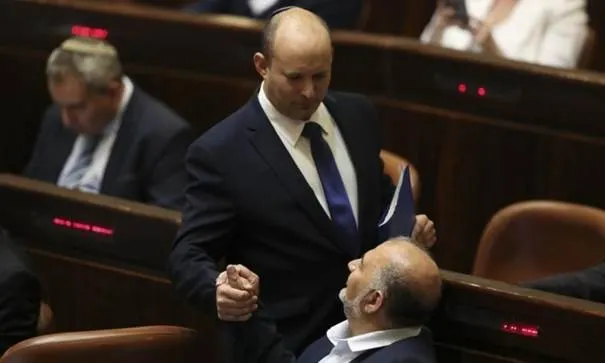
Ówczesny premier Izraela Naftali Bennett (po lewej) ściska dłoń lidera Zjednoczonej Listy Arabskiej Mansoura Abbasa podczas posiedzenia Knesetu w Jerozolimie, Izrael, 13 czerwca 2021 r. — AP/Archiwum

Nie oznacza to, że napięcia zniknęły. Indeks Demokracji Izraelskiej za 2025 r., opracowany przez Izraelski Instytut Demokracji, wykazał, że izraelscy Arabowie nadal zgłaszają istotne przejawy dyskryminacji i wskazują relacje żydowsko-arabskie jako najgłębszy podział społeczny w kraju. Jednak także w tym przypadku kluczowe znaczenie ma to, czego izraelscy Arabowie coraz częściej oczekują jako rozwiązania tych problemów. Sondaże sugerują, że zdecydowana większość nie chce likwidacji Izraela, lecz poprawy swojej pozycji w jego ramach.

To zasadnicza różnica.

Rozbieżność staje się jeszcze wyraźniejsza, gdy porówna się wyniki badań opinii wśród izraelskich Arabów z wynikami badań prowadzonych przez Palestyńskie Centrum Badań Politycznych i Sondaży wśród Palestyńczyków ze Strefy Gazy i Zachodniego Brzegu.

.
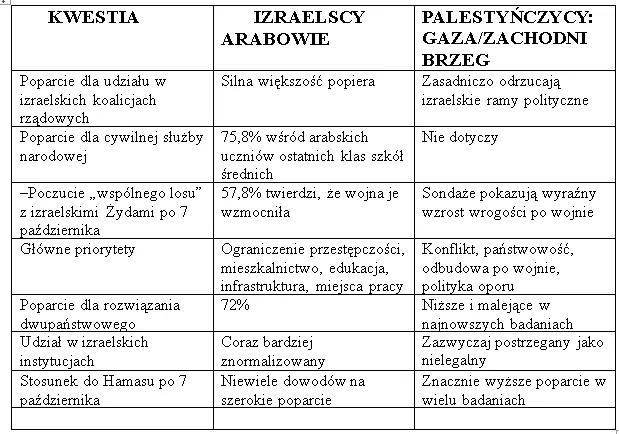
Tabela ukazuje głęboki rozdźwięk między izraelskimi Arabami a Arabami palestyńskimi, a także między ideologicznym aktywizmem za granicą a rzeczywistością życia w samym Izraelu.

Aktywiści skandujący „globalizować intifadę” wyobrażają sobie nieustanną walkę. Tymczasem sondaże coraz częściej wskazują na współistnienie połączone z frustracją oraz integrację połączoną z odrębnością kulturową.

Dlatego też inny niedawny trend w zachodnich mediach wydaje się coraz bardziej oderwany od rzeczywistości: nacisk na zastępowanie określenia „izraelscy Arabowie” terminem „palestyńscy obywatele Izraela”, jak gdyby ten drugi w pełni oddawał sposób, w jaki ta społeczność postrzega samą siebie.

Ci obywatele są niewątpliwie Arabami. Są też niewątpliwie związani kulturowo i emocjonalnie z szerszą historią palestyńską. Jednak badania coraz częściej pokazują, że postrzegają siebie również jako uczestników izraelskiego życia obywatelskiego, izraelskich instytucji, izraelskiej polityki, izraelskiego systemu edukacji i izraelskiej gospodarki. Głosują w izraelskich wyborach, coraz częściej popierają udział w koalicjach rządowych, coraz częściej wspierają służbę narodową i coraz częściej wyrażają poczucie przynależności do samego państwa.

Zachodni aktywiści posługują się językiem permanentnej rewolucji i niekończącego się „oporu”. Sondaże pokazują natomiast, że izraelscy Arabowie mówią językiem obywatelskiej przynależności, współistnienia, szans, bezpieczeństwa i praktycznej rzeczywistości.

Izraelscy Arabowie stanowią 21% ludności Izraela. Od 1948 r. ich liczba rosła szybciej niż liczba izraelskich Żydów. I coraz bardziej czują się u siebie w Państwie Żydowskim.


Link do oryginału: https://primarybowman.com/2026/05/13/the-polls-tell-a-very-different-story-about-israeli-arabs/?utm_source=substack&utm_medium=email

First One Through, 13 czerwca 2026


Zawartość publikowanych artykułów i materiałów nie reprezentuje poglądów ani opinii Reunion’68,
ani też webmastera Blogu Reunion’68, chyba ze jest to wyraźnie zaznaczone.
Twoje uwagi, linki, własne artykuły lub wiadomości prześlij na adres:
webmaster@reunion68.com


US Releases Full Iran Memorandum as Trump Warns Deal Remains Conditional


US Releases Full Iran Memorandum as Trump Warns Deal Remains Conditional

Ailin Vilches Arguello


US President Donald Trump attends a working lunch with the leaders of G7 and the Middle East during the G7 summit, in Evian-les-Bains, France, June 16, 2026. Photo: REUTERS/Christian Hartmann/Pool

The United States on Wednesday published the full text of its memorandum of understanding with Iran, ending days of speculation over the undisclosed agreement as US President Donald Trump cautioned that military action could resume if Tehran fails to comply with its commitments.

Once the agreement is signed in Switzerland on Friday, the United States and Iran will begin a 60-day negotiating process focused on turning the ceasefire into a permanent peace agreement and establishing new restrictions on Tehran’s nuclear activities.

“This is fundamentally an agreement that allows us to open the Strait of Hormuz immediately, commit the Iranians to destroying the nuclear dust, and then gives us a dial where if the Iranians dial up their good behavior, we respond by dialing up the kind of economic and sanctions relief that can make them a more prosperous country,” a senior US official said.

However, Trump warned that the agreement reached with Tehran remains only a preliminary framework, noting that Washington is prepared to resume military action “if they don’t behave.” 

“No, it’s not final. It’s a memorandum of understanding, and if I don’t like it, we’ll go back to shooting at them, dropping bombs on their head,” Trump said during a press conference at the G7 summit in France, alongside Egyptian President Abdel Fattah al-Sisi.

Based on the official version released by Washington, the 14-point memorandum lays out a framework for ending hostilities between the United States, Iran, and their respective allies, including Israel, while setting the stage for negotiations on a comprehensive final agreement.

The document calls for an immediate and permanent end to the war across all fronts, including Lebanon, with both sides pledging not to carry out hostile actions, threaten force, or interfere in each other’s internal affairs.

In Lebanon, Israel has been fighting the Iran-backed terrorist group Hezbollah, which opened fire on the Jewish state in early March, days after the joint US-Israeli military campaign began against the Iranian regime.

The memorandum also commits Tehran and Washington to negotiating a final agreement within 60 days, with the option of extending talks by mutual consent.

Under the agreed framework, the United States would lift restrictions on maritime traffic and restore normal navigation within 30 days, while Iran would ensure the safe resumption of commercial shipping through the Persian Gulf and the Sea of Oman.

Washington would also begin withdrawing forces from surrounding areas within 30 days of a final agreement being reached.

The memorandum further outlines a US-backed economic rehabilitation plan for Iran valued at a minimum of $300 billion and commits Washington to eventually lifting sanctions under a timetable to be determined during final negotiations.

In the meantime, the US Treasury Department would issue waivers allowing Iranian oil and petrochemical exports to continue, while frozen Iranian assets could gradually be released as talks progress.

On the nuclear front, Iran reiterates that it will not develop nuclear weapons, while both sides agree that Iran’s stockpiles of enriched material and other nuclear-related issues will be addressed in a final accord.

Notably, Iran has said for decades that it does not seek nuclear weapons, despite its extensive record of illicit nuclear activity at covert sites and enriching uranium near weapons-grade, well beyond what is required for civilian use.

Pending a final agreement, under the memorandum Tehran would maintain the current status of its nuclear program, while Washington would refrain from imposing new sanctions or expanding its military presence in the region.

The memorandum also calls for the creation of a joint mechanism to oversee implementation of a future agreement and states that any final deal would ultimately be approved through a binding resolution of the United Nations Security Council.

Titled the “Islamabad Memorandum of Understanding between the United States of America and the Islamic Republic of Iran,” read the full document below:

1. The United States of America and the Islamic Republic of Iran and their allies in the current war, by signing this MOU [Memorandum of Understanding], declare the immediate and permanent termination of military operations on all fronts, including in Lebanon, and undertake from now on not to initiate any war or any military operation against each other, and to refrain from the threat or use of force against each other, and ensuring the territorial integrity and sovereignty of Lebanon. The final deal will confirm the permanent termination of the war on all fronts, including in Lebanon, and other provisions of this paragraph.

2. The United States of America and the Islamic Republic of Iran undertake to respect each other’s sovereignty and territorial integrity, and to refrain from interfering in each other’s internal affairs.

3. The United States of America and the Islamic Republic of Iran commit to negotiating and achieving the final deal in maximum 60 days extendable with mutual consent.

4. Immediately upon the signing of this MOU, the United States of America will begin the removal of its naval blockade and any disturbances or impediments against the Islamic Republic of Iran, and will fully end the naval blockade within 30 days. During this period, the traffic of vessels will be in proportion to the numbers of pre-war traffic being restored by the Islamic Republic of Iran. The United States of America further undertakes to remove its forces from the proximity of the Islamic Republic of Iran within 30 days after the final deal.

5. Upon the signing of this MOU, the Islamic Republic of Iran will make arrangements using its best efforts for the safe passage of commercial vessels with no charge for 60 days only from the Persian Gulf to the Sea of Oman and vice versa. The traffic of commercial vessels will immediately start and, considering the need for removing the technical and military obstacles and de-mining by the Islamic Republic of Iran, will be instated within 30 days. The Islamic Republic of Iran will conduct dialog with the Sultanate of Oman to define the future administration and maritime services in the Strait of Hormuz, in discussion with other Persian Gulf littoral states in line with the applicable international law and the sovereign rights of coastal states of the Strait of Hormuz.

6. The United States of America undertakes with regional partners to develop a definitive, mutually agreed plan with at least USD 300 billion for the reconstruction and economic development of the Islamic Republic of Iran. The mechanism for the implementation of this plan will be finalized as part of final deal within 60 days. All required licenses, waivers, and permissions needed for the relevant financial transactions will be granted by the United States of America.

7. The United States of America undertakes to terminate all types of sanctions against the Islamic Republic of Iran, including the United Nations Security Council resolutions, i.e. IAEA Board of Governors resolutions, and all unilateral U.S. sanctions, primary and secondary, in an agreed upon schedule as part of the final deal. The Islamic Republic of Iran and the United States of America acknowledge the critical importance of the sanctions termination issue above mentioned and express their intentions to immediately address these issues in the negotiations in order to achieve mutual agreement on them.

8. The Islamic Republic of Iran reaffirms that it shall not procure or develop nuclear weapons. The United States of America and the Islamic Republic of Iran have agreed to resolve the disposition of stockpiled enriched material pursuant to a mechanism that will be mutually agreed upon, in accordance with the schedule mentioned in paragraph seven with the minimum methodology to be down blending on site under the supervision of the IAEA. The two parties also agreed to discuss the issue of enrichment and other mutually agreed matters related to the Islamic Republic of Iran‘s nuclear needs, based on a satisfactory framework being agreed upon in the final deal. The final deal will confirm the provisions of this paragraph. The United States of America and the Islamic Republic of Iran acknowledge the critical importance of the nuclear issues above mentioned and express their intention to immediately address these issues in the negotiations in order to achieve mutual agreement on them.

9. Pending the final deal, the United States of America and the Islamic Republic of Iran agree to maintain the status quo. The Islamic Republic of Iran will maintain the current status quo of its nuclear program and the United States of America will not impose any new sanctions and will not deploy additional forces in the region.

10. The United States of America undertakes that immediately upon the signing of this MOU and until the termination of sanctions, U.S. Department of Treasury will issue waivers for the export of Iranian crude oil, petroleum products, and derivatives, and all associated services, including banking transactions, insurances, transportation, etc.

11. The United States of America undertakes to make fully available for use the frozen or restricted funds and assets of the Islamic Republic of Iran. Upon the implementation of this MOU, the United States of America and the Islamic Republic of Iran will mutually agree on the procedures related to the release of these funds during the negotiation. Such funds, whether retained in the original account or transferred, shall be made fully usable for payment to any ultimate beneficiary designated by the Central Bank of the Islamic Republic of Iran. The United States of America undertakes to issue all necessary licenses and authorizations accordingly.

12. The United States of America and the Islamic Republic of Iran agree that an executive mechanism will be established to monitor the successful implementation of this MOU and the future compliance of the final deal.

13. After signing this MOU, and subject to the beginning of the implementation of paragraphs 1,4,5,10 and 11 of this MOU, and the continuing implementation of these measures, the United States of America and the Islamic Republic of Iran will start negotiations regarding the final deal exclusively on the other paragraphs.

14. The final deal will be endorsed by a binding UNSC resolution.


Zawartość publikowanych artykułów i materiałów nie reprezentuje poglądów ani opinii Reunion’68,
ani też webmastera Blogu Reunion’68, chyba ze jest to wyraźnie zaznaczone.
Twoje uwagi, linki, własne artykuły lub wiadomości prześlij na adres:
webmaster@reunion68.com


Antisemitism Becomes a Daily Reality for Jews in Germany as Hate Crimes Hit Record High


Antisemitism Becomes a Daily Reality for Jews in Germany as Hate Crimes Hit Record High

Ailin Vilches Arguello


Supporters of Hamas gather in Berlin. Photo: Reuters/M. Golejewski

The relentless wave of antisemitism sweeping Germany has created an increasingly hostile and dangerous reality as antisemitic incidents surge to unprecedented levels, turning fear, harassment, and exclusion into a routine part of everyday life.

According to new statistics published Tuesday by the German Federal Ministry of the Interior, the number of hate crimes in Germany climbed to a record 22,159 cases in 2025.

In particular, antisemitic offenses were among the fastest-rising categories, reaching an all-time high of 6,548 cases amid a volatile social climate targeting Jews and Israelis.

In the last near-decade, antisemitic hate crimes in Germany have surged dramatically, more than quadrupling from 1,504 recorded cases in 2017.

Among the reported incidents were threats, vandalism, social exclusion, physical assaults on individuals, and attacks on Jewish institutions, highlighting what Jewish leaders describe as an increasingly hostile environment across Germany.

“Incidents of this kind show that antisemitism has long been a part of everyday life – in schools, government offices, and political debates,” Andreas Büttner, the Brandenburg Commissioner against Antisemitism, said in a statement.

In the last few weeks alone, reports have emerged of a pastor being called a “Jewish pig,” Jewish students fearing violence in their schools, and security staff at Berlin Brandenburg Airport allegedly hurling antisemitic insults at two travelers bound for Tel Aviv.

German media reported this week that, after two years in office, Büttner warned of a “creeping normalization” of antisemitism, saying anti-Jewish hostility had increasingly penetrated the mainstream of German society.

He also noted that official statistics likely understate the true extent of antisemitism, as many victims refrain from reporting incidents out of fear or skepticism that authorities will take effective action.

“Hatred of Jews has become louder, more open, and more commonplace, and the boundaries of what is socially acceptable to say have shifted,” Büttner said.

For example, he pointed to a recent case involving a former Brandenburg city councilor who allegedly declared that “a world without Jews would be a better world.”

In a recent incident, a group of customers was reportedly asked to leave a café at Berlin’s Potsdamer Platz — one of the capital’s busiest public squares — on Saturday after one member of the group displayed an Israeli flag.

According to the German newspaper Bild, the incident unfolded on the sidelines of a pro-Palestinian demonstration in Berlin-Mitte, where police reportedly had to shield the group after protesters began harassing them.

In social media videos widely circulated online, the group can be seen sitting in the cordoned-off outdoor area of the Espresso House café when an employee allegedly asked them to leave because one woman was wearing an Israeli flag draped over her shoulders.

After the incident drew widespread media attention and sparked outrage among Jewish leaders and political figures, the café chain’s managing director, Nikolas Niebuhr, said the group had been loudly chanting slogans as demonstrators passed by, which he said was the reason they were asked to leave.

“Guests felt disturbed and complained. We don’t want to be part of a demonstration. We simply want to sell coffee,” Niebuhr told the German newspaper Berliner Zeitung.

Reflecting broader concerns within Germany’s Jewish community, Babka & Krantz, a Jewish bakery owned by Polish and Israeli immigrants in Berlin, closed last week, with its owners pointing to both financial difficulties and antisemitic harassment.

Located in Berlin’s Friedenau district, café owners and married couple Shahar Elkin and Marcin Liera-Elkin opened their first shop in November 2022, later expanding in December 2024 with a second location near the memorial at the site where Nazi officials planned the Holocaust’s “Final Solution.”

However, the second location closed last November, and now the original bakery has also shut down, bringing the venture to an end.

“We are just a bakery that wants to offer great products. But now we are only confronted with problems and politics that leave us in despair,” Elkin told the German newspaper Morgenpost. “We really don’t know if Berlin is still the right place for us.”


Zawartość publikowanych artykułów i materiałów nie reprezentuje poglądów ani opinii Reunion’68,
ani też webmastera Blogu Reunion’68, chyba ze jest to wyraźnie zaznaczone.
Twoje uwagi, linki, własne artykuły lub wiadomości prześlij na adres:
webmaster@reunion68.com