Guy Millière
- The massacre of thousands of Israelis by the terrorist group Hamas on October 7, 2023 triggered an explosion of attacks on Jews in the United Kingdom.
- “London has become a no-go zone for Jews….” — UK Commissioner for Countering Extremism Robin Simcox, BBC, March 8, 2024.
- After every attack, the British government, along with other political leaders, take great care to condemn antisemitism. They also take great care each time to avoid saying who the perpetrators are. Their condemnations therefore amount to empty words. If you do not identify the source of the Jew-hate, how can you combat it?
- In July 2025, on behalf of the United Kingdom, Starmer agreed to the publication of a communiqué — also signed by 28 other countries — falsely accusing Israel of depriving Palestinians of “human dignity” and perpetrating the “inhumane killing of civilians.” The communiqué was – no surprise — exploited by all of Israel’s enemies, particularly those also falsely accusing Israel of genocide.
- Starmer was just warming up. As if that were not odious enough, Starmer went on, in the name of the UK, officially to recognize a non-existent “State of Palestine.”
- Starmer recognized this fictitious “State of Palestine” even as Hamas still held power and hostages in Gaza. His weakness cannot be overstated.
- He was — along with the current leaders of France, Belgium, Ireland, Spain, Norway and Sweden — just among the too many countries also recognizing an imaginary Palestinian State.
- “The Palestinian people does not exist. The creation of a Palestinian state is only a means for continuing our struggle against the state of Israel for our Arab unity. In reality, today there is no difference between Jordanians, Palestinians, Syrians and Lebanese. Only for political and tactical reasons do we speak today about the existence of a Palestinian people, since Arab national interests demand that we posit the existence of a distinct Palestinian people to oppose Zionism. For tactical reasons, Jordan, which is a sovereign state with defined borders, cannot raise claims to Haifa and Jaffa, while as a Palestinian, I can undoubtedly demand Haifa, Jaffa, Beer-Sheva and Jerusalem. However, the moment we reclaim our right to all of Palestine, we will not wait even a minute to unite Palestine and Jordan.” — Zoheir Mohsen, senior official of Palestine Liberation Organization, Trouw, March 31, 1977.
- Meanwhile, Muslims continue to enter the UK, both legally and illegally. As their population continues to grow, they have been integrating less and less. Many appear to have come not only for employment opportunities and welfare benefits, but also to transform Great Britain into a country indistinguishable from the ones they left.
- Some people might call that imperialism. The Portuguese and Spanish displaced the cultures of South America; England tried to bring its customs to its colonies, and so on. At the time, the countries overtaken did not have the means to stop these invasions. Today’s Britons are not Aztecs.
- Hatred of Israel and Jews, doctrinally imposed by the Qur’an and the hadith, is deeply entrenched within Muslim communities in Western Europe, and accommodated by much of non-Muslim society there.
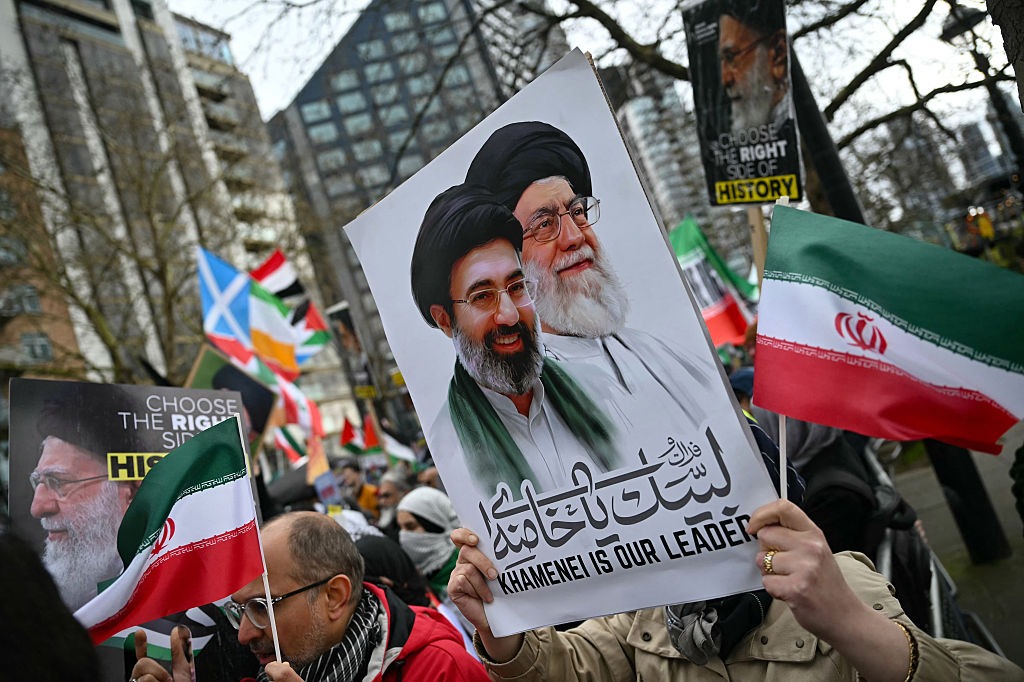 Hatred of Israel and Jews, doctrinally imposed by the Qur’an and the hadith, is deeply entrenched within Muslim communities in Western Europe, and accommodated by much of non-Muslim society there. Almost all antisemitic acts in Britain are carried out by radicalized Muslims, yet it has become a problem to state that openly. Britons who question Muslim antisemitism are accused of “stirring up racial or religious hatred.” Pictured: A demonstration supporting the Iranian regime in its war against Israel and the US, in central London on March 15, 2026. (Photo by Justin Tallis/AFP via Getty Images)
London. Sunday, May 10. A protest against rising anti-Semitism is organized in front of the prime minister’s residence. About 20,000 people are present, mostly Jews. Secretary of State for Work and Pensions Pat McFadden, who addressed them, was jeered and booed. “I feel your pain,” he told the crowd. The reply was, “Action, no more words.”
When British Prime Minister Keir Starmer, a few days before the protest, visited Golders Green, a heavily Jewish area of London where two Jews had been stabbed on April 29, he was greeted with chants of “Keir Starmer, Jew Harmer.”
Jews in the United Kingdom are no longer safe. The year 2025 saw 3,700 anti-Semitic incidents recorded — approximately ten a day. By the end of 2026, it looks as if the figures will be at least as high. In 2023, the figures were even higher. The massacre of thousands of Israelis by the terrorist group Hamas on October 7, 2023 triggered an explosion of attacks on Jews in the United Kingdom.
Violent attacks against Jews and Jewish institutions in London are on the rise. On March 23, an arson attack destroyed four ambulances belonging to a Jewish volunteer emergency medical service, Hatzola Northwest. On April 18, the Kenton United Synagogue in northwest London was firebombed. On April 29, there were the stabbings in Golders Green.
Jewish children are harassed on their way to school. It is dangerous to display any Jewishness. Men hide their skullcaps and women conceal the Star of David pendants they wear.
“London has become a no-go zone for Jews,” UK Commissioner for Countering Extremism Robin Simcox said on March 8.
What is happening in London is happening throughout the UK, wherever Jewish communities exist. On October 2, 2025 — during the Yom Kippur holiday — a 35-year-old Syrian, Jihad Al-Shamie, plowed his car into a gathering of Jews who had come to pray at a synagogue in Manchester, then began slashing and stabbing them, and finally tried to force his way into the synagogue. He left two dead and three wounded.
Almost all antisemitic acts in Britain are carried out by radicalized Muslims, yet it has become a problem to state that openly. Britons who question Muslim antisemitism are accused of “stirring up racial or religious hatred.”
After every attack, the British government, along with other political leaders, take great care to condemn antisemitism. They also take great care each time to avoid saying who the perpetrators are. Their condemnations therefore amount to empty words. If you do not identify the source of the Jew-hate, how can you combat it?
Hatred of Jews, of course, goes hand in hand with hatred of Israel. It is a sentiment shared by a large segment of the UK population.
Starmer, who, a few years ago, claimed to have purged antisemites and anti-Israel elements from the Labour Party – and for five minutes appeared to be a friend of Israel — now sharply criticizes country as well as its democratically elected government.
In July 2025, on behalf of the United Kingdom, Starmer agreed to the publication of a communiqué — also signed by 28 other countries — falsely accusing Israel of depriving Palestinians of “human dignity” and perpetrating the “inhumane killing of civilians.” The communiqué was – no surprise — exploited by all of Israel’s enemies, particularly those also falsely accusing Israel of genocide.
Starmer was just warming up. As if that were not odious enough, Starmer went on, in the name of the UK, officially to recognize a non-existent “State of Palestine.”
In the words of Zoheir Mohsen, wo was a senior Palestine Liberation Organization official from 1971-1979:
“The Palestinian people does not exist. The creation of a Palestinian state is only a means for continuing our struggle against the state of Israel for our Arab unity. In reality, today there is no difference between Jordanians, Palestinians, Syrians and Lebanese. Only for political and tactical reasons do we speak today about the existence of a Palestinian people, since Arab national interests demand that we posit the existence of a distinct Palestinian people to oppose Zionism.
“For tactical reasons, Jordan, which is a sovereign state with defined borders, cannot raise claims to Haifa and Jaffa, while as a Palestinian, I can undoubtedly demand Haifa, Jaffa, Beer-Sheva and Jerusalem. However, the moment we reclaim our right to all of Palestine, we will not wait even a minute to unite Palestine and Jordan.”
Starmer recognized this fictitious “State of Palestine” even as Hamas still held power and hostages in Gaza. His weakness cannot be overstated.
He was — along with the current leaders of France, Belgium, Ireland, Spain, Norway and Sweden — just among the too many countries also recognizing an imaginary Palestinian State.
Stamer was also quick to declare on April 1, “This is not our war” — as if Iran’s pursuit of nuclear weapons and the threats through terrorism that the Iranian regime poses to the West are not matters of concern to the UK. Starmer must surely be aware that at least one Iranian group — Harakat Ashab al-Yamin al-Islamia (HAYI) — is directly responsible for numerous antisemitic attacks in the country. Starmer has never publicly condemned HAYI or any similar group.
Starmer further sought to deny the U.S. Air Force access to the joint US-UK airbase on Diego Garcia and RAF Fairford in Gloucestershire. His consent included the pitiful stipulation that the bases should be used for “defensive” missions only.
Several countries in Europe — Spain, Italy, France, and Austria — also barred U.S. Air Force aircraft from using their bases and airspace.
Many in the UK now see that unless a course correction is undertaken — and fast –, the country is facing an extremely bleak future. British civilization itself appears positioned to perish.
On March 10, 2025, a protest march was organized by political activist Tommy Robinson — one of the very few people in England consistently to speak out on behalf of the tens of thousands of British children who have been raped and trafficked by gangs of “Asian” migrants (a euphemism for Pakistani as well as others).
On May 16, 2026, Robinson organized a “Unite the Kingdom” march, which drew another massive crowd — tens of thousands. Starmer claimed that Robinson and those who work with him peddle “hatred and division.”
The day before the march, Starmer announced that “We’ve already blocked visas for far-right agitators who want to come here to spew their extremist views,” — but not, of course, for potential rapists.
The local elections on May 7 — described in several British newspapers as an unofficial referendum on Starmer — were a disaster for Starmer’s Labour Party — and a huge victory for Reform UK, the anti-immigration party created in 2018 as the “Brexit Party” by Nigel Farage. Labour lost more than 1,100 of the 2,300 council seats it had held. It also lost control of 35 councils it had held for decades. Reform UK won more than 1,400 council seats and gained control of 14 councils.
After such a rout, it was expected that Starmer would resign. So far, he has chosen to remain in his post. Four members of the British government, however, did resign; more than 80 Labour MPs urged him to quit.
The next elections for parliament are scheduled for 2029. If the government falls before then, elections would be held sooner. If they were held today, Reform UK would likely win, accompanied by a recovery of the endlessly mismanaged country (such as here, here and here).
Meanwhile, Muslims continue to enter the UK, both legally and illegally. As their population continues to grow, they have been integrating less and less. Many appear to have come not only for employment opportunities and welfare benefits, but also to transform Great Britain into a country indistinguishable from the ones they left.
Some people might call that imperialism. The Portuguese and Spanish displaced the cultures of South America; England tried to bring its customs to its colonies, and so on. At the time, the countries overtaken did not have the means to stop these invasions. Today’s Britons are not Aztecs.
There are now officially almost four million Muslims in the UK (6% of the population). In 2001, there were only 1.59 million Muslims in the country (2.7% of the total population).
A Pew Research Center study estimated that under just a “medium” migration scenario, the Muslim population in the UK by 2050 could be around 16.7%–17.2%, approximately 13–13.5 million people.
Jews continue to leave Britain. According to the Institute for Jewish Policy Research, there are 313,000 Jews left in the UK (0.4% of the population), and the number falls every year.
The problem, in addition to the sharp shift in demographics, is also one of determination. In 404 BCE, it took only 30 men working on behalf of Sparta to bring down Athens, one of the great foundational civilizations of Western culture.
Even among non-radicalized Muslims, there is widespread acceptance of Sharia practices, such as the continual cover-up of sexual abuse crimes. There has been a consistently permissive attitude toward rape gangs by the police, the government and the judiciary — all of whom are apparently terrified of being labeled racist. There has also been an increasing suppression of free speech — the cousin of blasphemy laws — as well as the rejection of Judeo-Christian traditions, such as Christmas, and a subversion of common law (such as finding that terrorists just have “mental health” problems. All this has been accompanied by a rise in hatred of Jews, of Israel, and of the culture of the West.
Meanwhile, the British economy continues to fall. The official unemployment rate is low, 4.9%. Mostly people seem to be exiting the labor market and becoming economically inactive, apparently content to live off welfare benefits and “free stuff.” Almost 14 million British citizens (21% of the population) live in poverty, have an income below 60% of the national median, and struggle to afford food, housing and essential services.
As in the UK, the economies of most Western European countries are in decline. In 2000, the member states of the European Union collectively accounted for 20% of global GDP. By 2024, they represented only 15.2 %.
The birthrate among Muslim women everywhere in Western Europe is far higher than the birth rate among non-Muslim women.
In France, the birthrate is 1.56. In Germany, 1.35. In Italy, 1.14, and in Spain, 1.10.
The birthrate in the United Kingdom has also been falling. It is now 1.41 children per woman, well below the replacement level of 2.1. The birthrate among Muslim women is far higher. In the UK, even if polygamy is not allowed, a Muslim man’s extra wives receive extra welfare benefits. If the polygamous marriage took place overseas, you see, that makes it all right. There are reports that sometimes each of the four wives has her own house — presumably at the British taxpayers’ expense.
What is happening in the United Kingdom is also happening throughout Western Europe — and has established a foothold in the United States.
In France, antisemitic acts may not be as frequent as in the United Kingdom, yet they remain common: 1,320 incidents recorded in 2025—more than 3.5 each day. Jews in France make up slightly less than 1% of the population, yet, year after year, they are the victims of more than 50% of all anti-religious hate crimes.
In Belgium, the Jewish population is even smaller — fewer than 30,000 — but the number of antisemitic incidents nevertheless jumped from 57 in 2022 to 277 in 2024, a more than fourfold increase. A survey conducted in 2024 for the European Jewish Congress showed that many Belgians apparently do not even consider it antisemitic to scrawl graffiti on a synagogue, or to insult or threaten a Jew or person thought to be a “Zionist”: 22% of respondents said they regarded such acts to be understandable, acceptable and legitimate.
In Germany, the Jews account for less than 0.2 percent of the total population, yet suffer a disproportionate number of anti-religious attacks – also on an upward trend: from 1,824 antisemitic attacks recorded in 2024 to 2,267 in 2025.
The same pattern can be seen across all of Western Europe. For years, virtually all antisemitic acts — as in the United Kingdom – have been perpetrated by radicalized Muslims. Again, most Western European politicians condemn “antisemitism” but without mentioning who the perpetrators are.
Hatred of Israel and Jews, doctrinally imposed by the Qur’an and the hadith, is deeply entrenched within Muslim communities in Western Europe, and accommodated by much of non-Muslim society there.
Every current Western European leader, just like Starmer, has stated — in varying terms —that the war in Iran is “not their war.”
Lately in Western Europe, political parties with platforms like that of the right-of-center Reform UK are gaining ground. Several appear poised to win elections. They see — and say aloud — that in Europe, Western civilization could die. They are calling for national renewal.
The governments of some Central European countries — Poland, Hungary, the Czech Republic, Slovakia — have adopted a firm stance against immigration — for which the European Union thoroughly excoriated them. Hungary experienced being occupied by the Ottoman Empire for nearly 200 years. Former Prime Minister Viktor Orbán — who just lost an election — did not want to see another Islamic occupation.
Central Europe still has one of the world’s lowest Muslim populations (roughly between 0.1% and 1% of the total population). Jews living there face virtually no violent antisemitic attacks. Central Europe, however, is also seeing declining birthrates. In the Czech Republic, it fell to 1.28 children per woman. In Hungary, it now stands at 1.31; in Poland, the figure is 1.1.
Is saving Europe still possible? If the political parties that are seeking to preserve Western civilization prevail, probably yes — but time is just about up.
Dr. Guy Millière, a professor at the University of Paris, is the author of 27 books on France and Europe.
 Warszawa 01.1965. Poetka, autorka tekstów piosenek Agnieszka Osiecka w swoim mieszkaniu na Saskiej Kępie. Fot. PAP/Erazm Ciołek
 Odnalezione zapiski Osieckiej z lat 70., czyli nieudana próba udomowienia poetki