Jonathan S. Tobin
Back in 2015, the GOP and most Americans opposed Obama’s appeasement of Tehran. Now, Democrats are against Israel on any issue, and Republicans will not defy Trump.
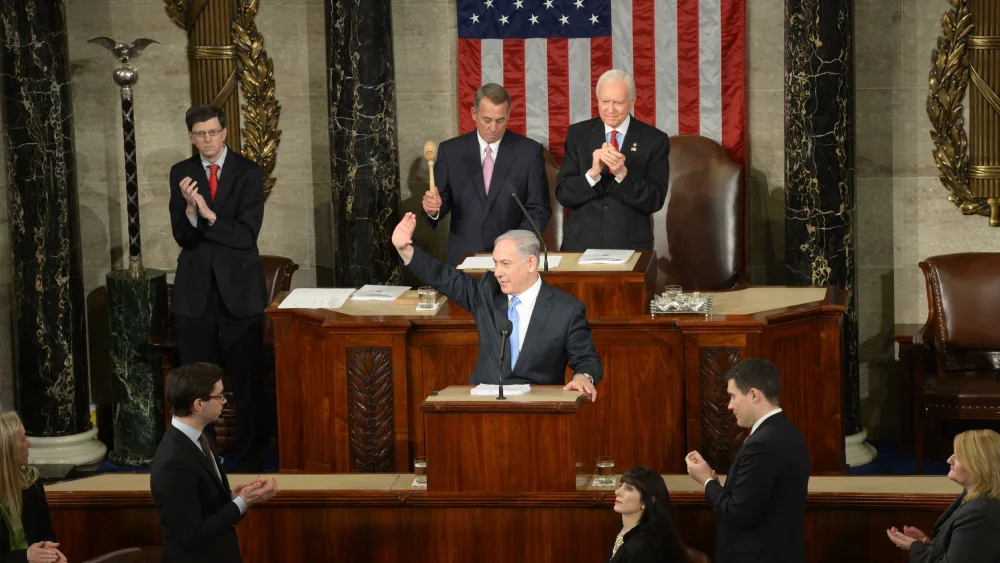 Israeli Prime Minister Benjamin Netanyahu waves to the crowd during his address to a joint session of Congress in Washington, March 3, 2015. Photo by Amos Ben Gershom/GPO.
In the never-ending churning of news cycles, commentators and the public alike are always ready to overreact to each aspect of every story as they roll out. Under these circumstances, historical perspective is rarely part of anyone’s understanding of events. This was amply illustrated by the discussion about the United States signing a Memorandum of Understanding with Iran.
The deal, whose terms were at first kept secret and have since been revealed, will conclude, at least for the next 60 days, the war America and Israel waged on Tehran starting on Feb. 28.
Hysteria about the implications of the deal for Israel, which was cut out of the negotiations over the agreement, is probably unwise. It’s not clear how much of the Jewish state’s freedom of action to defend itself against Iran, as well as its Hezbollah auxiliaries in Lebanon and Hamas in Gaza, will be curtailed. Nor can we know for sure what President Donald Trump will do in the immediate future.
Trump’s priorities
His desire to end the fighting and for the renewed flow of oil to lower gas prices at the pump appears to be his main priority. For the moment, that seems to outweigh concerns about his desperation to get a deal that will accomplish these goals, which led him to strike a bargain that bears a troubling resemblance to the one former President Barack Obama concluded with Tehran in 2015.
Trump can always change his mind about that and order strikes once it becomes clear—as anyone who knows anything about the subject understands—that Iran’s leaders have no intention of keeping their word about not acquiring a nuclear weapon. Though his public comments about the agreement make that seem highly unlikely, given the president’s panic about his sinking poll numbers linked to the rise in gas prices. But it’s still theoretically possible. It’s also a dead certainty that it will continue its buildup of missiles and terrorism that threaten its neighbors and the West.
There is one thing, however, that can be said with absolute certainty about the current situation. Now that we know the deal is as bad as many feared, those who speak up against it are not only in no position to stop or even slow the process down. They will also be far more isolated than those who opposed Obama’s deal.
Simply put, unlike the situation 11 years ago—when a broad coalition of Democratic security hawks, Republicans and pro-Israel advocates spoke up against Obama’s disastrous Joint Comprehensive Plan of Action—critics of Trump’s Iran deal will be limited to the pro-Israel community. And they are likely to stand alone.
Unpersuasive advocates
Trump and Vice President JD Vance have been doing their best to fend off criticism of their decision to end the war with what the former described as a “peace deal” with the Islamist terror regime. That effort was undermined by their initial unwillingness to reveal details of the agreement—something that Vance claimed was due to sensitivities in the Muslim world, an excuse that raised even more concerns about its implications.
Trump’s supporters have been telling everyone who has criticized the deal in the days since it was announced to take a deep breath, and to wait and see what happens. There’s a certain logic to that. The structure of the accord appears to hinge on what will happen during a 60-day period when America lifts its blockade of Iranian ports so Tehran stops menacing shipping in the Strait of Hormuz. Yet now that the details are known—with unfrozen funds already flowing to Iran, no mention of Iranian missiles and terrorism in it, and no mechanism, other than a resumption of the war, to prevent a regime that can claim it forced Trump to back down from resuming its march to a nuclear weapon—optimism about it seems deeply unpersuasive.
In theory, Trump could reverse his decision, and sensible observers should not abandon all hope that he will. Accepting a terrible deal—and the terms of the agreement make it clear that the United States is doing almost all of the giving and Iran nearly all of the taking—would be out of character for a man who thinks of himself as having mastered “the art of the deal.”
With Trump’s characteristic hyperbole, he has characterized the results of the indirect negotiations conducted by Middle East special envoy Steve Witkoff and adviser/son-in-law Jared Kushner in flattering terms. He has even declared the Iranian negotiators to be “rational people” who are “nice to deal with,” even though the desperate-for-a-deal-at-any-price duo never actually sat down with them. But the man who spent the last decade rightly mocking Obama and his negotiators for their weakness and gullibility ought to be ashamed of accepting terms that seem to depend on Iran’s goodwill and trustworthiness.
Trump’s critics should acknowledge that not only is the current president far preferable to his Democratic predecessors or to any Democratic Party alternative when it comes to his approach to the Middle East and Israel. They should be equally willing to speak of the damage done to Iran’s military, nuclear and missile programs, and other war-making infrastructure both as part of the 12-day war last June and from the fighting since Feb. 28. The ability of a government that has been at war with the United States, Israel and the West since 1979 to inflict terror on the region and the rest of the world has been set back, perhaps by years.
At the same time, Israel is far stronger vis-à-vis its Islamist foes than it was on Oct. 6, 2023, before the Iranians and their allies launched their cruel war on the Jewish state with the atrocities of Oct. 7.
Still, it appears that Trump has kicked the can down the road with respect to ending the threat from Iran. And it is also almost certainly true that despite raising the hopes of Iran’s tortured people, he has nevertheless ensured the survival of a despotic regime that murdered tens of thousands of them in January. This means that the long war Iran has been waging on America, Israel and the West will continue. It will doom the world to years of more terrorism and the ever-present threat that it will be able to acquire the ability to inflict mass destruction on the Jewish state and moderate Arab countries that oppose it.
As such, this agreement deserves to be vigorously debated. And, to his credit, Trump has offered to submit any deal to Congress for its approval.
If so, that will make it equally clear that the political correlation of forces with respect to Iran is now very different from the situation in 2015 when Obama rammed his catastrophic JCPOA down the throats of an unwilling Congress and American people.
The JCPOA was unpopular
It should be recalled that Obama’s Iran policy was deeply unpopular. A Pew Research Institute poll taken in September 2015 showed that the Iran deal was opposed by a large plurality of Americans, with 49% opposing it and only 21% in favor, with 30% saying they did not know (an unsurprising result given that most Americans pay little attention to most foreign-policy issues). And the more Americans knew about the agreement, the less they liked it, something indicated by the fact that opposition to the deal increased over the course of the year.
Majorities in both Houses of Congress also opposed the JCPOA.
It was only approved by a sleight-of-hand bargain in which Obama and Sen. Bob Corker (R-Tenn.), the feckless Republican who chaired the Senate Foreign Relations Committee, agreed that it would be put to a vote, which required a two-thirds majority to kill it. This was the opposite of the constitutional requirement for a two-thirds majority to pass a treaty. The House voted 269-162 (with 244 Republicans and 25 Democrats voting no) not to approve the JCPOA, with an equally large majority in the Senate also ready to vote against it. But since that fell short of a super-majority, Obama’s signature foreign-policy “achievement” that guaranteed that Iran would eventually get a nuclear weapon snuck through.
Trump won’t have to resort to those kinds of legislative tricks.
More to the point, the party opposed to the sitting president will play a very different role in 2026 than it did in 2015.
11 years makes a big difference
A decade ago, Congressional Republicans were united against the Iran deal while Democrats were split on it. The GOP even went so far as to invite Israeli Prime Minister Benjamin Netanyahu to address a joint meeting of Congress that year, during which he gave an unprecedented address in which he urged its members to oppose Obama’s effort to enrich and empower an Iranian regime that threatened the United States as much as Israel.
It was only by making support for the measure a litmus test of loyalty to himself that Obama was able to rally most Democrats behind a policy of appeasement that all but the most hard-core left-wingers in the party had opposed only a couple of years earlier. In 2015, there were still pro-Israel Democrats willing to speak up against Obama, even though most of those who had once claimed that title, like Sens. Chuck Schumer (D-N.Y.) and Corey Booker (D-N.J.), failed to maintain that stance when push came to shove.
If anything, the current Democratic caucuses will be even more eager to terminate the war and appease Iran than they were then. While members of the opposition to the administration would seize on any pretext to thwart Trump, he can rely on them to support an end to the war. They will also be eager to do something that will be perceived as undermining Israel’s security.
By contrast, the House and Senate GOP caucuses today are, as they were in 2015, almost uniformly pro-Israel and hawkish on Iran, with only outliers like lame-duck Rep. Thomas Massie (R-Ky.) and his fellow libertarian Sen. Rand Paul (R-Ky.), the rare exceptions to that rule.
What will Republicans do?
That said, how many pro-Israel Republicans will vote against Trump on his Iran deal?
Doing so will not only require the temerity to oppose a president who doesn’t lightly brook opposition and often gets even with those who do so, no matter how long it takes. It will also mean risking being portrayed as warmongers or advocates for a policy that would raise gas prices. It’s far from clear that even the most ardent supporters of a strong Israel and those most interested in stopping Iran would think it wise to try to thwart Trump from ending a deeply unpopular war, even if it is clearly in America’s best interests.
Nor does it require much of an imagination to predict what Trump’s reaction would be to Netanyahu or any other Israeli or pro-Israel organization that advocated for Congress to turn down his version of Iran appeasement, as they did in 2015. It would make Obama’s spiteful attacks on those who opposed him on this issue seem quite tame by comparison.
Thus, while Israel’s strategic position in the Middle East is far stronger than it was in 2015, in the United States, opposition to an appeasement of Iran on Trump’s part would be minimal. Those voices decrying a deal that trusted Iran to keep its word or which would depend on an unlikely decision by this president or one of his successors to resort to the use of force against the Islamist regime would find themselves largely alone, abandoned by Republican friends and mocked by Democratic foes.
Don’t blame Netanyahu
There will be those who will blame this predicament on Netanyahu. His domestic opponents will claim that he depended too heavily on Trump’s friendship for Israel and that of the Republicans. And they will say he alienated Democrats.
This is both untrue and deeply unfair. Whatever one might say about Netanyahu when it comes to navigating the political landscape of his country’s sole superpower ally, the current alignment has little or nothing to do with his unpopularity in the United States or his judgment.
The drift by Democrats away from Israel is the result of the growing influence of toxic left-wing ideologies that falsely label it as a “white” oppressor state. Their willingness to accept and spread blood libels about Israel committing “genocide” in Gaza is not the product of Israeli behavior, but of the hijacking of the Democratic Party by antisemitic progressives. The prime minister had no chance of preserving a pro-Israel Democratic Party; the same would have been true of any Israeli leader.
That means that Israel and its friends are in a position where they have no choice but to rely on pro-Israel Republicans to preserve the alliance. That worked wonderfully so long as Trump was behaving—as he has done during the first five-and-a-half years of his two terms—as the most pro-Israel president since the founding of the modern Jewish state. But with Trump adopting a more equivocal stand in which he may be waving the white flag on Iran and bristling with resentment at Netanyahu’s refusal to stop defending his citizens, that leaves supporters of Israel isolated in the United States on this issue.
We must hope that it doesn’t come to that—and that Trump isn’t willing to go on deceiving himself and the American people about the dubious prospects for a policy that will preserve the despotic regime in Tehran and ensure that there will be more Middle East wars and bloodshed in the coming years.
But if he is determined to stand by his own Iran deal, it won’t just signal that the aggressive presidency of the past 17 months is about to become a lame-duck administration, even before the outcome of the midterm elections is known. It will also mean that Israel and its friends will largely stand alone when it comes to the debate about this latest appeasement of the Islamist regime of Iran that Trump has given a new lease on life.
 Jonathan S. Tobin is editor-in-chief of the Jewish News Syndicate, a senior contributor for The Federalist, a columnist for Newsweek and a contributor to many other publications. He covers the American political scene, foreign policy, the U.S.-Israel relationship, Middle East diplomacy, the Jewish world and the arts. He hosts the JNS “Think Twice” podcast, both the weekly video program and the “Jonathan Tobin Daily” program, which are available on all major audio platforms and YouTube. Previously, he was executive editor, then senior online editor and chief political blogger, for Commentary magazine. Before that, he was editor-in-chief of The Jewish Exponent in Philadelphia and editor of the Connecticut Jewish Ledger. He has won more than 60 awards for commentary, art criticism and other writing. He appears regularly on television, commenting on politics and foreign policy. Born in New York City, he studied history at Columbia University.
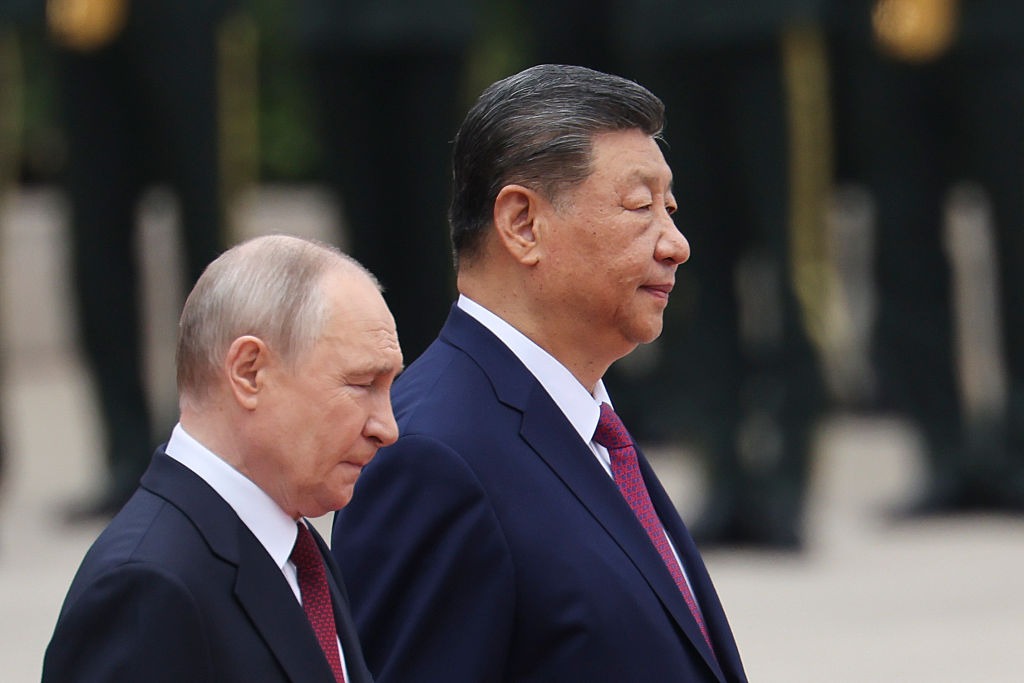 Na zdjęciu: Prezydent Rosji Władimir Putin spotyka się z prezydentem Chin Xi Jinpingiem podczas ceremonii powitalnej w Wielkiej Hali Ludowej, 20 maja 2026 roku w Pekinie w Chinach. (Zdjęcie: Maxim Shemetov/Pool/Getty Images)
 Gdy Xi i Putin spierają się o gazociąg, USA nadal trzymają Chiny za energetyczne gardło