
Archives

Israel Respects Gay Rights; the Palestinians Do Not

Israel Respects Gay Rights; the Palestinians Do Not

Aidan Segal


Revelers take part in Tel Aviv’s annual Pride Parade, June 14, 2019. Photo: Reuters / Ronen Zvulun.

The University of Pittsburgh’s chapter of Students for Justice in Palestine (SJP) held a meeting in October on the topic of “pinkwashing” —  the accusation that Israel exploits the LGBTQ+ community to propagandize a progressive image of the country, and to obscure the reality that Israel is allegedly an apartheid state.

Pinkwashing is one of many false narratives manufactured by anti-Israel organizations. Like any country, Israel is not perfect and not without prejudice; but it strives to be a beacon of freedom for all its inhabitants. In a region hardly brimming with liberal democracies, Israel “adamantly protects the rights of its gay citizens, and the LGBT community is represented in the highest echelons and in all facets of Israeli society.”

Israel celebrates the community not to appear progressive, but because it truly respects gay rights, and has an uncanny level of support for the LGBT+ community.

The founder of modern Zionism, Theodor Herzl, wrote that a Jewish state would be a positive force not only for Jews, but “for the good of humanity.” Nothing could be more true for the prosperous LGBTQ+ community in Israel, though anti-Zionist activists such as adherents to the BDS movement insist that an ulterior motive is at play.

The BDS movement claims that “Israel’s pinkwashing agenda seeks to portray itself as a fun-loving gay haven while using racist stereotypes to depict Palestinians as backward.”

In reality, there are no civil rights protections for LGBTQ+ people in the territories controlled by the Palestinian Authority and Hamas, which has prompted hundreds of gay Palestinians to flee to Israel for fear of persecution.

According to Amnesty International, there have been “at least eight cases of LGBTI individuals who were arbitrarily arrested or ill-treated by Palestinian security forces in the West Bank in relation to their sexual orientation or gender identity.” Not to mention that, according to a survey conducted by the Arab Barometer research network just last year, only 5% of West Bank Palestinians accept gay relationships.

Homosexual activity is an imprisonable, even fatal, offense in the Gaza Strip. The terrorist organization Hamas executed one of its own commanders in 2016 for, among other allegations, “moral turpitude, by which Hamas meant homosexuality,” according to a New York Times report. While no society is completely free of intolerance, singling out the Jewish state as uniquely evil while disregarding the plight of the LGBTQ+ community throughout the region is antisemitic and intellectually dishonest.

For example, Middle East Eye contributor Nada Elia didn’t seem the least bit concerned about the treatment of the LGBTQ+ community under the Palestinian leadership in an article published in 2018. Instead, she accused Israel of pinkwashing. “All of Israel is not gay-friendly,” she wrote, “and even those few places that are, are ‘white-and Jewish-gay-friendly.’”

Elia’s canards are nothing new. In her book How to Fight Anti-Semitism, journalist Bari Weiss explains how antisemitism conveniently “turns Jews into the symbol of whatever a given civilization defines as its most sinister and threatening qualities.” In Elia’s case, Jews aptly fill the role of colonialist white people — a nonsensical attempt to conceal Israel’s distinctive LGBTQ+ rights record and its vibrant communities from North Africa and the greater Middle East.

In nations such as Iran, Saudia Arabia, and Yemen, same-sex relations are punishable by death, yet these countries seldom face the same degree of criticism from activist groups as Israel does.

Pinkwashing claims can be similar to other falsehoods peddled by anti-Zionist organizations, in that they are at best an undermining of Israel’s LGBTQ+ rights records, and at worst, a political facade masking Jew hatred and antisemitism. In 2019, the DC Dyke March banned the Israeli flag in the name of restricting “nationalist symbols” and representations of “violent nationalism.” Palestinian flags, on the other hand, were deemed acceptable, even though they are also “nationalist symbols.”

Israelis know better than anyone the pain of being rejected by the world, and thus should be proud to have fostered such a tolerant environment for another persecuted people. Anti-Zionist organizations continually selling the baseless and homophobic myth that LGBTQ+ Israelis are simply parts of an apartheid propaganda machine only decreases chances for peace, and more devastatingly, risks hurting the very people they claim to be liberating.


Aidan Segal is a student at the University of Pittsburgh, and a campus fellow for the Committee for Accuracy in Middle East Reporting and Analysis (CAMERA).


Zawartość publikowanych artykułów i materiałów nie reprezentuje poglądów ani opinii Reunion’68,
ani też webmastera Blogu Reunion’68, chyba ze jest to wyraźnie zaznaczone.
Twoje uwagi, linki, własne artykuły lub wiadomości prześlij na adres:
webmaster@reunion68.com

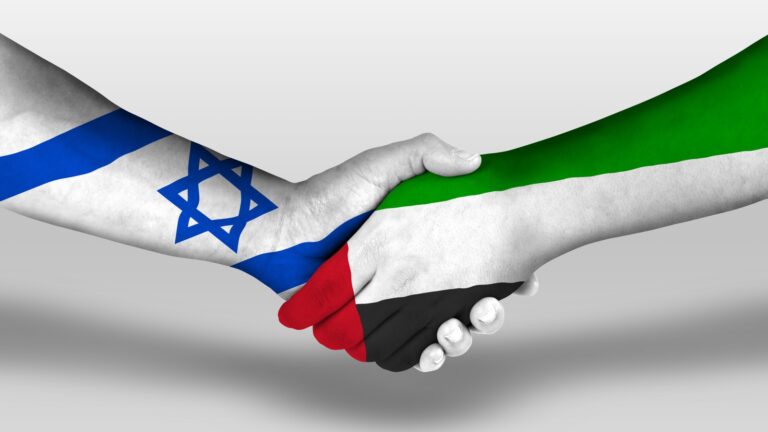

Hebrew language and Israeli culture institute opens in UAE

Hebrew language and Israeli culture institute opens in UAE

Abigail Klein Leichman


First-of-its-kind school opening in 4 locations in Abu Dhabi and Dubai for businesspeople interested in Israeli conversation, culture and cuisine.

Image via Shutterstock.com

Here’s an item you never would have read in the United Arab Emirates’ Khaleej Times until quite recently: “First Hebrew institute to open in UAE in January.”

Josh Samet, director of the forthcoming Educational Hebrew Institute, told Khaleej Times that the Abraham Accords signed by Israel and the UAE “have fueled curiosity for knowledge and education centered around the Hebrew language.”

Indeed, as ISRAEL21c reported recently, businesspeople and government officials from the UAE and Bahrain are signing up to learn conversational Hebrew online with Israeli-based language schools.

But now, Emirati authorities have confirmed that EHI, the first Hebrew language and Israeli culture institute in the UAE, will open in January.

In-person classes taught by Israelis in Dubai and Abu Dhabi will acquaint local businesspeople with Israeli-style communication and cuisine in “a fun and interactive way.”

EHI is offering a variety of formats — morning, afternoon and evening classes, private instruction and gender-segregated classes in English-Hebrew and English-Arabic for beginner, intermediate and advanced students – at four locations or onsite at corporate or government offices.


Zawartość publikowanych artykułów i materiałów nie reprezentuje poglądów ani opinii Reunion’68,
ani też webmastera Blogu Reunion’68, chyba ze jest to wyraźnie zaznaczone.
Twoje uwagi, linki, własne artykuły lub wiadomości prześlij na adres:
webmaster@reunion68.com

King David-era fort found in Israel’s Golan Heights

King David-era fort found in Israel’s Golan Heights

HANNAH BROWN


The archaeologists think that the fort was built by the kingdom of Geshur, an ally of King David.

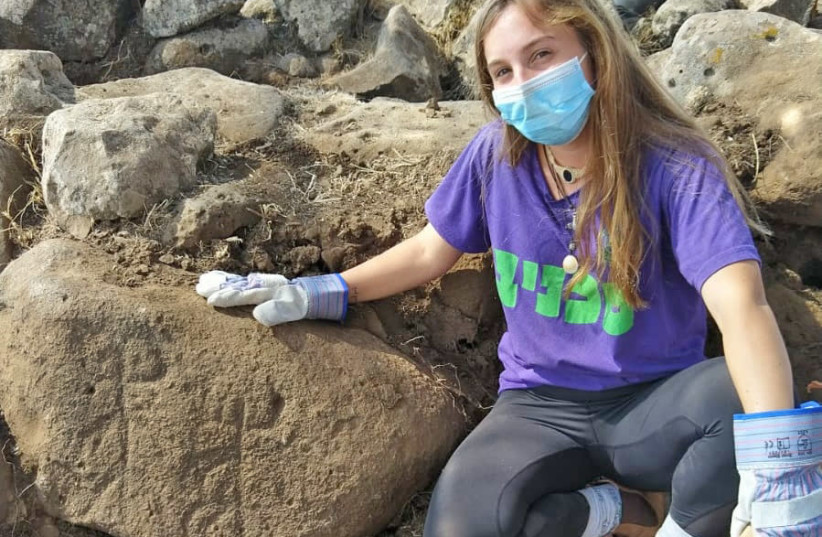
Ofri Eitan of the Kfar Hanasi pre-military Academi next to the engraved stone /  (photo credit: TIDHAR MOAV / ISRAEL ANTIQUITIES AUTHORITY)

Excavations carried out by the Antiquities Authority on the Golan revealed a fortified complex from the time of King David, during 11th to 10th centuries BCE. This unique fortified complex raises new research issues on the settlement of the Golan in the Iron Age.

The archaeologists think that the fort was built by the kingdom of Geshur, an ally of King David, to control the region.

The excavation was undertaken prior to the construction of a new neighborhood in Hispin, and funded by the Construction and Housing Ministry and the Golan Regional Council, with the participation of many residents of Hispin and Nov, and students from the pre-military academies at Natur, Kfar Hanasi, Elrom, Meitzar and Katzrin.

According to Barak Tzin and Enno Bron, excavation directors on behalf of the Antiquities Authority, “The complex we exposed was built at a strategic location on the small hilltop, above the El-Al canyon, overlooking the region, at a spot where it was possible to cross the river. The c. 1.5-m.-wide fort walls, built of large basalt boulders, encompassed the hill. In the excavation, we were astonished to discover a rare and exciting find: a large basalt stone with a schematic engraving of two horned figures with outspread arms. There may also be another object next to them.”

A figure carved on a cultic stone stele was found in the Bethsaida Expedition Project in 2019, directed by Dr. Rami Arav of Nebraska University, at Bethsaida just north of Lake Kinneret (Sea of Galilee). The stele, which depicts a horned figure with outspread arms, was erected next to a raised platform adjacent to the city gate. This scene was identified by Arav as representing the Moon-God Cult.

The Hispin stone was located on a shelf next to the entrance, and not one but two figures were depicted on it. According to the archaeologists, “It is possible that a person who saw the impressive Bethsaida stele decided to create a local copy of the royal stele.”

The fortified city of Bethsaida is considered by scholars to be the capital of the Aramean kingdom of Geshur that ruled the central and southern Golan 3,000 years ago. According to the Bible, the kingdom maintained diplomatic and family relations with the House of David, and one of David’s wives was Maacah, the daughter of Talmi, king of Geshur.

Cities of the kingdom of Geshur were found along the Kinneret shore, including Tel Ein Gev, Tel Hadar and Tel Sorag, but such sites are rare in the Golan. Archaeologists will now start researching the possibility that the Geshur kingdom had a more extensive presence in the Golan than was previously thought.

Following this discovery, changes in the development plans will be carried out together with the Construction and Housing Ministry so that the unique fortified complex will not be damaged.

The complex will be developed as an open area along the El-Al river bank, where educational archaeological activities will be carried out, as part of cultural heritage and a link with the past.
This aligns with the authority’s policy that learning the past through working in the field strengthens the younger generation’s bonds with their roots.


Zawartość publikowanych artykułów i materiałów nie reprezentuje poglądów ani opinii Reunion’68,
ani też webmastera Blogu Reunion’68, chyba ze jest to wyraźnie zaznaczone.
Twoje uwagi, linki, własne artykuły lub wiadomości prześlij na adres:
webmaster@reunion68.com


Israel’s Sound Radix wins Emmy award

Israel’s Sound Radix wins Emmy award

Abigail Klein Leichman


Auto-Align Post microphone technology improves the sound of actors moving on stage.

Sound Radix’s Auto-Align Post automates what was previously a labor-intensive task for sound editors across the industry. Photo: courtesy

Israeli company Sound Radix will receive an Emmy statuette at the 72nd Engineering Emmy Awards on October 29.

The winning product, Auto-Align Post, makes phase/time corrections of a moving multi-microphone recording.

“By dynamically correcting delay and phase between the boom and lavalier microphones as they move around the set, this tool automates what was previously a labor-intensive task for sound editors across the industry,” a press statement from the Television Academy explained.

This year’s Engineering Emmys, honoring developments in broadcast technology, were presented to nine companies and five individuals. Sound Radix was one of seven to be recognized in the category of exceptional engineering developments.

“Wow, we have no words… We’re humbled and deeply thankful to the academy members for honoring us with the Engineering Emmy Award for Auto-Align Post,” the company posted on Facebook.

“Knowing the pressure that sound departments are often under to meet deadlines, it is extremely rewarding to know that we helped make a tough job a little easier. We want the audio community to know that more help is coming from us!”


Zawartość publikowanych artykułów i materiałów nie reprezentuje poglądów ani opinii Reunion’68,
ani też webmastera Blogu Reunion’68, chyba ze jest to wyraźnie zaznaczone.
Twoje uwagi, linki, własne artykuły lub wiadomości prześlij na adres:
webmaster@reunion68.com

Jerusalem geologist believes we have the nails used for crucifixion

Jerusalem geologist believes we have the nails used for crucifixion

SARAH CHEMLA


Aryeh Shimron found out that the nails were the same ones taken from the Caiaphas site, and were also used to crucify someone. And they have bone on them.

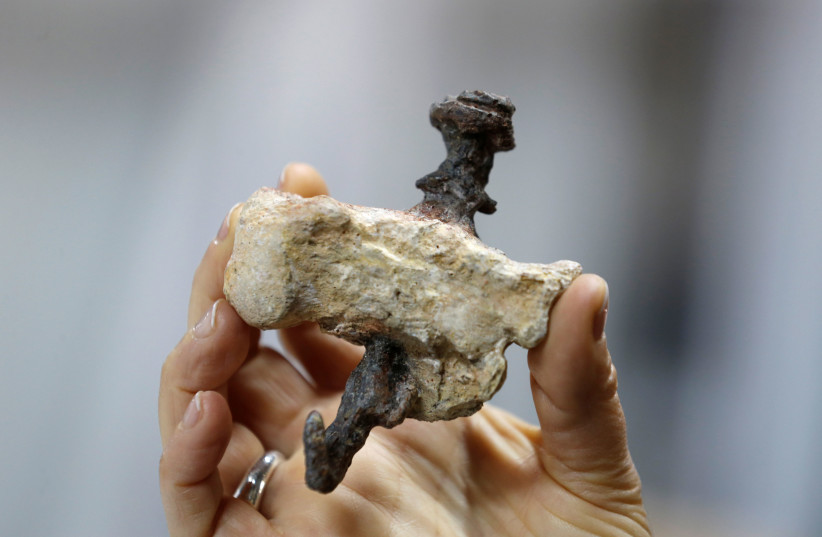
A replica of a find from Jerusalem, shows a heel bone pierced with an iron nail, believed to be the bone of Yehohanan Ben Hagkol, during a media tour presenting significant findings from that time, at Israel’s National Treasures Storeroom, in Beit Shemesh. / (photo credit: REUTERS)

Fragments of nails believed to have been used in crucifixion have ancient wood and fragments of bone on them, according to a new study, The New York Post reported.

The fragments appeared for the first time after a 1990 excavation of a burial site of Caiaphas, the high priest who organized a plot to kill Jesus according to the New Testament.

Scholars at the time slammed the suggestion, denying the nails that Israeli filmmaker Simcha Jacobovici had found were the same ones from Caiaphas’s tomb.

Last week, Aryeh Shimron, a retired Jerusalem-based geologist who led a new study on these fragments, discovered that the nails were the same ones taken from the Caiaphas site and were also used to crucify someone.

“Within the rust and sediment attached to the nails, we also identified and photographed a number of microscopic fragments of bone,” he said.

“I believe that the scientific evidence that the nails were used to crucify somebody is indeed powerful,” Shimron said.

At one point, the nails mysteriously disappeared, only to resurface when Jacobovici said in his 2011 documentary Nails of the Cross that he found the nails that were used in the crucifixion. The film follows three years of research in which he presents his assertions – some based on empirical data, others requiring much imagination and a leap of faith.

Jacobovici said the find was historic. But most experts and scholars contacted by Reuters dismissed his case as far-fetched, with some calling it a publicity stunt.

Many ancient relics, including other nails supposedly traced back to the crucifixion, have been presented over the centuries as having a connection to Jesus. Many were deemed phony, while others were embraced as holy.

“If you look at the whole story – historical, textual, archaeological – they all seem to point at these two nails being involved in a crucifixion,” Jacobovici said. “And since Caiaphas is only associated with Jesus’s crucifixion, you put two and two together and they seem to imply that these are the nails.”

The Israel Antiquities Authority, which oversaw the Jerusalem excavation, said in reaction to the film’s release it had never been proven beyond doubt that the tomb was the burial place of Caiaphas. It also said nails are commonly found in tombs.

“There is no doubt that the talented director Simcha Jacobovici created an interesting film with a real archaeological find at its center, but the interpretation presented in it has no basis in archaeological findings or research,” the IAA said.


Reuters contributed to this report.


Zawartość publikowanych artykułów i materiałów nie reprezentuje poglądów ani opinii Reunion’68,
ani też webmastera Blogu Reunion’68, chyba ze jest to wyraźnie zaznaczone.
Twoje uwagi, linki, własne artykuły lub wiadomości prześlij na adres:
webmaster@reunion68.com