Archives

Ashkenazi: Halting annexation created diplomatic space for normalization

Ashkenazi: Halting annexation created diplomatic space for normalization

LAHAV HARKOV


The view from Mount Bental, overlooking the border with Syria in the Golan Heights, August 22, 2020 / (photo credit: YONATAN SINDEL/FLASH90)

Stopping the plan to extend Israeli sovereignty to parts of Judea and Samaria created diplomatic opportunities, Foreign Minister Gabi Ashkenazi told the Knesset Foreign Affairs and Defense Committee on Wednesday.

“The conversation around the region changed from one of annexation to one of peace and normalization in the region,” Ashkenazi said.

Ashkenazi also touted the economic opportunities in establishing relations between Israel and Arab states.

In recent months, Israel normalized ties with the United Arab Emirates and Bahrain, and Sudan announced in October that it would be next.
Most of Ashkenazi’s comments to the committee were made behind closed doors.

Foreign Affairs and Defense Committee chairman Zvi Hauser (Derech Eretz) compared the recent steps to normalize ties between Israel and Arab states to the period after the fall of the Soviet Union, in which Russia, China and many other countries established diplomatic relations with Israel: “I hope we are at the beginning of another wave.”

“It took a decade after the Arab Spring, and we see messianic times, as believers may say,” Hauser added. “Agreements with the Emirates, Bahrain, Sudan and I hope other countries.”

Hauser also expressed hope that more countries will recognize Jerusalem as Israel’s capital and move their embassies there, and recognize Israeli sovereignty in the Golan Heights.

“Every reasonable person understands there is no longer any possibility of Israel leaving the Golan Heights. These are solid facts and the time has come for the world to recognize the changes in the Middle East, following the collapse of the systems surrounding us, and the fact that Israel is in the Golan Heights and will stay there forever,” Hauser said.


Zawartość publikowanych artykułów i materiałów nie reprezentuje poglądów ani opinii Reunion’68,
ani też webmastera Blogu Reunion’68, chyba ze jest to wyraźnie zaznaczone.
Twoje uwagi, linki, własne artykuły lub wiadomości prześlij na adres:
webmaster@reunion68.com


2,000-year-old gem seal depicting Greek god Apollo found under City of David

2,000-year-old gem seal depicting Greek god Apollo found under City of David

HANNAH BROWN


Although Apollo is an Olympian deity of the Greek and Roman cultures, it is highly probable that the person wearing the ring with Apollo’s portrait was a Jew.
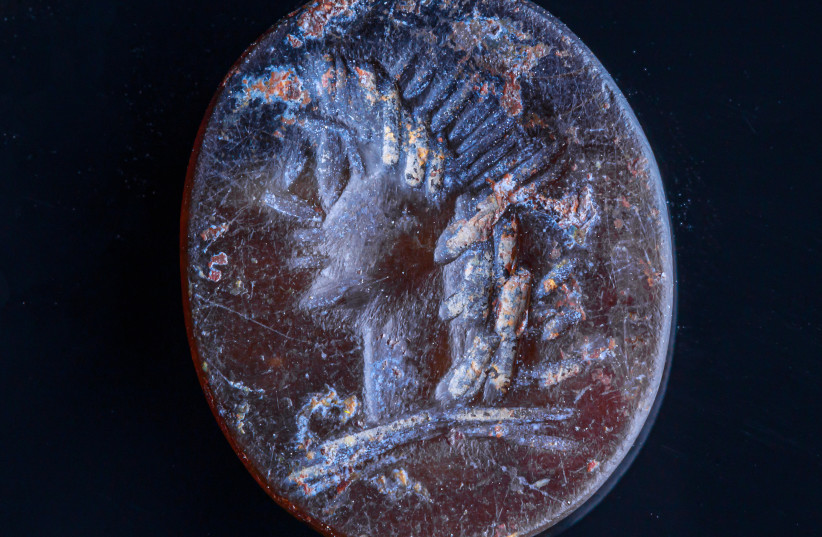
Seal with the image of Apollo.
(photo credit: ELIYAHU YANAI/CITY OF DAVID)

Researchers discovered a gem seal featuring a portrait of Apollo in the drainage channel of the City of David late last month. It was found in archaeological soil that was removed from the foundations of the Western Wall during work on the Archaeological Sifting Project in Tzurim Valley National Park.

The excavations were carried out under the auspices of the City of David and the Israel Nature and Parks Authority.
The gem features an engraved portrait of the god Apollo. According to researchers, this surprising and rare find is only the third secured gem sealing (intaglio) from the Second Temple period to have been discovered in Jerusalem.

The gem is cut from dark brown jasper and has remnants of light yellow, brown and white layers. In antiquity, jasper was considered a precious stone. The gem sealing was embedded in a ring, and it dates from the first century CE (Second Temple period).

The oval-shaped gem is 13 mm. long, 11 mm. wide and 3 mm. thick. Because it is an intaglio – having a design carved into the upper side of the stone – its main function was a seal to be stamped on soft material, usually beeswax, for use as a personal signature on contracts, letters, wills, goods and bundles of money.

The intaglio features an engraving of Apollo’s head in profile to the left, with long hair flowing over a wide, pillar-like neck, large nose, thick lips and small, prominent chin. The hair is styled in a series of parallel lines directed to the apex and surrounded by a braid above the forehead. One line of hair marks a strand that covers the ear; long curls flow over part of the neck, reaching the left shoulder. Thin diagonal lines at the base of the head mark the upper end of the garment and the body.

Although Apollo is an Olympian deity of the Greek and Roman cultures, it is highly probable that the person wearing the ring with Apollo’s portrait was a Jew, according to the researchers, archaeologist Eli Shukron, Prof. Shua Amorai-Stark and senior archaeologist Malka Hershkovitz.

SHUKRON, who conducted the excavation in which the gem was found, said in a press release: “It is rare to find seal remains bearing the image of the god Apollo at sites identified with the Jewish population. To this day, two such gems [seals] have been found at Masada, another in Jerusalem inside an ossuary [burial box] in a Jewish tomb on Mount Scopus and the current gem that was discovered in close proximity to the Temple Mount.

“When we found the gem, we asked ourselves: ‘What is Apollo doing in Jerusalem? And why would a Jew wear a ring with the portrait of a foreign god?’ The answer to this, in our opinion, lies in the fact that the owner of the ring did so not as a ritual act that expresses religious belief, but as a means of making use of the impact that Apollo’s figure represents: light, purity, health and success.”

Amorai-Stark, a researcher of engraved gems, added: “At the end of the Second Temple period, the sun god Apollo was one of the most popular and revered deities in Eastern Mediterranean regions. Apollo was a god of manifold functions, meanings and epithets. Among Apollo’s spheres of responsibility, it is likely that association with sun and light – as well as with logic, reason, prophecy and healing – that fascinated some Jews, given that the element of light versus darkness was prominently present in the Jewish worldview in those days.”

“The fact that the craftsman of this gem left the yellow-golden and light brown layers on the god’s hair probably indicates a desire to emphasize the aspect of light in the god’s persona, as well as in the aura that surrounded his head,” he said. “The choice of a dark stone with yellow coloring of hair suggests that the creator or owner of this intaglio sought to emphasize the dichotomous aspect of light and darkness and/or their connectedness.”

The Archaeological Sifting Project at Tzurim Valley National Park, sponsored by the City of David and the Nature and National Parks Authority, is a large-scale archaeological project that offers the public an opportunity to experience and appreciate archaeological activity without the need for advanced training or specialized knowledge.

The sifting has been supervised closely by archaeologists. It allows participants to become “archaeologists for a day” as they process archaeological material unearthed in City of David excavations, where they often find ancient treasures. The findings discovered thus far in the project include an imprint of King Hezekiah, coins from different periods, arrowheads and jewelry.

Due to the current nationwide closure of tourist sites, the site is closed. But it will be reopened to the public as soon as conditions permit.


Zawartość publikowanych artykułów i materiałów nie reprezentuje poglądów ani opinii Reunion’68,
ani też webmastera Blogu Reunion’68, chyba ze jest to wyraźnie zaznaczone.
Twoje uwagi, linki, własne artykuły lub wiadomości prześlij na adres:
webmaster@reunion68.com


News From Israel – Nov. 15

News From Israel – Nov. 15

ILTV Israel News


The #IDF hits #Hamas targets in the #Gaza Strip, after overnight rockets land in Israel.
–
How is crime changing amid the pandemic? We’ll explore if staying home is stopping Israelis from breaking the law.
–
Happy birthday Joseph! A Holocaust hero gets birthday messages from around the world for his 101st birthday.


Zawartość publikowanych artykułów i materiałów nie reprezentuje poglądów ani opinii Reunion’68,
ani też webmastera Blogu Reunion’68, chyba ze jest to wyraźnie zaznaczone.
Twoje uwagi, linki, własne artykuły lub wiadomości prześlij na adres:
webmaster@reunion68.com


The ultimate recipe for baba ganoush

The ultimate recipe for baba ganoush

21see


Our Tayim chef shows you how to make this delicious roasted eggplant dish from the comfort of your own home.


Zawartość publikowanych artykułów i materiałów nie reprezentuje poglądów ani opinii Reunion’68,
ani też webmastera Blogu Reunion’68, chyba ze jest to wyraźnie zaznaczone.
Twoje uwagi, linki, własne artykuły lub wiadomości prześlij na adres:
webmaster@reunion68.com


My Word: The lasting legacy of Rabbi Lord Jonathan Sacks

My Word: The lasting legacy of Rabbi Lord Jonathan Sacks

LIAT COLLINS


Knighted in 2005 and made a life peer four years later, Rabbi Sacks will forever be known as Britain’s former chief rabbi.
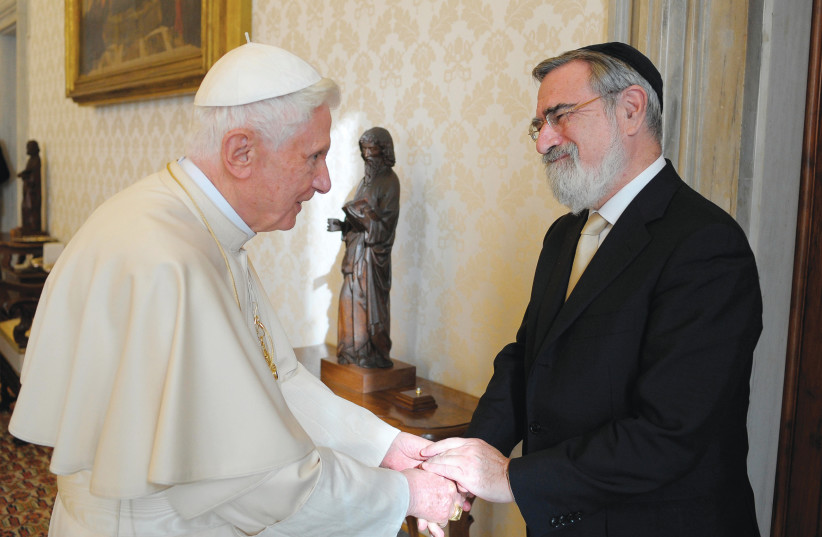
POPE BENEDICT XVI greets Rabbi Lord Jonathan Sacks during a private audience at the Vatican in 2011. /  (photo credit: OSSERVATORE ROMANO / REUTERS)

Like so many others, I had been praying for a miracle. A miracle that didn’t happen. When I checked the news last Saturday night to see what I had missed during the 25 hours when, as an Orthodox Jew, I switch off all my electronic devices and take a blessed break from current affairs, I felt as if I had been punched in the gut.

Among the polarization and vitriol surrounding the US presidential election results that was filling up my Facebook news feed was a post from a friend written through tears: Rabbi Lord Jonathan Sacks had passed away – just a month after it was announced that he was battling cancer for the third time in his 72 years.

I swiftly went through several classic stages of grieving from denial – I checked the rabbi’s official website to make sure this was not pernicious fake news – to anger that he had died when he had so much still to give, and on to acceptance, because Rabbi Sacks himself stressed that death is a natural part of life. Only God is immortal.

“What the parsha is telling us is that for each of us there is a Jordan we will not cross, a promised land we will not enter. ‘It is not for you to complete the task,’” he wrote in a commentary on the Torah portion Hukkat in 2016.

Rabbi Sacks was known to a broader audience through his regular appearances on BBC Radio 4’s “Thought for the Day,” as well as speaking engagements and interviews. The tributes that poured in from around the world confirmed that we had all lost a special person.

Knighted in 2005 and made a life peer four years later, Rabbi Sacks will forever be known as Britain’s former chief rabbi. The title is misleading. His title was “Chief Rabbi of the United Hebrew Congregations of the Commonwealth” for 22 years. He never officially represented all Anglo Jewry and yet, particularly after he left office in 2013, he became the voice of all Jews everywhere.

Furthermore, he became the sane, moral voice for all those, of any religion, looking for reason. Earlier this year he published the last of some 30 books. The title says it all: Morality: Restoring the Common Good in Divided Times.

Rabbi Sacks’s standing can be seen from those who eulogized him. Charles, Prince of Wales, issued a statement describing his “profound personal sorrow” and saying: “With his passing, the Jewish community, our nation, and the entire world have lost a leader whose wisdom, scholarship and humanity were without equal.”

Archbishop of Canterbury Justin Welby, the most senior bishop in the Church of England, said: “We are all the beneficiaries of his wisdom” while Nick Baines, the Anglican bishop of Leeds, declared: “A giant has gone.”

As reported by Vatican News, Roman Catholic Cardinal Vincent Nichols, the archbishop of Westminster, recalled his meeting with Pope Benedict in September 2010, in which Rabbi Sacks “gave eloquent expression to the shared Jewish and Christian beliefs with these poignant words: ‘In the face of a deeply individualistic culture we offer community. Against consumerism, we talk about the things that have value but not a price. Against cynicism, we dare to admire and respect. In the face of fragmenting families, we believe in consecrating relationships.”

I NEVER MET Rabbi Sacks, although interviewing him was on my professional and personal wish list. Every week, I read his “Covenant and Conversation” discussion on the Torah portion. It was as much a part of my Shabbat as prayers and kiddush.

With his doctorate in philosophy, Rabbi Sacks had the incredible ability to make Judaism accessible while drawing on broad sources. These went well beyond the great Jewish names such as Maimonides and Nachmanides and Rabbi Joseph Soloveitchik.

Discussing “The Arc of the Moral Universe,” Sacks quotes ancient Athenian historian Thucydides, Shakespeare, Martin Luther King, Moses, Job, the Talmud and more – all in an article of a few hundred words. It’s incredible that what could have been distant and pretentious instead was readable and easy to understand and identify with. His genius was in the way he pulled the different threads together to create something original.

Over and over, there is a message that a true leader must take personal responsibility, moral responsibility and collective responsibility. A central tenet was that we must each act morally. “There is one respect in which each of us has precisely the same strength as Moses. Namely, the strength to choose. There is no hand of heaven – no physiological, genetic, psychological or Providential compulsion – that forces us to act one way rather than another,” he wrote in Tradition in an Untraditional Age.

Of the current crisis he was quoted as saying: “The coronavirus is going to test our capacity to work for the benefit of others. Selfishness is not going to protect us.”

Recently, I looked up something he wrote in which he quotes New York Times columnist David Brooks’s book The Road to Character, distinguishing between what Brooks calls “resumé virtues” and “eulogy virtues.”

“The resumé virtues are the ones we write on our curriculum vitae, our achievements, our qualifications, our skills,” explained Rabbi Sacks. “But it is the eulogy virtues that are the ones for which we will be remembered. Are we kind, honest, faithful? What are the ideals for which we live, and how do we live them? These are not what we write on our resumé, but they make all the difference to our quality of life and the impact we have on those around us.”

In Rabbi Sacks’s case, both the resumé virtues and the eulogy ones are evidently impressive. His intellect, warmth, wit and humanity were mentioned in many tributes.

Rabbi Sacks had pride in his Judaism and taught other Jews to speak out. “Judaism is an ongoing moral revolution,” he declared. For Israel’s 60th anniversary he published a double CD in which he narrated the country’s history interspersed with Hebrew songs.

In his book Radical Then, Radical Now, he wrote: “The only sane response to antisemitism is to monitor it, fight it, but never let it affect our idea of who we are. Pride is always a healthier response than shame.” Although he rarely tackled political subjects per se, he did not keep silent about what he perceived to be the dangerous climate of antisemitism in the Labour Party under Jeremy Corbyn.

Fortunately, his voice lives on in his recorded talks, books and articles. His website contains a treasure trove of his thought and wisdom, including a selection of quotes arranged alphabetically by topic. I hit “C” for “Challenges” and find: “We are as great as the challenges we have the courage to undertake”

There is something for everyone, for as Rabbi Sacks told readers in Faith in the Future, “Faiths are like languages. There are many of them, and they are not reducible to one another. In order to express myself at all, I must acquire a mastery of my own language… But as I venture out into the world I discover that there are other people who have different languages which I must learn if we are to communicate across borders.”

One of my favorite quotes is: “Optimism is the belief that things are going to get better. Hope is the belief that we can make things better. Optimism is a passive virtue, hope is an active one. It takes no courage to be an optimist, but it does need courage to hope.” It comes from Rabbi Sacks’s book Celebrating Life: Finding Happiness in Unexpected Places – a title that was also the motto by which he lived.

“Choose life” is God’s message to the people of Israel as Moses hands over to Joshua (Deut. 30:19). “Celebrate life” is a fitting message on which to end a tribute to Lord Jonathan Sacks – a revered rabbi of blessed memory.


Zawartość publikowanych artykułów i materiałów nie reprezentuje poglądów ani opinii Reunion’68,
ani też webmastera Blogu Reunion’68, chyba ze jest to wyraźnie zaznaczone.
Twoje uwagi, linki, własne artykuły lub wiadomości prześlij na adres:
webmaster@reunion68.com