
Archives

Israel, Lebanon agree to hold maritime border negotiations

Israel, Lebanon agree to hold maritime border negotiations

LAHAV HARKOV


A senior American representative, likely Assistant Secretary of State for Near East Affairs David Schenker, will be present, along with a UN rapporteur.

An Israeli naval vessel sails in the Mediterranean sea near the border with Lebanon, as Mount Carmel and the Israeli city of Haifa are seen in the background December 16, 2013 / (photo credit: REUTERS/AMIR COHEN)

Israel and Lebanon reached an agreement to hold negotiations on their maritime border, after a years-long impasse, a spokesman for Energy Minister Yuval Steinitz confirmed on Friday.

Talks are expected to begin in mid-October, after the Sukkot holiday, in Naquora, a city in southern Lebanon near Rosh Hanikra, where headquarters for the UN Interim Force in Lebanon (UNIFIL) are located.

A senior American representative, likely Assistant Secretary of State for Near East Affairs David Schenker, will be present, along with a UN rapporteur.

Schenker, who visited Israel last week, has been involved in getting Jerusalem and Beirut to the table, with Energy Minister Yuval Steinitz representing Israel, as the dispute has been over who has the rights to drill for natural gas. On the Lebanese side, Parliament Speaker Nabih Berri and officials in President Michel Aoun’s office were involved.

Schenker updated Steinitz and Foreign Minister Gabi Ashkenazi with an updated agreement to launch a new round of talks last week. Rather than have both the US and the UN mediate, as Lebanon originally sought, the current agreement is for the US to mediate and the UN observe.

The dispute between Lebanon and Israel, which began over a decade ago, involves 860 square km in the Mediterranean Sea. Israel has agreed to split the area 58:42 in favor of Lebanon, which would like to start drilling for gas as soon as possible to help dig itself out of its ongoing economic crisis. Hezbollah, which is part of the Lebanese government, repeatedly got in the way of starting talks with Israel. Jerusalem also opposed UN mediation for the negotiations.

After last month’s massive explosion in Beirut and growing public criticism of Hezbollah’s role in Lebanon, the country showed greater readiness to negotiate with Israel.

The Trump administration will likely seek to present the talks as a further step towards making peace and normalization in the Middle East.


Zawartość publikowanych artykułów i materiałów nie reprezentuje poglądów ani opinii Reunion’68,
ani też webmastera Blogu Reunion’68, chyba ze jest to wyraźnie zaznaczone.
Twoje uwagi, linki, własne artykuły lub wiadomości prześlij na adres:
webmaster@reunion68.com


Modern scans may show traces of the original dimensions of the ‘tefach’

Modern scans may show traces of the original dimensions of the ‘tefach’

HANNAH BROWN


The tefach, an ancient unit of measurement, was used by ancient Israelites.

Ortal Harush with one of the Iron-Age jars found in Khirbet Qeiyafa / (photo credit: HEBREW UNIVERSITY)

Modern-day sukkah builders may find it interesting that recently created 3D scans of ancient pottery could reveal the original dimensions of the tefah, a unit of biblical measurement based on the dimensions of a male hand.

The tefah was used primarily by ancient Israelites. It appears frequently in the Bible and is the basis for many Jewish laws. It is an especially important measurement at this time of year, as it is used by observant Jews to calculate the precise dimensions according to Jewish law for building a sukkah, the outdoor structure where the holiday of Sukkot, which begins on Friday, is celebrated.

In a paper published recently, three Israeli archaeologists report that they found a surprising common denominator in a variety of storage jars from a period of over 350 years, from the Kingdom Judah and the Israelite Kingdom: the inner-rim diameter of the jars’ necks are consistent with measurements of the palm of a male hand and may reflect the original metrics for the biblical measurement of the tefah.

The three archaeologists – the Hebrew University of Jerusalem’s Ortal Harush, Antiquities Authority’s Avshalom Karasik and Weizmann Institute of Science’s Uzy Smilansky – published their findings in the Bulletin of the American Schools of Oriental Research, which is published by the University of Chicago Press Journals.

In the article, the researchers describe how they did 3D scans of 307 Iron Age jars found in Khirbet Qeiyafa from the Judean Kingdom in the early 10th century BCE; “hippo” jars from northern Israel from the Israelite Kingdom, ninth century BCE – nicknamed for their large size and loop handles which were thought to resemble hippopotamuses; and royal Judean Kingdom storage jars from the 8th-7th century BCE.

“It was natural for the ancient potters to adopt the handbreadth – tefah – standard. It was a unit of length that was widely used in ancient times, and is mentioned both in Assyrian and Egyptian sources and in the Old Testament, for instance: Numbers 25:25, Numbers 37:12,” the researchers wrote.

The team observed large variations among the jars – even those from the same time period and geographic region. Only one measurement remained constant: the average inner-rim diameter, which always measured, with a standard deviation, between 8.85 and 8.97 centimeters.

The distribution of this diameter is statistically identical to the average male hand’s breadth. To ascertain the standard measure of a modern man’s palm, the team examined measurements taken by the US Army when ordering gloves for its soldiers, which was consistent with the measurements taken from the ancient jars. Though human heights and weights have changed over time due to many factors, including improved diet and health, previous research has shown that palm dimensions have not changed much over the last 3,000 years.

The researchers have several theories as to why the inner rim has remained the same while the overall shape of the jars varies so much. They theorize that the inner rim stayed consistent because it was a natural choice for ancient potters to use their palms as the standard diameter for jar openings. And since storage jars were used for years, it was important to be able to fit hands into jars to clean them.

The researchers also theorized that the biblical purity laws also played a part in the uniform dimensions of the inner-rim diameter. The Book of Numbers deals with the question of whether jars left in the vicinity of a corpse were ritually pure or impure. Numbers 19:14-15 states, “This is the law, if a man dies in a tent, anyone entering the tent and anything in the tent shall be unclean for seven days. Any open vessel that has no seal fastened around it becomes unclean.”

According to these lines, the contents of a jar left near a corpse would become impure and unusable unless there was a special seal on its top. Over the centuries, Jewish authorities quantified these rules of impurity, stating that the minimal opening size through which impurity may enter is the square of a hand’s breadth by hand’s breadth, or tefah by tefah.
Over time, various rabbis attempted to provide conversions of the traditional biblical measurements to modern measurements. The conversions for the tefah vary, with competing theories from Avraham Chaim Naeh and the Chazon Ish, both 20th-century Orthodox rabbis who lived in pre-state Israel. According to Naeh, one tefah is equal to 8 cm., whereas according to the Chazon Ish one tefah is 9.6 cm. The uniform opening of the ancient storage jars, which is between 8.85-8.97 cm, falls squarely in between these two opinions and may shed light on the dimensions of the biblical tefah, dimensions that determine so much of religious law.


Zawartość publikowanych artykułów i materiałów nie reprezentuje poglądów ani opinii Reunion’68,
ani też webmastera Blogu Reunion’68, chyba ze jest to wyraźnie zaznaczone.
Twoje uwagi, linki, własne artykuły lub wiadomości prześlij na adres:
webmaster@reunion68.com


Knesset votes 46 to 38 to limit anti-Netanyahu protests

Knesset votes 46 to 38 to limit anti-Netanyahu protests

GIL HOFFMAN


Three detained, including general, at violent protests

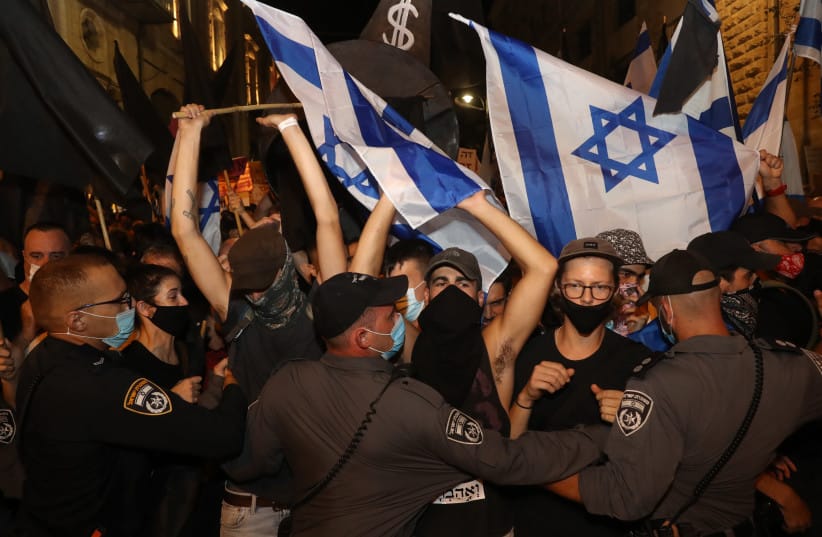
Israelis protest against Israeli prime minister Benjamin Netanyahu in Jerusalem on August 29, 2020 / (photo credit: YONATAN SINDEL/FLASH90)

The Knesset plenum voted 46 to 38 at 4:30am to limit demonstrations against Prime Minister Benjamin Netanyahu.

Blue and White MKs Miki Haimovich and Ram Shefa voted against, together with the opposition.

Opposition leader Yair Lapid, praised her, saying she had more courage than two IDF chief of staff, referring to party leaders Benny Gantz and Gabi Ashkenazi.

Earlier Tuesday, the Knesset Law Constitution and Justice Committee voted nine to six on Tuesday morning to approve the changes, which would limit the protests during the current lockdown to people who live within a kilometer of Netanyahu’s official residence in Jerusalem.

The new rules will already take effect late Tuesday night after they are passed and would last for only a week. The rules will be able to be extended for up to three weeks, but each extension will need to be passed in the cabinet and can be canceled by the Law Committee.

The Movement for Quality Government announced that it would challenge the new law in a petition to the High Court of Justice.
The changes were passed thanks to compromises between Blue and White and Likud, which dropped attempts to make the limitations last longer, even after the full lockdown is over.

“The dangerous attempt by Likud to forbid protests until the entire corona crisis is over failed,” said Justice Minister Avi Nissenkorn of Blue and White.

Netanyahu downplayed the protests in a Facebook Live chat.

“There have always been protests against me,” he said. “They can continue protesting within 1000 meters or near their homes. The problem is the spreading of the disease and the spreading of anarchy.”

Five protest movements sent convoys of hundreds of cars to the Knesset on Tuesday, where violence took place between police and protesters after they tried to hang a sign across from the Knesset with the slogan “using coronavirus to bring dictatorship.”

One protester was detained for injuring a policewoman. Two other protesters, including Brig.-Gen. Asaf Agmon, were detained for alleged violence against police. All three were later released.

“You will be responsible for the grave harm that is being done to equality and freedom of the citizens of the State of Israel,” a spokesman for the coalition of groups said.

A spokesman for the Black Flag movement said that “instead of destroying the coronavirus, Blue and White destroyed Israel’s democracy.”

Blue and White MK Michal Cotler-Wunsh, who is a member of the committee, rejected the charges of the protest movements.

“We remain committed to safeguarding the necessary checks and balances in democracy, taking into account that we are in an emergency situation,” she said. “With Israel leading in numbers of COVID-19 patients per capita, there must be a proportionate balance between the public’s health and civic rights. It is important to know that the law regarding demonstrations applies only during the time of complete lockdown, for prescribed short periods, with full parliamentary supervision, in transparent processes to the public eye.”

In a rare consensus, the MKs agree to a Health Ministry request to permit an exception to the lockdown for all medical care, not just”essential” medical care, as in the current law.


Zawartość publikowanych artykułów i materiałów nie reprezentuje poglądów ani opinii Reunion’68,
ani też webmastera Blogu Reunion’68, chyba ze jest to wyraźnie zaznaczone.
Twoje uwagi, linki, własne artykuły lub wiadomości prześlij na adres:
webmaster@reunion68.com


France accuses Hezbollah of Lebanon-crisis

France accuses Hezbollah of Lebanon-crisis

TV7 Israel News


1) Rival Palestinian factions reach an agreement that will see parliamentary and presidential elections held within six-months – as part of a collective Palestinian effort to resist Israel’s normalization with Arab and Muslim states.

2) Damascus is reportedly seeking to revive direct-negotiations with Jerusalem.

3) French president Emmanuel Macron accuses Hezbollah and its allies for the failure to attain much’ sought-after political breakthrough for Lebanon.


Zawartość publikowanych artykułów i materiałów nie reprezentuje poglądów ani opinii Reunion’68,
ani też webmastera Blogu Reunion’68, chyba ze jest to wyraźnie zaznaczone.
Twoje uwagi, linki, własne artykuły lub wiadomości prześlij na adres:
webmaster@reunion68.com


Shira Choir, Levy Falkowitz, Nafshi

Shira Choir, Levy Falkowitz, Nafshi


shiezoli


Come along for a rich visual ride as we explore the voices and inspiration behind the new fan-favorite Nafshi, This original composition was written by the prolific Pinky Weber and first performed by Levy Falkowitz on his hit debut album, Achake Loi.

Set against a backdrop of the familial get-together, this beautiful music video draws on the concurrent themes of longing and joy which are as evident in the room as they are in the age-old lyrics, Nafshi Cholas Ahavasecha, my soul is sick with yearning for your love.

Watch as Shira and child soloist Avrum Chaim Green mingle together in brotherly harmony, and discover newfound heart in the song that launched a thousand kumzitzes.

נפשי חולת אהבתיך אנא אל נא רפא נא לה בהראות לה נועם זיוך

לא כל יום מתכנסת לה מקהלת שירה לערב שכולו עונג וגיבוש חברים כשעומד בראשה ידידי ובוגר המקהלה הזמר הפופולארי לוי פולקוביץ.
הערב תוכננה על ידי מנהלה של מקהלת שירה יחד עם המפיק המפתיע הגראמר הנודע אברהם מרדכי שוורץ הידוע למפיק אלבומו של פולקוביץ ויחד הובילו ללילה מהנה ומשגשג שכל כולו מוזיקה טהורה ושבת אחים יחד סביב שולחנות ערוכים בטוב טעם עם יינות משובחות ובשרים מדושנים כיאה לקבוצה שמביאה מוזיקה טהורה לבתי אחינו בני ישראל.
שיא של הלילה היה כשלוי פצח בשירה אדירה את השיר נפשי חולת אהבתיך כשהמקהלה מחווה אותו בחן ובכישרון רב ונלווה אליהם ילד הפלא אברהם חיים גרין , הלילה הוכתרה להצלחה רבה והוחלט להקליטו ולפרסמו ברבים לטובת קהל השוחר דבר נאה ומתקבל , המפיק אברהם מרדכי שוורץ שחרר הצהרה לעוד דברים דומים ברמה כה גבוהה העומדים על הפרק ויבואו תחת חסותו ולוי פולקוביץ

Produced by: Avrum Mordche Schwartz
Filmed & edited by: BenHesh Studios
Directored by: Chaim Moskowitz
Second camera: Evan Cohn
Editing by: Chaim Moskowitz
Colourist: Ralph Mastromonaso
Assistant: Zalmen Perl
Music arranged by: Yoely Dickman
Choir conducted by: Yoely Horowitz
Mixed and mastered by: Udi Damari

Event manager: Motty Jay
Event designed by: Frimi Rosenberg


Zawartość publikowanych artykułów i materiałów nie reprezentuje poglądów ani opinii Reunion’68,
ani też webmastera Blogu Reunion’68, chyba ze jest to wyraźnie zaznaczone.
Twoje uwagi, linki, własne artykuły lub wiadomości prześlij na adres:
webmaster@reunion68.com