Archives

Gaza Disengagement: Memories and lessons 15 years on

Gaza Disengagement: Memories and lessons 15 years on

YAAKOV KATZ


‘The Jerusalem Post’s editor-in-chief remembers his experiences as a reporter for the paper during this tumultuous time.
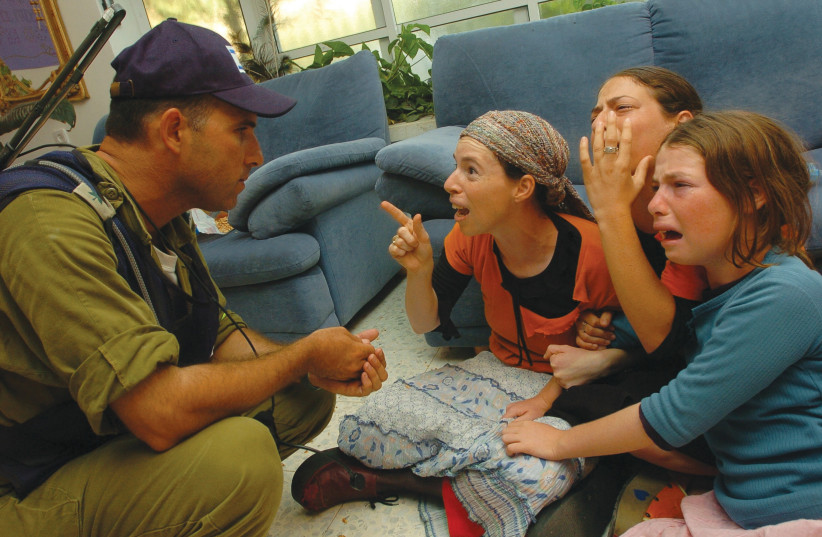
AN IDF soldier evicts residents from their Neveh Dekalim home on August 18, 2005 / (photo credit: FLASH90)

On Monday, August 16, 2005, I was in Morag. Together with a group of journalists, we had been bused into the Gaza Strip settlement the night before, just ahead of the distribution of eviction orders planned for the following day.

We spent the night sleeping on some cardboard boxes in a home whose owners had left early, apparently to spare themselves the trauma of being forcefully evicted.

In the morning, the soldiers came – dozens of them, led by Col. Erez Zukerman, then the commander of the Golani Brigade. The soldiers were unarmed, and in addition to issuing the eviction orders – set to go into effect within 48 hours – they had come to offer their assistance to the residents of Gush Katif, law-abiding citizens who had been sent to build homes they were now being ordered to leave.

“We didn’t come here to clash with you, but to offer assistance and to help the people we once protected and worked hand-in-hand with,” Zukerman called out to the residents.

Out of the crowd emerged a young man with tears streaming down his face.
“I was an officer under your command,” he called out to Zukerman. “You taught me what it was to be an officer and protect the Israeli people. We are not your enemy, but you have turned us into your enemy. Just six months ago, I was wearing an army uniform and serving side by side with you.”

Recognizing his former subordinate, Zukerman wrapped his arms tightly around him, evoking cries of anguish and sadness from the crowd.

Zukerman told the assembled people he loved them and that no matter what was happening, Israel had to remain united. The crowd broke out in “Hatikva.”
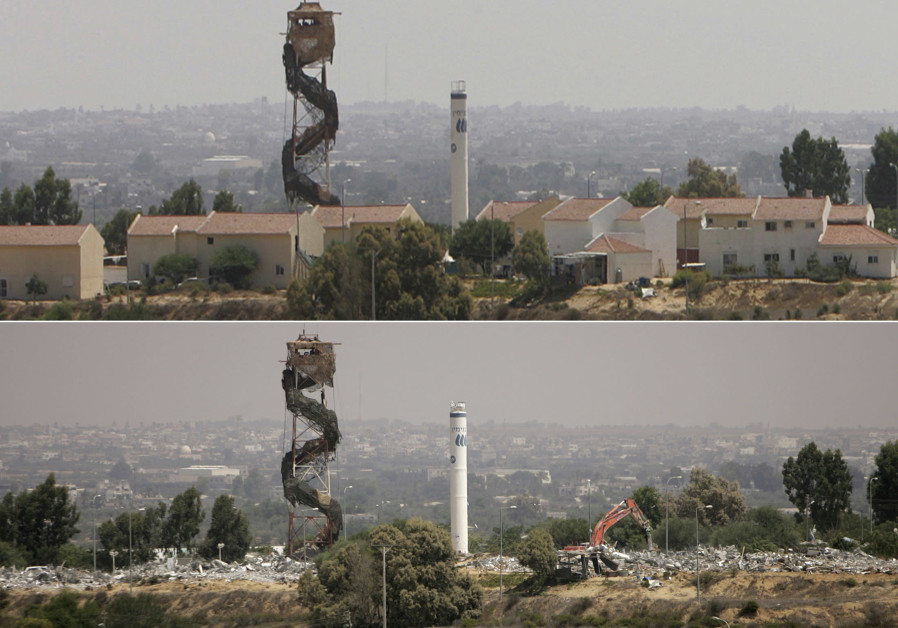
THIS COMBINATION picture shows the settlement of Morag before and after it was demolished. Top – before: August 12, 2005; bottom, Israeli heavy equipment destroys houses, August 23, 2005. (Suhaib Salem SJS/KS/Reuters)

Peduyim Junction

The atmosphere grew tense as thousands of marchers suddenly emerged from the thick dust-filled dark road into police-erected spotlights just two kilometers west of Ofakim.

Southern Police chief Cmdr. Uri Bar-Lev straightened his police cap and uniform and took several steps forward to greet the first of the marchers. Behind him were 6,500 policemen and soldiers, 20 police horses and three water-canon trucks.

The marchers, many of them wearing orange shirts – the color of their struggle – had come from Kfar Maimon, a nearby national-religious moshav where they had been holed up for three days as they tried to make their way to Gush Katif to stop the eviction and break through the IDF-imposed blockade over the Gaza Strip.

For close to an hour, the sides scuffled. Columns of disengagement opponents were rushing the human wall of soldiers and police, and more were coming. The activists, in their last-ditch effort to thwart the pullout, were determined to break through and reach the sealed-off settlement bloc which they hoped they could then physically save from prime minister Ariel Sharon’s Disengagement Plan.

Fighting to regain control of the situation, the police chief ordered his men to move back. The situation seemed on the verge of an explosion. Israeli was fighting Israeli. Protester against soldier. Policeman against settler.

Suddenly, Rabbi Shlomo Aviner, head of the Ateret Kohanim Yeshiva in Jerusalem, climbed onto the roof of a nearby car unnoticed with his orange-decorated bag slung over his shoulder.

As fisticuffs continued, Aviner grabbed a megaphone and in his high-pitched voice and French accent, managed to distract the crowd with a Torah lesson. Before long, he had calmed the tense atmosphere.

Neveh Dekalim

Everyone cried – the Border Police, the IDF soldiers, the settlers and the journalists. They cried as the Gaza Strip’s largest synagogue, shaped like a Star of David and located in the center of the Gush Katif settlement of Neveh Dekalim, was evacuated.

Hundreds of youth had gathered in the synagogue for one last stand against the withdrawal. They were completely outnumbered, but it was their final attempt. Men were in the Ashkenazi sanctuary and women were in the Sephardi sanctuary. They prayed, they chanted Psalms, they sang and they cried. But when the policemen came inside, they stood no chance.

Many shook and cried as they sat on the floor or on pews, unable to move when the police told them to leave. One by one they were pulled apart and carried out of the building.

I stood right outside, talking to Moshe Karadi, Israel’s police commissioner at the time.

“The police proved their might and that they were unstoppable,” Karadi told me that day. “At last month’s standoff at Kfar Maimon we demonstrated our might, and that helped deter the settlers today.”

Within a few weeks, the synagogue would be burned down by Palestinian rioters. Israel’s presence in Gaza was now officially over.
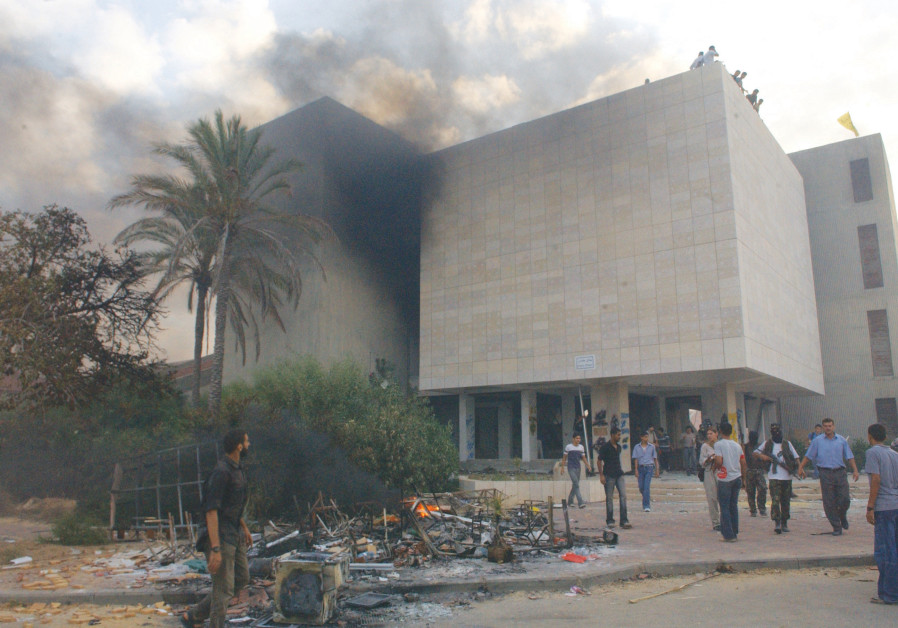
Palestinians burn the yeshiva in evacuated Neveh Dekalim on September 13, 2005. (Yossi Zamir/Flash90)

LOOKING BACK on the events of 15 years ago, it is hard not to feel a sense of sadness. It is a sadness for the trauma experienced by the thousands of families evicted from homes that consecutive Israeli governments had sent them to build, as well as for the way the withdrawal was carried out, unilaterally without coordination.

All of this seems to be connected. On one hand, the Disengagement sent a bad message to Israel’s enemies that the Jewish state is weak and unsure of itself. That it is willing to uproot people and give land to its enemies without receiving anything in return. Why, Hamas legitimately learned that summer, would that ever change? Why not keep up the resistance against Israel until it decides to surrender something once again? That erodes deterrence.

On the other hand, that doesn’t mean it wasn’t right for Israel to leave Gaza. The continued sustainability of a small settlement bloc inside a sea of Palestinians was always going to be limited in time.

For most Israelis, leaving the Gaza Strip didn’t mean much. The majority of Israelis thought of Gaza as a place that cost lives, a piece of land that didn’t bring security but on the contrary, cost a heavy price in human life. For most people, the Disengagement was a short battle that pitted commanders against former soldiers, kipot against payot, uniformed soldiers against women in headscarves. Pulling out, these people argued, actually made Israel stronger, letting the country and its military focus on missions that are essential – not on operations that appeared at the time to be useless and without real purpose.

The fact is, these supporters point out, that no one in government today advocates for Israel to return to Gaza and to rebuild settlements inside that piece of land.

THE WEEKS running up to the withdrawal, as well as the evacuation itself, were an emotional time for this country. There were fears that it would lead to a mass refusal of orders by IDF soldiers, extreme violence between right-wing activists and security forces or a civil war. Thankfully, they were all wrong. Israel got through it.

But after 15 years, Israel continues to fall short by failing to figure out what it wants to do with the Gaza Strip. The pullout went smoothly, but the IDF plan at the time was only good until the day the last soldier stepped out of the Gaza Strip and locked the gate behind him. Not enough thought was given to the day after that or the nearly 5,500 days that have passed since then.

On one hand, due to this lack of an overarching strategy, Israel has been smart in its approach, usually doing what it can to avoid big operations in Gaza. Except for Cast Lead in 2009 and Protective Edge in 2014, Israel has mostly worked to contain Gaza and Hamas and never let it blow too much out of control. In short, Israel prefers to end each flare-up of violence as quickly as possible.

But this is not a strategy. Hamas will continue to use violence and attacks as long as it feels that doing so will help advance its cause. Just last week, after a period of quiet, incendiary balloons were flown across the Gaza border into Israel and Hamas fired a dozen rockets toward the sea in a warning to Israel. In response, the Israeli Air Force struck some targets someplace in Gaza.

Will this tit-for-tat really change anything? Doesn’t this continued situation do an injustice to the price the Israelis who lived there paid? Isn’t this a disservice to the country that kept itself together and didn’t let extremists – on either side – pull it apart?

There is no clear answer what will work, but there are steps that Israel hasn’t tried yet. One option is to fight back hard against any act of terror, but also to try to ease the economic and humanitarian crisis in Gaza. One way would be to finally launch a plan floated by the Likud in recent years to build an artificial island off the Gaza coast that would serve as a port, or to construct a new power plant so Palestinians can have continuous electricity. Sewage treatment plants need to be repaired and industrial zones need to be built to create jobs.

There is no shortage of ideas. There is only a shortage in someone willing to take the steps needed to make things move. Calculated risks combined with a tough stance on security.

None of the above will guarantee that war won’t break out again. But after trying the same thing for so long – or truthfully, trying no real strategy at all – would it hurt to try something new?

These measures might not stop war, but they have the potential to improve the quality of life in Gaza and force Hamas to think a few extra times before setting off a new round of violence with Israel.

Fifteen years after uprooting peoples’ lives and dreams from Gaza, Israel owes itself a chance to try to change the outcome of the Disengagement. It is not too late.


The writer was The Jerusalem Post’s police reporter, then military reporter and defense analyst from 2003 until 2013, becoming editor-in-chief in 2016.


Zawartość publikowanych artykułów i materiałów nie reprezentuje poglądów ani opinii Reunion’68,
ani też webmastera Blogu Reunion’68, chyba ze jest to wyraźnie zaznaczone.
Twoje uwagi, linki, własne artykuły lub wiadomości prześlij na adres:
webmaster@reunion68.com


[Israel] Will Covid-19 make our cities better than ever?

Will Covid-19 make our cities better than ever?

21 See


Zawartość publikowanych artykułów i materiałów nie reprezentuje poglądów ani opinii Reunion’68,
ani też webmastera Blogu Reunion’68, chyba ze jest to wyraźnie zaznaczone.
Twoje uwagi, linki, własne artykuły lub wiadomości prześlij na adres:
webmaster@reunion68.com


Israel, UAE reach historic peace deal: ‘We can make a wonderful future’

Israel, UAE reach historic peace deal: ‘We can make a wonderful future’

LAHAV HARKOV, OMRI NAHMIAS


Third-ever peace treaty between Israel and an Arab state includes embassies, direct flights; agreement “suspends” annexation, but Netanyahu says: “I will never give up on our right to our land.”

L-R: Crown Prince of Abu Dhabi Sheikh Mohammed Bin Zayed, US President Donald Trump, Israeli Prime Minister Benjamin Netanyahu / (photo credit: REUTERS)

Israel and the UAE agreed to full normalization of relations in a phone call with US President Donald Trump on Thursday, marking the first peace treaty between Israel and an Arab country in 25 years.

Israel agreed to suspend its planned extension of sovereignty over parts of Judea and Samaria to facilitate relations with the UAE and potentially other Arab and Muslim countries.

The agreement will include establishing embassies and exchanging ambassadors, investments into the Israeli economy, trade, direct flights between Tel Aviv and Abu Dhabi, an investment in Israeli efforts to develop a coronavirus vaccine – as first reported in The Jerusalem Post last month – and cooperation in matters of energy and water. An important element of the deal for the UAE is the expectation that its citizens would be able to visit the Al-Aksa mosque in Jerusalem.

Prime Minister Benjamin Netanyahu called the deal “full, formal peace” with “one of the strongest countries in the world.”

“Together we can bring a wonderful future. It is an incomparably exciting moment,” Netanyahu said. “I have the great privilege to make the third peace treaty between Israel and an Arab country, the UAE.”

Netanyahu wished Crown Prince of Abu Dhabi Mohamed bin Zayed “Salam Aleykum v’Shalom Aleynu – peace unto you and peace unto us.”

Trump said in a statement posted to his twitter account: “Opening direct ties between two of the Middle East’s most dynamic societies and advanced economies will transform the region by spurring economic growth, enhancing technological innovation, and forging closer people-to-people relations.”

In subsequent remarks in the Oval Office, Trump alluded to “many more countries” in the region normalizing ties with Israel, and “some very exciting things including, ultimately with the Palestinians.”
Netanyahu said he has “reason to be very optimistic that today’s announcement w the UAE will be joined by more countries in this expanding circle of peace.”

The agreement “ushers in a new era of peace between Israel and the Arab world,” he said.

Sources in Washington and Jerusalem said the Trump administration is in talks with other Gulf States to reach normalization agreements with Israel. Bahrain is likely to be next, to the extent that there was a chance they would have announced normalization before the UAE.

The US president also mentioned Iran, about which the UAE and other Gulf States share concerns with Israel, saying that he will make a deal with them “within 30 days” if he wins the election. Trump said the Iranians are “dying to make a deal,” but would prefer that it be with the Democratic candidate for president, Joe Biden, “because that would be like a dream” for them. Trump’s Special Adviser Jared Kushner clarified that the deal would not allow Iran to obtain nuclear weapons.

Netanyahu remarked that the moves towards normalization were kept tightly under wraps because Iran would have liked to sabotage them.

Iran has played a major role in the closer ties between Israel and Gulf States since the previous US government and other world powers signed the nuclear deal with Tehran in 2015. The countries began cooperating on national security and that moved to other issues after trust was built between them, to the point that an American source said normalization seemed inevitable.

As a reaction, Iran’s Foreign Minister declared to the state news agency IRNA that the deal was “dangerous and illegitimate.” He said that “this is stabbing the Palestinians in the back and will strengthen the regional unity against the Zionist regime.”

“The shameful measure of Abu Dhabi to reach an agreement with the fake Zionist regime (Israel) is a dangerous move and the UAE and other states that backed it will be responsible for its consequences,” the statement added, according to IRNA.

Netanyahu touted a formula of “peace for peace,” based on shared interests, emphasizing economic cooperation, and peace that comes from a position of strength, rather than peace in exchange for concessions.

However, bin Zayed presented the matter as though he had exacted concessions from Israel, emphasizing the suspension of sovereignty plans over normalization. He tweeted that “an agreement was reached to stop further Israeli annexation of Palestinian territories. The UAE and Israel also agreed to cooperation and setting a roadmap towards establishing a bilateral relationship.”

Egyptian President Abdel-Fatah a-Sisi similarly called it “the agreement to stop Israel’s annexation of the Palestinian Territories and taking steps to bring Peace to the Middle East.” He said in a tweet that he “values the efforts… in order to achieve prosperity and stability for our region.”
The Trump administration’s “Vision for Peace” would allow Israel to apply its law to 30% of Judea and Samaria, including all settlements and the Jordan Valley.

The rest of the West Bank would be designated for an eventual Palestinian state, which would receive recognition and a $50 billion aid package from the US if it meets a list of pre-conditions, including demilitarization and stopping incitement and salaries for terrorists.

Netanyahu said that he still plans to apply Israeli sovereignty in Judea and Samaria.

“I’m not giving up on it. It’s on the table because of me. Trump put sovereignty into his peace plan because I asked for it,” Netanyahu said. “But in the first place I said again and again that we would only implement sovereignty in coordination with the US. Without support from the US, in the best case it would be worthless, and in the worst case, it would hurt ties very much.”

Netanyahu emphasized that he “did not and will not remove sovereignty from the agenda… I will never give up on our right to our land.”

Diplomatic sources in Jerusalem and Washington pointed to the use of the word “suspend,” which implies that the pause is only temporary. The wording was agreed upon by all three sides.

It is unclear for how long annexation would remain suspended, but it is unlikely that anything would happen before the end of this year, the Washington source said.

The Trump peace team’s efforts gained steam in July and led to Israel’s decision to skip the original July 1 date that Netanyahu had discussed for sovereignty moves. The administration felt that the opportunity for Israel to normalize ties with the UAE was a “better choice.”

“In the long term, this will solidify security,” one American official said. Peace between Israel and the UAE presented an opportunity for “real peace” unlike the cold peace it has with Egypt and Jordan, since Israel and the UAE were never enemies that fought a war against each other.

Sovereignty moves would have stopped the momentum towards normalization with Gulf States, another source said.

The American source said: “Israel was presented with two opportunities and chose one. They’re aggressively pursuing [normalization] and not complicating it by doing sovereignty.”

Trump called the diplomatic breakthrough a “labor of love for a lot of people in the room,” speaking to how it is also an achievement for Special Adviser to the President Jared Kushner, who heads the Middle East peace team, and Special Representative for International Negotiations Avi Berkowitz, who worked behind the scenes in recent months to promote normalization between Israel and the Arab world, and US Ambassador to Israel David Friedman.

Friedman said “the normalization of relations between Israel and the UAE will make Israel stronger and safer and will likely lead to additional exciting opportunities and incremental prosperity for Israel, its neighbors and the entire region.”

A senior Likud source remarked that “the Israeli and international Left always said we can’t bring peace with Arab states without peace with the Palestinians, that there is no other way than withdrawing to ‘67 lines, evacuating settlements, dividing Jerusalem and establishing a Palestinian state. For the first time in history Prime Minister Netanyahu broke the paradigm of ‘land for peace’ and brought ‘peace for peace.’”

Foreign Minister Gabi Ashkenazi praised the agreement, saying “the good news of normalization with the UAE is important and an opening to more agreements.”

Ashkenazi also praised “avoiding the one-sided annexation plan,” and called for the complete Trump peace plan to be implemented.

Yamina leader Naftali Bennett praised the normalization, saying “relations between the countries are no longer held hostage by Palestinian recalcitrance,” but slammed Netanyahu for suspending sovereignty plans.

“It’s unfortunate that Netanyahu gave up a once-in-a-century chance to apply sovereignty to the Jordan Valley, Ma’aleh Adumim, Bet El and the rest of Israeli settlements,” he said. “It is tragic that Netanyahu did not seize the moment and didn’t have the courage to apply sovereignty to a centimeter of the Land of Israel, but sovereignty over the parts of our homeland will come from somewhere else.”

Joint List MK Mtanes Shihadeh accused the UAE of a “betrayal… no less than a knife in the back of the Palestinian people and the Arab nations.”

Shehadeh posited that “Netanyahu and Israel never really meant to annex, but in order for him to abandon the plan, the UAE agreed to make its secret relations open. Nothing will change and anyone who thinks the Palestinians will disappear are mistaken.”

Democratic candidate for president Joe Biden said “the UAE’s offer to publicly recognize the State of Israel is a welcome, brave and badly-needed act of statesmanship. Annexation would be a bloody blow to the course of peace, which is why I oppose it now and would oppose it as president.”

The Turkish Foreign Ministry said on Friday that history and the conscience of the region’s people will not forget and never forgive the “hypocritical behavior” of the United Arab Emirates in agreeing a deal with Israel.

It said in a written statement that the Palestinian people and administration were right to show a strong reaction against the agreement, which will lead to a full normalization of diplomatic relations between the UAE and Israel.


Zawartość publikowanych artykułów i materiałów nie reprezentuje poglądów ani opinii Reunion’68,
ani też webmastera Blogu Reunion’68, chyba ze jest to wyraźnie zaznaczone.
Twoje uwagi, linki, własne artykuły lub wiadomości prześlij na adres:
webmaster@reunion68.com


Tensions continue to mount on Gaza border; Israel tests Arrow 2 Missile

Tensions continue to mount on Gaza border; Israel tests Arrow 2 Missile

TV7 Israel News


1) Tensions along Israel’s southern front with the Hamas-controlled Gaza Strip are gradually rising.

2) The Israeli Defense Ministry announced that it conducted a successful test of its Arrow 2 missile system late last night – elevating Israel’s aerial defense capabilities against long-range surface-to-surface missile – including ballistic missiles capable of carrying a nuclear payload.

3) Israel has donated state-of-the-art artificial’ intelligence-based technologies and high-end equipment to the ‘All India Institute of Medical Science’ – commonly referred to as AIIMS – for the purpose of combating the relentless spread of the Corona contagion throughout the 1.35 billion strong nation.


Zawartość publikowanych artykułów i materiałów nie reprezentuje poglądów ani opinii Reunion’68,
ani też webmastera Blogu Reunion’68, chyba ze jest to wyraźnie zaznaczone.
Twoje uwagi, linki, własne artykuły lub wiadomości prześlij na adres:
webmaster@reunion68.com


If one can’t have a good marriage, at least have a good divorce

If one can’t have a good marriage, at least have a good divorce

PNINA OMER


Get-refusal is nothing less than a disgrace. Although it is not forbidden by Jewish law, we have a moral and religious obligation to prevent it.

A NEW bride and groom visit a blossoming almond grove in Latrun on their wedding day in 2019. / (photo credit: HADAS PARUSH/FLASH90)

The Jewish festival of love falls on Tu Be’av (the 15th day of the Hebrew month of Av), at the height of the traditional wedding season. In ancient times, women would dress in white and go dancing in the vineyards to find a spouse.

And the men? We can’t say for sure what might have happened, but we are wont to imagine that they spotted their potential bride, the two gazed into each other’s eyes, and then he asked for her hand in marriage.

All very romantic.

However, the Mishna, in recalling this interaction, adds a warning to the groom: “Young man, lift up your eyes and see what you choose for yourself. Do not set your eyes on beauty but rather, set your eyes on the family.”
The message is clear: Dancing women in white certainly makes for a fine fairy tale, but you need to appreciate that marriage is not just about romance or even love; it’s about a lifelong commitment that comes with many other things in between.

There’s a saying that – although a bit uncomfortable – deserves to be heard more among marrying couples: “It isn’t enough to just know who to marry. You also need to know who to divorce.”

The reality of couplehood is, unfortunately, that things don’t always work out.

And appreciating that reality, we need to go into marital commitment with the promise that we will know how to get out of it with minimal injury to either side, mutual respect, and while agreeing never to forcibly tie one another to a relationship that is unwanted or inviable.

As ironic as it might seem, nothing could be more romantic than a promise that at any given moment of our life together, we know we are together of our own free will, and that we would be able to separate of our own free will.

It’s important to remember that while weddings are about fun and flowers, music and dancing, marriage is at its essence a formal contract between two parties. Our rabbis already understood the importance of mutual commitments in marriage some 2,000 years ago. That’s why they drew up the ketuba, a marriage contract that guarantees not only income, intimate relations and alimony, but also includes protections for the woman in the event of death or divorce.

Through the legal tool generally referred to as the “prenuptial agreement,” the ketuba can be expanded to include protection from a challenge that is becoming increasingly prevalent in our modern world: All too often, both men and women are guilty of misuse of the Jewish bill of divorcement or get (known as get-refusal), holding their spouse hostage in order to torment and bully them, or otherwise improve their bargaining position in the divorce proceedings.

GET-REFUSAL IS nothing less than a disgrace. Although it is not forbidden by Halacha (Jewish law), we have a moral and religious obligation to prevent it, which is why the concept of the pre-nup was drawn up. We have the right and obligation to ensure that the couple is protected, especially when it can be done without putting a damper on romance or violating Halacha.

This agreement is signed by both partners, usually before the wedding (but can technically be signed any time after as well), and includes a halachic mechanism to protect from get-refusal and to prevent situations in which one partner is forced to remain in a relationship from which they want to escape.

A positive aspect of this agreement is that it guarantees that both sides are invested in staying in the marriage. If the marriage fails, the couple has agreed ahead of time that if their attempts at reconciliation are unsuccessful and one of them insists on a divorce, the other will comply.

A predetermined (large) sum is defined as alimony to be paid by whichever spouse does not comply, or if he or she delays the divorce proceedings. This sum makes refusal an expensive move that does not pay.

However, the agreement’s main significance is in the fact that all parties know that it is there. It overshadows the divorce proceedings and prevents any thought of abusing the get for extortion or threats.

We know that there will always be malicious people and circumstances, and prenuptial agreements will not solve all the problems of get-refusal and agunot (women “chained” to marriage) in the Jewish world. But they will prevent hundreds, or even thousands, of divorces from heading down a collision course and steer them back to a respectful separation.

The notion of modern love must be built with the recognition that not all marriages can be saved, nor should they all be. But basic dignity requires that we do whatever possible to ensure that even if the marriage fails, it need not mean we can’t save the divorce.

A personal final word: Even if you are not convinced to sign the prenuptial agreement, if you are sure “it won’t happen to us,” or think it is completely unromantic, please, even if you won’t do it for yourselves, do it for the greater community by sending the message that this is a concept that deserves to be widely embraced.

From my considerable experience, I can tell you that the prenuptial agreement will save someone you know, or at least someone who knows someone you know, from get-refusal and help them gain their freedom. Help us change the social norms in order to help people marry wisely, so that when necessary, marriages can be respectfully dissolved.


The writer is the director of Yad La’isha: the Monica Dennis Goldberg Legal Aid Center and Hotline for Agunot, part of the international Ohr Torah Stone network.


Zawartość publikowanych artykułów i materiałów nie reprezentuje poglądów ani opinii Reunion’68,
ani też webmastera Blogu Reunion’68, chyba ze jest to wyraźnie zaznaczone.
Twoje uwagi, linki, własne artykuły lub wiadomości prześlij na adres:
webmaster@reunion68.com